


Genesis 36:40
Bible text: King James Version (1769 Blayney text) · Public domain
Bible text: King James Version with Strong's numbers · Public domain
Bible text: Berean Standard Bible · Public domain
Bible text: American Standard Version (1901) · Public domain
Bible text: World English Bible, Messianic edition · Public domain
Bible text: Geneva Bible (1599) · Public domain
Bible text: Young's Literal Translation · Public domain
- וְאֵלֶּהVe·'e·lehand theseH428Conj-w ¦ PrtParticle Demonstrativeוְandאֵלֶּהthese
- שְׁמוֹתshe·Mot[were] [the] names ofH8034N-fpcNoun Plural Feminine Construct
- אַלּוּפֵי'a·lu·Fei[the] chiefs ofH441N-mpcNoun Plural Masculine Construct
- עֵשָׂו'e·SavEsauH6215N-properNoun Proper Location
- לְמִשְׁפְּחֹתָםle·mish·pe·cho·Tamto their clansH4940Prep-l ¦ N-fpc ¦ 3mpNoun Plural Feminine Constructלְtoמִשְׁפְּחֹתָclansםtheir
- לִמְקֹמֹתָםlim·ko·mo·Tamto their placesH4725Prep-l ¦ N-fpc ¦ 3mpNoun Plural Feminine Constructלִtoמְקֹמֹתָplacesםtheir
- בִּשְׁמֹתָםbish·mo·Tamby their namesH8034Prep-b ¦ N-fpc ¦ 3mpNoun Plural Feminine Constructבִּbyשְׁמֹתָnamesםtheir
- אַלּוּף'a·LufchiefH441N-msNoun Singular Masculine Absolute
- תִּמְנָעtim·Na'TimnaH8555N-proper-mNoun Proper Masculine
- אַלּוּף'a·LufchiefH441N-msNoun Singular Masculine Absolute
- עַלְוָה'al·VahAlvahH5933N-proper-mNoun Proper Masculine
- אַלּוּף'a·LufchiefH441N-msNoun Singular Masculine Absolute
- יְתֵתye·TetJethethH3509N-proper-mNoun Proper Masculine
English is a literal word-by-word gloss of the Hebrew, not the KJV's wording. Why?
This is the original text the KJV's translators worked from — each Hebrew word with its own literal English meaning in this verse, prepared by scholars at Tyndale House, Cambridge. The KJV translates whole sentences, not word by word, so its wording differs: one Hebrew word can become several English words, and the KJV may choose “the LORD” where the gloss reads “Yahweh”. Both are faithful — they answer different questions. For the KJV's own rendering, switch to the KJV text.
Details
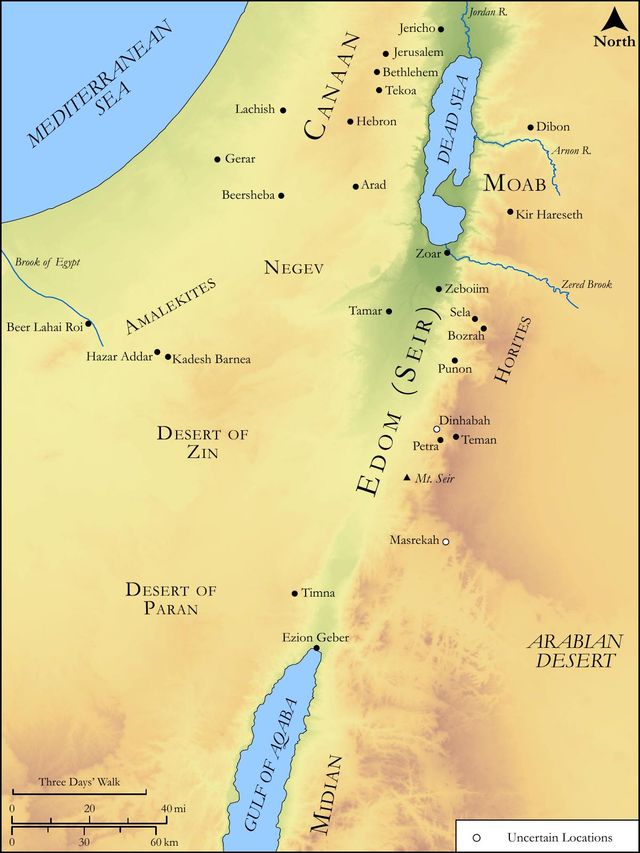
See on the biblical-era maps


Study this verse
Public-domain commentary
Matthew Henry
From his Commentary on the Whole Bible. Henry comments on passages, not single verses — this entry covers Genesis 36:31–43.
By degrees, it seems, the Edomites wormed out the Horites, obtained full possession of the country, and had a government of their own. 1. They were ruled by kings, who governed the whole country, and seem to have come to the throne by election, and not by lineal descent; so bishop Patrick observes. These kings reigned in Edom before there reigned any king over the children of Israel, that is, before Moses's time, for he was king in Jeshurun, Gen 36:3. God had lately promised Jacob that kings should come out of his loins (Gen 35:11), yet Esau's blood becomes royal long before any of Jacob's did. Note, In external prosperity and honour, the children of the covenant are often cast behind, and those that are out of covenant get the start. The triumphing of the wicked may be quick, but it is short; soon ripe, and as soon rotten: but the products of the promise, though they are slow, are sure and lasting; at the end it shall speak, and not lie. We may suppose it was a great trial to the faith of God's Israel to hear of the pomp and power of the kings of Edom, while they were bond-slaves in Egypt; but those that look for great things from God must be content to wait for them; God's time is the best time. 2. They were afterwards governed by dukes, again here named, who, I suppose, ruled all at the same time in several places in the country. Either they set up this form of government in conformity to the Horites, who had used it (Gen 36:29), or God's providence reduced them to it, as some conjecture, to correct them for their unkindness to Israel, in refusing them a passage though their country, Num 20:18. Note, When power is abused, it is just with God to weaken it, by turning it into divers channels. For the transgression of a land, many are the princes thereof. Sin brought Edom from kings to dukes, from crowns to coronets. We read of the dukes of Edom (Exo 15:15), yet, long afterwards, of their kings again. 3. Mount Seir is called the land of their possession, Gen 36:43. While the Israelites dwelt in the house of bondage, and their Canaan was only the land of promise, the Edomites dwelt in their own habitations, and Seir was in their possession. Note, The children of this world have their all in hand, and nothing in hope (Luk 16:25); while the children of God have their all in hope, and next to nothing in hand. But, all things considered, it is better to have Canaan in promise than mount Seir in possession.
Continue studying Genesis 36:40 across the web’s major study libraries — every link below opens this exact verse, chapter, or book on the destination site.
Read & Compare
 BibleGatewayThis verse in more than 200 translations and 70 languages.
 Bible.comThe YouVersion reader — hundreds of translations, reading plans, and highlights.
 ESV.orgCrossway's official English Standard Version reader.
 NET BibleThe NET translation with 60,000+ translators' notes on every rendering decision.
 STEP BibleTyndale House's free study tool — original text, vocabulary, and scholarly resources.
 BibliaLogos Bible Software's free web reader.
 USCCBThe New American Bible (Revised Edition) with the U.S. bishops' study notes.
Commentaries
 BibleHub CommentariesDozens of classic commentaries on this verse, gathered on one page.
 StudyLightMore than 100 commentary sets — the largest collection on the web.
 BibleRefPlain-English commentary on what this verse means, verse by verse.
 Enduring WordDavid Guzik's free commentary on this chapter, widely used by Bible teachers.
 Bible Study ToolsVerse commentary alongside Greek and Hebrew study aids.
Original Language & Research
- BibleHub InterlinearThe verse word by word — original language, transliteration, and English.
- BibleHub LexiconEvery word's original-language definition and Strong's entry.
 Blue Letter BibleDeep-study tools — Strong's numbers, concordance, and word studies.
 SefariaThe Hebrew text with Rashi and centuries of Jewish commentary.
Sermons, Hymns & Audio


TrulyRandomVerse is not affiliated with these sites and doesn’t control their content. They’re linked because they’re genuinely useful.
Summary
Genesis 36:40 marks the commencement of the final section of Esau's comprehensive genealogy, meticulously cataloging the "dukes" or tribal chiefs of Edom, organized according to their familial lines and territorial domains. This verse, alongside the subsequent verses, completes the detailed record of Esau's descendants, thereby illuminating the established leadership structure and the nascent national identity of the Edomite people.
Context
ShowHideLiterary Context
Genesis 36 is an extensive genealogical record dedicated entirely to Esau, also known as Edom. It systematically traces his lineage and the development of his descendants into a distinct nation. The chapter begins with Esau's immediate family and migration to Seir (Genesis 36:1-8), followed by a detailed list of his sons and grandsons, highlighting the origins of various Edomite clans (Genesis 36:9-19). The narrative then shifts to the indigenous Horite inhabitants of Seir, whose chiefs are listed, indicating their eventual integration or subjugation by the Edomites (Genesis 36:20-30). Subsequently, the chapter provides a list of kings who reigned in Edom before any king reigned over the Israelites (Genesis 36:31-39). Genesis 36:40, therefore, initiates the concluding enumeration of "dukes," which serves as a final, perhaps more localized or clan-based, set of leaders, further emphasizing the complex and developed societal structure of Edom. This meticulous record contrasts sharply with the narrative focus on Jacob's family, underscoring the distinct paths of the two brothers' descendants.
Historical & Cultural Context
The mention of "dukes" in Genesis 36:40 provides a window into the early socio-political organization of the Edomites. Unlike the later Israelite monarchy, the Edomites, at this stage, appear to have a leadership structure that combined both kings and these "dukes" (Hebrew: alluph). This dual system could reflect different stages of national development or parallel forms of governance—territorial chiefs alongside a national king. Geographically, Edom was situated in the mountainous region south and east of the Dead Sea, a strategic location that controlled important trade routes. The detailed lists of families, places, and names in this chapter highlight the establishment of a settled population with defined territories and leadership, indicating a mature tribal confederation or nascent state. This level of organization was typical of powerful tribal groups among the nations of that day, often driven by the need for defense and resource management.
Key Themes
ShowHideGenesis 36, including verse 40, contributes significantly to several overarching themes within the book of Genesis. Foremost is the Distinction of Nations, particularly between Esau's descendants (Edom) and Jacob's (Israel). The comprehensive genealogy of Esau serves to clearly delineate the two peoples, fulfilling the divine prophecy given to Rebekah that two nations would come from her womb. Another crucial theme is Divine Sovereignty and Providence, demonstrating that God's plan extends beyond the direct covenant line of Abraham and Isaac to encompass all peoples. Even Esau, though not the heir to the primary covenant promises, receives a blessing and forms a powerful nation, as Isaac prophesied in Genesis 27:39-40. The meticulous Genealogical Precision evident in this chapter underscores the Bible's commitment to historical accuracy and its role in establishing national identities and land claims, which are vital for understanding the unfolding of God's redemptive narrative. Finally, the chapter illustrates the Development of Societal Structures, showing the evolution from nomadic clans to settled tribal confederations with established leadership, whether "dukes" or "kings," providing insight into the diverse forms of governance among the nations.
Exposition and Analysis
ShowHideKey Word Analysis
ShowHideThis primitive word signifies an appellation, a mark, or a memorial of individuality. Beyond mere designation, it implies honor, authority, and character. In this context, the listing of names confers legitimacy and establishes the distinct identity and authority of these Edomite leaders, making them memorable and significant within their societal structure.
Derived from a root meaning "familiar" or "gentle," this term evolved to denote a "chieftain" or "leader," often associated with being notable or preeminent, much like prime cattle. In the Old Testament, ʼallûwph is almost exclusively used for the leaders of Edom, distinguishing them from other types of leaders (e.g., nasi for Israelite princes). Its usage here highlights a tribal or clan-based leadership structure, emphasizing their role as prominent figures in their respective territories or families.
This word refers to a circle of relatives, a clan, or a tribe. Figuratively, it can also denote a class of persons or a species. In Genesis 36:40, it underscores that the Edomite dukes' authority and position were rooted in their kinship groups, reflecting a societal organization where familial ties were paramount to political structure and identity.
This term properly means "a standing" or "a spot," but is widely used for a locality, whether general or specific, and can even refer to a condition. Here, "places" indicates the specific territories or regions over which these dukes held sway, emphasizing the territorial aspect of their leadership and the settled nature of the Edomite nation.
Verse Breakdown
ShowHide"And these are the names of the dukes that came of Esau"
This introductory clause signals the beginning of a new list of leaders within Esau's lineage. The term "dukes" (Hebrew: alluph) immediately distinguishes these leaders, emphasizing their unique role as clan or tribal chiefs within the Edomite socio-political landscape. Their origin "of Esau" firmly roots them within the broader genealogical narrative of Esau's descendants.
"according to their families"
This phrase specifies the primary organizational principle for these dukes. Their authority and identity are intrinsically linked to their respective clans or kinship groups, highlighting a tribal structure where familial lineage determined leadership and social standing. This emphasizes the communal and hereditary nature of their power.
"after their places"
This further clarifies the basis of their leadership, indicating that these dukes also held authority over specific geographical territories or settlements. This suggests a more settled and organized society than a purely nomadic one, with established domains for each chieftain, reflecting the development of the Edomite nation.
"by their names; duke Timnah, duke Alvah, duke Jetheth"
This final part of the verse provides the initial list of specific individuals holding the title of "duke." The repetition of "duke" before each name reinforces their designated status. These names represent specific Edomite clans or regions, providing concrete examples of the leadership structure being described.
Literary Devices
ShowHideThe primary literary device employed in Genesis 36:40 is Enumeration, as the verse explicitly lists the names of the Edomite dukes. This detailed listing is characteristic of Genealogy, a broader literary form prevalent throughout Genesis, which serves to establish lineage, national identity, and the fulfillment of divine promises. The Repetition of the title "duke" before each name (e.g., "duke Timnah, duke Alvah, duke Jetheth") emphasizes the specific office and its significance within the Edomite hierarchy. This precise cataloging contributes to the overall meticulousness of the chapter, reinforcing the historicity and distinctness of Esau's descendants from Jacob's.
Theological and Thematic Connections
ShowHideGenesis 36:40, as part of Esau's extensive genealogy, profoundly illustrates God's sovereign hand in shaping the destinies of nations, even those outside the direct covenant line of Israel. While the Abrahamic covenant's promises of land and a great nation were specifically channeled through Isaac and Jacob, God's providential care extended to Esau, allowing his descendants to form a powerful and organized nation of their own. This demonstrates a broader theological truth: God's governance is universal, encompassing all peoples and their societal formations. The meticulous detail in listing these "dukes" underscores the Bible's commitment to historical veracity and its careful preservation of lineage, which was crucial for establishing national identity and distinguishing Edom from Israel, affirming the reality of God's unfolding plan through history.
Reflection and Application
ShowHideWhile a list of names and titles in an ancient genealogy might seem distant from contemporary life, Genesis 36:40 offers profound insights into God's character and His meticulous involvement in human history. This verse reminds us that every detail in Scripture, even seemingly mundane genealogies, serves a divine purpose: to confirm historical realities, to illustrate the unfolding of God's overarching narrative, and to assure us that God is actively involved in the rise and fall of all human societies. It teaches us the importance of recognizing God's sovereignty over all nations and peoples, not just those we might consider "chosen." For us today, it underscores the value of our own heritage and identity within God's grand story, encouraging us to trust in His steadfast promises and perfect record-keeping. It calls us to consider how God's providential hand guides even the seemingly insignificant details of our lives and communities, just as He meticulously organized the Edomite nation.
Questions for Reflection
ShowHideFAQ
ShowHideWhy does Genesis 36 list both "kings" and "dukes" for Edom, and what is the significance of the term alluph?
ShowHideGenesis 36 indeed details both kings (Genesis 36:31-39) and "dukes" (Genesis 36:40-43). The presence of both likely reflects the evolving socio-political structure of early Edom. The "dukes" (Hebrew: alluph, אַלּוּף) represent an earlier, perhaps more traditional, tribal-based leadership structure, signifying clan or territorial chiefs. These could have existed concurrently with, or preceded, the more centralized monarchy. The term alluph itself, meaning "chief" or "clan leader," is notably used almost exclusively for Edomite leaders in the Old Testament, distinguishing them from the "princes" (nasi) of Israel. This highlights Edom's unique tribal organization and its distinct path of national development compared to Israel.
What is the theological significance of such detailed genealogies for Esau's descendants, given that the covenant line passes through Jacob?
ShowHideThe extensive genealogies of Esau's descendants, including the list of dukes, serve several crucial theological purposes. Firstly, they demonstrate God's sovereign control over all nations, not just Israel. Despite Esau not being the heir to the primary covenant promises, God still blessed him and oversaw the formation of a powerful nation from his lineage, fulfilling the blessing given to Esau in Genesis 27:39-40. Secondly, these genealogies underscore the Bible's commitment to historical accuracy and its careful preservation of lineage, which was vital for establishing national identity and distinguishing Edom from Israel, as prophesied in Genesis 25:23. Such meticulous details affirm the reality of God's unfolding plan through history, ensuring the clarity of the lineage through which the Messiah would eventually come.
Christ-Centered Fulfillment
ShowHideWhile Genesis 36:40 focuses on the lineage of Esau and the formation of the Edomite nation, its inclusion within the broader biblical narrative is essential for understanding the grand sweep of God's redemptive plan, which culminates in Christ. The meticulous record-keeping of genealogies, even for those outside the direct covenant line of Jacob, underscores God's sovereign control over all of human history and all nations. This divine oversight ensures that the specific lineage through which the Messiah would ultimately come—the line of Abraham, Isaac, and Jacob (Matthew 1:1-17; Luke 3:23-38), was preserved and precisely distinguished. The very existence of distinct nations like Edom, with their own leaders and territories, provides the necessary historical and theological backdrop for understanding God's particular covenant with Israel and the ultimate arrival of Jesus Christ. Jesus, as the promised Seed of Abraham, fulfills the universal scope of the Abrahamic covenant, bringing salvation not just to the descendants of Jacob but to all peoples, reconciling them to God (Galatians 3:8; Revelation 7:9). Thus, even the seemingly peripheral details of Edomite dukes contribute to the comprehensive narrative that highlights God's unwavering faithfulness and His ultimate purpose to redeem a people for Himself from every tribe and nation through His Son (John 3:16).