


Genesis 31:32
Bible text: King James Version (1769 Blayney text) · Public domain
Bible text: King James Version with Strong's numbers · Public domain
Bible text: Berean Standard Bible · Public domain
Bible text: American Standard Version (1901) · Public domain
Bible text: World English Bible, Messianic edition · Public domain
Bible text: Geneva Bible (1599) · Public domain
Bible text: Young's Literal Translation · Public domain
- עִם'imwithH5973PrepPreposition
- אֲשֶׁר'a·Sher[anyone] whomH834RelParticle Relative
- תִּמְצָאtim·Tza'you will findH4672V-Qal-Imperf-2msVerb Qal Imperfect 2nd Singular Masculine
- אֶת'et<obj.>H853DirObjMParticle Object Indicator
- אֱלֹהֶיךָ'e·lo·hei·Khayour godsH430N-mpc ¦ 2msNoun Plural Masculine Constructאֱלֹהֶיgodsךָyour
- לֹאlo'notH3808NegParticle Negative
- יִחְיֶהyich·Yehhe will liveH2421V-Qal-Imperf-3msVerb Qal Imperfect 3rd Singular Masculine
- נֶגֶדNe·gedbeforeH5048Adj-mscAdjective Numerical Singular Masculine Construct
- אַחֵינוּ'a·Chei·nuour relativesH251N-mpc ¦ 1cpNoun Plural Masculine Constructאַחֵיrelativesנוּour
- הַכֶּרha·kerinvestigateH5234V-Hiphil-Imp-2msVerb Hiphil Imperative 2nd Singular Masculine
- לְךָle·Khafor <the> yourselfPrep-l ¦ 2msSuffix Personal 2nd Singular Masculineלְfor <the>ךָyourself
- מָהmahwhat?H4100InterrogPronoun Interrogative
- עִמָּדִי'i·ma·Di[is] with meH5978Prep ¦ 1csPrepositionעִמָּדִ[is] withיme
- וְקַחve·kachand take [it]H3947Conj-w ¦ V-Qal-Imp-2msVerb Qal Imperative 2nd Singular Masculineוְandקַחtake [it]
- לָךְLakhfor <the> yourselfPrep-l ¦ 2msSuffix Personal 2nd Singular Masculineלָfor <the>ךְyourself
- וְלֹאve·lo'and notH3808Conj-w ¦ NegParticle Negativeוְandלֹאnot
- יָדַעya·Da'he knewH3045V-Qal-Perf-3msVerb Qal Perfect 3rd Singular Masculine
- יַעֲקֹבya·'a·KoJacobH3290N-proper-mNoun Proper Masculine
- כִּיkithatH3588PrtParticle Conditional
- רָחֵלra·ChelRachelH7354N-proper-fNoun Proper Feminine
- גְּנָבָתַםge·na·Va·tamshe had stolen themH1589V-Qal-Perf-3fs ¦ 3mpVerb Qal Perfect 3rd Singular Feminineגְּנָבָתַshe had stolenםthem
English is a literal word-by-word gloss of the Hebrew, not the KJV's wording. Why?
This is the original text the KJV's translators worked from — each Hebrew word with its own literal English meaning in this verse, prepared by scholars at Tyndale House, Cambridge. The KJV translates whole sentences, not word by word, so its wording differs: one Hebrew word can become several English words, and the KJV may choose “the LORD” where the gloss reads “Yahweh”. Both are faithful — they answer different questions. For the KJV's own rendering, switch to the KJV text.
Details
See on the biblical-era maps


Study this verse
Public-domain commentary
Matthew Henry
From his Commentary on the Whole Bible. Henry comments on passages, not single verses — this entry covers Genesis 31:25–35. His three-level outline is real structure in the source text, so it is rendered as structure.
We have here the reasoning, not to say the rallying, that took place between Laban and Jacob at their meeting, in that mountain which was afterwards called Gilead, Gen 31:25. Here is,
I.The high charge which Laban exhibited against him. He accuses him,
1.As a renegade that had unjustly deserted his service. To represent Jacob as a criminal, he will have it thought that he intended kindness to his daughters (Gen 31:27, Gen 31:28), that he would have dismissed them with all the marks of love and honour that could be, that he would have made a solemn business of it, would have kissed his little grandchildren (and that was all he would have given them), and, according to the foolish custom of the country, would have sent them away with mirth, and with songs, with tabret, and with harp: not as Rebekah was sent away out of the same family, above 120 years before, with prayers and blessings (Gen 24:60), but with sport and merriment, which was a sign that religion had very much decayed in the family, and that they had lost their seriousness. However, he pretends they would have been treated with respect at parting. Note, It is common for bad men, when they are disappointed in their malicious projects, to pretend that they designed nothing but what was kind and fair. When they cannot do the mischief they intended, they are loth it should be thought that they ever did intend it. When they have not done what they should have done they come off with this excuse, that they would have done it. Men may thus be deceived, but God cannot. He likewise suggests that Jacob had some bad design in stealing away thus (Gen 31:26), that he took his wives away as captives. Note, Those that mean ill themselves are most apt to put the worst construction upon what others do innocently. The insinuating and the aggravating of faults are the artifices of a designing malice, and those must be represented (though never so unjustly) as intending ill against whom ill is intended. Upon the whole matter,
(1.)He boasts of his own power (Gen 31:29): It is in the power of my hand to do you hurt. He supposes that he had both right on his side (a good action, as we say, against Jacob) and strength on his side, either to avenge the wrong or recover the right. Note, Bad people commonly value themselves much upon their power to do hurt, whereas a power to do good is much more valuable. Those that will do nothing to make themselves amiable love to be thought formidable. And yet,
(2.)He owns himself under the check and restraint of God's power; and, though it redounds much to the credit and comfort of Jacob, he cannot avoid telling him the caution God had given him the night before in a dream, Speak not to Jacob good nor bad. Note, As God has all wicked instruments in a chain, so when he pleases he can make them sensible of it, and force them to own it to his praise, as protector of the good, as Balaam did. Or we may look upon this as an instance of some conscientious regard felt by Laban for God's express prohibitions. As bad as he was he durst not injure one whom he saw to be the particular care of Heaven. Note, A great deal of mischief would be prevented if men would but attend to the caveats which their own consciences give them in slumberings upon the bed, and regard the voice of God in them.
2.As a thief, Gen 31:30. Rather than own that he had given him any colour of provocation to depart, he is willing to impute it to a foolish fondness for his father's house, which made him that he would needs begone; but then (says he) wherefore hast thou stolen my gods? Foolish man! to call those his gods that could be stolen! Could he expect protection from those that could neither resist nor discover their invaders? Happy are those who have the Lord for their God, for they have a God that they cannot be robbed of. Enemies may steal our goods, but not our God. Here Laban lays to Jacob's charge things that he knew not, the common distress of oppressed innocency.
II.Jacob's apology for himself.
Those that commit their cause to God, yet are not forbidden to plead it themselves with meekness and fear.
1.As to the charge of stealing away his own wives he clears himself by giving the true reason why he went away unknown to Laban, Gen 31:31. He feared lest Laban would by force take away his daughters, and so oblige him, by the bond of his affection to his wives, to continue in his service. Note, Those that are unjust in the least, it may be suspected, will be unjust also in much, Luk 16:10. If Laban deceive Jacob in his wages, it is likely he will make no conscience of robbing him of his wives, and putting those asunder whom God has joined together. What may not be feared from men that have no principle of honesty?
2.As to the charge of stealing Laban's gods he pleads not guilty, Gen 31:32. He not only did not take them himself (he was not so fond of them), but he did not know that they were taken. Yet perhaps he spoke too hastily and inconsiderately when he said, "Whoever had taken them, let him not live;" upon this he might reflect with some bitterness when, not long after, Rachel who had taken them died suddenly in travail. How just soever we think ourselves to be, it is best to forbear imprecations, lest they fall heavier than we imagine.
III.The diligent search Laban made for his gods (Gen 31:33-35), partly out of hatred to Jacob, whom he would gladly have an occasion to quarrel with, partly out of love to his idols, which he was loth to part with. We do not find that he searched Jacob's flocks for stolen cattle; but he searched his furniture for stolen gods. He was of Micah's mind, You have taken away my gods, and what have I more? Jdg 18:24. Were the worshippers of false gods so set upon their idols? did they thus walk in the name of their gods? and shall not we be as solicitous in our enquires after the true God? When he has justly departed from us, how carefully should we ask, Where is God my Maker? O that I knew where I might find him! Job 23:3. Laban, after all his searches, missed of finding his gods, and was baffled in his enquiry with a sham; but our God will not only by found of those that seek him, but they shall find him their bountiful rewarder.
Historical interpretation
Historical reception
2 surviving comments on this verse. Each one is dated, so this reads as a timeline rather than a list.
Therefore none of the enemies can take your soul unless it has first been made empty. Do not be afraid of those who can plunder treasures of gold and silver; such people take nothing from you. They take away what you do not have, they take away what you are not able to possess, they take away not an ornament to your soul but a burden on it. They take away what does not enrich your heart but weighs it down; “for where your treasure is, there also will your heart be,” as you have heard in today’s reading. Many people shut in their gold with bars upon their gates, but they have no confidence in either their bolts or their barricades. Many people employ guards, but they too are generally more afraid of the guards. Many go to bed upon buried gold; their gold is beneath the ground, and so is their heart. Watch out, then, that you do not entrench your heart in the ground while you are still living. We have no need to be afraid of thieves who steal such gold; but you must watch out for the usurer who examines the wealth of your soul, if you have bargained for any coin of more serious sin. He confines your heart in the earth and buries your soul in the ground, where you have hidden your gold. He crushes your spirit with interest compounded a hundredfold and buries it in a heavy tomb, from which no one rises again. Follow the example of holy Jacob; he had no part in the vices of others, nor was he empty and devoid of his own virtues, but he was filled with the fruit of justice.
Now let us consider how the just person ought to behave if enmity arises. First, let him avoid it; it is better to go away without strife than to settle down with contention. Next, let him possess a property that he can carry off with him so that he cannot be held under any obligation by the adversary but may say, “Identify whatever of yours I may have.” And Laban searched and found nothing of his with Jacob. He was a great man and truly happy who could lose nothing of his and possess nothing of another’s, that is, possess nothing too little and nothing to excess. Therefore the person who has no lack of anything has been perfected; the person who has nothing to excess is just—this is to observe the proper mean of justice. How powerful virtue is! Alliance with it brought gain but did not inflict loss. This is what perfection is; it gives the greatest advantage to those who hold to it but brings them no disadvantage whatsoever.Accordingly the man who desired to do harm to Jacob was not able to send him away empty. For the wise person is never empty but always has the garment of prudence on himself and is able to say, “I was clad with justice, and I clothed myself with judgment,” as Job said. Surely these are the inner veils of the spirit, and no one can take them away except when someone strips them off by his own guilty action. In fact, Adam was found stripped so, and naked, whereas Joseph was not naked even though he had thrown off his external clothing, as he possessed the safe covering of virtue. Therefore the wise person is never empty. How could he be empty? He has taken from the fullness of Christ and keeps what he has received. How could he be empty? His soul is filled, for it guards the garments of grace it has received. We must be afraid that someone may lose the veil of blamelessness and that ungodly people may transgress the bonds of justice with onslaughts of sacrilege and persecution and snatch away the garment of the soul and of the spirit. This does not readily happen unless a person has first been stripped of his clothing by the voice of his iniquity. On this account David also says, “If there is iniquity in my hands, let me deservedly fall empty before my enemies. Let the enemy pursue my soul and take it.”
Continue studying Genesis 31:32 across the web’s major study libraries — every link below opens this exact verse, chapter, or book on the destination site.
Read & Compare
 BibleGatewayThis verse in more than 200 translations and 70 languages.
 Bible.comThe YouVersion reader — hundreds of translations, reading plans, and highlights.
 ESV.orgCrossway's official English Standard Version reader.
 NET BibleThe NET translation with 60,000+ translators' notes on every rendering decision.
 STEP BibleTyndale House's free study tool — original text, vocabulary, and scholarly resources.
 BibliaLogos Bible Software's free web reader.
 USCCBThe New American Bible (Revised Edition) with the U.S. bishops' study notes.
Commentaries
 BibleHub CommentariesDozens of classic commentaries on this verse, gathered on one page.
 StudyLightMore than 100 commentary sets — the largest collection on the web.
 BibleRefPlain-English commentary on what this verse means, verse by verse.
 Enduring WordDavid Guzik's free commentary on this chapter, widely used by Bible teachers.
 Bible Study ToolsVerse commentary alongside Greek and Hebrew study aids.
Original Language & Research
- BibleHub InterlinearThe verse word by word — original language, transliteration, and English.
- BibleHub LexiconEvery word's original-language definition and Strong's entry.
 Blue Letter BibleDeep-study tools — Strong's numbers, concordance, and word studies.
 SefariaThe Hebrew text with Rashi and centuries of Jewish commentary.
Sermons, Hymns & Audio


TrulyRandomVerse is not affiliated with these sites and doesn’t control their content. They’re linked because they’re genuinely useful.
Summary
Genesis 31:32 is a moment of profound dramatic irony, capturing Jacob's unwitting pronouncement of a death sentence upon whoever stole Laban's household idols, or teraphim. Unbeknownst to Jacob, his beloved wife Rachel was the culprit, having secretly taken these pagan objects, thereby setting the stage for unforeseen consequences and powerfully underscoring the complexities of hidden sin and the far-reaching impact of rash words within a family unit.
Context
ShowHideLiterary Context
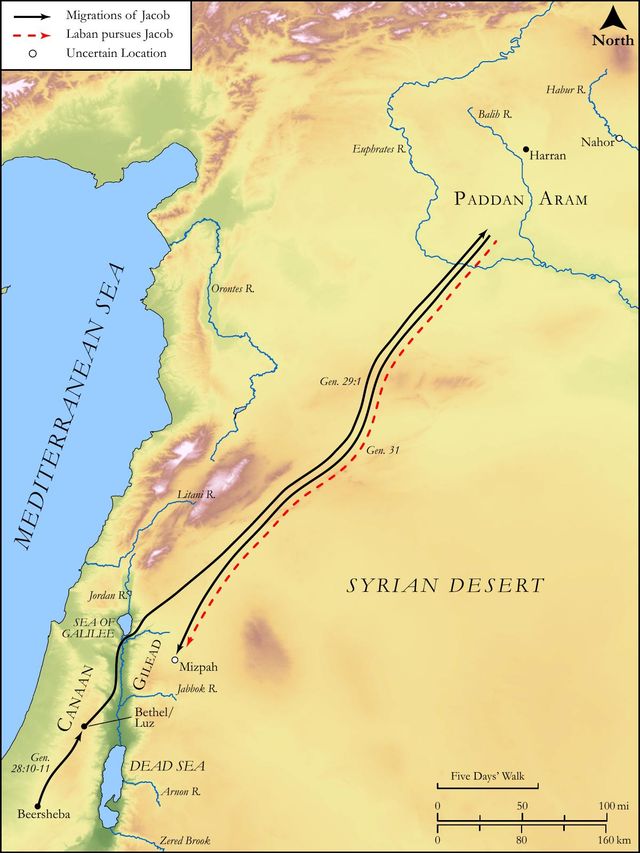
This pivotal verse occurs during a tense and dramatic confrontation between Jacob and Laban. Jacob, having served Laban for twenty arduous years, secretly departed from Laban's household with his family and vast possessions, fearing Laban would prevent their departure, as detailed in Genesis 31:17-21. Laban, upon discovering Jacob's flight and the missing household gods, pursued them relentlessly for seven days, finally catching up in the hill country of Gilead (Genesis 31:22-25). The immediate context of verse 32 is Laban's accusation that Jacob has stolen his "gods" and Jacob's indignant, yet tragically ignorant, response. This sets up the dramatic irony that permeates the subsequent search.
Historical & Cultural Context
The "gods" mentioned in the text refer to teraphim (Hebrew: תְּרָפִים), which were household idols or images common among the nations round about. It has been suggested that possession of these teraphim could sometimes be linked to inheritance rights, particularly in cases where a son-in-law might claim a share of the family inheritance. While their exact function could vary—ranging from objects for divination or protection to symbols of family headship—their presence in Laban's household clearly indicates his continued adherence to pagan religious practices, contrasting sharply with Jacob's burgeoning, albeit imperfect, faith in the God of Abraham and Isaac. Rachel's motivation for taking them is debated, possibly for sentimental reasons, as a claim to inheritance, or to prevent Laban from using them for divination against Jacob.
Key Themes
ShowHideGenesis 31:32 contributes significantly to several major themes within the broader narrative of Jacob. Foremost among these is the theme of deception and its consequences, as seen in Rachel's secret theft and Jacob's prior deceptions against Laban and Esau, highlighting the pervasive nature of deceit within this family lineage. Another crucial theme is divine sovereignty and protection, as God continues to watch over Jacob despite human failings and conflicts, ensuring His covenant promises are upheld (as seen in Genesis 31:24). The verse also underscores the danger of rash oaths and unbridled speech, as Jacob's impulsive declaration has potentially dire consequences, a principle echoed throughout wisdom literature (e.g., Proverbs 18:21). Finally, it highlights the contrast between idolatry and true worship, with Laban's attachment to the teraphim standing in stark opposition to Jacob's journey toward a deeper relationship with the one true God.
Exposition and Analysis
ShowHideKey Word Analysis
ShowHideThis word, translated as "gods" in this context, is the plural form of ʼĕlôah (God). While it often refers to the supreme God (especially with the article, as in Ha-ʼElohim), here it denotes pagan deities or household idols, specifically the teraphim. Laban's "gods" represent his polytheistic worldview, standing in stark contrast to Jacob's covenant relationship with the singular, true God, highlighting the spiritual divide between the two men.
Translated as "live" in the phrase "let him not live," this primitive root means "to live, whether literally or figuratively; causatively, to revive." In Jacob's declaration, it signifies a pronouncement of death or a curse, implying a forfeiture of life for the one found with the stolen idols. This rash statement, made in ignorance, carries immense weight and foreshadows potential tragedy, emphasizing the gravity of words spoken in haste.
This primitive root, meaning "to thieve (literally or figuratively); by implication, to deceive," is translated as "stolen." It describes Rachel's secret act of taking the teraphim, an act of theft that is also a form of deception. This word underscores the hidden sin within Jacob's own family, an act of dishonesty that creates the central dramatic tension of the passage and sets the stage for future complications.
Verse Breakdown
ShowHide"With whomsoever thou findest thy gods, let him not live"
Jacob, confident in his own and his household's innocence, issues a severe and impulsive oath. This declaration is a solemn vow, effectively pronouncing a death sentence on the thief. His confidence is rooted in his belief that no one in his family would commit such an act, making the statement an unwitting curse upon his beloved wife, Rachel. This highlights Jacob's rashness and the potentially fatal consequences of speaking without full knowledge.
"before our brethren discern thou what [is] thine with me, and take [it] to thee"
Jacob challenges Laban to conduct a public search in the presence of their kinsmen, who are now witnesses. He invites Laban to identify and reclaim anything that rightfully belongs to him, expressing a desire for transparent justice and vindication. This part of the verse underscores Jacob's indignation at the accusation and his readiness to prove his integrity before his extended family.
"For Jacob knew not that Rachel had stolen them"
This concluding clause is the linchpin of the dramatic irony. It reveals to the reader the tragic truth that is hidden from Jacob himself. His ignorance creates a profound tension, as the audience is aware that the very person Jacob loves most is the one who has committed the offense and is now subject to his own unwitting curse. This secret act of theft by Rachel sets in motion a chain of events with significant implications for the family's future.
Literary Devices
ShowHideThe primary literary device at play in Genesis 31:32 is Dramatic Irony. The audience is privy to information (Rachel's theft) that the character (Jacob) is not, creating a powerful sense of tension and foreboding as Jacob pronounces a curse upon the very person he loves. This irony underscores the tragic consequences of hidden sin and rash speech. Additionally, the verse employs Foreshadowing, as many commentators link Jacob's impulsive oath to Rachel's premature death during childbirth later in their journey (Genesis 35:19), suggesting a connection between the spoken word and subsequent events. There is also a subtle Contrast between Jacob's confident, albeit mistaken, assertion of innocence and Rachel's secret act of deception, highlighting the complexities and hidden brokenness within even intimate family relationships.
Theological and Thematic Connections
ShowHideGenesis 31:32 offers profound theological insights into the nature of human words, the pervasiveness of sin, and God's overarching sovereignty. Jacob's impulsive vow serves as a powerful biblical warning against speaking thoughtlessly or making solemn declarations without full knowledge, emphasizing the significant spiritual and practical consequences that can arise from unbridled speech. Rachel's hidden act of theft illustrates how secret sins, even within the most intimate family circles, can lead to unforeseen complications and tragic outcomes, impacting innocent parties and revealing the deep-seated human propensity for idolatry and deceit. Despite these human failings, the narrative implicitly affirms God's providential guidance, demonstrating His ability to work through imperfect individuals and situations to advance His redemptive plan.
Reflection and Application
ShowHideGenesis 31:32 offers timeless lessons for believers today, urging us to cultivate wisdom and intentionality in our daily lives. It serves as a stern caution to be mindful of our words, especially solemn declarations or vows, recognizing that they carry significant weight and can have unforeseen and often tragic consequences, as Jacob's rash oath inadvertently cursed his beloved wife. This passage also reminds us that hidden sins, even those committed by loved ones or ourselves, can inadvertently impact others and create complex situations, urging us towards honesty, transparency, and a commitment to rooting out idolatry in all its forms from our hearts and homes. Ultimately, it reinforces the profound truth that despite human imperfections, deceit, and conflicts, God's sovereign plan and unwavering protection prevail for those who trust in Him, guiding them through trials and fulfilling His promises, even when we stumble.
Questions for Reflection
ShowHideFAQ
ShowHideWhat were teraphim and why were they significant?
ShowHideTeraphim were household idols or images, common among the nations round about, believed to offer protection, facilitate divination, or even signify inheritance rights. Their possession by Laban highlights his pagan background and continued idolatry, contrasting with Jacob's growing faith in the true God. Rachel's theft of them suggests a desire for their perceived power, a claim to inheritance, or a means to prevent Laban from using them against Jacob, underscoring the spiritual struggle within Jacob's family as they transitioned from a pagan environment.
Did Jacob's oath cause Rachel's death?
ShowHideWhile the Bible does not explicitly state a direct causal link, many commentators interpret Jacob's rash oath ("let him not live") as having contributed to or foreshadowed Rachel's premature death during childbirth (Genesis 35:19). This interpretation serves as a powerful illustration of the serious consequences of thoughtless vows, even if the primary cause of her death was childbirth complications. It highlights the biblical principle that words carry power and that God often allows natural consequences to follow human actions, particularly when solemn vows are made.
Christ-Centered Fulfillment
ShowHideIn Genesis 31:32, the themes of hidden sin, human fallibility, and the consequences of rash words find their ultimate resolution and counterpoint in Christ. Jacob's ignorance leads him to unwittingly pronounce a potential curse upon his own household, a tragic reflection of humanity's inability to fully know or overcome its own sin. Yet, in stark contrast, Jesus Christ, who "knew no sin" (2 Corinthians 5:21), willingly bore the curse of humanity's hidden and open sins on the cross, becoming a curse for us to redeem us from the law's condemnation (Galatians 3:13). The teraphim represent humanity's futile reliance on idols and false gods for security and inheritance, but Christ is the true and living God, the ultimate inheritance and source of divine protection, fulfilling God's covenant promises not through human schemes or pagan objects, but through His perfect obedience and sacrificial death (Hebrews 1:1-3). He is the one who brings all truth to light, overcoming the deception and brokenness exemplified in this narrative, securing a path for God's people despite their imperfections and leading them into true freedom and life (John 8:32).