


Genesis 31:25
Bible text: King James Version (1769 Blayney text) · Public domain
Bible text: Berean Standard Bible · Public domain
Bible text: American Standard Version (1901) · Public domain
Bible text: World English Bible, Messianic edition · Public domain
Bible text: Geneva Bible (1599) · Public domain
Bible text: Young's Literal Translation · Public domain
- וַיַּשֵּׂגvai·ya·Segand he overtookH5381Conj-w ¦ V-Hiphil-ConsecImperf-3msVerb Hiphil Consecutive Imperfect 3rd Singular Masculineוַandיַּשֵּׂגhe overtook
- לָבָןla·VanLabanH3837N-proper-mNoun Proper Masculine
- אֶת'et<obj.>H853DirObjMParticle Object Indicator
- יַעֲקֹבya·'a·KoJacobH3290N-proper-mNoun Proper Masculine
- וְיַעֲקֹבve·ya·'a·Koand JacobH3290Conj-w ¦ N-proper-mNoun Proper MasculineוְandיַעֲקֹבJacob
- תָּקַעta·Ka'he had pitchedH8628V-Qal-Perf-3msVerb Qal Perfect 3rd Singular Masculine
- אֶת'et<obj.>H853DirObjMParticle Object Indicator
- אָהֳלוֹ'o·ho·Lohis tentH168N-msc ¦ 3msNoun Singular Masculine Constructאָהֳלtentוֹhis
- בָּהָרba·Harin the hill countryH2022Prep-b ¦ N-msNoun Singular Masculine Absoluteבָּin theהָרhill country
- וְלָבָןve·la·Vanand LabanH3837Conj-w ¦ N-proper-mNoun Proper MasculineוְandלָבָןLaban
- תָּקַעta·Ka'he pitched tentH8628V-Qal-Perf-3msVerb Qal Perfect 3rd Singular Masculine
- אֶת'etwithH854PrepPreposition
- אֶחָיו'e·Chavhis relativesH251N-mpc ¦ 3msNoun Plural Masculine Constructאֶחָיrelativesוhis
- בְּהַרbe·Harin [the] hill country ofH2022Prep-b ¦ N-mscNoun Singular Masculine Constructבְּinהַר[the] hill country of
- הַגִּלְעָדha·gil·'Ad<the> GileadH1568Art ¦ N-properNoun Proper Locationהַ<the>גִּלְעָדGilead
English is a literal word-by-word gloss of the Hebrew, not the KJV's wording. Why?
This is the original text the KJV's translators worked from — each Hebrew word with its own literal English meaning in this verse, prepared by scholars at Tyndale House, Cambridge. The KJV translates whole sentences, not word by word, so its wording differs: one Hebrew word can become several English words, and the KJV may choose “the LORD” where the gloss reads “Yahweh”. Both are faithful — they answer different questions. For the KJV's own rendering, switch to the KJV text.
Details
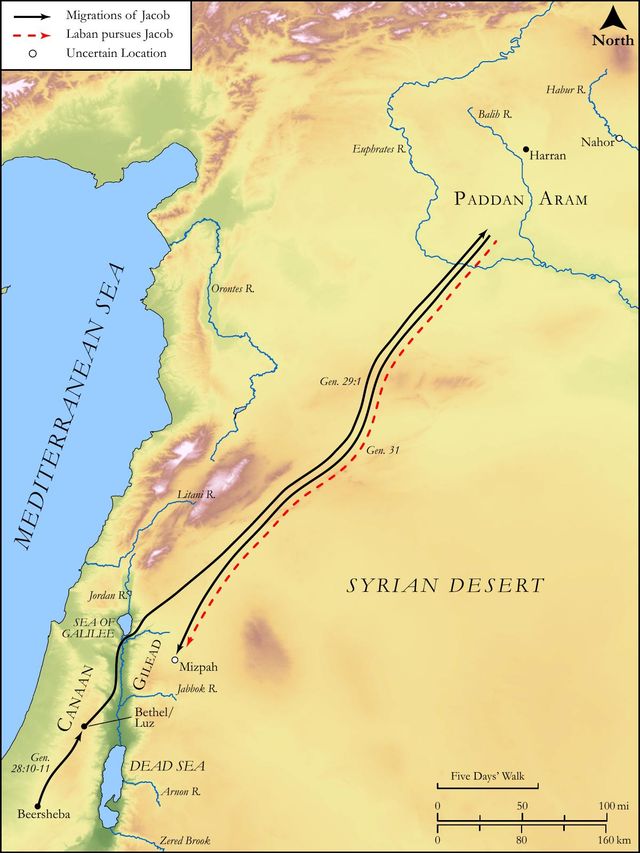
See on the biblical-era maps


Study this verse
Public-domain commentary
Matthew Henry
From his Commentary on the Whole Bible. Henry comments on passages, not single verses — this entry covers Genesis 31:25–35. His three-level outline is real structure in the source text, so it is rendered as structure.
We have here the reasoning, not to say the rallying, that took place between Laban and Jacob at their meeting, in that mountain which was afterwards called Gilead, Gen 31:25. Here is,
I.The high charge which Laban exhibited against him. He accuses him,
1.As a renegade that had unjustly deserted his service. To represent Jacob as a criminal, he will have it thought that he intended kindness to his daughters (Gen 31:27, Gen 31:28), that he would have dismissed them with all the marks of love and honour that could be, that he would have made a solemn business of it, would have kissed his little grandchildren (and that was all he would have given them), and, according to the foolish custom of the country, would have sent them away with mirth, and with songs, with tabret, and with harp: not as Rebekah was sent away out of the same family, above 120 years before, with prayers and blessings (Gen 24:60), but with sport and merriment, which was a sign that religion had very much decayed in the family, and that they had lost their seriousness. However, he pretends they would have been treated with respect at parting. Note, It is common for bad men, when they are disappointed in their malicious projects, to pretend that they designed nothing but what was kind and fair. When they cannot do the mischief they intended, they are loth it should be thought that they ever did intend it. When they have not done what they should have done they come off with this excuse, that they would have done it. Men may thus be deceived, but God cannot. He likewise suggests that Jacob had some bad design in stealing away thus (Gen 31:26), that he took his wives away as captives. Note, Those that mean ill themselves are most apt to put the worst construction upon what others do innocently. The insinuating and the aggravating of faults are the artifices of a designing malice, and those must be represented (though never so unjustly) as intending ill against whom ill is intended. Upon the whole matter,
(1.)He boasts of his own power (Gen 31:29): It is in the power of my hand to do you hurt. He supposes that he had both right on his side (a good action, as we say, against Jacob) and strength on his side, either to avenge the wrong or recover the right. Note, Bad people commonly value themselves much upon their power to do hurt, whereas a power to do good is much more valuable. Those that will do nothing to make themselves amiable love to be thought formidable. And yet,
(2.)He owns himself under the check and restraint of God's power; and, though it redounds much to the credit and comfort of Jacob, he cannot avoid telling him the caution God had given him the night before in a dream, Speak not to Jacob good nor bad. Note, As God has all wicked instruments in a chain, so when he pleases he can make them sensible of it, and force them to own it to his praise, as protector of the good, as Balaam did. Or we may look upon this as an instance of some conscientious regard felt by Laban for God's express prohibitions. As bad as he was he durst not injure one whom he saw to be the particular care of Heaven. Note, A great deal of mischief would be prevented if men would but attend to the caveats which their own consciences give them in slumberings upon the bed, and regard the voice of God in them.
2.As a thief, Gen 31:30. Rather than own that he had given him any colour of provocation to depart, he is willing to impute it to a foolish fondness for his father's house, which made him that he would needs begone; but then (says he) wherefore hast thou stolen my gods? Foolish man! to call those his gods that could be stolen! Could he expect protection from those that could neither resist nor discover their invaders? Happy are those who have the Lord for their God, for they have a God that they cannot be robbed of. Enemies may steal our goods, but not our God. Here Laban lays to Jacob's charge things that he knew not, the common distress of oppressed innocency.
II.Jacob's apology for himself.
Those that commit their cause to God, yet are not forbidden to plead it themselves with meekness and fear.
1.As to the charge of stealing away his own wives he clears himself by giving the true reason why he went away unknown to Laban, Gen 31:31. He feared lest Laban would by force take away his daughters, and so oblige him, by the bond of his affection to his wives, to continue in his service. Note, Those that are unjust in the least, it may be suspected, will be unjust also in much, Luk 16:10. If Laban deceive Jacob in his wages, it is likely he will make no conscience of robbing him of his wives, and putting those asunder whom God has joined together. What may not be feared from men that have no principle of honesty?
2.As to the charge of stealing Laban's gods he pleads not guilty, Gen 31:32. He not only did not take them himself (he was not so fond of them), but he did not know that they were taken. Yet perhaps he spoke too hastily and inconsiderately when he said, "Whoever had taken them, let him not live;" upon this he might reflect with some bitterness when, not long after, Rachel who had taken them died suddenly in travail. How just soever we think ourselves to be, it is best to forbear imprecations, lest they fall heavier than we imagine.
III.The diligent search Laban made for his gods (Gen 31:33-35), partly out of hatred to Jacob, whom he would gladly have an occasion to quarrel with, partly out of love to his idols, which he was loth to part with. We do not find that he searched Jacob's flocks for stolen cattle; but he searched his furniture for stolen gods. He was of Micah's mind, You have taken away my gods, and what have I more? Jdg 18:24. Were the worshippers of false gods so set upon their idols? did they thus walk in the name of their gods? and shall not we be as solicitous in our enquires after the true God? When he has justly departed from us, how carefully should we ask, Where is God my Maker? O that I knew where I might find him! Job 23:3. Laban, after all his searches, missed of finding his gods, and was baffled in his enquiry with a sham; but our God will not only by found of those that seek him, but they shall find him their bountiful rewarder.
Continue studying Genesis 31:25 across the web’s major study libraries — every link below opens this exact verse, chapter, or book on the destination site.
Read & Compare
 BibleGatewayThis verse in more than 200 translations and 70 languages.
 Bible.comThe YouVersion reader — hundreds of translations, reading plans, and highlights.
 ESV.orgCrossway's official English Standard Version reader.
 NET BibleThe NET translation with 60,000+ translators' notes on every rendering decision.
 STEP BibleTyndale House's free study tool — original text, vocabulary, and scholarly resources.
 BibliaLogos Bible Software's free web reader.
 USCCBThe New American Bible (Revised Edition) with the U.S. bishops' study notes.
Commentaries
 BibleHub CommentariesDozens of classic commentaries on this verse, gathered on one page.
 StudyLightMore than 100 commentary sets — the largest collection on the web.
 BibleRefPlain-English commentary on what this verse means, verse by verse.
 Enduring WordDavid Guzik's free commentary on this chapter, widely used by Bible teachers.
 Bible Study ToolsVerse commentary alongside Greek and Hebrew study aids.
Original Language & Research
- BibleHub InterlinearThe verse word by word — original language, transliteration, and English.
- BibleHub LexiconEvery word's original-language definition and Strong's entry.
 Blue Letter BibleDeep-study tools — Strong's numbers, concordance, and word studies.
 SefariaThe Hebrew text with Rashi and centuries of Jewish commentary.
Sermons, Hymns & Audio


TrulyRandomVerse is not affiliated with these sites and doesn’t control their content. They’re linked because they’re genuinely useful.
Summary
Genesis 31:25 marks the climactic moment in Laban's determined pursuit of Jacob, as he finally overtakes his son-in-law in the mountainous region of Gilead. After Jacob's clandestine departure with his family and extensive possessions, this verse sets the stage for a tense, yet divinely orchestrated, confrontation. Both parties establish their camps in the same vicinity, signaling a pause in the chase and the inevitable face-to-face encounter that will shape the future of their strained relationship.
Context
ShowHideLiterary Context
This verse serves as the immediate culmination of a dramatic seven-day chase. Preceding it, Jacob, prompted by a divine command to return to his homeland (Genesis 31:3), secretly flees Laban's household after twenty years of service, taking his wives, children, and all his acquired wealth. Laban, upon discovering Jacob's flight and the theft of his household idols (teraphim) by Rachel (Genesis 31:19), immediately mobilizes his kinsmen and embarks on a relentless pursuit. Genesis 31:25 describes the successful conclusion of this chase, placing Laban and Jacob in physical proximity, setting the scene for the verbal confrontation and covenant-making that follow in the subsequent verses of Genesis 31.
Historical & Cultural Context
In the days of the patriarchs, family honor, property rights, and the sanctity of oaths were paramount. Laban's pursuit was driven by a complex mix of these factors: anger over Jacob's clandestine departure, a sense of betrayal regarding his daughters and grandchildren, and the significant loss of his teraphim, which could have represented family lineage, property deeds, or even religious authority. The act of "pitching tents" by both parties, though seemingly mundane, signifies a temporary halt to hostilities and a preparation for negotiation or confrontation, a common practice in nomadic cultures. The "mount of Gilead" was a well-known geographical marker, a rugged region east of the Jordan River, often serving as a natural boundary or a place for significant encounters. The patriarchal narratives frequently feature such encounters in specific geographical locations, imbuing them with symbolic meaning.
Key Themes
ShowHideGenesis 31:25 contributes significantly to several overarching themes within the book of Genesis and the broader Pentateuch. It powerfully illustrates Divine Providence and Protection, as God's unseen hand had already intervened to warn Laban not to harm Jacob in a dream the night before (Genesis 31:24), ensuring Jacob's safety despite the perilous situation. The verse also underscores the theme of God's Faithfulness to His Covenant Promises, as Jacob's return to Canaan is a direct fulfillment of God's earlier commitment to bring him back to the land (Genesis 28:15). Furthermore, it highlights the Resolution of Familial Conflict, setting the stage for Jacob and Laban to finally address their long-standing tensions and establish boundaries, a recurring motif in the patriarchal narratives concerning sibling rivalry and inter-family strife.
Exposition and Analysis
ShowHideKey Word Analysis
ShowHideThis verb (H5381) signifies to "reach," "attain unto," or "take hold of." In this context, it precisely describes Laban's successful conclusion of the chase, emphasizing his determination and the physical reality of catching up to Jacob. It implies that Jacob's flight, though swift, was ultimately insufficient to evade Laban's pursuit.
This verb (H8628) means "to drive (a nail or tent-pin)," "to fasten," or "to strike." When used with "tent" (H168, ʼôhel), it specifically denotes the act of setting up a temporary dwelling. The repetition of this action for both Jacob and Laban highlights a deliberate pause in the narrative, moving from active pursuit to a static, confrontational stance. It suggests a preparation for dialogue rather than immediate violence.
This noun (H2022) refers to a "mountain or range of hills." The use of "the mount" (twice) and "mount of Gilead" emphasizes the geographical setting. Mountains often symbolize places of encounter, revelation, or significant events in biblical narratives. Here, it provides a rugged, natural backdrop for the impending confrontation and the subsequent covenant, which will be marked by a "heap of witness" on this very terrain.
Verse Breakdown
ShowHide"¶ Then Laban overtook Jacob."
This opening clause immediately establishes the narrative's turning point. After a seven-day pursuit, Laban's relentless chase has concluded successfully. The verb "overtook" (Hebrew: nâsag) implies a direct, physical catching up, leaving Jacob with no further means of evasion. This marks the end of Jacob's flight and the beginning of the inevitable confrontation.
"Now Jacob had pitched his tent in the mount:"
This phrase indicates Jacob's state upon being overtaken. He had already established a temporary encampment, perhaps for rest, or in anticipation of Laban's arrival. The "mount" (Hebrew: har) suggests a strategic or defensive position, or simply a convenient place to halt. This detail shows Jacob was not caught entirely by surprise mid-flight but had settled, albeit temporarily.
"and Laban with his brethren pitched in the mount of Gilead."
This final clause mirrors Jacob's action, showing Laban and his kinsmen also setting up camp. The phrase "with his brethren" (Hebrew: ʼâch) underscores the numerical superiority and potential threat Laban posed. The specification "in the mount of Gilead" (Hebrew: Har Gilʻâd) provides the precise geographical location, which will become highly significant in the ensuing narrative as the site of their covenant and the naming of "Galeed," meaning "heap of witness." The act of both parties pitching tents signifies a mutual, albeit tense, pause, preparing for a direct, face-to-face encounter rather than continued flight or immediate aggression.
Literary Devices
ShowHideGenesis 31:25 effectively employs several literary devices to enhance its narrative impact. The most prominent is Foreshadowing, as the act of both parties pitching their tents in the "mount of Gilead" directly anticipates the covenant and the "heap of witness" (Galeed) that will be established there in Genesis 31:47. The very name "Gilead" (H1568, Gilʻâd), possibly meaning "heap of witness," adds a layer of Symbolism, suggesting that this location is destined for a significant testimonial event. There is also a subtle Irony at play: while Laban's pursuit is driven by human anger and a desire for retribution, the reader knows from Genesis 31:24 that God has already intervened, limiting Laban's capacity to harm Jacob. This creates a dramatic tension where human intent is circumscribed by divine sovereignty. The parallel structure of "Jacob had pitched... and Laban... pitched" creates a sense of Balance and a visual representation of the two opposing parties now poised for confrontation.
Theological and Thematic Connections
ShowHideGenesis 31:25, while seemingly a straightforward narrative detail, is rich with theological implications. It underscores the theme of divine sovereignty and protection over Jacob, God's chosen patriarch. Even as human conflict reaches its peak, God's unseen hand is at work, ensuring His promises to Jacob are fulfilled and that Jacob's life is preserved for the unfolding of His redemptive plan. This moment of confrontation, orchestrated by Laban's pursuit, ultimately serves God's larger purpose of bringing Jacob back to the Promised Land, demonstrating that even human malice can be constrained and redirected by divine will.
Reflection and Application
ShowHideGenesis 31:25 offers profound lessons for contemporary believers. The narrative reminds us that God's providence extends even to the most challenging and seemingly perilous situations of our lives. Just as Jacob was unaware of God's prior intervention to protect him from Laban's wrath, we often navigate difficult circumstances without fully comprehending the unseen hand of God working on our behalf, averting dangers or orchestrating outcomes for our good. This should cultivate a deep sense of trust and peace, knowing that our sovereign God is actively involved in our journey, fulfilling His purposes even amidst human conflict and uncertainty. Furthermore, this verse highlights the inevitability of confronting unresolved relational issues. While Jacob sought to avoid a direct parting, the pursuit forced a necessary encounter. This calls us to courageously address conflicts in our own lives—whether with family, friends, or colleagues—with a reliance on God's wisdom and strength, seeking resolution and the establishment of healthy boundaries rather than perpetual evasion. God remains faithful to His word, guiding His people through complex dynamics to fulfill His greater purposes, encouraging us to persevere in faith, knowing that He is our ultimate protector and guide.
Questions for Reflection
ShowHideFAQ
ShowHideWhy did Laban pursue Jacob so relentlessly?
ShowHideLaban's relentless pursuit of Jacob stemmed from multiple grievances. Primarily, he was incensed by Jacob's clandestine departure after twenty years of service, viewing it as a betrayal and a loss of control over his daughters and grandchildren. He felt cheated out of a proper farewell and the customary gifts that would accompany such a departure. Furthermore, Laban was particularly angered by Rachel's theft of his household idols, or teraphim, which held significant religious, familial, and potentially legal importance in Laban's household, perhaps even symbolizing his family's inheritance rights. His pursuit was therefore driven by a desire to reclaim his property, assert his authority, and seek retribution.
What is the significance of the "Mount of Gilead" in this narrative?
ShowHideThe "Mount of Gilead" (Hebrew: Har Gilʻâd) is a prominent mountainous region located east of the Jordan River. Its significance in this narrative is both geographical and symbolic. As a natural boundary, it marks the edge of Laban's territory and the gateway to Canaan, Jacob's destination. Symbolically, the name "Gilead" itself is linguistically connected to the Hebrew phrase "heap of witness" (from gal-Ê¿ed). This directly foreshadows the covenant and the "heap of witness" that Jacob and Laban will establish there in the subsequent verses (Genesis 31:47), marking their agreement and separation. Thus, the location becomes a lasting monument to their reconciled, albeit tense, relationship and the boundaries they set.
Was Jacob in immediate danger when Laban overtook him?
ShowHideFrom a purely human perspective, Jacob was in significant danger. Laban was furious and had pursued Jacob with his kinsmen, suggesting an intent to reclaim his property and potentially inflict harm. Laban explicitly states his power to harm Jacob in Genesis 31:29. However, unknown to Jacob at the time, God had providentially intervened the night before. In a dream, God appeared to Laban and gave him a direct warning not to harm Jacob, stating, "Be careful not to say anything to Jacob, either good or bad." Therefore, while the situation was extremely tense and humanly perilous, God's unseen hand ensured Jacob's safety, demonstrating His protective sovereignty.
Christ-Centered Fulfillment
ShowHideThe dramatic confrontation in Genesis 31:25, where Laban overtakes Jacob, finds profound Christ-centered fulfillment in the person and work of Jesus Christ. Jacob's journey, fraught with human conflict yet divinely protected, foreshadows the secure pilgrimage of believers under the ultimate Shepherd, Jesus Christ. Just as God intervened to prevent Laban from harming Jacob, so Christ provides perfect and unwavering protection for His church, shielding believers from spiritual adversaries and guiding them through the wilderness of this world towards their eternal inheritance. The tension between Jacob and Laban, and their eventual, albeit fragile, reconciliation, points to Christ as the supreme Reconciler. Through His atoning sacrifice on the cross, Jesus bridges the chasm between a holy God and sinful humanity (2 Corinthians 5:18-19), offering true peace and the path to reconciliation among people (Ephesians 2:14-16). In Christ, the promises made to Jacob—of land, numerous descendants, and divine presence—find their ultimate "yes" and "amen" (2 Corinthians 1:20), ensuring a secure destiny and an eternal dwelling place for all who trust in Him, far surpassing any earthly tent pitched in Gilead.