


Genesis 31:47
Bible text: King James Version (1769 Blayney text) · Public domain
Bible text: Berean Standard Bible · Public domain
Bible text: American Standard Version (1901) · Public domain
Bible text: World English Bible, Messianic edition · Public domain
Bible text: Geneva Bible (1599) · Public domain
Bible text: Young's Literal Translation · Public domain
- וַיִּקְרָאvai·yik·ra'and he calledH7121Conj-w ¦ V-Qal-ConsecImperf-3msVerb Qal Consecutive Imperfect 3rd Singular Masculineוַandיִּקְרָאhe called
- לוֹlo<to> <the> itPrep-l ¦ 3msSuffix Personal 3rd Singular Masculineל<to> <the>וֹit
- לָבָןla·VanLabanH3837N-proper-mNoun Proper Masculine
- יְגַרye·GarJegarH3026N-properNoun Proper Location
- שָׂהֲדוּתָאsa·ha·du·Ta'SahaduthaH3026N-properNoun Proper Location
- וְיַעֲקֹבve·ya·'a·Koand JacobH3290Conj-w ¦ N-proper-mNoun Proper MasculineוְandיַעֲקֹבJacob
- קָרָאKa·ra'he calledH7121V-Qal-Perf-3msVerb Qal Perfect 3rd Singular Masculine
- לוֹlo<to> <the> itPrep-l ¦ 3msSuffix Personal 3rd Singular Masculineל<to> <the>וֹit
- גַּלְעֵדgal·'EdGaleedH1567N-properNoun Proper Location
English is a literal word-by-word gloss of the Hebrew, not the KJV's wording. Why?
This is the original text the KJV's translators worked from — each Hebrew word with its own literal English meaning in this verse, prepared by scholars at Tyndale House, Cambridge. The KJV translates whole sentences, not word by word, so its wording differs: one Hebrew word can become several English words, and the KJV may choose “the LORD” where the gloss reads “Yahweh”. Both are faithful — they answer different questions. For the KJV's own rendering, switch to the KJV text.
Details
See on the biblical-era maps


Study this verse
Public-domain commentary
Matthew Henry
From his Commentary on the Whole Bible. Henry comments on passages, not single verses — this entry covers Genesis 31:43–55. His four-level outline is real structure in the source text, so it is rendered as structure.
We have here the compromising of the matter between Laban and Jacob. Laban had nothing to say in reply to Jacob's remonstrance: he could neither justify himself nor condemn Jacob, but was convicted by his own conscience of the wrong he had done him; and therefore desires to hear no more of the matter He is not willing to own himself in a fault, nor to ask Jacob's forgiveness, and make him satisfaction, as he ought to have done. But,
I.He turns it off with a profession of kindness for Jacob's wives and children (Gen 31:43):
These daughters are my daughters. When he cannot excuse what he has done, he does, in effect, own what he should have done; he should have treated them as his own, but he had counted them as strangers, Gen 31:15. Note, It si common for those who are without natural affection to pretend much to it when it will serve a turn. Or perhaps Laban said this in a vain-glorious say, as one that loved to talk big, and use great swelling words of vanity: "All that thou seest is mine." It was not so, it was all Jacob's, and he had paid dearly for it; yet Jacob let him have his saying, perceiving him coming into a better humour. Note, Property lies near the hearts of worldly people. They love to boast of it, "This is mine, and the other is mine," as Nabal, Sa1 25:11, my bread and my water.
II.He proposes a covenant of friendship between them, to which Jacob readily agrees, without insisting upon Laban's submission, much less his restitution. Note, When quarrels happen, we should be willing to be friends again upon any terms: peace and love are such valuable jewels that we can scarcely buy them too dearly. Better sit down losers than go on in strife. Now observe here,
1.The substance of this covenant. Jacob left it wholly to Laban to settle it. The tenour of it was,
(1.)That Jacob should be a good husband to his wives, that he should not afflict them, nor marry other wives besides them, Gen 31:50. Jacob had never given him any cause to suspect that he would be any other than a kind husband; yet, as if he had, he was willing to come under this engagement. Though Laban had afflicted them himself, yet he will bind Jacob that he shall not afflict them. Note, Those that are injurious themselves are commonly most jealous of others, and those that do not do their own duty are most peremptory in demanding duty from others.
(2.)That he should never be a bad neighbour to Laban, Gen 31:52. It was agreed that no act of hostility should ever pass between them, that Jacob should forgive and forget all the wrongs he had received and not remember them against Laban or his family in after-times. Note, We may resent an injury which yet we may not revenge.
2.The ceremony of this covenant. It was made and ratified with great solemnity, according to the usages of those times.
(1.)A pillar was erected (Gen 31:45), and a heap of stones raised (Gen 31:46), to perpetuate the memory or the ting, the way of recording agreements by writing being then either not known or not used.
(2.)A sacrifice was offered (Gen 31:54), a sacrifice of peace-offerings. Note, Our peace with God is that which puts true comfort into our peace with our friends. If parties contend, the reconciliation of both to him will facilitate their reconciliation one to another.
(3.)They did eat bread together (Gen 31:46), jointly partaking of the feast upon the sacrifice, Gen 31:54. This was in token of a hearty reconciliation. Covenants of friendship were anciently ratified by the parties eating and drinking together. It was in the nature of a love-feast.
(4.)They solemnly appealed to God concerning their sincerity herein,
[1.]As a witness (Gen 31:49): The Lord watch between me and thee, that is, "The Lord take cognizance of every thing that shall be done on either side in violation of this league. When we are out of one another's sight, let his be a restraint upon us, that wherever we are we are under God's eye." This appeal is convertible into a prayer. Friends at a distance from each other may take the comfort of this, that when they cannot know or succour one another God watches between them, and has his eye on them both.
[2.]As a Judge, Gen 31:53. The God of Abraham (from whom Jacob descended), and the God of Nahor (from whom Laban descended), the God of their father (the common ancestor, form whom they both descended), judge betwixt us. God's relation to them is thus expressed to intimate that they worshipped one and the same God, upon which consideration there ought to be no enmity between them. Note, Those that have one God should have one heart: those that agree in religion should strive to agree in every thing else. God is Judge between contending parties, and he will judge righteously; whoever does wrong, it is at his peril.
(5.)They gave a new name to the place, Gen 31:47, Gen 31:48. Laban called it in Syriac, and Jacob in Hebrew, the heap of witness; and (Gen 31:49) it was called Mizpah, a watch-tower. Posterity being included in the league, care was taken that thus the memory of it should be preserved. These names are applicable to the seals of the gospel covenant, which are witnesses to us if we be faithful, but witnesses to us if we be faithful, but witnesses against us if we be false. The name Jacob gave this heap (Galeed) stuck by it, not the name Laban gave it. In all this rencounter, Laban was noisy and full of words, affecting to say much; Jacob was silent, and said little. When Laban appealed to God under many titles, Jacob only swore by the fear of his father Isaac, that is, the God whom his father Isaac feared, who had never served other gods, as Abraham and Nahor had done. Two words of Jacob's were more memorable than all Laban's speeches and vain repetitions: for the words of wise men are heard in quiet, more than the cry of him that ruleth among fools, Ecc 9:17.
Lastly, After all this angry parley, they part friends, Gen 31:55. Laban very affectionately kissed his sons and his daughters, and blessed them, and then went back in peace. Note, God is often better to us than our fears, and strangely overrules the spirits of men in our favour, beyond what we could have expected; for it is not in vain to trust in him.
Continue studying Genesis 31:47 across the web’s major study libraries — every link below opens this exact verse, chapter, or book on the destination site.
Read & Compare
 BibleGatewayThis verse in more than 200 translations and 70 languages.
 Bible.comThe YouVersion reader — hundreds of translations, reading plans, and highlights.
 ESV.orgCrossway's official English Standard Version reader.
 NET BibleThe NET translation with 60,000+ translators' notes on every rendering decision.
 STEP BibleTyndale House's free study tool — original text, vocabulary, and scholarly resources.
 BibliaLogos Bible Software's free web reader.
 USCCBThe New American Bible (Revised Edition) with the U.S. bishops' study notes.
Commentaries
 BibleHub CommentariesDozens of classic commentaries on this verse, gathered on one page.
 StudyLightMore than 100 commentary sets — the largest collection on the web.
 BibleRefPlain-English commentary on what this verse means, verse by verse.
 Enduring WordDavid Guzik's free commentary on this chapter, widely used by Bible teachers.
 Bible Study ToolsVerse commentary alongside Greek and Hebrew study aids.
Original Language & Research
- BibleHub InterlinearThe verse word by word — original language, transliteration, and English.
- BibleHub LexiconEvery word's original-language definition and Strong's entry.
 Blue Letter BibleDeep-study tools — Strong's numbers, concordance, and word studies.
 SefariaThe Hebrew text with Rashi and centuries of Jewish commentary.
Sermons, Hymns & Audio


TrulyRandomVerse is not affiliated with these sites and doesn’t control their content. They’re linked because they’re genuinely useful.
Summary
Genesis 31:47 records a significant moment in the strained relationship between Jacob and Laban, detailing the naming of a heap of stones by both men. Laban, speaking Aramaic, named it "Jegarsahadutha," while Jacob, speaking Hebrew, named it "Galeed." Both names carry the identical meaning of "heap of witness" or "heap of testimony," signifying the establishment of a covenant of peace and non-aggression. This act solidified a tangible boundary and a mutual agreement, underscoring the importance of clear covenants and the role of God as a witness to human affairs, bridging linguistic and cultural divides.
Context
ShowHideLiterary Context
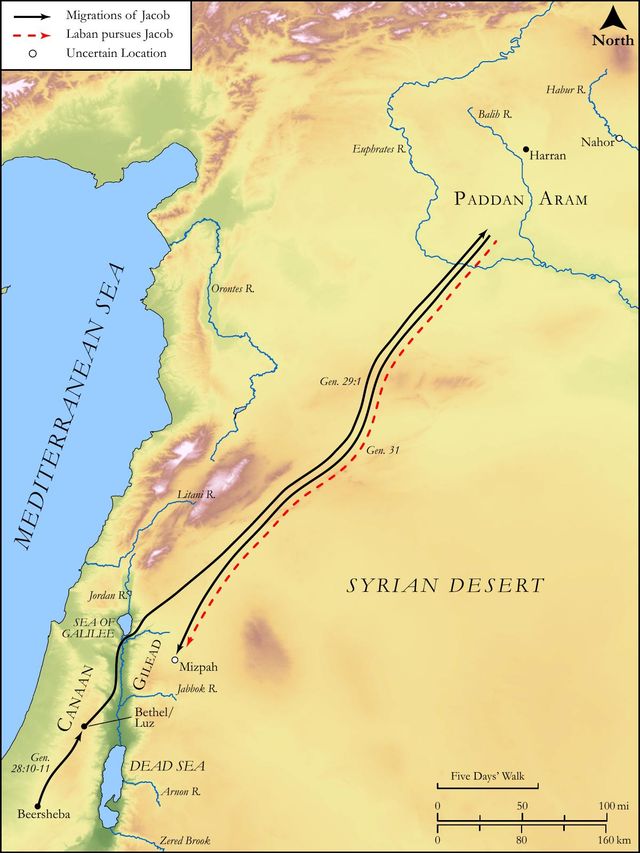
Genesis 31:47 is situated at the climax of a protracted and often contentious relationship between Jacob and his father-in-law, Laban. Following two decades of service, during which Jacob felt exploited and deceived, he secretly departed Laban's household with his family and extensive possessions. Laban pursued him relentlessly for seven days, eventually catching up in the hill country of Gilead. The preceding verses detail the tense confrontation, where Laban accuses Jacob of theft and deceit, and Jacob passionately defends his integrity and recounts Laban's repeated changes to his wages (Genesis 31:25-42). Crucially, God intervened, warning Laban in a dream not to harm Jacob (Genesis 31:24). The naming of the heap of stones, along with the subsequent covenant meal and the "Mizpah" pronouncement in Genesis 31:48-55, marks the resolution of this conflict and the formal separation of the two households, allowing Jacob to continue his journey back to Canaan.
Historical & Cultural Context
The practice of erecting stone heaps or pillars as memorials, boundary markers, or witnesses to covenants was a common and deeply ingrained custom in the days of the patriarchs. These monuments served as tangible, enduring symbols of agreements, oaths, or significant events, often invoking divine oversight to reinforce their binding nature. In a pre-literate or semi-literate society, such physical markers were crucial for establishing and remembering legal and social contracts. The linguistic duality in Genesis 31:47—Laban speaking Aramaic and Jacob speaking Hebrew—reflects the cultural crossroads of the region. Laban, from Paddan-Aram (Mesopotamia), represented the Aramean culture, while Jacob, though residing there, was of Hebrew stock, destined to be the patriarch of Israel. This linguistic distinction highlights the diverse tongues of Laban the Syrian and Jacob and the practical need for mutual understanding in agreements between peoples. The location, Gilead, was a significant geographical region east of the Jordan River, often serving as a borderland.
Key Themes
ShowHideThis verse contributes significantly to several overarching themes within the book of Genesis and the broader biblical narrative. Firstly, it underscores the theme of Covenant and Reconciliation, demonstrating how even deeply fractured relationships can find a path to peace and mutual understanding through formal agreements, albeit imperfect ones. Secondly, the concept of Witness and Testimony is central; the heap of stones serves as a physical witness to the verbal covenant, with God Himself invoked as the ultimate witness to human integrity and promises (Genesis 31:49). Thirdly, the verse highlights Linguistic and Cultural Identity, showcasing the distinct heritage of Jacob and Laban while simultaneously demonstrating their ability to bridge these differences for a common purpose. Finally, it reinforces the theme of Divine Providence and Protection, as God's intervention was instrumental in preventing Laban from harming Jacob, ensuring the covenant was made in peace rather than conflict, thereby safeguarding the lineage through which His promises would be fulfilled.
Exposition and Analysis
ShowHideThe precise wording of Genesis 31:47 reveals the culmination of a tense encounter, solidifying a covenant through a shared understanding, despite linguistic differences. The act of naming the heap of stones by both parties signifies their mutual agreement and the solemnity of the occasion.
Key Word Analysis
ShowHideThis Aramaic term, used by Laban, literally means "heap of the testimony" or "heap of witness." It is derived from a root meaning "to gather" (referring to the heap) and a word corresponding to "witness." Laban's use of Aramaic reflects his cultural and linguistic background from Paddan-Aram, emphasizing the shared understanding of the covenant's purpose even across linguistic boundaries.
This Hebrew term, used by Jacob, is a compound word formed from gal (גַּל), meaning "heap," and ed (עֵד), meaning "witness" or "testimony." Thus, "Galeed" precisely mirrors the meaning of "Jegarsahadutha." Jacob's choice of Hebrew underscores his identity as the patriarch of the nascent Israelite nation and the distinct linguistic heritage he carries.
This primitive root signifies "to call out to," "to address by name," or "to proclaim." In this context, it denotes the solemn act of naming the monument, which serves to declare its purpose and significance publicly and formally. The repetition of "called" for both Laban and Jacob emphasizes their joint participation and agreement in establishing the covenant and its physical marker.
Verse Breakdown
ShowHide"And Laban called it Jegarsahadutha:"
This clause details Laban's action in naming the heap of stones. His choice of the Aramaic "Jegarsahadutha" (heap of witness) highlights his cultural and linguistic heritage from Paddan-Aram. This act is not merely a linguistic preference but a formal declaration of the monument's purpose from his perspective, signifying his commitment to the covenant being established. It underscores the shared understanding of the monument's function, despite the language barrier.
"but Jacob called it Galeed."
This clause presents Jacob's parallel action, naming the same heap of stones. His use of the Hebrew "Galeed" (heap of witness) reflects his identity as a Hebrew patriarch. The conjunction "but" emphasizes the linguistic distinction while simultaneously affirming the identical meaning and shared purpose of the naming. This duality highlights the agreement reached between two individuals from different cultural backgrounds, signifying a mutual commitment to the terms of their covenant.
Literary Devices
ShowHideThe verse effectively employs several literary devices to convey its meaning and significance. Bilingualism is prominently featured, with the same concept ("heap of witness") expressed in two distinct languages, Aramaic (Jegarsahadutha) and Hebrew (Galeed). This linguistic contrast not only highlights the cultural backgrounds of Laban and Jacob but also underscores their shared understanding and agreement despite their differences. Symbolism is central, as the physical heap of stones serves as a powerful symbol of the covenant, a tangible witness to their vows, and a boundary marker. The very act of naming it by both parties imbues it with symbolic weight. Furthermore, a form of Parallelism is evident in the structure "Laban called it X; but Jacob called it Y," where X and Y are semantic equivalents. This structural repetition emphasizes the dual naming and the mutual agreement, reinforcing the idea that both men acknowledged the same purpose for the monument.
Theological and Thematic Connections
ShowHideGenesis 31:47, while detailing a specific historical event, resonates with profound theological and thematic truths. It illustrates the biblical emphasis on the importance of covenants, not merely as legal agreements, but as sacred bonds established under divine witness. The dual naming of the heap of stones, "Jegarsahadutha" and "Galeed," signifies a mutual commitment to peace and non-aggression, even between estranged parties. This act of reconciliation, though imperfect and born out of necessity, foreshadows the broader biblical narrative of God's covenant faithfulness and His desire for humanity to live in peace. It underscores that true agreements require clear terms and a shared understanding, even across cultural and linguistic divides. The invocation of God as a witness, implied in the very meaning of "heap of witness," highlights divine oversight in human affairs and the accountability of individuals before their Creator for their promises.
Reflection and Application
ShowHideThe naming of Jegarsahadutha/Galeed offers timeless lessons for contemporary life, emphasizing the critical value of defining terms and establishing clear boundaries in all relationships—be they personal, familial, or professional. This passage encourages us to proactively prevent future misunderstandings and conflicts by articulating expectations and limits. It serves as a powerful reminder to honor our commitments, recognizing that our words carry significant weight and that our agreements, whether formal or informal, are observed by a higher power. Just as Jacob and Laban, despite their deep-seated differences and linguistic barriers, found common ground for peace, we are called to seek reconciliation and mutual respect even with those who hold vastly different backgrounds or beliefs. This narrative underscores the universal call to pursue understanding, practice forgiveness, and live peaceably with all, remembering that our integrity in agreements reflects our character and our reverence for the God who sees and witnesses all. This principle is beautifully echoed in the reminder that God is a God of covenant and faithfulness, always honoring His word.
Questions for Reflection
ShowHideFAQ
ShowHideWhy are two different names given for the same heap of stones?
ShowHideThe two names, Jegarsahadutha (Aramaic) and Galeed (Hebrew), are given because Laban and Jacob spoke different languages, reflecting their distinct cultural and ethnic backgrounds. Both names mean "heap of witness" or "heap of testimony," demonstrating that despite their linguistic differences, they had a shared understanding and agreement regarding the purpose of the monument and the covenant it represented. This linguistic duality underscores the mutual assent to the terms of the peace treaty.
What was the primary purpose of the heap of stones and the covenant made there?
ShowHideThe primary purpose of the heap of stones was to serve as a tangible, physical witness to a covenant of peace and non-aggression established between Jacob and Laban. It marked a clear boundary that neither man was to cross with hostile intent, ensuring the safety and separation of their families and possessions. This monument also invoked God as a divine witness to their solemn agreement, reinforcing its binding nature and the accountability of both parties to their vows, as seen when Laban appeals to the God of Abraham and the God of Nahor.
Does this story have relevance for modern relationships and agreements?
ShowHideYes, this story offers significant relevance for modern relationships and agreements. It underscores the importance of clear communication, establishing explicit boundaries, and honoring commitments. The concept of a "witness" reminds us that integrity in our agreements is paramount, and that our words carry weight, whether or not a physical monument exists. It also highlights the possibility of reconciliation and finding common ground even between individuals or groups with significant differences, encouraging us to seek peace and understanding in all our interactions, echoing the New Testament call to live peaceably with all.
Christ-Centered Fulfillment
ShowHideWhile Genesis 31:47 describes a historical covenant between men, it powerfully foreshadows deeper theological truths ultimately fulfilled in Jesus Christ. The "heap of witness," whether called Jegarsahadutha or Galeed, points to the ultimate and perfect witness, Jesus Christ, who is Himself "the faithful and true witness" (Revelation 3:14) and the very embodiment of God's testimony to humanity. Just as the heap established a covenant of peace and a boundary between Jacob and Laban, Christ Himself is our peace, having broken down the dividing wall of hostility—both between God and humanity and between different peoples—through His atoning work on the cross (Ephesians 2:14). The reconciliation achieved between Jacob and Laban, though imperfect and temporary, prefigures the perfect and eternal reconciliation offered through Christ's sacrifice, where the ultimate covenant of grace is established, not by a heap of stones or human promises, but by His precious blood, bringing eternal testimony to God's unwavering faithfulness and His profound love for a fallen world (Hebrews 9:15). He is the true "heap of witness," the living monument to God's redemptive plan.