


Genesis 29:5
Bible text: King James Version (1769 Blayney text) · Public domain
Bible text: Berean Standard Bible · Public domain
Bible text: American Standard Version (1901) · Public domain
Bible text: World English Bible, Messianic edition · Public domain
Bible text: Geneva Bible (1599) · Public domain
Bible text: Young's Literal Translation · Public domain
- וַיֹּאמֶרvai·Yo·merand he saidH559Conj-w ¦ V-Qal-ConsecImperf-3msVerb Qal Consecutive Imperfect 3rd Singular Masculineוַandיֹּאמֶרhe said
- לָהֶםla·Hemto <the> themPrep-l ¦ 3mpSuffix Personal 3rd Plural Masculineלָto <the>הֶםthem
- הַיְדַעְתֶּםhay·da'·Tem¿ do you knowH3045Interrog ¦ V-Qal-Perf-2mpVerb Qal Perfect 2nd Plural Masculineהַ¿יְדַעְתֶּםdo you know
- אֶת'et<obj.>H853DirObjMParticle Object Indicator
- לָבָןla·VanLabanH3837N-proper-mNoun Proper Masculine
- בֶּןben[the] son ofH1121N-mscNoun Singular Masculine Construct
- נָחוֹרna·ChorNahorH5152N-proper-mNoun Proper Masculine
- וַיֹּאמְרוּvai·yo·me·Ruand they saidH559Conj-w ¦ V-Qal-ConsecImperf-3mpVerb Qal Consecutive Imperfect 3rd Plural Masculineוַandיֹּאמְרוּthey said
- יָדָעְנוּya·Da·'e·nuwe know [him]H3045V-Qal-Perf-1cpVerb Qal Perfect 1st Plural common gender
English is a literal word-by-word gloss of the Hebrew, not the KJV's wording. Why?
This is the original text the KJV's translators worked from — each Hebrew word with its own literal English meaning in this verse, prepared by scholars at Tyndale House, Cambridge. The KJV translates whole sentences, not word by word, so its wording differs: one Hebrew word can become several English words, and the KJV may choose “the LORD” where the gloss reads “Yahweh”. Both are faithful — they answer different questions. For the KJV's own rendering, switch to the KJV text.
Details
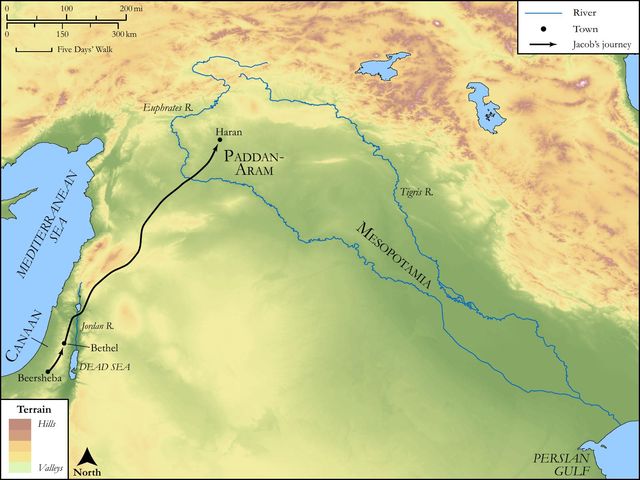
See on the biblical-era maps


Study this verse
Public-domain commentary
Matthew Henry
From his Commentary on the Whole Bible. Henry comments on passages, not single verses — this entry covers Genesis 29:1–8.
All the stages Israel's march to Canaan are distinctly noticed, but no particular journal is kept of Jacob's expedition further than Beth-el; no, he had no more such happy nights as he had at Beth-el, no more such visions of the Almighty. That was intended for a feast; he must not expect it to be his daily bread. But, 1. We are here told how cheerfully he proceeded in his journey after the sweet communion he had with God at Beth-el: Then Jacob lifted up his feet; so the margin reads it, Gen 29:1. Then he went on with cheerfulness and alacrity, not burdened with his cares, nor cramped with his fears, being assured of God's gracious presence with him. Note, After the visions we have had of God, and the vows we have made to him in solemn ordinances, we should run the way of his commandments with enlarged hearts, Heb 12:1. 2. How happily he arrived at his journey's end. Providence brought him to the very field where his uncle's flocks were to be watered, and there he met with Rachel, who was to be his wife. Observe, (1.) The divine Providence is to be acknowledged in all the little circumstances which concur to make a journey, or other undertaking, comfortable and successful. If, when we are at a loss, we meet seasonably with those that can direct us - if we meet with a disaster, and those are at hand that will help us - we must not say that it was by chance, nor that fortune therein favoured us, but that it was by Providence, and that God therein favoured us. Our ways are ways of pleasantness, if we continually acknowledge God in them. (2.) Those that have flocks must look well to them, and be diligent to know their state, Pro 27:23. What is here said of the constant care of the shepherds concerning their sheep (Gen 29:2, Gen 29:3, Gen 29:7, Gen 29:8) may serve to illustrate the tender concern which our Lord Jesus, the great Shepherd of the sheep, has for his flock, the church; for he is the good Shepherd, that knows his sheep, and is known of them, Joh 10:14. The stone at the well's mouth, which is so often mentioned here, was either to secure their property in it (for water was scarce, it was not there usus communis aquarum - for every one's use), or it was to save the well from receiving damage from the heat of the sun, or from any spiteful hand, or to prevent the lambs of the flock from being drowned in it. (3.) Separate interests should not take us from joint and mutual help; when all the shepherds came together with their flocks, then, like loving neighbours, at watering-time, they watered their flocks together. (4.) It becomes us to speak civilly and respectfully to strangers. Though Jacob was no courtier, but a plain man, dwelling in tents, and a stranger to compliment, yet he addresses himself very obligingly to the people he met with, and calls them his brethren, Gen 29:4. The law of kindness in the tongue has a commanding power, Pro 31:26. Some think he calls them brethren because they were of the same trade, shepherds like him. Though he was now upon his preferment, he was not ashamed of his occupation. (5.) Those that show respect have usually respect shown to them. As Jacob was civil to these strangers, so he found them civil to him. When he undertook to teach them how to despatch their business (Gen 29:7), they did not bid him meddle with his own concerns and let them alone; but, though he was a stranger, they gave him the reason of their delay, Gen 29:8. Those that are neighbourly and friendly shall have neighbourly and friendly usage.
Continue studying Genesis 29:5 across the web’s major study libraries — every link below opens this exact verse, chapter, or book on the destination site.
Read & Compare
 BibleGatewayThis verse in more than 200 translations and 70 languages.
 Bible.comThe YouVersion reader — hundreds of translations, reading plans, and highlights.
 ESV.orgCrossway's official English Standard Version reader.
 NET BibleThe NET translation with 60,000+ translators' notes on every rendering decision.
 STEP BibleTyndale House's free study tool — original text, vocabulary, and scholarly resources.
 BibliaLogos Bible Software's free web reader.
 USCCBThe New American Bible (Revised Edition) with the U.S. bishops' study notes.
Commentaries
 BibleHub CommentariesDozens of classic commentaries on this verse, gathered on one page.
 StudyLightMore than 100 commentary sets — the largest collection on the web.
 BibleRefPlain-English commentary on what this verse means, verse by verse.
 Enduring WordDavid Guzik's free commentary on this chapter, widely used by Bible teachers.
 Bible Study ToolsVerse commentary alongside Greek and Hebrew study aids.
Original Language & Research
- BibleHub InterlinearThe verse word by word — original language, transliteration, and English.
- BibleHub LexiconEvery word's original-language definition and Strong's entry.
 Blue Letter BibleDeep-study tools — Strong's numbers, concordance, and word studies.
 SefariaThe Hebrew text with Rashi and centuries of Jewish commentary.
Sermons, Hymns & Audio


TrulyRandomVerse is not affiliated with these sites and doesn’t control their content. They’re linked because they’re genuinely useful.
Summary
Genesis 29:5 marks a pivotal moment in Jacob's journey, recording his initial inquiry to local shepherds at a well in Haran: "Know ye Laban the son of Nahor?" This seemingly simple question is divinely orchestrated, immediately preceding his encounter with Rachel, Laban's daughter, and setting the stage for Jacob's extended stay with his mother's kin, fulfilling God's providential guidance for his life and the continuation of the covenant lineage.
Context
ShowHideLiterary Context
Genesis 29:5 is situated immediately after Jacob's arrival in the land of the people of the East, having fled from Esau and experienced the transformative dream at Bethel, where God reiterated the Abrahamic covenant promises to him (Genesis 28:10-22). The narrative flow transitions from Jacob's solitary journey and divine encounter to his integration into human society and the commencement of his family life. This verse serves as the crucial opening dialogue that connects Jacob to his extended family, specifically Laban's household, which is the stated purpose of his journey as instructed by Isaac (Genesis 28:1-2). The well, a recurring motif in Genesis for significant encounters (e.g., Abraham's servant and Rebekah in Genesis 24), here functions as the divinely appointed meeting place.
Historical & Cultural Context
In Haran and Canaan alike, wells were far more than mere water sources; they were vital social and economic hubs. In arid regions, access to water dictated settlement patterns and daily routines. Shepherds, like those Jacob encounters, would gather their flocks at wells during specific times of the day for watering, making them natural places for communication, news exchange, and the formation of relationships. Familial ties and tribal loyalty were paramount in this patriarchal society, and endogamous marriage (marrying within one's kin group) was strongly preferred to maintain lineage purity and strengthen family alliances. Jacob's journey to Haran to find a wife from his mother's family (Genesis 24:3-4) reflects this deep-seated cultural norm, ensuring the continuation of the covenant line through a recognized and acceptable source.
Key Themes
ShowHideThis verse contributes to several overarching themes in Genesis. It highlights Divine Providence and Guidance, demonstrating how God orchestrates seemingly mundane human interactions to fulfill His grand purposes, as promised to Jacob at Bethel (Genesis 28:15). The theme of Kinship and Covenant Continuation is central, as Jacob's quest is directly tied to securing a wife from his own people to perpetuate the lineage through which God's promises to Abraham would be realized (Genesis 12:1-3). Furthermore, the narrative emphasizes The Significance of Wells as Meeting Places, not just for physical sustenance but for pivotal life events and the forging of new relationships, a motif seen earlier with Rebekah and Eliezer in Genesis 24.
Exposition and Analysis
ShowHideKey Word Analysis
ShowHideThis word (H3045) is a primitive root meaning "to know," but it encompasses a vast range of understanding, from simple acquaintance to intimate, experiential knowledge. Here, Jacob's use of "know ye" is a direct inquiry about their familiarity with Laban, implying not just knowledge of his existence but his whereabouts, reputation, perhaps even his character. The shepherds' affirmative response, "We know [him]," signifies their direct acquaintance and ability to confirm his presence in the region, which is crucial for Jacob's next steps.
This proper noun (H3837) refers to Laban, the son of Bethuel and brother of Rebekah, making him Jacob's uncle. His name means "white," possibly referring to his flocks or a personal characteristic. Jacob's specific inquiry about Laban indicates his precise knowledge of his mother's family, underscoring the purpose of his journey to find a wife from his kin in Paddan-Aram. Laban will become a central figure in Jacob's life for the next two decades, his character evolving from a welcoming relative to a shrewd and deceptive employer.
The Hebrew word ben (H1121) literally means "son," but as the Strong's data indicates, it has a much broader semantic range, often signifying "descendant," "kinsman," or even "member of a group." While Laban was genealogically the grandson of Nahor (Abraham's brother) and the son of Bethuel (Genesis 24:29), the phrase "Laban the son of Nahor" is a common biblical idiom for a close familial relationship or descent within a patriarchal line, rather than a strict direct father-son link. This usage emphasizes Laban's direct connection to Jacob's ancestral family through Nahor, solidifying his identity within the broader clan Jacob was seeking.
Verse Breakdown
ShowHide"And he said unto them,"
This simple introductory clause establishes Jacob as the speaker, initiating the conversation. It highlights his proactive approach upon encountering the local shepherds, immediately seeking information pertinent to his mission. This direct address underscores the urgency and singular focus of Jacob's quest.
"Know ye Laban the son of Nahor?"
This is Jacob's direct and pointed question. It reveals his specific objective: to locate his mother's brother, Laban, in Haran. The inclusion of "the son of Nahor" serves to clearly identify Laban within the broader family lineage of Abraham's brother Nahor, ensuring that the shepherds understand precisely whom Jacob is inquiring about. This question is the linchpin that connects Jacob to his future.
"And they said, We know [him]."
The shepherds' succinct and affirmative response confirms Jacob's successful arrival at the correct location and his immediate proximity to his relatives. This brief exchange is profoundly significant; it is the confirmation Jacob needed, opening the door to the next phase of his life and setting the stage for his encounter with Rachel, Laban's daughter, who arrives moments later.
Literary Devices
ShowHideThe verse primarily employs Dialogue, which is a fundamental literary device for advancing the plot and revealing character. Jacob's direct question and the shepherds' concise reply efficiently convey crucial information and establish the immediate setting for the unfolding narrative. There is a subtle use of Foreshadowing in the seemingly innocuous question about Laban; while it appears to be a simple inquiry, it subtly hints at the significant, and often challenging, role Laban will play in Jacob's life for the next two decades. The Well Motif itself is a symbolic device, frequently appearing in biblical narratives as a place of significant encounters, betrothals, and divine provision, here serving as the stage for Jacob's destiny-altering meeting.
Theological and Thematic Connections
ShowHideThis verse powerfully illustrates the theme of God's meticulous Sovereignty and Providence working through seemingly ordinary human interactions. Jacob's journey, though fraught with danger and uncertainty, is divinely guided, leading him to the precise well at the opportune moment to connect with the very people he sought. This encounter is not coincidental but a direct fulfillment of God's promise to Jacob at Bethel, assuring him of divine protection and guidance (Genesis 28:15). It underscores that God's plan unfolds even in the mundane details of life, directing steps and orchestrating meetings to achieve His redemptive purposes, particularly concerning the continuation of the covenant lineage.
Reflection and Application
ShowHideGenesis 29:5 offers a profound lesson on the interplay between human initiative and divine providence. Jacob, having received divine promises, still actively engages in his journey, asking direct questions and seeking information. This reminds us that faith is not passive; it involves taking steps, asking for guidance, and engaging with the world around us, trusting that God is at work in our efforts. We are encouraged to seek wise counsel and information, recognizing that God can use the most ordinary conversations and connections to direct our paths. This verse also highlights the importance of community and shared spaces, like the well, where unexpected but divinely appointed connections can be made. It calls us to be attentive to the seemingly small details of our lives, for it is often in these moments that God's hand is most clearly seen, guiding us toward His purposes and connecting us with the people and resources we need for the next phase of our journey.
Questions for Reflection
ShowHideFAQ
ShowHideWhy does the KJV say "Laban the son of Nahor" when he was his grandson?
ShowHideThe Hebrew word for "son" (ben, H1121) has a broader meaning than its English equivalent, often referring to a descendant, including a grandson, or even a more distant kinsman within a patriarchal lineage. In biblical genealogies, this broader usage is common to emphasize familial connection rather than strict direct parentage. Laban was indeed the son of Bethuel, who was the son of Nahor (Genesis 24:29), making Laban Nahor's grandson. The phrase "Laban the son of Nahor" therefore accurately conveys his direct descent and close family relationship within Nahor's household, which was the family Jacob was seeking.
What is the significance of Jacob asking about Laban specifically?
ShowHideJacob's mother, Rebekah, was Laban's sister (Genesis 24:29). Jacob was following his father Isaac's instruction to find a wife from his mother's family in Paddan-Aram (Genesis 28:2). Therefore, asking for Laban was the most direct and logical way to locate his mother's kin and fulfill the primary purpose of his journey: to secure a wife from his own people to continue the Abrahamic covenant lineage.
Why were wells so important in ancient biblical times?
ShowHideWells were absolutely crucial for survival in the arid climate of Canaan and Paddan-aram, providing the essential water for humans, livestock, and agriculture. Beyond their practical utility, they served as vital social and economic hubs. People gathered daily at wells to water their flocks, exchange news, conduct business, and form relationships. Many significant biblical encounters, including betrothals (like Isaac and Rebekah in Genesis 24 and Jacob and Rachel in Genesis 29), occur at wells, underscoring their importance as centers of community, sustenance, and the unfolding of life-altering events.
Christ-Centered Fulfillment
ShowHideJacob's journey to find a bride from his own people, marked by divine guidance and culminating in his providential encounter at the well, profoundly foreshadows Christ's relationship with His Church. Just as Jacob was sent by his father to a distant land to secure a wife from his kin, so Christ, the ultimate Bridegroom, was sent by the Father from heaven to earth to gather His bride, the Church, from among all peoples (Ephesians 5:25-27). Jacob's seemingly ordinary question at the well, divinely orchestrated to lead him to Rachel, parallels the meticulous care with which God works out His redemptive plan, ultimately revealed in Christ. Through His perfect life, atoning death, and glorious resurrection, Jesus perfectly embodies the fulfillment of all God's covenant promises, gathering His chosen ones into an eternal union with Himself, making them "one flesh" with Him, just as Jacob and Rachel became one. The Church, as the spiritual offspring of Christ, continues the lineage of faith, fulfilling God's eternal purpose to have a people for His own possession, purchased by the precious blood of the Lamb of God.