


Genesis 24:24
Bible text: King James Version (1769 Blayney text) · Public domain
Bible text: Berean Standard Bible · Public domain
Bible text: American Standard Version (1901) · Public domain
Bible text: World English Bible, Messianic edition · Public domain
Bible text: Geneva Bible (1599) · Public domain
Bible text: Young's Literal Translation · Public domain
- וַתֹּאמֶרva·To·merand she saidH559Conj-w ¦ V-Qal-ConsecImperf-3fsVerb Qal Consecutive Imperfect 3rd Singular Feminineוַandתֹּאמֶרshe said
- אֵלָיו'e·Lavto himH413Prep ¦ 3msPreposition Definiteאֵלָיtoוhim
- בַּתbat[am] [the] daughter ofH1323N-fscNoun Singular Feminine Construct
- בְּתוּאֵלbe·tu·'ElBethuelH1328N-proper-mNoun Proper Masculine
- אָנֹכִי'a·No·khiIH595Pro-1csPronoun Personal 1st Singular common gender
- בֶּןben[the] son ofH1121N-mscNoun Singular Masculine Construct
- מִלְכָּהmil·KahMilcahH4435N-proper-fNoun Proper Feminine
- אֲשֶׁר'a·SherwhomH834RelParticle Relative
- יָלְדָהyal·Dahshe boreH3205V-Qal-Perf-3fsVerb Qal Perfect 3rd Singular Feminine
- לְנָחוֹרle·na·Chorto NahorH5152Prep-l ¦ N-proper-mNoun Proper MasculineלְtoנָחוֹרNahor
English is a literal word-by-word gloss of the Hebrew, not the KJV's wording. Why?
This is the original text the KJV's translators worked from — each Hebrew word with its own literal English meaning in this verse, prepared by scholars at Tyndale House, Cambridge. The KJV translates whole sentences, not word by word, so its wording differs: one Hebrew word can become several English words, and the KJV may choose “the LORD” where the gloss reads “Yahweh”. Both are faithful — they answer different questions. For the KJV's own rendering, switch to the KJV text.
Details
See on the biblical-era maps


Study this verse
Public-domain commentary
Matthew Henry
From his Commentary on the Whole Bible. Henry comments on passages, not single verses — this entry covers Genesis 24:10–28. His four-level outline is real structure in the source text, so it is rendered as structure.
Abraham's servant now begins to make a figure in this story; and, though he is not named, yet much is here recorded to his honour, and for an example to all servants, who shall be honoured if, by faithfully serving God and their masters, they adorn the doctrine of Christ (compare Pro 27:18 with Tit 2:10); for there is no respect of persons with God, Col 3:24, Col 3:25. A good servant that makes conscience of the duty of his place, and does it in the fear of God, though he make not a figure in the world nor have praise of men, yet shall be owned and accepted of God and have praise of him. Observe here,
I.How faithful Abraham's servant approved himself to his master.
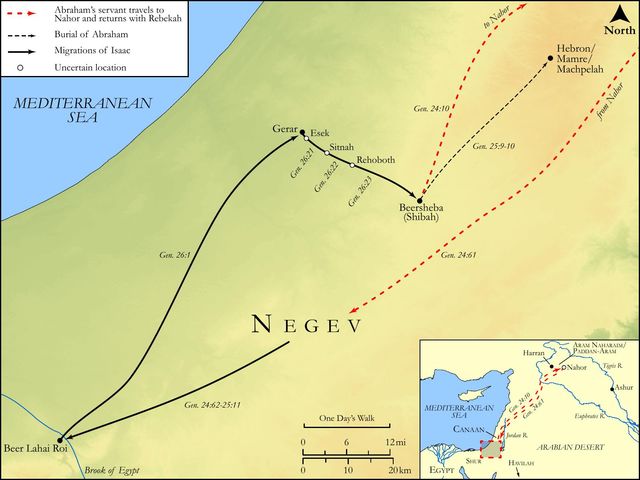
Having received his charge, he with all expedition set out on his journey, with an equipage suitable to the object of his negotiation (Gen 24:10), and he had all the goods of his master, that is, a schedule or particular account of them, in his hand, to show to those with whom he was to treat; for, from first to last, he consulted his master's honour. Isaac being a type of Christ, some make this fetching of a wife for him to signify the espousing of the church by the agency of his servants the ministers. The church is the bride, the Lamb's wife, Rev 21:9. Christ is the bridegroom, and ministers are the friends of the bridegroom (Joh 3:29), whose work it is to persuade souls to consent to him, Co2 11:2. The spouse of Christ must not be of the Canaanites, but of his own kindred, born again from above. Ministers, like Abraham's servant, must lay out themselves with the utmost wisdom and care to serve their master's interest herein.
II.How devoutly he acknowledged God in this affair, like one of that happy household which Abraham had commanded to keep the way of the Lord, etc., Gen 18:19. He arrived early in the evening (after many days' journeying) at the place of his destination, and reposed himself by a well of water, to consider how he might manage his business for the best. And,
1.He acknowledges God by a particular prayer (Gen 24:12-14), wherein,
(1.)He petitions for prosperity and good success in this affair: Send me good speed, this day. Note, We have leave to be particular in recommending our affairs to the conduct and care of the divine Providence. Those that would have good speed must pray for it. This day, in this affair; thus we must, in all our ways, acknowledge God, Pro 3:6. And, if we thus look up to God in every undertaking which we are in care about, we shall have the comfort of having done our duty, whatever the issue be.
(2.)He pleads God's covenant with his master Abraham: O God of my master Abraham, show kindness to him. Note, As the children of good parents, so the servants of good masters, have peculiar encouragement in the prayers they offer to God for prosperity and success.
(3.)He proposes a sign (Gen 24:14), not by it to limit God, nor with a design to proceed no further if he were not gratified in it; but it is a prayer,
[1.]That God would provide a good wife for his young master, and this was a good prayer. He knew that a prudent wife is from the Lord (Pro 19:14), and therefore that for this he will be enquired of. He desires that his master's wife might be humble and industrious woman, bred up to care and labour, and willing to put her hand to any work that was to be done; and that she might be of a courteous disposition, and charitable to strangers. When he came to seek a wife for his master, he did not go to the playhouse or the park, and pray that he might meet one there, but to the well of water, expecting to find one there well employed.
[2.]That he would please to make his way, in this matter, plain and clear before him, by the concurrence of minute circumstances in his favour. Note, First, It is the comfort, as well as the belief, of a good man, that God's providence extends itself to the smallest occurrences and admirably serves its own purposes by them. Our times are in God's hand; not only events themselves, but the times of them. Secondly, It is our wisdom, in all our affairs, to follow Providence, and folly to force it. Thirdly, It is very desirable, and that which we may lawfully pray for, while in the general we set God's will before us as our rule, that he will, by hints of providence, direct us in the way of our duty, and give us indications what his mind it. Thus he guides his people with his eye (Psa 32:8), and leads them in a plain path, Psa 27:11.
2.God owns him by a particular providence. He decreed the thing, and it was established to him, Job 22:28. According to his faith, so was it unto him. The answer to this prayer was,
(1.)Speedy - before he had made an end of speaking (Gen 24:15), as it is written (Isa 65:24), While they are yet speaking, I will hear. Though we are backward to pray, God is forward to hear prayer.
(2.)Satisfactory: the first that came to draw water was, and did, in every thing, according to his own heart.
[1.]She was so well qualified that in all respects she answered the characters he wished for in the woman that was to be his master's wife, handsome and healthful, humble and industrious, very courteous and obliging to a stranger, and having all the marks of a good disposition. When she came to the well (Gen 24:16), she went down and filled her pitcher, and came up to go home with it. She did not stand to gaze upon the strange man and his camels, but minded her business, and would not have been diverted from it but by an opportunity of doing good. She did not curiously nor confidently enter into discourse with him, but modestly answered him, with all the decorum that became her sex. What a degenerate age do we live in, in which appear all the instances of pride, luxury, and laziness, the reverse of Rebekah's character, whose daughters few are! Those instances of goodness which were then in honour are now in contempt.
[2.]Providence so ordered it that she did that which exactly answered to his sign, and was wonderfully the counterpart of his proposal: she not only gave him drink, but, which was more than could have been expected, she offered her services to give his camels drink, which was the very sign he proposed. Note, First, God, in his providence, does sometimes wonderfully own the prayer of faith, and gratify the innocent desires of his praying people, even in little things, that he may show the extent of his care, and may encourage them at all times to seek to him and trust in him; yet we must take heed of being over-bold in prescribing to God, lest the event should weaken our faith rather than strengthen it. Secondly, It is good to take all opportunities of showing a humble, courteous, charitable, disposition, because, some time or other, it may turn more to our honour and benefit than we think of; some hereby have entertained angels, and Rebekah hereby, quite beyond her expectation at this time, was brought into the line of Christ and the covenant. Thirdly, There may be a great deal of obliging kindness in that which costs but little: our Saviour has promised a reward for a cup of cold water, Mat 10:42. Fourthly, The concurrence of providences and their minute circumstances, for the furtherance of our success in any business, ought to be particularly observed, with wonder and thankfulness, to the glory of God: The man wondered, Gen 24:21. We have been wanting to ourselves, both in duty and in comfort, by neglecting to observe Providence.
[3.]Upon enquiry he found, to his great satisfaction, that she was a near relation to his master, and that the family she was of was considerable, and able to give him entertainment, Gen 24:23-25. Note, Providence sometimes wonderfully directs those that by faith and prayer seek direction from heaven in the choice of suitable yoke-fellows: happy marriages those are likely to be that are made in the fear of God; and these, we are sure, are made in heaven.
3.He acknowledges God in a particular thanksgiving. He first paid his respects to Rebekah, in gratitude for her civility (Gen 24:22), obliging her with such ornaments and attire as a maid, especially a bride, cannot forget (Jer 2:32), which yet, we should think, ill suited the pitcher of water; but the ear-rings and bracelets she sometimes wore did not make her think herself above the labours of a virtuous woman (Pro 31:13), who works willingly with her hands; nor the services of a child, who, while under age, differs nothing from a servant, Gal 4:1. Having done this, he turns his wonder (Gen 24:21) into worshipping: Blessed be the Lord God of my master Abraham, Gen 24:26, Gen 24:27. Observe here,
(1.)He had prayed for good speed (Gen 24:12), and now that he had sped well he gives thanks. Note, What we win by prayer we must wear with praise; for mercies in answer to prayer lay us under particular obligations.
(2.)He had as yet but a comfortable prospect of mercy, and was not certain what the issue might prove; yet he gives thanks. Note, When God's favours are coming towards us we must meet them with our praises.
(3.)He blesses God for success when he was negotiating for his master. Note, We should be thankful for our friend's mercies as for our own.
(4.)He gives thanks that, being in the way, at a loss what course to steer, the Lord had led him. Note, In doubtful cases, it is very comfortable to see God leading us, as he led Israel in the wilderness by the pillar of cloud and fire.
(5.)He thinks himself very happy, and owns God in it, that he was led to the house of his master's brethren, those of them that had come out of Ur of the Chaldees, though they had not come to Canaan, but remained in Haran. They were not idolaters, but worshippers of the true God, and inclinable to the religion of Abraham's family. Note, God is to be acknowledged in providing suitable yoke-fellows, especially such as are agreeable in religion.
(6.)He acknowledges that God, herein, had not left his master destitute of his mercy and truth. God had promised to build up Abraham's family, yet it seemed destitute of the benefit of that promise; but now Providence is working towards the accomplishing of it. Note,
[1.]God's faithful ones, how destitute soever they may be of worldly comforts, shall never be left destitute of God's mercy and truth; for God's mercy is an inexhaustible fountain, and his truth an inviolable foundation.
[2.]It adds much to the comfort of any blessing to see in it the continuance of God's mercy and truth.
Continue studying Genesis 24:24 across the web’s major study libraries — every link below opens this exact verse, chapter, or book on the destination site.
Read & Compare
 BibleGatewayThis verse in more than 200 translations and 70 languages.
 Bible.comThe YouVersion reader — hundreds of translations, reading plans, and highlights.
 ESV.orgCrossway's official English Standard Version reader.
 NET BibleThe NET translation with 60,000+ translators' notes on every rendering decision.
 STEP BibleTyndale House's free study tool — original text, vocabulary, and scholarly resources.
 BibliaLogos Bible Software's free web reader.
 USCCBThe New American Bible (Revised Edition) with the U.S. bishops' study notes.
Commentaries
 BibleHub CommentariesDozens of classic commentaries on this verse, gathered on one page.
 StudyLightMore than 100 commentary sets — the largest collection on the web.
 BibleRefPlain-English commentary on what this verse means, verse by verse.
 Enduring WordDavid Guzik's free commentary on this chapter, widely used by Bible teachers.
 Bible Study ToolsVerse commentary alongside Greek and Hebrew study aids.
Original Language & Research
- BibleHub InterlinearThe verse word by word — original language, transliteration, and English.
- BibleHub LexiconEvery word's original-language definition and Strong's entry.
 Blue Letter BibleDeep-study tools — Strong's numbers, concordance, and word studies.
 SefariaThe Hebrew text with Rashi and centuries of Jewish commentary.
Sermons, Hymns & Audio


TrulyRandomVerse is not affiliated with these sites and doesn’t control their content. They’re linked because they’re genuinely useful.
Summary
Genesis 24:24 marks a divinely orchestrated moment in the narrative of Abraham's servant seeking a wife for Isaac. Rebekah's clear and concise self-identification, stating her lineage as the daughter of Bethuel, son of Milcah, whom she bore to Nahor, provides the crucial genealogical confirmation. This declaration validates the servant's belief in God's direct guidance, ensuring Isaac would marry within Abraham's extended family, thereby preserving the covenant line as commanded.
Context
ShowHideLiterary Context
This verse is the climax of the servant's initial interaction with Rebekah, immediately following his prayer for divine guidance and Rebekah's extraordinary act of hospitality in watering his ten camels. Having just presented her with valuable gifts, the servant's next logical step is to inquire about her family, specifically whether there is room in her father's house for him to lodge. Rebekah's response in Genesis 24:24 directly answers this implicit need for genealogical verification, confirming her connection to Abraham's kin and signaling the miraculous fulfillment of the servant's prayer and Abraham's specific instructions. It sets the stage for the servant's subsequent worship of God and his formal request to her family.
Historical & Cultural Context
Among the patriarchal families, marriage was not merely a personal affair but a strategic alliance between families, deeply rooted in lineage and tribal identity. Abraham's insistence that Isaac not take a wife from the Canaanites (Genesis 24:3) was not only a cultural preference but a theological imperative to preserve the purity of the covenant line from idolatrous influences. Rebekah's detailed genealogical identification in this verse was therefore paramount. It immediately established her as a legitimate candidate from Abraham's own extended family (his brother Nahor's lineage), satisfying the strict requirements for maintaining the integrity of the promised seed and the distinct identity of God's chosen people. Hospitality, exemplified by Rebekah's actions and her family's subsequent invitation, was also a highly valued cultural norm, signifying honor and trustworthiness.
Key Themes
ShowHideGenesis 24:24 powerfully underscores the theme of Divine Providence and Guidance. The servant's prayer for a specific sign, followed by Rebekah's immediate and perfect fulfillment of that sign, culminating in her precise genealogical declaration, demonstrates God's active involvement in guiding the lives of His people. This meticulous orchestration highlights God's faithfulness to His Covenant Promises with Abraham, ensuring the continuation of the lineage through which the ultimate blessing would come. The verse also subtly reinforces the Importance of Lineage and Kinship in preserving the spiritual and physical integrity of the covenant community, illustrating how God works through human relationships to achieve His redemptive purposes, as seen throughout the patriarchal narratives, from Abraham's call in Genesis 12 to the establishment of Israel.
Exposition and Analysis
ShowHideGenesis 24:24 presents Rebekah's self-identification, which is concise yet profoundly significant for the unfolding narrative. Her statement, "And she said unto him, I [am] the daughter of Bethuel the son of Milcah, which she bare unto Nahor," provides the crucial genealogical link the servant desperately sought.
Key Word Analysis
ShowHideThis primitive root signifies not merely speaking, but often carries the weight of declaring, commanding, or even promising. In this context, Rebekah's "saying" is a direct, clear, and unhesitating declaration of her identity, carrying the authority of truth and fulfilling the servant's unspoken need for verification. It is a decisive utterance that propels the narrative forward.
Derived from the root meaning "to build" (as in building a family), this term denotes a female offspring but is used in a very wide sense in Hebrew, encompassing various relationships, including a member of a community or a characteristic. Here, it specifically denotes Rebekah's direct familial relationship to Bethuel, establishing her immediate paternal lineage and her place within the family structure.
Similar to "daughter," this term also comes from the root "to build" and signifies a male offspring, often used in a broad sense for descendants, members of a group, or even characteristics. In this verse, it precisely identifies Bethuel as the male offspring of Milcah and Nahor, thereby tracing Rebekah's lineage back to Abraham's brother.
This primitive root means "to bear young" or "to beget," often used in the context of childbirth or showing lineage. Its inclusion here explicitly states that Milcah was the one who gave birth to Bethuel by Nahor, solidifying the specific parental relationship and leaving no ambiguity about the genealogical connection.
Verse Breakdown
ShowHide"And she said unto him,"
This opening clause highlights Rebekah's immediate and direct response to the servant's inquiry (implied from Genesis 24:23). Her willingness to speak openly and clearly about her family demonstrates her forthright character and sets a tone of transparency, which is crucial for the servant's mission.
"I [am] the daughter of Bethuel"
This establishes Rebekah's immediate paternal lineage. Bethuel is identified as her father, providing the first critical piece of the genealogical puzzle. This direct statement of filial relationship is foundational for the servant to proceed with his inquiry about lodging and, ultimately, a potential marriage proposal.
"the son of Milcah,"
This phrase specifies Bethuel's mother, Milcah. This detail is profoundly significant because Milcah is known to be the wife of Nahor, Abraham's brother. By identifying Bethuel's mother, Rebekah provides the crucial link to Abraham's extended family, even before explicitly naming Nahor.
"which she bare unto Nahor."
This final clause explicitly connects Milcah to Nahor, Abraham's brother (Genesis 11:29). This confirms that Rebekah is Abraham's great-niece, fulfilling Abraham's mandate for Isaac to marry from his own kindred. The precision of this genealogical statement leaves no doubt about the divine orchestration of the encounter, as the servant had prayed for a woman from Abraham's family.
Literary Devices
ShowHideThe primary literary device at play in Genesis 24:24 is Genealogy, which is a recurring and vital feature throughout the book of Genesis. The precise naming of "Bethuel the son of Milcah, which she bare unto Nahor" serves not merely as factual information but as a narrative confirmation of divine providence. This detailed lineage functions as a Plot Device, resolving the servant's immediate dilemma and affirming that his journey has been guided by God. The direct and unprompted nature of Rebekah's full genealogical disclosure also hints at Divine Irony or Divine Coincidence, where seemingly natural events unfold in a way that perfectly aligns with God's pre-ordained plan, making the miraculous appear mundane. Her simple declaration carries immense theological weight, confirming the divine orchestration of events and the faithfulness of God to His covenant promises.
Theological and Thematic Connections
ShowHideGenesis 24:24 is a profound testament to God's meticulous providence and His unwavering commitment to His covenant promises. Rebekah's precise self-identification, confirming her lineage to Abraham's brother Nahor, is the direct answer to the servant's earnest prayer for a sign, demonstrating God's active involvement in the smallest details of His people's lives. This divine orchestration ensures that the covenant line, through which the promised seed would come, remains pure and distinct from the surrounding Canaanite cultures. It underscores the biblical principle that God is not a distant deity but one who intimately guides and directs the paths of those who trust in Him, often working through seemingly ordinary circumstances to achieve extraordinary outcomes. The finding of Rebekah is a pivotal moment in the unfolding redemptive history, securing the next generation of the covenant family.
Reflection and Application
ShowHideGenesis 24:24 serves as a powerful reminder of God's meticulous care in guiding the lives of His people. For believers today, this verse encourages us to trust in God's providential hand in all major life decisions, whether it is choosing a spouse, a career, or a place to live. Just as God orchestrated Rebekah's encounter with the servant and confirmed her identity, He continues to work in our lives, often in ways unseen, to lead us according to His perfect will. This narrative underscores the importance of seeking God's will through diligent prayer, patiently waiting for His timing, and remaining obedient to His principles, knowing that He is faithful to fulfill His promises. It calls us to cultivate a life of dependence on God, recognizing that His sovereignty extends to every detail, ensuring that His purposes are accomplished through us.
Questions for Reflection
ShowHideFAQ
ShowHideWhy was Rebekah's lineage so important to Abraham?
ShowHideRebekah's lineage was of paramount importance to Abraham because it directly related to God's covenant promises. God had chosen Abraham and promised that through his offspring, all the nations of the earth would be blessed (Genesis 12:3). This covenant was to be preserved through Isaac. Abraham's insistence that Isaac not marry a Canaanite woman (Genesis 24:3) stemmed from a desire to maintain the purity of the covenant line and prevent the assimilation of his descendants into the idolatrous and morally corrupt practices of the surrounding nations. Marrying within his own kindred (specifically, his brother Nahor's family) ensured that Isaac's wife would come from a family that shared a common heritage and, presumably, a similar understanding of God, thereby safeguarding the distinct identity and spiritual integrity of God's chosen people and the future of the promised seed.
Christ-Centered Fulfillment
ShowHideThe meticulous divine orchestration of Rebekah's identity and her selection as Isaac's bride beautifully prefigures the sovereign care with which God prepares the lineage leading to Christ and gathers His Church. Just as Rebekah was chosen from Abraham's own kin to preserve the covenant line and ensure the continuation of the promised seed, so too was Christ born into this specific, divinely preserved lineage, fulfilling the promises made to Abraham and culminating in the "seed" who would crush the serpent's head (Genesis 3:15). Furthermore, the servant's quest for a bride for Isaac can be seen as a profound type of the Holy Spirit's ongoing work in gathering a bride (the Church) for Christ. The Spirit, like the servant, seeks out those whom the Father has chosen, drawing them into an eternal covenant relationship with the Son. This narrative underscores that our salvation and inclusion in the family of God are not accidental but are part of God's perfect, pre-ordained plan, demonstrating His faithfulness to bring about His redemptive purposes through His Son, Jesus Christ, the ultimate Bridegroom of His Church (Ephesians 5:25-27).