


Ezekiel 16:40
- וְהֶעֱלוּve·he·'e·Luand they will bring upH5927Conj-w ¦ V-Hiphil-ConsecPerf-3cpVerb Hiphil Consecutive Perfect 3rd Plural common genderוְandהֶעֱלוּthey will bring up
- עָלַיִךְ'a·La·yikhon youH5921Prep ¦ 2fsPrepositionעָלַיִonךְyou
- קָהָלka·Hala companyH6951N-msNoun Singular Masculine Absolute
- וְרָגְמוּve·ra·ge·Muand they will stoneH7275Conj-w ¦ V-Qal-ConsecPerf-3cpVerb Qal Consecutive Perfect 3rd Plural common genderוְandרָגְמוּthey will stone
- אוֹתָךְ'o·Takh<obj.> youH853DirObjM ¦ 2fsParticle Object Indicatorאוֹתָ<obj.>ךְyou
- בָּאָבֶןba·'A·venwith <the> stone[s]H68Prep-b ¦ N-fsNoun Singular Feminine Absoluteבָּwith <the>אָבֶןstone[s]
- וּבִתְּקוּךְu·vi·te·Kukhand they will cut to pieces youH1333Conj-w ¦ V-Piel-ConsecPerf-3cp ¦ 2fsVerb Piel Consecutive Perfect 3rd Plural common genderוּandבִתְּקוּthey will cut to piecesךְyou
- בְּחַרְבוֹתָםbe·char·vo·Tamwith their swordsH2719Prep-b ¦ N-fpc ¦ 3mpNoun Plural Feminine Constructבְּwithחַרְבוֹתָswordsםtheir
English is a literal word-by-word gloss of the Hebrew, not the KJV's wording. Why?
This is the original text the KJV's translators worked from — each Hebrew word with its own literal English meaning in this verse, prepared by scholars at Tyndale House, Cambridge. The KJV translates whole sentences, not word by word, so its wording differs: one Hebrew word can become several English words, and the KJV may choose “the LORD” where the gloss reads “Yahweh”. Both are faithful — they answer different questions. For the KJV's own rendering, switch to the KJV text.
Details
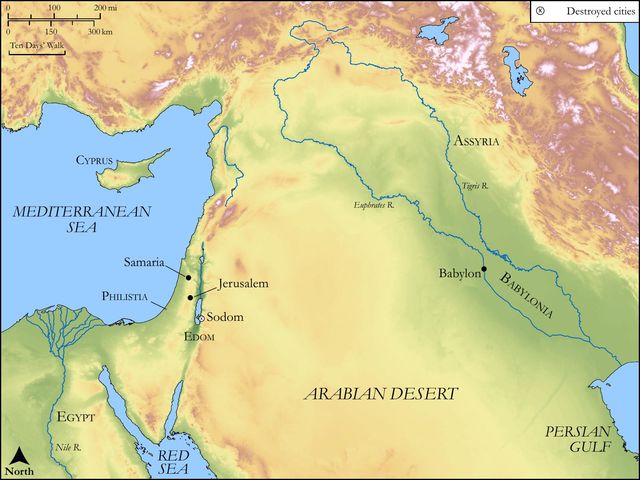
See on the biblical-era map
Study this verse
Public-domain commentary
Matthew Henry
From his Commentary on the Whole Bible. Henry comments on passages, not single verses — this entry covers Ezekiel 16:35–43. His three-level outline is real structure in the source text, so it is rendered as structure.
Adultery was by the law of Moses made a capital crime. This notorious adulteress, the criminal at the bar, being in the foregoing verses found guilty, here has sentence passed upon her. It is ushered in with solemnity, Eze 16:35. The prophet, as the judge, in God's name calls to her, O harlot! hear the word of the Lord. Our Saviour preached to harlots, for their conversion, to bring them into the kingdom of God, not as the prophet here, to expel them out of it. Note, An apostate church is a harlot. Jerusalem is so if she become idolatrous. How has the faithful city become a harlot! Rome is so represented in the Revelation, when it is marked for ruin, as Jerusalem here. Rev 17:1, Come, and I will show thee the judgments of the great whore. Those who will not hear the commanding word of the Lord and obey it shall be made to hear the condemning word of the Lord and shall tremble at it. Let us attend while judgment is given.
I.The crime is stated and the articles of the charge are summed up (Eze 16:36) and (as is usual) with the attendant aggravations (Eze 16:43); for when God speaks in wrath he will be justified, and clear when he judges, clear when he is judged; and sinners, when they are condemned, shall have their sins so set in order before them that their mouth shall be stopped and they shall not have a word to object against the equity of the sentence. The crimes which this harlot stands convicted of, and is now to be condemned for, are,
1.The violation of the first two commandments of the first table by idolatry, which is here called her whoredoms with her lovers (so she called them, Hos 2:12, because she loved them as if they had been indeed her benefactors), that is, with all the idols of her abominations, the abominable idols which she served and worshipped. This was the sin which provoked God to jealousy.
2.The violation of the first two commandments of the second table by the murder of their own innocent infants: The blood of thy children which thou didst give unto them. It is not strange if those that have cast off God and his fear break through the strongest and most sacred bonds of natural affection. Their sins are aggravated from the consideration,
(1.)Of the dishonour they had thereby done to themselves: "Hereby thy filthiness was poured out; the uncleanness that was in thy heart was hereby discovered and brought to light, and thy nakedness was exposed to view, and thou wast thereby exposed to contempt." God is displeased with his professing people for shaming themselves by their sins.
(2.)Their base ingratitude is another aggravation of their sins: "Thou hast not remembered the days of thy youth, and the kindness that was done thee then, when otherwise thou wouldst have perished," Eze 16:43. And,
(3.)The vexation which their sins gave to God, whom they ought to have pleased: "Thou hast fretted me in all these things, not only angered me, but grieved me." It is a strange expression, and, one would think, enough to melt a heart of stone, that the great God, who cannot admit any uneasiness, is pleased to speak of the sins and follies of his professing people as fretting to him. Forty years long was I grieved with this generation.
II.The sentence is passed in general:
I will judge thee as women that break wedlock and shed blood are judged (Eze 16:38), and those two crimes were punished with death, with an ignominious death. "Thou hast shed blood, and therefore I will give thee blood; thou hast broken wedlock, and therefore I will give it thee, not only in justice, but in jealousy, not only as a righteous Judge, but as an injured and incensed husband, who will not spare in the day of vengeance," Pro 6:34, Pro 6:35. He will recompense their way upon their head, Eze 16:43. In all the judgments God executes upon sinners we must see their own way recompensed upon their head; they are dealt with not only as they deserved, but as they procured. It is the end which their sin, as a way, had a direct tendency to. More particularly,
1.This criminal must be (as is usually done with criminals) exposed to public shame, Eze 16:37. Malefactors are not executed privately, but are made a spectacle to the world. Care is here taken to bring spectators together: "All those whom thou hast loved, with whom thou hast taken pleasure, shall come to be witnesses of the execution, that they may take warning and prevent their own like ruin; and those also whom thou hast hated, who will insult over thee and triumph in thy fall." Both ways the calamities of Jerusalem will be aggravated, that they will be the grief of her friends and the joy of her foes. These shall not only be gathered around her, but gathered against her; even those with whom she took unlawful pleasure, with whom she contracted unlawful leagues, the Egyptians and Assyrians, shall now contribute to her ruin. As, when a man's ways please the Lord, he makes even his enemies to be at peace with him, so when a man's ways displease the Lord he makes even his friends to be at war with him; and justly makes those a scourge and a plague to sinners, and instruments of their destruction, who were their tempters, and with whom they were partakers in wickedness. Those whom they have suffered to strip them of their virtue shall see them stripped, and perhaps help to strip them, of all their other ornaments; to see the nakedness of the land will they come. It is added, to the same purport (Eze 16:41), I will execute judgments upon thee in the sight of many women; thou shalt be made an example of in terrorem - that others may see and fear and do no more presumptuously.
2.The criminal is condemned to die, for her sins are such as death is the wages of (Eze 16:40): They shall bring up a company (that is, a company shall be brought up) against thee, and they shall stone thee with stones, and thrust thee through with their swords; so great a death, so many deaths in one, is this adulteress adjudged to. When the walls of Jerusalem were battered down with stones shot against them, and the inhabitants of Jerusalem were put to the sword, then this sentence was executed in the letter of it.
3.The estate of the criminal is confiscated, and all that belonged to her destroyed with her (Eze 16:39): They shall throw down thy eminent place, and (Eze 16:41) they shall burn thy houses, as the habitations of bad women are destroyed, in detestation of their lewdness. Their high places, erected in honour of their idols, by which they thought to ingratiate themselves with their neighbours, shall be an offence to them, and even they shall break them down. It was long the complaint, even in some of the best reigns of the kings of Judah, that the high places were not taken away; but now the army of the Chaldeans, when they lay all waste, shall break them down. If iniquity be not taken away by the justice of the nation, it shall be taken away by the judgments of God upon the nation.
4.Thus both the sin and the sinners shall be abolished together, and an end put to both: Thou shalt cease from playing the harlot; there shall be no remainders of idolatry in the land, because the inhabitants shall be wholly extirpated, and they shall give no more hire because they shall have no more to give. Some that will not leave their sins live till their sins leave them. When all that with which they honoured their idols is taken from them they shall not give hire any more (Eze 16:41): "Then thou shalt not commit this lewdness of sacrificing thy children, which was a crime provoking above all thy abominations, for thy children shall all be cut off by the sword or carried into captivity, so that thou shalt have none to sacrifice," Eze 16:43. Or it may be meant of the reformation of those of them that escape and survive the punishment; they shall take warning, and shall do no more presumptuously. The captivity in Babylon made the people of Israel to cease for ever from playing the harlot; it effectually cured them of their inclination to idolatry. And then all shall be well, when this is the fruit, even the taking away of sin; then (Eze 16:42) my jealousy shall depart. I will be quiet, and no more angry. When we begin to be at war with sin God will be at peace with us; for he continues the affliction no longer than till it has done its work. When sin departs God's jealousy will soon depart, for he is never jealous but when we give him just cause to be so. Yet some understand this as a threatening of utter ruin, that God will make a full end and the fire of his anger shall burn as long as there is any fuel for it. His fury shall rest upon them, and not remove. Compare this with that doom of unbelievers, Joh 3:36. The wrath of God abideth on them. They shall drink the dregs of the cup, and then God will be no more angry, for he is eased of his adversaries (Isa 1:24), is satisfied in the abandoning of them, and therefore will be no more angry, because there are no more for his anger to fasten upon. They had fretted him, when judgment and mercy were contesting; but now he is quiet, as he will be in the eternal damnation of sinners, wherein he will be glorified, and therefore he will be satisfied.
Historical interpretation
Historical reception
1 surviving comment on this verse from the historical church.
(Verse 35 and following) Therefore, prostitute, listen to the word of the Lord. Thus says the Lord God: Because your bronze has been poured out, and your disgrace has been revealed in your fornication (in your adulteries), with your lovers, and with the idols of your abominations, in the blood of your sons, whom you have given to them. Behold, I will gather all your lovers, with whom you have mingled, and all those whom you have loved with all those whom you have hated, and I will gather them against you from all sides, and I will uncover your disgrace before them, and they will see all your shame. And I will judge you with the judgments of adulteresses, and those who shed blood, and I will give you into the blood (Vulg. blood) of fury and zeal, and I will give you into their hands, and they will destroy your brothel, and they will demolish your prostitution house, and they will strip you of your clothes, and they will take away the vessels of your beauty, and they will leave you naked, full of shame. And they will bring a multitude upon you, and they will stone you with stones, and they will kill (Al. mutilate) you with their swords. And they will burn your houses with fire, and they will bring judgment upon you in the eyes of many women, and you will cease to fornicate and no longer give bribes. And my indignation will rest on you, and my jealousy will be taken away from you, and I will rest and not be angry anymore, because you have not remembered the days of your youth and you have provoked me in all these things. Therefore, I have given you your ways upon your head, says the Lord God, and I have not acted according to your wickedness in all your abominations. LXX: Therefore, prostitute, hear the word of the Lord: Thus says the Lord God: Because you have poured out your wrath and your shame will be revealed in your prostitution to your lovers, and in all your wicked thoughts, and in the blood of your sons, whom you have given to them. Therefore, behold, I will gather all your lovers, with whom you have mingled, and all those you loved with all those you hated, and I will gather them against you from all around, and I will reveal your evil deeds to them, and they will see all your shame. And I will avenge on you the vengeance of adulteries and the shedding of blood, and I will put you in the blood of fury and zeal, and I will deliver you into their hands: and they shall demolish your brothel, and destroy your foundation, and they shall strip you of your garments, and they shall take away the vessels of your glory, and they shall leave you naked and full of shame, and they shall bring a multitude upon you, and they shall stone you with stones, and they shall cut you with their swords. And they shall set fire to your houses, and they shall execute punishments on you in the presence of many women: and I will turn you away from fornication, and you shall no longer give rewards, and I will unleash my fury upon you, and my zeal shall depart from you, and I will rest and will be no longer concerned: because you have not remembered the days of your infancy, and you have grieved me in all these things. And behold, I will bring your ways upon your head, declares the Lord God, so that you have done wickednesses above all your other wickednesses. We lay the foundations of the story first. Because you have done these things and those things which the previous speech comprehends: therefore hear, O harlot, what you have done and what you will suffer. You poured out your brass which you received from me, and you gave payment to your lovers, which you should have received, and you killed your sons as you offered them to idols: so that you have become not only an adulteress, but also a murderer of your own children. Therefore, I will gather all your lovers with whom you have prostituted yourself, both those whom you have loved and those whom you have hated, and I will expose you as an adulteress and reveal your nakedness, so that all may see your shame and the genitals for which you were once consumed with passion. All these things are said metaphorically of an adulterous and murderous woman, who not only committed acts of adultery against her husband, but also killed her children. They are spoken concerning Jerusalem and the gathering of all the nations against her, of which she worshiped idols and turned all of God's gifts into their worship, and the temple of Baal must be destroyed and the altars of every city must be overturned by fire, so that nothing remains in her. And just as it is customary for all to throw stones at the adulteress and to slay the harlot, so that she may be killed by the wounds of each: so shall all women see the punishment of the fornicator. Thus, in the sight of others, in the surrounding cities and nations, Jerusalem shall be abandoned. And this shall be done, so that she may cease her whoring and no longer give wages to her lovers, and the anger of God may rest, and He may not be angered by her when she ceases to love. From this we understand that there is great offense, not taken care of by God, but allowed for man's crimes and sins. My zeal will be removed from you, I will rest, and no longer be angry, as if it were someone else, and what has departed from me, and which I have handed over to eternal nakedness. But if Jerusalem has endured this, because it fornicated with idols, what do we think it will endure, when it has killed God's Son? And you have done all these things, forgetting past kindnesses, and you have provoked me to anger, or saddened me, when you should have provoked me to joy with your good works. Therefore, I have also rendered your deeds upon your head. And when I destroy you, O adulteress, I will exercise less of my anger against you than you deserve, so that divine mercy may be shown, that sins may be greater than punishments. According to tropology, every soul receives spiritual money from God, according to the Gospel (Mt. 25, Lk. 19) which is spoken in five and two parables, and of one talent, and ten servants receiving each a single mina, who, when they act negligently, become debtors of fifty (or ten) denarii and five hundred, and because of this, in the presence of lovers, whom we understand as demons and contrary virtues, the ignominy of Jerusalem is revealed, either on the day of judgment or at the time of repentance when they are reproached. And indeed only the omnipotent God sees hidden things, as the Gospel says: And the Father who sees in secret (Matthew 6:6). And in another place: God, who searches the heart and reins (Psalm 7:10). And in the book of Kings: You alone know the hearts of all the sons of men (2 Kings 8). But when it is fulfilled: There is nothing hidden that will not be made manifest, nor secret that will not be revealed (Luke 12:2). And in another place: Judge not before the time, until the Lord comes, who will bring to light the hidden things of darkness, and will make manifest the counsels of the hearts; and then shall every man have praise from God (1 Corinthians 4:5); and when the time of correction comes, then shall be fulfilled what Hosea says: Now their own thoughts have surrounded them (Hosea 7:2). And in another place: Mutual accusations or defenses of thoughts, on the day when God will judge the hidden things of men (Rom. II, 15). And again: Behold the man, and his works before his face. And all who had fornicated with her before will see her disgrace, and God will give it to them in the blood of fury and zeal. For the fury of a man is full against an adulterous wife, and it cannot be redeemed at any price. And the blood of the children can be understood in this way, that we call the good thoughts of men implanted by God in them the children of Jerusalem; the adulteress kills them when she turns to evil deeds. It is also advantageous for Jerusalem, that its brothel be dug up, and the entire seedbed of fornication be destroyed. For when this has been done, it will no longer provide wages, and the wrath of God will rest, and he will not be jealous of its chastity: namely, according to those who understand in a positive sense what is said. Others, however, as we have said above, take the opposite view, that it is a great anger of God not to be angry, since he has once despised the fornicator, and has despaired of his salvation. But if heretics who do not accept the old Testament according to the Septuagint edition criticize this passage that was said: And you were grieved in all these; because God not only receives wrath but also submits to sorrow and sadness, let us ask them how they accept what is certainly a commandment of the good God: Do not grieve the Holy Spirit of God, in whom you were sealed on the day of redemption (Ephesians 4:30). Whatever they may say in defense of that testimony, we will include it in the satisfaction of the present discourse.
Continue studying Ezekiel 16:40 across the web’s major study libraries — every link below opens this exact verse, chapter, or book on the destination site.
Read & Compare
 BibleGatewayThis verse in more than 200 translations and 70 languages.
 Bible.comThe YouVersion reader — hundreds of translations, reading plans, and highlights.
 ESV.orgCrossway's official English Standard Version reader.
 NET BibleThe NET translation with 60,000+ translators' notes on every rendering decision.
 STEP BibleTyndale House's free study tool — original text, vocabulary, and scholarly resources.
 BibliaLogos Bible Software's free web reader.
 USCCBThe New American Bible (Revised Edition) with the U.S. bishops' study notes.
Commentaries
 BibleHub CommentariesDozens of classic commentaries on this verse, gathered on one page.
 StudyLightMore than 100 commentary sets — the largest collection on the web.
 BibleRefPlain-English commentary on what this verse means, verse by verse.
 Enduring WordDavid Guzik's free commentary on this chapter, widely used by Bible teachers.
 Bible Study ToolsVerse commentary alongside Greek and Hebrew study aids.
Original Language & Research
- BibleHub InterlinearThe verse word by word — original language, transliteration, and English.
- BibleHub LexiconEvery word's original-language definition and Strong's entry.
 Blue Letter BibleDeep-study tools — Strong's numbers, concordance, and word studies.
 SefariaThe Hebrew text with Rashi and centuries of Jewish commentary.
Sermons, Hymns & Audio


TrulyRandomVerse is not affiliated with these sites and doesn’t control their content. They’re linked because they’re genuinely useful.
Summary
Ezekiel 16:40 powerfully depicts the severe judgment awaiting Jerusalem, personified as an unfaithful wife, at the hands of the very nations she illicitly pursued for alliances and idolatry. This verse culminates a lengthy prophetic allegory, illustrating a public and violent execution through stoning and sword, symbolizing the ultimate, humiliating consequences of spiritual adultery and rebellion against God, where divine retribution is meted out by the instruments of her own sin.
Context
ShowHideLiterary Context
Ezekiel 16 presents a profound and extended prophetic allegory, portraying Jerusalem's spiritual journey from a helpless, abandoned infant rescued and nurtured by God, to a beautiful bride adorned by Him, who then tragically betrays her covenant vows through rampant idolatry and alliances with pagan nations. Prior to verse 40, God meticulously recounts Jerusalem's escalating unfaithfulness, detailing her "harlotry" with Egypt, Assyria, and Babylon, and her abominable sacrifices of children to idols. Ezekiel 16:38-39 specifically pronounce God's judgment, declaring that Jerusalem will be judged as adulteresses and those who shed blood are judged, leading directly into the specific methods of punishment outlined in verse 40. This verse serves as the climax of the judgment pronouncements, illustrating the public and violent execution of the divine sentence.
Historical & Cultural Context
The historical backdrop for Ezekiel's prophecy is the impending or ongoing Babylonian exile, a period of immense national trauma for Judah. Ezekiel, prophesying from exile, addresses a people who had repeatedly broken their covenant with Yahweh, adopting the religious practices and political strategies of surrounding pagan cultures. Stoning was a prescribed method of capital punishment under Mosaic Law for severe offenses such as adultery and blasphemy, as detailed in Leviticus 20:10 and Deuteronomy 13:10. The use of swords signifies military conquest and violent death, common in ancient warfare. The "company" bringing up a charge against Jerusalem reflects the ancient practice of public accusation and communal execution, often carried out by the very people or nations who felt wronged or betrayed. This judgment would be executed by the very nations Jerusalem had sought to please, highlighting the ironic and humiliating nature of her downfall.
Key Themes
ShowHideThis verse powerfully contributes to several overarching themes in Ezekiel and broader prophetic literature. The primary theme is Divine Retribution and Justice, where God's righteous judgment is meted out precisely for Jerusalem's spiritual prostitution and idolatry. It underscores the Consequences of Covenant Unfaithfulness, showing that abandoning God for worldly alliances and false gods inevitably leads to destruction and shame, not security. The concept of Public Shame and Exposure is also prominent, as Jerusalem's "nakedness" and "abominations" are laid bare before her former "lovers," who now become her executioners. This judgment also highlights the Futility of Trusting in Worldly Powers, as the nations Israel relied upon for protection and prosperity ultimately turn against her, a recurring motif seen elsewhere in the prophets, such as in Lamentations 1:2. The entire chapter of Ezekiel 16 vividly portrays these themes.
Exposition and Analysis
ShowHideKey Word Analysis
ShowHideFrom a root meaning "to assemble," this word (H6951) denotes an "assemblage," "congregation," or "multitude." In this context, it refers to a hostile gathering of nations, specifically those Jerusalem had made alliances with, now united against her to execute divine judgment. It emphasizes the public and collective nature of her condemnation.
A primitive root (H7275) meaning "to cast together (stones)," or "to lapidate." This term directly refers to the act of stoning, a method of capital punishment under Mosaic Law for severe moral and religious transgressions, particularly adultery and idolatry. Its use here underscores the legal and covenantal basis for Jerusalem's judgment.
From a root meaning "drought" (suggesting destructive effect), this noun (H2719) refers to a "cutting instrument" such as a knife, sword, or other sharp implement. It represents the instrument of warfare and execution, symbolizing the military conquest and violent end that awaits Jerusalem.
Verse Breakdown
ShowHide"They shall also bring up a company against thee"
This clause signifies a formal, public accusation and mobilization of forces. The "company" refers to a multitude, specifically the pagan nations (Babylon, Egypt, etc.) with whom Jerusalem had committed spiritual adultery. They are not merely attacking but are "brought up" by divine orchestration, acting as instruments of God's judgment against her. This highlights God's sovereignty even over the actions of hostile nations.
"and they shall stone thee with stones"
This describes a specific, brutal form of execution. Stoning was a legal penalty for capital offenses like adultery and idolatry under the Mosaic Law. Here, it symbolizes the just punishment for Jerusalem's spiritual harlotry and idolatry, emphasizing the public shame and violent nature of her demise. The redundancy ("stone thee with stones") adds emphatic weight to the act, underscoring its certainty and severity.
"and thrust thee through with their swords"
This complements the stoning, indicating another method of violent death, likely in the context of military conquest. "Thrust through" implies a fatal piercing, signifying a complete and decisive destruction. The use of "swords" highlights the role of foreign armies in executing God's judgment, bringing about a comprehensive and bloody end to Jerusalem's rebellion, leaving no doubt as to her fate.
Literary Devices
ShowHideEzekiel 16:40 employs potent Imagery to convey the severity of God's judgment. The vivid descriptions of "stoning with stones" and "thrusting through with swords" create a visceral picture of violent execution and military conquest, designed to shock the audience into understanding the gravity of Jerusalem's sin. This imagery is deeply rooted in the overarching Allegory of Ezekiel 16, where Jerusalem is Personified as an unfaithful wife. The judgment described is a direct consequence of her "spiritual adultery," making the punishment a symbolic reflection of her crime. There is profound Irony in the fact that her former "lovers"—the very nations she sought alliances with and worshipped their idols—are now the instruments of her public humiliation and destruction. This reversal underscores the futility and treacherous nature of abandoning God for worldly security and illicit spiritual pursuits.
Theological and Thematic Connections
ShowHideThis verse powerfully articulates God's unwavering justice and the severe consequences of spiritual unfaithfulness. It reveals that God will not tolerate idolatry and covenant-breaking indefinitely, and that His judgment, though painful, is righteous. The nations, though seemingly acting on their own accord, are ultimately instruments in God's sovereign hand to bring about His purposes. This passage serves as a stark reminder that abandoning the true God for worldly alliances or false idols leads not to security, but to betrayal and ruin, often at the hands of those very entities one trusted. It underscores the principle that sin, particularly spiritual adultery, carries a heavy price, and God's holiness demands a response to such profound rebellion.
Reflection and Application
ShowHideEzekiel 16:40 is a sobering reminder of the seriousness with which God views spiritual unfaithfulness. For believers today, while we live under a new covenant of grace, the underlying principles of faithfulness and idolatry remain eternally relevant. We are called to exclusive devotion to Christ, recognizing that anything that takes His rightful place in our hearts—be it possessions, power, relationships, or even good causes—becomes an idol. This passage challenges us to examine our allegiances: are we truly trusting in God's provision and guidance, or are we secretly relying on worldly systems, human wisdom, or fleeting pleasures for our security and satisfaction? The "company" that turns against Jerusalem can represent the ultimate emptiness and betrayal of worldly pursuits when they replace God. Understanding the severity of past judgments should cultivate a deep reverence for God's holiness and a renewed commitment to wholehearted obedience, fostering a desire to live a life of unwavering faithfulness, knowing that God's justice is perfect, and His grace is sufficient for true repentance.
Questions for Reflection
ShowHideFAQ
ShowHideDoes this verse mean God literally commanded other nations to attack Jerusalem?
ShowHideYes, in a theological sense. While the nations acted according to their own political and military ambitions, the prophetic message consistently portrays them as instruments of God's divine judgment. God, in His sovereignty, uses human actions and historical events to bring about His righteous purposes, including the punishment of His unfaithful people. The "company" bringing up a charge against Jerusalem signifies that these nations were divinely appointed to execute the judgment for her spiritual harlotry and covenant breaking, as seen in other prophetic books like Isaiah 10:5-6.
What is "spiritual adultery" as described in Ezekiel 16?
ShowHide"Spiritual adultery" is a pervasive metaphor throughout the Old Testament, particularly in prophetic books like Ezekiel and Hosea. It describes Israel's unfaithfulness to her covenant relationship with Yahweh, who is depicted as her husband. This unfaithfulness manifested primarily through idolatry (worshipping other gods) and forming political alliances with pagan nations instead of trusting in God alone. Just as physical adultery breaks the sacred bond of marriage, spiritual adultery breaks the sacred covenant between God and His people, as detailed throughout Ezekiel 16.
Christ-Centered Fulfillment
ShowHideEzekiel 16:40, with its graphic depiction of judgment for spiritual unfaithfulness, finds its ultimate Christ-centered fulfillment not in a similar judgment upon believers, but in the radical transformation and redemption offered through Jesus Christ. While Jerusalem faced stoning and the sword for her harlotry, Christ, the true Israel and faithful Bridegroom, willingly endured the ultimate judgment for the sins of His people. He was "thrust through" for our transgressions, as prophesied in Isaiah 53:5, bearing the full weight of God's wrath against sin, including spiritual idolatry. Through His atoning sacrifice on the cross, the penalty of death and public shame that unfaithful Israel deserved was absorbed by the spotless Lamb of God, who takes away the sin of the world. Furthermore, the "company" that brought judgment against Jerusalem foreshadows the ultimate gathering of all nations before Christ, not for their judgment of His bride, but for His righteous judgment of all sin and the establishment of His eternal kingdom, as described in Matthew 25:31-32. In Christ, the new covenant is established, where the Spirit writes God's law on hearts, enabling a faithfulness impossible under the old covenant, fulfilling the promise in Jeremiah 31:33. Thus, Ezekiel 16:40, while a grim warning of judgment, ultimately points to the profound grace of Christ, who bore our judgment so that we, His Church, might be presented as a pure and spotless bride, forever faithful to Him, as envisioned in Ephesians 5:27.