


Exodus 38:6
Bible text: King James Version (1769 Blayney text) · Public domain
Bible text: Berean Standard Bible · Public domain
Bible text: American Standard Version (1901) · Public domain
Bible text: World English Bible, Messianic edition · Public domain
Bible text: Geneva Bible (1599) · Public domain
Bible text: Young's Literal Translation · Public domain
- וַיַּעַשׂvai·Ya·'asand he madeH6213Conj-w ¦ V-Qal-ConsecImperf-3msVerb Qal Consecutive Imperfect 3rd Singular Masculineוַandיַּעַשׂhe made
- אֶת'et<obj.>H853DirObjMParticle Object Indicator
- הַבַּדִּיםha·ba·Dimthe polesH905Art ¦ N-mpNoun Plural Masculine Absoluteהַtheבַּדִּיםpoles
- עֲצֵי'a·Tzeiwood<s> ofH6086N-mpcNoun Plural Masculine Construct
- שִׁטִּיםshi·TimacaciaH7848N-mpNoun Plural Masculine Absolute
- וַיְצַףvay·Tzafand he overlaidH6823Conj-w ¦ V-Piel-ConsecImperf-3msVerb Piel Consecutive Imperfect 3rd Singular Masculineוַandיְצַףhe overlaid
- אֹתָם'o·Tam<obj.> themH853DirObjM ¦ 3mpParticle Object Indicatorאֹתָ<obj.>םthem
- נְחֹשֶׁתne·Cho·shetbronzeH5178N-fsNoun Singular Feminine Absolute
English is a literal word-by-word gloss of the Hebrew, not the KJV's wording. Why?
This is the original text the KJV's translators worked from — each Hebrew word with its own literal English meaning in this verse, prepared by scholars at Tyndale House, Cambridge. The KJV translates whole sentences, not word by word, so its wording differs: one Hebrew word can become several English words, and the KJV may choose “the LORD” where the gloss reads “Yahweh”. Both are faithful — they answer different questions. For the KJV's own rendering, switch to the KJV text.
Details
See on the biblical-era maps

Study this verse
Public-domain commentary
Matthew Henry
From his Commentary on the Whole Bible. Henry comments on passages, not single verses — this entry covers Exodus 38:1–8. His three-level outline is real structure in the source text, so it is rendered as structure.
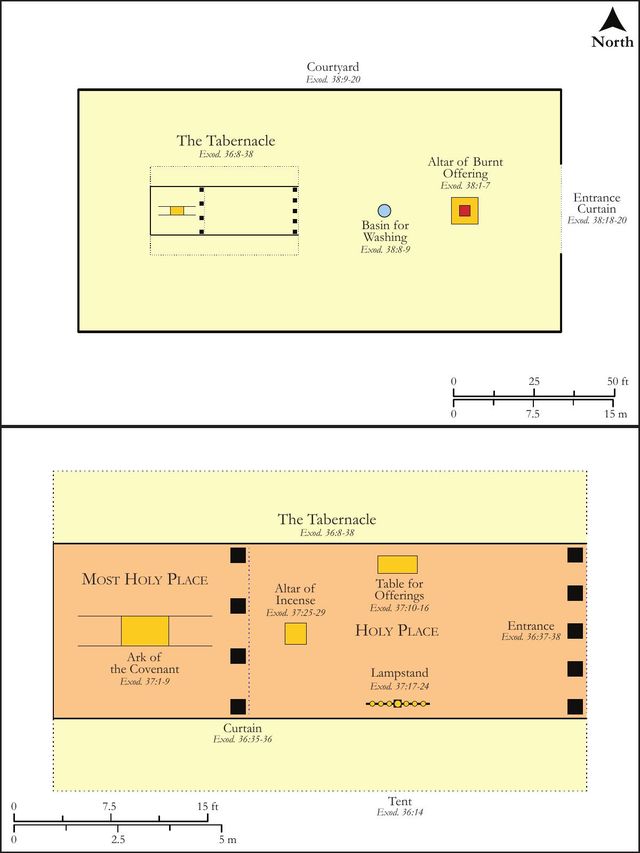
Bezaleel having finished the gold-work, which, though the richest, yet was ordered to lie most out of sight, in the tabernacle itself, here goes on to prepare the court, which lay open to the view of all. Two things the court was furnished with, and both made of brass: -
I.An altar of burnt-offering, Exo 38:1-7.
On this all their sacrifices were offered, and it was this which, being sanctified itself for this purpose by the divine appointment, sanctified the gift that was in faith offered on it. Christ was himself the altar to his own sacrifice of atonement, and so he is to all our sacrifices of acknowledgment. We must have an eye to him in offering them, as God has in accepting them.
II.A laver, to hold water for the priests to wash in when they went in to minister, Exo 38:8.
This signified the provision that is made in the gospel of Christ for the cleansing of our souls from the moral pollution of sin by the merit and grace of Christ, that we may be fit to serve the holy God in holy duties. This is here said to be made of the looking-glasses (or mirrors) of the women that assembled at the door of the tabernacle.
1.It should seem these women were eminent and exemplary for devotion, attending more frequently and seriously at the place of public worship than others did; and notice is here taken of it to their honour. Anna was such a one long afterwards, who departed not from the temple, but served God with fastings and prayers night and day, Luk 2:37. It seems in every age of the church there have been some who have thus distinguished themselves by their serious zealous piety, and they have thereby distinguished themselves; for devout women are really honourable women (Act 13:50), and not the less so for their being called, by the scoffers of the latter days, silly women. Probably these women were such as showed their zeal upon this occasion, by assisting in the work that was now going on for the service of the tabernacle. They assembled by troops, so the word is; a blessed sight, to see so many, and those so zealous and so unanimous, in this good work.
2.These women parted with their mirrors (which were of the finest brass, burnished for that purpose) for the use of the tabernacle. Those women that admire their own beauty, are in love with their own shadow, and make the putting on of apparel their chief adorning by which they value and recommend themselves, can but ill spare their looking-glasses; yet these women offered them to God, either,
(1.)In token of their repentance for the former abuse of them, to the support of their pride and vanity; now that they were convinced of their folly, and had devoted themselves to the service of God at the door of the tabernacle, they thus threw away that which, though lawful and useful in itself, yet had been an occasion of sin to them. Thus Mary Magdalene, who had been a sinner, when she became a penitent wiped Christ's feet with her hair. Or,
(2.)In token of their great zeal for the work of the tabernacle; rather than the workmen should want brass, or not have of the best, they would part with their mirrors, though they could not do well without them. God's service and glory must always be preferred by us before any satisfactions or accommodations of our own. Let us never complain of the want of that which we may honour God by parting with.
3.These mirrors were used for the making of the laver. Either they were artfully joined together, or else molten down and cast anew; but it is probable that the laver was so brightly burnished that the sides of it still served for mirrors, that the priests, when they came to wash, might there see their faces, and so discover the spots, to wash them clean. Note, In the washing of repentance, there is need of the looking-glass of self-examination. The word of God is a glass, in which we may see our own faces (see Jam 1:23); and with it we must compare our own hearts and lives, that, finding out our blemishes, we may wash with particular sorrow, and application of the blood of Christ to our souls. Usually the more particular we are in the confession of sin the more comfort we have in the sense of the pardon.
Continue studying Exodus 38:6 across the web’s major study libraries — every link below opens this exact verse, chapter, or book on the destination site.
Read & Compare
 BibleGatewayThis verse in more than 200 translations and 70 languages.
 Bible.comThe YouVersion reader — hundreds of translations, reading plans, and highlights.
 ESV.orgCrossway's official English Standard Version reader.
 NET BibleThe NET translation with 60,000+ translators' notes on every rendering decision.
 STEP BibleTyndale House's free study tool — original text, vocabulary, and scholarly resources.
 BibliaLogos Bible Software's free web reader.
 USCCBThe New American Bible (Revised Edition) with the U.S. bishops' study notes.
Commentaries
 BibleHub CommentariesDozens of classic commentaries on this verse, gathered on one page.
 StudyLightMore than 100 commentary sets — the largest collection on the web.
 BibleRefPlain-English commentary on what this verse means, verse by verse.
 Enduring WordDavid Guzik's free commentary on this chapter, widely used by Bible teachers.
 Bible Study ToolsVerse commentary alongside Greek and Hebrew study aids.
Original Language & Research
- BibleHub InterlinearThe verse word by word — original language, transliteration, and English.
- BibleHub LexiconEvery word's original-language definition and Strong's entry.
 Blue Letter BibleDeep-study tools — Strong's numbers, concordance, and word studies.
 SefariaThe Hebrew text with Rashi and centuries of Jewish commentary.
Sermons, Hymns & Audio


TrulyRandomVerse is not affiliated with these sites and doesn’t control their content. They’re linked because they’re genuinely useful.
Summary
Exodus 38:6 precisely details the construction of the carrying poles for the altar of burnt offering, specifying their composition from durable shittim wood overlaid with bronze. This verse, situated within the meticulous account of the Tabernacle's fabrication, underscores the divine blueprint's exactitude for every element of the portable sanctuary, ensuring the altar's mobility and symbolic integrity as the central place of sacrifice and atonement for the wandering Israelites.
Context
ShowHideLiterary Context
Exodus 38:6 is embedded within the detailed description of the Tabernacle's construction, specifically the fabrication of the altar of burnt offering, as recorded in Exodus 38:1-7. This section immediately follows the account of the bronze laver and its stand in Exodus 38:8 and precedes the extensive description of the Tabernacle's courtyard in Exodus 38:9-20. The entire latter half of Exodus (chapters 25-40) emphasizes the meticulous fulfillment of God's instructions given to Moses on Mount Sinai, demonstrating the Israelites' faithful obedience in bringing the divine blueprint to tangible reality. The recurring phrase "as the Lord commanded Moses" highlights the overarching theme of divine authority and human compliance, ensuring that every detail of the Tabernacle's design and construction was a direct response to God's revealed will.
Historical & Cultural Context
The construction of the Tabernacle occurred during the Israelites' forty-year sojourn in the wilderness, a period of nomadic existence following their liberation from Egyptian bondage. Given their transient lifestyle, the Tabernacle, as God's dwelling place among them, had to be entirely portable. Every piece of furniture, including the large brazen altar, was designed with carrying poles for easy dismantling and transport by the Levites, as detailed in Numbers 4. The materials specified—shittim wood and bronze—were readily available or could be acquired in the Sinai region. Acacia wood (shittim wood) was indigenous to the desert and highly valued for its hardness, resistance to decay, and insect repellence, making it ideal for enduring the harsh desert conditions. Bronze, an alloy of copper and tin, was a common metal from the days of Tubal-cain and held significant symbolic weight in the Tabernacle, particularly in relation to the altar of burnt offering, which was entirely covered in bronze (Exodus 27:1-8).
Key Themes
ShowHideThis verse contributes to several key themes pervasive throughout the Tabernacle narratives. First, it reinforces the theme of Divine Precision and Holiness, demonstrating that God's instructions for worship are absolute and require meticulous adherence; no detail, however small, is arbitrary. Second, the portability of the altar, facilitated by these staves, highlights the theme of God's Dynamic Presence among His people, emphasizing that His dwelling was not static but moved with them throughout their wilderness journey. This foreshadows a more intimate and accessible divine presence. Third, the materials themselves contribute to the theme of Symbolism and Atonement. Shittim wood, with its durability, speaks to the enduring nature of God's covenant, while bronze, consistently associated with judgment and purification in the Tabernacle (e.g., Exodus 30:18), points to the necessity of atonement and the fiery nature of divine justice.
Exposition and Analysis
ShowHideKey Word Analysis
ShowHideThis primitive root signifies "to do or make, in the broadest sense and widest application." In the context of the Tabernacle, it emphasizes the act of creation and execution according to divine command. It highlights that the construction was not merely human ingenuity but a faithful accomplishment of God's blueprint, reflecting the obedience of Bezaleel and the skilled artisans.
Derived from a root meaning "separation," this word refers to a part of the body, a branch, or, as here, a bar for carrying. These poles were specifically designed for transporting the sacred furniture, signifying the portability and transient nature of God's dwelling among His people in the wilderness. Their purpose underscores the practical necessity of mobility for the nomadic Israelites.
While often translated as "brass" in older versions, this Hebrew term more accurately denotes "copper" or, more commonly, "bronze" (an alloy of copper and tin). In the Tabernacle, bronze is frequently associated with judgment, divine wrath, and atonement, particularly in relation to the altar of burnt offering. Its use here for the overlay on the staves visually and symbolically links them to the altar's function as the place where sin was judged and atonement made through sacrifice.
Verse Breakdown
ShowHide"And he made the staves"
This clause refers to Bezaleel, the chief craftsman, who, along with Aholiab and other divinely gifted artisans, was empowered to execute God's precise instructions for the Tabernacle's construction (Exodus 31:1-6). The active verb "made" underscores the faithful and skilled craftsmanship involved in bringing the divine blueprint into tangible reality, emphasizing obedience to the divine mandate.
"[of] shittim wood"
This specifies the primary material for the staves: the wood of the acacia tree. Abundant in the Sinai peninsula, acacia wood (shittim wood) was chosen for its exceptional durability, hardness, and resistance to decay and insects, making it perfectly suited for the harsh desert environment. This choice was not arbitrary but divinely ordained, ensuring the longevity and structural integrity of the sacred carrying poles.
"and overlaid them with brass"
This detail indicates that the shittim wood poles were completely covered with a layer of bronze. This overlay served not only to provide additional strength and protection but, more significantly, to visually and symbolically link the staves directly to the brazen altar itself, which was also constructed of shittim wood overlaid with bronze (Exodus 27:1-2). This reinforces the altar's identity and its profound association with judgment, purification, and atonement.
Literary Devices
ShowHideExodus 38:6, like much of the Tabernacle narrative, employs Precision and Repetition as fundamental literary devices. The meticulous detailing of materials and methods underscores the divine blueprint's exactitude, emphasizing that every component, no matter how seemingly minor, was divinely ordained and held profound significance. The consistent mention of "shittim wood" and "brass" (bronze) throughout the Tabernacle accounts creates a strong sense of Symbolism, where the materials themselves carry theological weight. Shittim wood, being naturally incorruptible, symbolizes endurance, purity, and the unblemished nature of divine instruction. Bronze, conversely, consistently points to judgment, the fiery nature of atonement, and purification. The very existence of "staves" for the altar is a form of Metonymy, where the part (the carrying poles) stands for the function (the altar's portability), illustrating the transient and mobile nature of God's presence with His people in the wilderness.
Theological and Thematic Connections
ShowHideExodus 38:6, though seemingly a technical construction detail, profoundly illustrates several key theological truths. It underscores the principle of divine precision in worship, demonstrating that God cares deeply about the details of how He is approached and served, emphasizing that true worship is always on His terms. The very existence and material of the staves emphasize the portability of God's presence, signifying that His dwelling was not confined to a static temple but moved with His people, adapting to their journey and prefiguring a more accessible and internalized presence of God. Furthermore, the materials themselves carry symbolic weight: the durable shittim wood speaks to the enduring nature of God's covenant and His unchangeable character, while the bronze overlay points to the necessity of judgment and atonement, central to the altar's purpose and the means by which a holy God could dwell among an unholy people.
Reflection and Application
ShowHideThis verse invites us to reflect on the profound significance of divine detail and faithful stewardship in our own lives. Just as the ancient craftsmen meticulously followed God's instructions for even the carrying poles, we are called to approach our service to God with diligence, excellence, and obedience, understanding that no task, however small or seemingly mundane, is insignificant in His eyes when done for His glory. The portability of the Tabernacle, powerfully symbolized by these staves, reminds us that our worship and access to God are not bound by physical locations or grand structures, but are accessible wherever we are, accompanying us through all seasons and journeys of life. This encourages a dynamic, everyday faith that is resilient ("shittim wood") and acknowledges the transformative power of Christ's sacrifice ("brass"), enabling us to carry the presence of God into every sphere of our lives, making our very lives a portable sanctuary for His glory.
Questions for Reflection
ShowHideFAQ
ShowHideWhy were staves needed for the altar of burnt offering?
ShowHideThe staves were absolutely essential for the portability of the altar of burnt offering, as the Israelites were a nomadic people journeying through the wilderness. The entire Tabernacle, including all its furnishings like the altar, was designed to be easily dismantled, transported, and reassembled. This ensured that God's dwelling place and the central point of worship and sacrifice could accompany His people wherever they went, symbolizing His continuous presence and accessibility (Numbers 4:1-15).
What is "shittim wood" and why was it used?
ShowHide"Shittim wood" refers to the wood of the acacia tree, which was common and readily available in the Sinai desert where the Israelites wandered. It was highly valued for its exceptional durability, hardness, density, and resistance to decay and insects. These properties made it an ideal material for the sacred furnishings of the Tabernacle, ensuring their longevity and structural integrity in the harsh desert environment. Its incorruptible nature also carried symbolic weight, representing the enduring and unblemished character of God's covenant and His divine instructions.
What is the significance of the "brass" overlay?
ShowHideThe term "brass" in the KJV typically translates the Hebrew word nechoshet, which more accurately means "bronze" (an alloy of copper and tin). Bronze was a prominent metal in the Tabernacle, especially for the altar of burnt offering itself (Exodus 27:1-8). Symbolically, bronze in the Old Testament is often associated with judgment, divine wrath, and atonement. Its use for the staves of the altar visually and symbolically linked them to the altar's primary function as the place where sin was judged and atonement was made through sacrifice, emphasizing the weighty and sacred purpose of the object being carried and its connection to divine justice.
Christ-Centered Fulfillment
ShowHideExodus 38:6, detailing the construction of the altar's carrying poles from durable shittim wood overlaid with bronze, powerfully foreshadows aspects of Christ's person and redemptive work. The brazen altar, where sacrifices were made for sin, points directly to Jesus Christ as the ultimate and final sacrifice, the Lamb of God who takes away the sin of the world. The shittim wood, known for its incorruptibility and endurance, can be seen as a type of Christ's perfect, sinless humanity and His eternal, unblemished priesthood, which is unchangeable and everlasting. The bronze overlay, consistently associated with judgment and atonement in the Tabernacle, signifies that Christ, though perfectly righteous, bore the full weight of God's judgment for sin on the cross, becoming sin for us, though He knew no sin that we might become the righteousness of God in Him. Furthermore, the very portability of the altar, enabled by these staves, beautifully illustrates that Christ's atoning work is not confined to a specific place or time but is universally accessible to all who believe, transcending geographical and cultural boundaries. His sacrifice is eternally effective and His presence, through the Holy Spirit, now dwells within believers, making them temples of the Holy Spirit, a far greater and more intimate portability of God's presence than the Tabernacle ever offered.