


Exodus 38:5
Bible text: King James Version (1769 Blayney text) · Public domain
Bible text: Berean Standard Bible · Public domain
Bible text: American Standard Version (1901) · Public domain
Bible text: World English Bible, Messianic edition · Public domain
Bible text: Geneva Bible (1599) · Public domain
Bible text: Young's Literal Translation · Public domain
- וַיִּצֹקvai·yi·Tzokand he castH3332Conj-w ¦ V-Qal-ConsecImperf-3msVerb Qal Consecutive Imperfect 3rd Singular Masculineוַandיִּצֹקhe cast
- אַרְבַּע'ar·Ba'fourH702Adj-cscAdjective Numerical Singular common gender Construct
- טַבָּעֹתta·ba·'OtringsH2885N-fpNoun Plural Feminine Absolute
- בְּאַרְבַּעbe·'ar·Ba'on [the] fourH702Prep-b ¦ Adj-cscAdjective Numerical Singular common gender Constructבְּonאַרְבַּע[the] four
- הַקְּצָוֹתha·ke·tza·Votthe endsH7117Art ¦ N-fpNoun Plural Feminine Absoluteהַtheקְּצָוֹתends
- לְמִכְבַּרle·mikh·Barfor [the] grating ofH4345Prep-l ¦ N-mscNoun Singular Masculine Constructלְforמִכְבַּר[the] grating of
- הַנְּחֹשֶׁתha·ne·Cho·shet<the> bronzeH5178Art ¦ N-fsNoun Singular Feminine Absoluteהַ<the>נְּחֹשֶׁתbronze
- בָּתִּיםba·TimholdersH1004N-mpNoun Plural Masculine Absolute
- לַבַּדִּיםla·ba·Dimfor the polesH905Prep-l ¦ N-mpNoun Plural Masculine Absoluteלַfor theבַּדִּיםpoles
English is a literal word-by-word gloss of the Hebrew, not the KJV's wording. Why?
This is the original text the KJV's translators worked from — each Hebrew word with its own literal English meaning in this verse, prepared by scholars at Tyndale House, Cambridge. The KJV translates whole sentences, not word by word, so its wording differs: one Hebrew word can become several English words, and the KJV may choose “the LORD” where the gloss reads “Yahweh”. Both are faithful — they answer different questions. For the KJV's own rendering, switch to the KJV text.
Details
See on the biblical-era maps

Study this verse
Public-domain commentary
Matthew Henry
From his Commentary on the Whole Bible. Henry comments on passages, not single verses — this entry covers Exodus 38:1–8. His three-level outline is real structure in the source text, so it is rendered as structure.
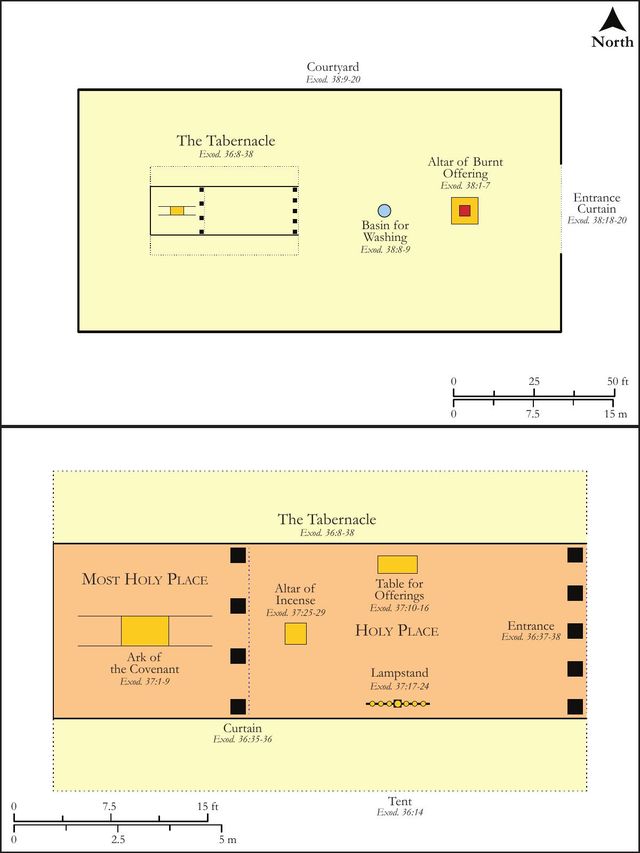
Bezaleel having finished the gold-work, which, though the richest, yet was ordered to lie most out of sight, in the tabernacle itself, here goes on to prepare the court, which lay open to the view of all. Two things the court was furnished with, and both made of brass: -
I.An altar of burnt-offering, Exo 38:1-7.
On this all their sacrifices were offered, and it was this which, being sanctified itself for this purpose by the divine appointment, sanctified the gift that was in faith offered on it. Christ was himself the altar to his own sacrifice of atonement, and so he is to all our sacrifices of acknowledgment. We must have an eye to him in offering them, as God has in accepting them.
II.A laver, to hold water for the priests to wash in when they went in to minister, Exo 38:8.
This signified the provision that is made in the gospel of Christ for the cleansing of our souls from the moral pollution of sin by the merit and grace of Christ, that we may be fit to serve the holy God in holy duties. This is here said to be made of the looking-glasses (or mirrors) of the women that assembled at the door of the tabernacle.
1.It should seem these women were eminent and exemplary for devotion, attending more frequently and seriously at the place of public worship than others did; and notice is here taken of it to their honour. Anna was such a one long afterwards, who departed not from the temple, but served God with fastings and prayers night and day, Luk 2:37. It seems in every age of the church there have been some who have thus distinguished themselves by their serious zealous piety, and they have thereby distinguished themselves; for devout women are really honourable women (Act 13:50), and not the less so for their being called, by the scoffers of the latter days, silly women. Probably these women were such as showed their zeal upon this occasion, by assisting in the work that was now going on for the service of the tabernacle. They assembled by troops, so the word is; a blessed sight, to see so many, and those so zealous and so unanimous, in this good work.
2.These women parted with their mirrors (which were of the finest brass, burnished for that purpose) for the use of the tabernacle. Those women that admire their own beauty, are in love with their own shadow, and make the putting on of apparel their chief adorning by which they value and recommend themselves, can but ill spare their looking-glasses; yet these women offered them to God, either,
(1.)In token of their repentance for the former abuse of them, to the support of their pride and vanity; now that they were convinced of their folly, and had devoted themselves to the service of God at the door of the tabernacle, they thus threw away that which, though lawful and useful in itself, yet had been an occasion of sin to them. Thus Mary Magdalene, who had been a sinner, when she became a penitent wiped Christ's feet with her hair. Or,
(2.)In token of their great zeal for the work of the tabernacle; rather than the workmen should want brass, or not have of the best, they would part with their mirrors, though they could not do well without them. God's service and glory must always be preferred by us before any satisfactions or accommodations of our own. Let us never complain of the want of that which we may honour God by parting with.
3.These mirrors were used for the making of the laver. Either they were artfully joined together, or else molten down and cast anew; but it is probable that the laver was so brightly burnished that the sides of it still served for mirrors, that the priests, when they came to wash, might there see their faces, and so discover the spots, to wash them clean. Note, In the washing of repentance, there is need of the looking-glass of self-examination. The word of God is a glass, in which we may see our own faces (see Jam 1:23); and with it we must compare our own hearts and lives, that, finding out our blemishes, we may wash with particular sorrow, and application of the blood of Christ to our souls. Usually the more particular we are in the confession of sin the more comfort we have in the sense of the pardon.
Continue studying Exodus 38:5 across the web’s major study libraries — every link below opens this exact verse, chapter, or book on the destination site.
Read & Compare
 BibleGatewayThis verse in more than 200 translations and 70 languages.
 Bible.comThe YouVersion reader — hundreds of translations, reading plans, and highlights.
 ESV.orgCrossway's official English Standard Version reader.
 NET BibleThe NET translation with 60,000+ translators' notes on every rendering decision.
 STEP BibleTyndale House's free study tool — original text, vocabulary, and scholarly resources.
 BibliaLogos Bible Software's free web reader.
 USCCBThe New American Bible (Revised Edition) with the U.S. bishops' study notes.
Commentaries
 BibleHub CommentariesDozens of classic commentaries on this verse, gathered on one page.
 StudyLightMore than 100 commentary sets — the largest collection on the web.
 BibleRefPlain-English commentary on what this verse means, verse by verse.
 Enduring WordDavid Guzik's free commentary on this chapter, widely used by Bible teachers.
 Bible Study ToolsVerse commentary alongside Greek and Hebrew study aids.
Original Language & Research
- BibleHub InterlinearThe verse word by word — original language, transliteration, and English.
- BibleHub LexiconEvery word's original-language definition and Strong's entry.
 Blue Letter BibleDeep-study tools — Strong's numbers, concordance, and word studies.
 SefariaThe Hebrew text with Rashi and centuries of Jewish commentary.
Sermons, Hymns & Audio


TrulyRandomVerse is not affiliated with these sites and doesn’t control their content. They’re linked because they’re genuinely useful.
Summary
Exodus 38:5 meticulously details the fabrication of four bronze rings for the altar of burnt offering's grate, specifically designed to serve as receptacles for the staves used in its transport. This seemingly minor architectural instruction highlights the divine emphasis on precision in worship, the essential portability of God's presence among His people, and the faithful obedience required in executing His sacred blueprint for the Tabernacle, ensuring the central place of atonement could accompany Israel on their nomadic journey.
Context
ShowHideLiterary Context
Exodus 38:5 is situated within the extensive narrative block of Exodus 35-40, which meticulously chronicles the actual construction of the Tabernacle and its sacred furnishings. This section follows the detailed divine instructions previously given to Moses on Mount Sinai in Exodus 25-31. Specifically, the verse describes a component of the altar of burnt offering, whose construction spans from Exodus 38:1 to Exodus 38:7. The "grate of brass" refers to the bronze network placed inside the altar, facilitating the collection of ashes from sacrifices. The divine specifications for this grate, including its rings and staves, were initially outlined in Exodus 27:4-7. The narrative consistently emphasizes the faithful and precise execution of God's blueprint by the divinely gifted artisans, particularly Bezalel and Aholiab, underscoring the importance of meticulous adherence to the divine mandate for His sanctuary.
Historical & Cultural Context
The construction of the Tabernacle occurred during Israel's forty-year sojourn in the wilderness, a period defined by their nomadic existence. This transient lifestyle necessitated that every major component of the Tabernacle, including the substantial altar of burnt offering, be designed for efficient portability. The rings and staves were not mere practical accessories but indispensable elements that enabled the movement of God's dwelling place. This inherent mobility underscored the dynamic nature of God's presence with His people; He was not confined to a static temple but journeyed with them, serving as a tangible sign of His covenant faithfulness and guidance. The meticulous instructions for handling and transporting these sacred articles, such as those for the Ark of the Covenant, also highlight the profound reverence and sanctity required in approaching and carrying anything associated with the divine presence. This context reinforces the idea that God's dwelling was both accessible and holy, mobile yet orderly, reflecting His sovereign control over their journey and their worship.
Key Themes
ShowHideThis verse contributes to several overarching themes within Exodus and the broader Pentateuch. Firstly, it underscores the theme of Divine Precision and Order, demonstrating God's meticulous attention to every detail of His dwelling place and worship, leaving nothing to human improvisation. Secondly, it highlights the theme of God's Presence and Portability, emphasizing that the God of Israel was not a localized deity but one who actively journeyed with His people, making His presence and the means of atonement continually accessible. The design of the Tabernacle, as seen in the rings and staves, ensured that the central place of sacrifice could move with the migrating community, as outlined in the instructions for the journeying of the Tabernacle. Thirdly, the verse exemplifies the theme of Obedience and Faithful Craftsmanship. The fact that these details are recorded as executed reflects the Israelites' faithful adherence to God's commands, particularly the skilled artisans like Bezalel and Aholiab, who were "filled with the Spirit of God, in wisdom, and in understanding, and in knowledge, and in all manner of workmanship" (Exodus 35:31). This meticulous obedience was crucial for the Tabernacle to function as a true representation of God's heavenly pattern (Hebrews 8:5).
Exposition and Analysis
ShowHideKey Word Analysis
ShowHideThis verb (H3332) signifies the process of pouring out molten metal to form an object, by implication, to melt or cast as metal. It denotes a deliberate and precise metallurgical act, transforming raw material into a specific, divinely ordained shape. The use of "cast" here emphasizes the intentionality and skill involved in creating the rings according to God's exact specifications.
This noun (H2885) refers to a circular object, specifically a ring. While it can denote a signet ring for sealing, in this context, it refers to a ring of any kind, specifically designed to function as a fastener or holder. The "four rings" indicate a symmetrical design for balanced carrying, consistent with their use on other Tabernacle furnishings for portability.
This noun (H905) refers to a bar for carrying, a staff, or a pole. In the context of the Tabernacle, these were long, sturdy poles inserted into the rings of sacred furniture, enabling the Levites to transport the heavy items without directly touching them. The staves were essential for the Tabernacle's mobility and for maintaining the ritual purity of the holy objects.
Verse Breakdown
ShowHide"And he cast four rings"
The subject "he" refers to Bezalel, the chief craftsman, or the skilled artisans working under his direction, who were divinely empowered for the task (Exodus 35:30-35). The act of "casting" implies a deliberate and precise metallurgical process, transforming raw bronze into perfectly formed rings according to God's exact specifications. The number "four" signifies completeness and direction, aligning with the four corners of the altar.
"for the four ends of the grate of brass"
This clause specifies the exact placement of the rings – at each of the four corners or extremities of the bronze grating. This precise location was critical for balanced carrying and stability. The "grate of brass" itself was a key component of the altar, indicating that the rings were attached to this internal structure, not the outer frame of the altar, ensuring the grate's stability during transport.
"[to be] places for the staves"
This clause explicitly states the functional purpose of the rings: they were designed as receptacles for the carrying poles. This functional design was paramount for the altar's portability, enabling the Levites to lift and transport the heavy altar of burnt offering as Israel moved through the wilderness. It underscores the practical foresight embedded within God's meticulously detailed architectural plan.
Literary Devices
ShowHideExodus 38:5, though a technical description, subtly employs several literary devices that enhance its theological significance. Most prominent is Precision, evident in the exact numbers ("four rings," "four ends") and specified materials ("grate of brass"). This meticulous detail mirrors the divine character, emphasizing God's absolute orderliness and His demand for exactitude in all matters pertaining to His worship. The verse also utilizes Functional Symbolism, where the physical components (rings, staves) are not merely utilitarian but symbolize the dynamic, portable nature of God's presence. The altar, the central place of atonement, was designed to move with the people, signifying that God's mercy and provision were not static but accessible throughout their journey. Furthermore, there is an element of Repetition of the number "four," reinforcing the idea of completeness and the comprehensive nature of the divine design. The emphasis on the "grate of brass" through Synecdoche (a part representing the whole, or vice-versa) allows this critical component to stand in for the altar's overall function and transport readiness.
Theological and Thematic Connections
ShowHideExodus 38:5, though seemingly a minor detail in the Tabernacle's construction, profoundly illustrates God's meticulous nature and the intentionality behind every aspect of His dwelling place. The divine blueprint for the Tabernacle, down to the rings for carrying poles, underscores that God cares deeply about order, precision, and the practical means by which His presence is facilitated among His people. This portability of the altar, the central place of sacrifice, signifies that access to God's atonement was not confined to a static location but was available to Israel throughout their journey, a testament to God's continuous provision and faithfulness. The faithful execution of these instructions by the craftsmen also highlights the importance of obedience and the dedication of God-given skills to His glory, demonstrating that even seemingly small acts of obedience contribute to God's grand redemptive plan.
Reflection and Application
ShowHideThe intricate details of Exodus 38:5 invite us to reflect deeply on the nature of God and our faithful response to His call. Just as God meticulously designed every component of the Tabernacle, down to the rings for portability, we are reminded that He is a God of order who cares about the seemingly small details of our lives and our worship. This verse challenges us to consider whether our own lives and ministries are designed for "portability" – are we ready to carry God's presence and the message of the Gospel wherever He leads, unhindered by static traditions, personal comfort zones, or fear of inconvenience? The altar, the place of sacrifice, was always ready to move, signifying that the means of reconciliation should always be accessible and dynamic. Furthermore, the faithful craftsmanship of Bezalel and Aholiab, who executed God's precise instructions with divine skill, serves as a powerful model for our own stewardship of God-given talents. Are we using our skills, no matter how mundane or extraordinary they may seem, with the same precision, dedication, and obedience for God's glory? This verse encourages us to embrace a dynamic faith, always prepared to follow God's leading, knowing that even the smallest acts of obedience contribute significantly to His grand redemptive design.
Questions for Reflection
ShowHideFAQ
ShowHideWhy were the rings and staves so important for the Tabernacle furniture?
ShowHideThe rings and staves were critically important because they enabled the Tabernacle and its sacred furnishings, including the heavy altar of burnt offering, to be transported during Israel's nomadic journey through the wilderness. Without these components, the large and weighty items could not have been moved according to divine protocol. The specific design ensured that the holy objects were handled reverently, without direct human touch, by inserting the staves through the rings. This system underscored the practical necessity of a mobile sanctuary for a traveling people, allowing God's presence and the means of atonement to accompany them wherever they went, as mandated in passages like Exodus 25:13-15.
What is the significance of "brass" (bronze) in the Tabernacle's construction?
ShowHideIn the Tabernacle, "brass" (more accurately, bronze) held significant symbolic meaning, particularly in relation to judgment and sacrifice. The altar of burnt offering, the laver, and their associated implements were predominantly made of bronze. Bronze is durable and resistant to fire, making it eminently suitable for the altar where sacrifices were consumed by fire. Theologically, bronze is often associated with God's judgment against sin, as seen in the bronze serpent in Numbers 21:9, which brought healing from judgment for those who looked upon it. Thus, the bronze grate and rings of the altar signify that the place where sin was atoned for was also the place where divine judgment was met, powerfully pointing forward to the ultimate sacrifice that would bear the full weight of God's wrath against sin.
Christ-Centered Fulfillment
ShowHideExodus 38:5, with its focus on the altar's rings and staves, points profoundly to Christ in its emphasis on sacrifice, access, and the portability of God's presence. The brazen altar, where daily sacrifices were offered for the atonement of sins, is a vivid type of Jesus Christ, who became the ultimate, once-for-all sacrifice for humanity's sin on the cross (Hebrews 9:26). The rings and staves, designed to ensure the altar's constant readiness for movement, foreshadow the New Covenant reality where God's presence is no longer confined to a physical structure or a static geographical location. Through Christ's atoning work, the Spirit of God now indwells believers, making each one a "temple of the Holy Ghost" (1 Corinthians 6:19). This means that the "altar" of God's presence and the "sacrifice" of reconciliation are now perpetually portable, carried within the hearts of His people wherever they go, fulfilling and expanding upon the nomadic nature of the Old Testament Tabernacle. Christ Himself is our ultimate access to God, our High Priest who has passed through the heavens, enabling us to draw near with confidence to the throne of grace (Hebrews 4:16). He is the Lamb of God who takes away the sin of the world, making the reality of atonement and God's dwelling infinitely more accessible, personal, and universally available than the physical Tabernacle could ever convey.