


Exodus 38:4
Bible text: King James Version (1769 Blayney text) · Public domain
Bible text: Berean Standard Bible · Public domain
Bible text: American Standard Version (1901) · Public domain
Bible text: World English Bible, Messianic edition · Public domain
Bible text: Geneva Bible (1599) · Public domain
Bible text: Young's Literal Translation · Public domain
- וַיַּעַשׂvai·Ya·'asand he madeH6213Conj-w ¦ V-Qal-ConsecImperf-3msVerb Qal Consecutive Imperfect 3rd Singular Masculineוַandיַּעַשׂhe made
- לַמִּזְבֵּחַla·miz·Be·achfor the altarH4196Prep-l ¦ N-msNoun Singular Masculine Absoluteלַfor theמִּזְבֵּחַaltar
- מִכְבָּרmikh·Bara gratingH4345N-msNoun Singular Masculine Absolute
- מַעֲשֵׂהma·'a·Seha work ofH4639N-mscNoun Singular Masculine Construct
- רֶשֶׁתRe·sheta net ofH7568N-fscNoun Singular Feminine Construct
- נְחֹשֶׁתne·Cho·shetbronzeH5178N-fsNoun Singular Feminine Absolute
- תַּחַתTa·chatunderH8478N-mscNoun Singular Masculine Construct
- כַּרְכֻּבּוֹkar·ku·Boits ledgeH3749N-msc ¦ 3msNoun Singular Masculine Constructכַּרְכֻּבּledgeוֹits
- מִלְּמַטָּהmi·le·Ma·tahfrom to downwardsH4295Prep-m ¦ Prep-l ¦ Adj-msAdjective Numerical Singular Masculine Absoluteמִfromלְּtoמַטָּהdownwards
- עַד'adtoH5704PrepPreposition
- חֶצְיוֹchetz·Yoits middleH2677N-msc ¦ 3msNoun Singular Masculine Constructחֶצְיmiddleוֹits
English is a literal word-by-word gloss of the Hebrew, not the KJV's wording. Why?
This is the original text the KJV's translators worked from — each Hebrew word with its own literal English meaning in this verse, prepared by scholars at Tyndale House, Cambridge. The KJV translates whole sentences, not word by word, so its wording differs: one Hebrew word can become several English words, and the KJV may choose “the LORD” where the gloss reads “Yahweh”. Both are faithful — they answer different questions. For the KJV's own rendering, switch to the KJV text.
Details
See on the biblical-era maps

Study this verse
Public-domain commentary
Matthew Henry
From his Commentary on the Whole Bible. Henry comments on passages, not single verses — this entry covers Exodus 38:1–8. His three-level outline is real structure in the source text, so it is rendered as structure.
Bezaleel having finished the gold-work, which, though the richest, yet was ordered to lie most out of sight, in the tabernacle itself, here goes on to prepare the court, which lay open to the view of all. Two things the court was furnished with, and both made of brass: -
I.An altar of burnt-offering, Exo 38:1-7.
On this all their sacrifices were offered, and it was this which, being sanctified itself for this purpose by the divine appointment, sanctified the gift that was in faith offered on it. Christ was himself the altar to his own sacrifice of atonement, and so he is to all our sacrifices of acknowledgment. We must have an eye to him in offering them, as God has in accepting them.
II.A laver, to hold water for the priests to wash in when they went in to minister, Exo 38:8.
This signified the provision that is made in the gospel of Christ for the cleansing of our souls from the moral pollution of sin by the merit and grace of Christ, that we may be fit to serve the holy God in holy duties. This is here said to be made of the looking-glasses (or mirrors) of the women that assembled at the door of the tabernacle.
1.It should seem these women were eminent and exemplary for devotion, attending more frequently and seriously at the place of public worship than others did; and notice is here taken of it to their honour. Anna was such a one long afterwards, who departed not from the temple, but served God with fastings and prayers night and day, Luk 2:37. It seems in every age of the church there have been some who have thus distinguished themselves by their serious zealous piety, and they have thereby distinguished themselves; for devout women are really honourable women (Act 13:50), and not the less so for their being called, by the scoffers of the latter days, silly women. Probably these women were such as showed their zeal upon this occasion, by assisting in the work that was now going on for the service of the tabernacle. They assembled by troops, so the word is; a blessed sight, to see so many, and those so zealous and so unanimous, in this good work.
2.These women parted with their mirrors (which were of the finest brass, burnished for that purpose) for the use of the tabernacle. Those women that admire their own beauty, are in love with their own shadow, and make the putting on of apparel their chief adorning by which they value and recommend themselves, can but ill spare their looking-glasses; yet these women offered them to God, either,
(1.)In token of their repentance for the former abuse of them, to the support of their pride and vanity; now that they were convinced of their folly, and had devoted themselves to the service of God at the door of the tabernacle, they thus threw away that which, though lawful and useful in itself, yet had been an occasion of sin to them. Thus Mary Magdalene, who had been a sinner, when she became a penitent wiped Christ's feet with her hair. Or,
(2.)In token of their great zeal for the work of the tabernacle; rather than the workmen should want brass, or not have of the best, they would part with their mirrors, though they could not do well without them. God's service and glory must always be preferred by us before any satisfactions or accommodations of our own. Let us never complain of the want of that which we may honour God by parting with.
3.These mirrors were used for the making of the laver. Either they were artfully joined together, or else molten down and cast anew; but it is probable that the laver was so brightly burnished that the sides of it still served for mirrors, that the priests, when they came to wash, might there see their faces, and so discover the spots, to wash them clean. Note, In the washing of repentance, there is need of the looking-glass of self-examination. The word of God is a glass, in which we may see our own faces (see Jam 1:23); and with it we must compare our own hearts and lives, that, finding out our blemishes, we may wash with particular sorrow, and application of the blood of Christ to our souls. Usually the more particular we are in the confession of sin the more comfort we have in the sense of the pardon.
Continue studying Exodus 38:4 across the web’s major study libraries — every link below opens this exact verse, chapter, or book on the destination site.
Read & Compare
 BibleGatewayThis verse in more than 200 translations and 70 languages.
 Bible.comThe YouVersion reader — hundreds of translations, reading plans, and highlights.
 ESV.orgCrossway's official English Standard Version reader.
 NET BibleThe NET translation with 60,000+ translators' notes on every rendering decision.
 STEP BibleTyndale House's free study tool — original text, vocabulary, and scholarly resources.
 BibliaLogos Bible Software's free web reader.
 USCCBThe New American Bible (Revised Edition) with the U.S. bishops' study notes.
Commentaries
 BibleHub CommentariesDozens of classic commentaries on this verse, gathered on one page.
 StudyLightMore than 100 commentary sets — the largest collection on the web.
 BibleRefPlain-English commentary on what this verse means, verse by verse.
 Enduring WordDavid Guzik's free commentary on this chapter, widely used by Bible teachers.
 Bible Study ToolsVerse commentary alongside Greek and Hebrew study aids.
Original Language & Research
- BibleHub InterlinearThe verse word by word — original language, transliteration, and English.
- BibleHub LexiconEvery word's original-language definition and Strong's entry.
 Blue Letter BibleDeep-study tools — Strong's numbers, concordance, and word studies.
 SefariaThe Hebrew text with Rashi and centuries of Jewish commentary.
Sermons, Hymns & Audio


TrulyRandomVerse is not affiliated with these sites and doesn’t control their content. They’re linked because they’re genuinely useful.
Summary
Exodus 38:4 meticulously details the construction of the bronze grate for the Altar of Burnt Offering, specifying its material, form, and precise placement within the altar's hollow structure. This verse underscores the divine precision required for sacred worship and the functional necessity of every component in facilitating the sacrificial system, which served as a profound foreshadowing of Christ's ultimate atonement.
Context
ShowHideLiterary Context
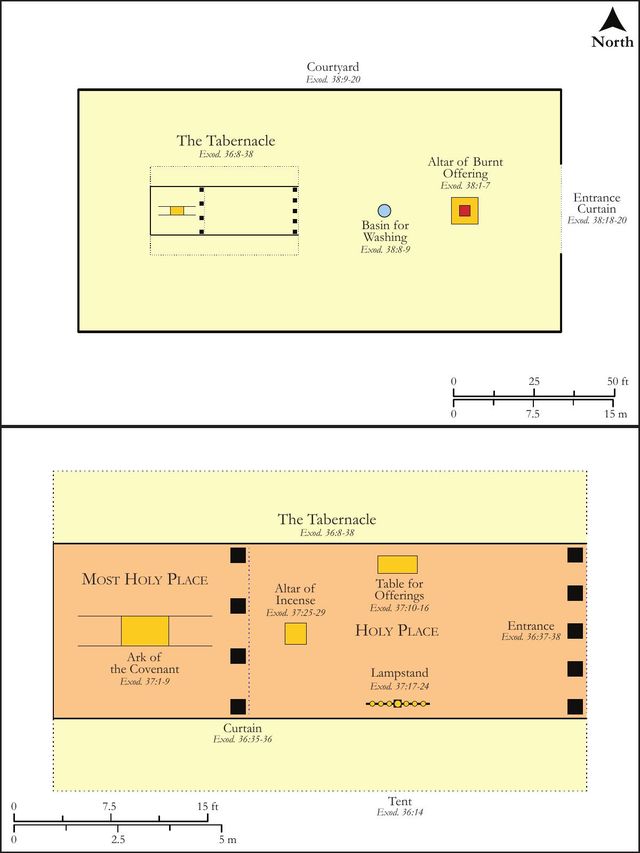
Exodus 38 is situated within the latter portion of the book, which transitions from God's detailed instructions for the Tabernacle's construction (Exodus 25-31) to the actual execution of those commands by Bezaleel, Oholiab, and their skilled artisans (Exodus 35-40). Specifically, chapter 38 focuses on the completion of the furnishings for the Tabernacle's outer court. This includes the Altar of Burnt Offering (Exodus 38:1-7), the bronze laver (Exodus 38:8), and the court hangings and pillars (Exodus 38:9-20). Exodus 38:4, in particular, describes a key component of the Altar of Burnt Offering, a "brasen grate of network," the design of which was initially commanded and described in Exodus 27:1-8. The meticulous repetition of these construction details throughout Exodus emphasizes the Israelites' faithful adherence to God's precise and holy instructions, highlighting the importance of obedience in worship.
Historical & Cultural Context
The Tabernacle served as the portable sanctuary for the Israelites during their wilderness journey, a tangible manifestation of God's presence among His people. Among the nations, various peoples had temples and altars for worship, but the Israelite Tabernacle was unique in its divinely revealed design and its emphasis on atonement through sacrifice. The use of "brasen" (bronze/copper) for the Altar of Burnt Offering and its grate was practical, as bronze is durable and heat-resistant, suitable for the intense fires of sacrifice. It also carried symbolic weight, often associated with judgment and strength, distinguishing the outer court where sin was dealt with from the more precious gold and silver used in the Holy Place and Most Holy Place. The meticulous detail in the construction, down to the grate's placement, reflects the absolute holiness of God and the seriousness required in approaching Him, contrasting with the often syncretistic and less precise worship practices of surrounding nations. The entire structure was a testament to God's covenant with Israel and His provision for their reconciliation through the sacrificial system, as outlined in Leviticus 1-7.
Key Themes
ShowHideExodus 38:4 contributes to several overarching themes within the book of Exodus and the Pentateuch. Firstly, it reinforces the theme of Divine Prescription and Human Obedience. God's detailed blueprint for the Tabernacle, down to the smallest component like the grate, demonstrates His sovereign authority and His desire for worship to be conducted according to His specific will, not human invention. The Israelites' faithful execution of these commands, as evidenced in this chapter, underscores the importance of obedience in their covenant relationship with God (Exodus 39:32). Secondly, the verse highlights the theme of Holiness and Atonement. The Altar of Burnt Offering, with its functional bronze grate, was the primary place where sin was addressed through sacrifice. The material (bronze) and the meticulous design speak to the seriousness of sin and the necessity of a divinely provided means of reconciliation. This points to the broader theme of God providing a way for sinful humanity to approach a holy God, a theme that finds its ultimate expression in Christ (Hebrews 9:22). Finally, the construction details emphasize God's Dwelling Among His People, as the Tabernacle was designed to be the physical manifestation of His presence, enabling Him to reside in the midst of Israel (Exodus 29:45-46).
Exposition and Analysis
ShowHideKey Word Analysis
ShowHideThis primitive root verb signifies "to do or make, in the broadest sense and widest application." In this context, it refers to the skilled craftsmanship of Bezaleel and his team in constructing the Tabernacle components precisely as commanded by God. It implies not just creation, but also accomplishment, execution, and fitting together, highlighting the deliberate and purposeful nature of the work.
This noun refers to copper, or more commonly, bronze (an alloy of copper), and by extension, something made of this metal. In the Tabernacle, bronze was used for items in the outer court, such as the Altar of Burnt Offering and its grate, signifying durability, resilience, and resistance to heat. Symbolically, bronze is often associated with judgment and strength in biblical contexts, marking the place where sin was confronted and dealt with.
This noun, derived from a root meaning "to cover" or "to weave," denotes a grating or network. It describes a mesh-like, open-work structure, crucial for the altar's function. This design allowed for proper air circulation to sustain the sacrificial fire and facilitated the drainage of blood and ashes, ensuring cleanliness and efficiency in the sacrificial rituals.
Derived from a root meaning "to divide," this noun refers to the half or middle of something. In the context of the grate's placement, it precisely indicates that the network extended upward to approximately the halfway point of the altar's height, ensuring optimal functional positioning for the burning sacrifices and the collection of their byproducts.
Verse Breakdown
ShowHide"And he made for the altar"
This phrase identifies the subject as Bezaleel, the chief craftsman, and his divinely empowered team (as described in Exodus 35:30-35). The "altar" refers to the Altar of Burnt Offering, the large, square altar located in the outer court of the Tabernacle, where animal sacrifices were offered to atone for sin.
"a brasen grate of network"
This specifies the material and form of a crucial component of the altar. It was a bronze structure, designed as an open grid or mesh. This was not merely decorative but highly functional, essential for the proper burning of sacrifices and the management of their byproducts, ensuring efficient combustion and cleanliness.
"under the compass thereof beneath unto the midst of it"
This clause precisely describes the grate's placement within the altar. "Under the compass thereof" indicates it was placed inside the hollow frame of the altar. "Beneath" suggests it started from the bottom, and "unto the midst of it" means it extended upwards to approximately the halfway point of the altar's height. This strategic positioning ensured optimal airflow for the sacrificial fire and allowed ashes and blood to fall through to the base, facilitating the cleaning process and maintaining the sanctity of the sacred space.
Literary Devices
ShowHideExodus 38:4, like much of the Tabernacle's construction narrative, primarily employs Precision and Repetition. The meticulous detailing of every component, down to the exact material, form, and placement of the bronze grate, underscores God's absolute precision in His divine blueprint and His demand for the Israelites' exact obedience in its execution. This repetition of construction details (first commanded in Exodus 27:1-8, then described as built in Exodus 38) serves to emphasize the sanctity of the work and the faithfulness of the builders. The bronze grate itself functions as a practical symbol of the necessary order and cleanliness in approaching a holy God. Furthermore, the entire description is a form of typology, where the physical structure and its components are divinely designed to foreshadow greater spiritual realities, particularly the ultimate sacrifice of Christ.
Theological and Thematic Connections
ShowHideThe construction of the "brasen grate of network" on the Altar of Burnt Offering, though a minute detail, profoundly illustrates God's demand for meticulous obedience in worship, where every element matters because it reflects His holy character and His perfect plan for redemption. The Tabernacle, and especially the Altar of Burnt Offering, served as a tangible representation of God's presence and the divinely ordained means of reconciliation between a holy God and sinful humanity. The bronze grate, essential for the altar's function, enabled the sacrificial system that foreshadowed the ultimate sacrifice. This attention to detail underscores that true worship is not arbitrary but is defined by God's revealed will, pointing to the profound theological truth that God orchestrates every aspect of salvation, leaving nothing to chance or human preference.
Reflection and Application
ShowHideExodus 38:4, while describing an ancient piece of Tabernacle furniture, offers timeless principles for our contemporary understanding of worship and service. It reminds us that God is a God of order, precision, and purpose, and He desires our worship and service to reflect these attributes. Our spiritual lives should not be haphazard or self-serving, but rather intentional, diligent, and aligned with His revealed will. Just as the bronze grate facilitated the sacred work of atonement by ensuring proper function and cleanliness, our lives, offered as "living sacrifices," should be ordered and prepared to facilitate God's purposes in the world. This means paying attention to the "details" of our spiritual walk—our integrity, our commitment to truth, our love for others, our consistent prayer life—recognizing that seemingly small acts of obedience contribute to a larger, divine design for our sanctification and His glory. This verse calls us to a worship that is both heartfelt and meticulously obedient to God's standards, understanding that our carefulness in seemingly minor areas can have significant spiritual implications.
Questions for Reflection
ShowHideFAQ
ShowHideWhat was the purpose of the "brasen grate of network"?
ShowHideThe "brasen grate of network" was a crucial component of the Altar of Burnt Offering. Its primary purpose was functional: to provide a support for the sacrificial offerings and the burning fire, while also allowing for proper ventilation and drainage of blood and ashes. This ensured the altar remained clean and efficient for the continuous sacrifices, which were central to Israelite worship and atonement for sin, as detailed in passages like Leviticus 1. It prevented the accumulation of debris and ensured the fire could burn effectively.
Why was it made of "brasen" (bronze)?
ShowHideBronze (or copper) was chosen for the grate and other outer court furnishings due to its durability, resistance to intense heat, and common availability. Theologically, bronze is often associated with judgment and strength in the Tabernacle's symbolism, distinguishing the outer court where sin was dealt with from the inner holy places adorned with more precious gold and silver. This material choice reinforced the seriousness of approaching God's holiness through sacrifice, as seen in the bronze serpent in Numbers 21:9 and the bronze laver for cleansing (Exodus 30:18).
Christ-Centered Fulfillment
ShowHideThe "brasen grate of network" on the Altar of Burnt Offering, though a seemingly minor detail, powerfully foreshadows the ultimate work of Christ. The altar itself was the primary place where sin was atoned for through the shedding of blood, and the grate facilitated this process by ensuring the proper burning and drainage of the sacrifices. This entire sacrificial system, with its meticulous requirements, pointed forward to Jesus Christ, who is the perfect and final sacrifice for sin. Just as the grate supported the offerings, Christ, through His perfect obedience and sinless life, perfectly fulfilled the requirements of the Law, offering Himself "once for all" (as seen in Hebrews 10:10). His body, broken on the cross, served as the ultimate altar, and His shed blood, far superior to that of bulls and goats, provides eternal redemption (as explained in Hebrews 9:12). The functional precision of the bronze grate in the Tabernacle thus symbolizes the divine precision and efficacy of Christ's atoning work, which perfectly cleanses us from all sin and grants us access to God's presence (as described in Hebrews 4:16). He is the Lamb of God who takes away the sin of the world, making all previous sacrifices obsolete (John 1:29; Hebrews 10:18).