


Exodus 36:24
Bible text: King James Version (1769 Blayney text) · Public domain
Bible text: King James Version with Strong's numbers · Public domain
Bible text: Berean Standard Bible · Public domain
Bible text: American Standard Version (1901) · Public domain
Bible text: World English Bible, Messianic edition · Public domain
Bible text: Geneva Bible (1599) · Public domain
Bible text: Young's Literal Translation · Public domain
- וְאַרְבָּעִיםve·'ar·ba·'Imand fortyH705Conj-w ¦ Adj-mpAdjective Numerical Plural Masculine Absoluteוְandאַרְבָּעִיםforty
- אַדְנֵי'ad·neibases ofH134N-mpcNoun Plural Masculine Construct
- כֶסֶףKhe·sefsilverH3701N-msNoun Singular Masculine Absolute
- עָשָׂה'a·Sahhe madeH6213V-Qal-Perf-3msVerb Qal Perfect 3rd Singular Masculine
- תַּחַתTa·chatunderH8478N-mscNoun Singular Masculine Construct
- עֶשְׂרִים'es·RimtwentyH6242Adj-mpAdjective Numerical Plural Masculine Absolute
- הַקְּרָשִׁיםha·ke·ra·Shimthe framesH7175Art ¦ N-mpNoun Plural Masculine Absoluteהַtheקְּרָשִׁיםframes
- שְׁנֵיshe·NeitwoH8147Adj-cdcAdjective Numerical Dual common gender Construct
- אֲדָנִים'a·da·NimbasesH134N-mpNoun Plural Masculine Absolute
- תַּחַתta·chat[were] underH8478N-mscNoun Singular Masculine Construct
- הַקֶּרֶשׁha·Ke·reshthe frameH7175Art ¦ N-msNoun Singular Masculine Absoluteהַtheקֶּרֶשׁframe
- הָאֶחָדha·'e·Chad<the> oneH259Art ¦ Adj-fsAdjective Numerical Singular Feminine Absoluteהָ<the>אֶחָדone
- לִשְׁתֵּיlish·Teifor [the] twoH8147Prep-l ¦ Adj-fdcAdjective Numerical Dual Feminine Constructלִforשְׁתֵּי[the] two
- יְדֹתָיוye·do·Tavits handsH3027N-fpc ¦ 3msNoun Plural Feminine Constructיְדֹתָיhandsוits
- וּשְׁנֵיu·she·Neiand twoH8147Conj-w ¦ Adj-cdcAdjective Numerical Dual common gender Constructוּandשְׁנֵיtwo
- אֲדָנִים'a·da·NimbasesH134N-mpNoun Plural Masculine Absolute
- תַּחַתta·chat[were] underH8478N-mscNoun Singular Masculine Construct
- הַקֶּרֶשׁha·Ke·reshthe frameH7175Art ¦ N-msNoun Singular Masculine Absoluteהַtheקֶּרֶשׁframe
- הָאֶחָדha·'e·Chad<the> oneH259Art ¦ Adj-fsAdjective Numerical Singular Feminine Absoluteהָ<the>אֶחָדone
- לִשְׁתֵּיlish·Teifor [the] twoH8147Prep-l ¦ Adj-fdcAdjective Numerical Dual Feminine Constructלִforשְׁתֵּי[the] two
- יְדֹתָיוye·do·Tavits handsH3027N-fpc ¦ 3msNoun Plural Feminine Constructיְדֹתָיhandsוits
English is a literal word-by-word gloss of the Hebrew, not the KJV's wording. Why?
This is the original text the KJV's translators worked from — each Hebrew word with its own literal English meaning in this verse, prepared by scholars at Tyndale House, Cambridge. The KJV translates whole sentences, not word by word, so its wording differs: one Hebrew word can become several English words, and the KJV may choose “the LORD” where the gloss reads “Yahweh”. Both are faithful — they answer different questions. For the KJV's own rendering, switch to the KJV text.
Details
See on the biblical-era maps

Study this verse
Public-domain commentary
Matthew Henry
From his Commentary on the Whole Bible. Henry comments on passages, not single verses — this entry covers Exodus 36:14–34.
Here, 1. The shelter and special protection that the church is under are signified by the curtains of hair-cloth, which were spread over the tabernacle, and the covering of rams' skins and badgers' skins over them, Exo 36:14-19. God has provided for his people a shadow from the heat, and a covert from storm and rain, Isa 4:6. They are armed against all weathers; the sun and the moon shall not smite them: and they are protected from the storms of divine wrath, that hail which will sweep away the refuge of lies, Isa 28:17. Those that dwell in God's house shall find, be the tempest ever so violent, or the dropping ever so continual, it does not rain in. 2. The strength and stability of the church, though it is but a tabernacle, are signified by the boards and bars with which the curtains were borne up, Exo 36:20-34. The boards were coupled together and joined by the bars which shot through them; for the union of the church, and the hearty agreement of those that are its stays and supporters, contribute abundantly to its strength and establishment.
Continue studying Exodus 36:24 across the web’s major study libraries — every link below opens this exact verse, chapter, or book on the destination site.
Read & Compare
 BibleGatewayThis verse in more than 200 translations and 70 languages.
 Bible.comThe YouVersion reader — hundreds of translations, reading plans, and highlights.
 ESV.orgCrossway's official English Standard Version reader.
 NET BibleThe NET translation with 60,000+ translators' notes on every rendering decision.
 STEP BibleTyndale House's free study tool — original text, vocabulary, and scholarly resources.
 BibliaLogos Bible Software's free web reader.
 USCCBThe New American Bible (Revised Edition) with the U.S. bishops' study notes.
Commentaries
 BibleHub CommentariesDozens of classic commentaries on this verse, gathered on one page.
 StudyLightMore than 100 commentary sets — the largest collection on the web.
 BibleRefPlain-English commentary on what this verse means, verse by verse.
 Enduring WordDavid Guzik's free commentary on this chapter, widely used by Bible teachers.
 Bible Study ToolsVerse commentary alongside Greek and Hebrew study aids.
Original Language & Research
- BibleHub InterlinearThe verse word by word — original language, transliteration, and English.
- BibleHub LexiconEvery word's original-language definition and Strong's entry.
 Blue Letter BibleDeep-study tools — Strong's numbers, concordance, and word studies.
 SefariaThe Hebrew text with Rashi and centuries of Jewish commentary.
Sermons, Hymns & Audio


TrulyRandomVerse is not affiliated with these sites and doesn’t control their content. They’re linked because they’re genuinely useful.
Summary
Exodus 36:24 meticulously details the construction of the Tabernacle's foundational elements, specifically describing the forty heavy silver sockets crafted to support the twenty acacia wood boards that formed the sanctuary's north and south walls. This verse underscores the precise execution of God's divine blueprint, emphasizing the critical role of these substantial silver bases in providing essential stability and structure for the portable dwelling place, with each board perfectly secured by its two tenons fitting into two corresponding sockets.
Context
ShowHideLiterary Context
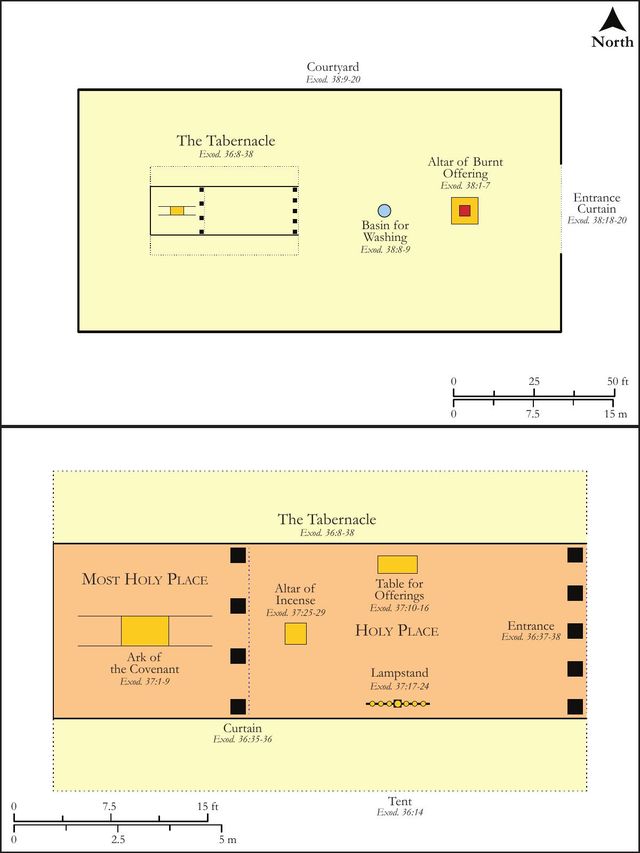
This verse is situated within the broader narrative of Exodus chapters 35-40, which meticulously recounts the actual construction and erection of the Tabernacle, its furnishings, and the priestly garments. Following the detailed divine instructions given to Moses on Mount Sinai in earlier chapters (particularly beginning in Exodus 25, with specific instructions for the Tabernacle's structure found in Exodus 26), chapters 35-39 describe the people's willing contributions and the skilled artisans' faithful execution of the work. Chapter 36, in particular, focuses on the construction of the Tabernacle's structural components, including the curtains, frames, and bases. Verse 24 specifically addresses the foundational elements for the north and south sides of the sanctuary, building upon the description of the boards themselves in Exodus 36:20-23. The meticulous detail highlights the direct fulfillment of God's commands, ensuring every part of the sacred dwelling was precisely as ordained.
Historical & Cultural Context
The construction of the Tabernacle occurred during the Israelites' wilderness journey, a pivotal period following their liberation from Egyptian bondage. As a nomadic people, a portable sanctuary was essential for maintaining God's presence among them. The materials, including the silver for these sockets, were largely derived from the freewill offerings of the people. Significantly, the silver for the sockets came from the half-shekel atonement money collected from every Israelite man aged twenty and above, as commanded in Exodus 30:11-16. This made the very foundation of God's dwelling place literally built upon the redemption offerings of His people, symbolizing their collective participation and atonement. The skilled craftsmen, like Bezalel and Oholiab, were divinely endowed with wisdom and understanding for this sacred task, ensuring the highest standards of artistry and precision were met in accordance with the divine architectural plans revealed to Moses on Mount Sinai, as detailed in Exodus 26:19-21. The use of heavy silver sockets for stability was crucial for a structure designed to be disassembled, transported, and reassembled repeatedly across diverse terrains.
Key Themes
ShowHideThis verse contributes significantly to several key themes within the book of Exodus and the broader Pentateuch. Firstly, it underscores the theme of Divine Prescription and Human Obedience, illustrating the Israelites' faithful adherence to God's exact and detailed instructions for the Tabernacle's construction, a testament to their commitment to His covenant. Secondly, the use of silver, specifically from the atonement money, highlights the theme of Redemption and Atonement as the Basis for God's Presence. The very foundation of the sanctuary was built upon the means of reconciliation, signifying that God's dwelling among His people is predicated on their redemption from sin. This concept is introduced in Exodus 30:11-16 and reinforced here. Thirdly, the meticulous design and interlocking components emphasize Stability and Order, reflecting the nature of God Himself—unchanging, reliable, and perfectly ordered. The Tabernacle, as God's dwelling, was designed to be a stable and secure representation of His presence amidst a transient people.
Exposition and Analysis
ShowHideKey Word Analysis
ShowHideFrom a root conveying strength, this term refers to the heavy, cast silver bases or pedestals into which the wooden boards of the Tabernacle were inserted. Though the verse uses the plural form, the singular ʼeden' denotes a "basis" or "foundation." These substantial bases, each weighing a talent (approximately 75 pounds, as inferred from the total silver used for them in Exodus 38:27), were crucial for the stability of the sanctuary walls, anchoring the upright boards firmly against the desert elements and the movements of the nomadic camp. They were the literal "feet" upon which the Tabernacle stood, signifying a strong and unyielding support.
This word refers to a "slab" or "plank." In the context of the Tabernacle, these were the upright frames or planks of acacia wood, overlaid with gold, that formed the walls of the sacred dwelling. Each board was carefully crafted with two tenons at its base, designed to fit precisely into the silver sockets. Their construction and arrangement, as described in previous verses, created a rigid and self-supporting structure when combined with the connecting bars, forming the very enclosure of God's presence.
While the verse uses the plural form, the singular yâd' literally means "hand." In this context, it refers to the projections or pegs at the bottom of each acacia wood board. The use of "hands" is a powerful metaphor, suggesting their gripping or holding function, as they were designed to be inserted firmly into the corresponding mortises within the silver sockets. This interlocking mechanism ensured a secure and stable connection between the wooden walls and their heavy silver foundations, allowing the entire structure to stand firm and unified.
Verse Breakdown
ShowHide"And forty sockets of silver he made under the twenty boards;"
This clause specifies the precise quantity and material of the foundational elements. For the twenty boards forming one side of the Tabernacle (either the north or south, as implied by the overall structure), a total of forty silver sockets were required. The "he" refers to Bezalel and the skilled craftsmen working under his divine inspiration and direction, meticulously following the divine instructions. This highlights the exact numerical requirement for the Tabernacle's structural integrity and stability.
"two sockets under one board for his two tenons, and two sockets under another board for his two tenons."
This elaborates on the specific arrangement and interlocking mechanism, clarifying that each of the twenty boards was supported by two distinct silver sockets. Each board had two tenons (projections) at its base, and these tenons were designed to fit securely into the two individual sockets. This dual support system ensured maximum stability and an even distribution of weight, creating a robust and immovable wall system for the sacred dwelling. The precise repetition of "two sockets...two tenons" emphasizes the perfect fit and interlocking nature of these components, signifying divine order and unwavering security.
Literary Devices
ShowHideThe passage employs Precision and Repetition to underscore the meticulous nature of the Tabernacle's construction and God's demand for exact adherence to His blueprint. The exact numbers ("forty sockets," "twenty boards," "two sockets," "two tenons") are not merely descriptive but prescriptive, highlighting God's demand for absolute accuracy in the execution of His divine plan. This precision serves to emphasize the holiness, order, and perfection inherent in God's dwelling place. Furthermore, the Symbolism of the silver sockets is profound. Silver, often associated with redemption, purification, and payment in the Old Testament, was derived from the atonement money. Thus, the very foundation of the Tabernacle, God's dwelling among His people, was built upon the collective offerings of atonement, symbolizing that God's presence is established on the basis of redemption and sacrifice. The heavy, unmovable nature of the sockets also symbolizes Stability and Endurance, representing the firm and unchanging foundation upon which God's covenant relationship with His people rests, capable of withstanding the trials of the wilderness journey.
Theological and Thematic Connections
ShowHideExodus 36:24 powerfully illustrates several key theological themes. Firstly, it emphasizes God's absolute demand for holiness and order in His dwelling place. Every detail, no matter how small or seemingly insignificant, was divinely specified and meticulously executed, reflecting God's perfect nature and His desire for a sanctuary that perfectly mirrored His glory and purity. Secondly, the silver sockets, derived from the atonement money, underscore the theme of redemption as the basis for God's presence. The very foundation of the Tabernacle was built upon the collective offering for atonement, signifying that access to God's presence is predicated on reconciliation and sacrifice. This foreshadows the ultimate sacrifice that would establish a new and living way into God's presence. Finally, the interconnectedness of the boards and sockets speaks to unity and stability. Each component, though distinct, was essential and perfectly fitted to create a strong, unified structure, symbolizing the corporate nature of God's people, where each member contributes to the strength and purpose of the whole, firmly established in God's design.
Reflection and Application
ShowHideThe meticulous detail in Exodus 36:24 serves as a profound reminder that God cares deeply about the foundations upon which things are built, whether physical structures or spiritual lives. Just as the Tabernacle required heavy, costly, and precisely fitted silver sockets for its stability, so too does our faith and Christian walk require a firm and divinely ordained foundation. This verse calls us to examine the "sockets" of our lives – the core beliefs, values, and commitments that support our spiritual structure. Are they solid, weighty, and derived from a place of redemption and sacrifice? It encourages us to build with diligence and precision, recognizing that even the seemingly small details of obedience and faithfulness contribute to the overall strength and integrity of our walk with God. Furthermore, the unity of the boards and sockets can inspire us to value the interconnectedness within the body of Christ, where each member, firmly rooted in the truth, contributes to the stability and collective witness of God's spiritual house, enabling it to stand strong against the shifting sands of the world.
Questions for Reflection
ShowHideFAQ
ShowHideWhy were the sockets made of silver and not gold, given that gold was used for so much of the Tabernacle?
ShowHideThe use of silver for the sockets, rather than gold, is highly significant and intentional. While gold symbolized divinity, purity, and glory, silver in the Old Testament was often associated with redemption, atonement, and payment. The silver for these sockets was specifically derived from the half-shekel atonement money collected from every Israelite man aged twenty and above (as detailed in Exodus 30:11-16). This means the very foundation of God's dwelling place among His people was literally built upon the collective offerings of atonement, emphasizing that God's presence is established on the basis of redemption and the reconciliation of His people. It powerfully symbolizes that access to God is granted through a payment for sin, foreshadowing the ultimate redemption found in Christ.
What is the significance of "two sockets under one board for his two tenons"?
ShowHideThis specific detail emphasizes the extreme stability and precision required for the Tabernacle's structure. Each board, forming part of the sanctuary wall, had two tenons (projections) at its base. These two tenons fit into two separate, heavy silver sockets. This dual support system provided unparalleled stability, ensuring that the walls of the holy dwelling were firmly anchored and could withstand the elements and the rigors of being transported across the wilderness. It highlights God's demand for a perfectly stable and secure dwelling place, symbolizing the unshakeable nature of His presence and His covenant. It also illustrates the principle of strong, redundant support for a sacred purpose, ensuring the integrity of the structure.
Christ-Centered Fulfillment
ShowHideExodus 36:24, with its focus on the foundational silver sockets, finds profound Christ-centered fulfillment. The heavy, costly silver sockets, derived from the atonement money, powerfully prefigure Jesus Christ as the ultimate and unshakeable foundation of God's dwelling among humanity. Just as the Tabernacle's stability rested entirely upon these sockets, so too does the spiritual house of God, the Church, rest upon Christ, the "chief cornerstone" (Ephesians 2:20) and the only true foundation upon which we can build (1 Corinthians 3:11). The silver, representing atonement, points directly to Jesus' sacrificial death on the cross, the once-for-all payment for sin that truly redeems and reconciles humanity to God (Hebrews 9:12). He is the true "atonement money" by which we gain access to God's presence and are made acceptable. Furthermore, the perfect fit of the boards into their sockets symbolizes the believer's secure placement in Christ; we are firmly rooted and established in Him, the solid ground upon which our faith stands (Colossians 2:7). The meticulous precision of the Tabernacle's construction foreshadows the perfect work of Christ, who flawlessly fulfilled every divine requirement, establishing a new and living way for God to dwell with His people, not in a temporary tent, but in the hearts of believers through the Holy Spirit (John 14:23; 1 Corinthians 6:19).