


Exodus 36:23
Bible text: King James Version (1769 Blayney text) · Public domain
Bible text: Berean Standard Bible · Public domain
Bible text: American Standard Version (1901) · Public domain
Bible text: World English Bible, Messianic edition · Public domain
Bible text: Geneva Bible (1599) · Public domain
Bible text: Young's Literal Translation · Public domain
- וַיַּעַשׂvai·Ya·'asand he madeH6213Conj-w ¦ V-Qal-ConsecImperf-3msVerb Qal Consecutive Imperfect 3rd Singular Masculineוַandיַּעַשׂhe made
- אֶת'et<obj.>H853DirObjMParticle Object Indicator
- הַקְּרָשִׁיםha·ke·ra·Shimthe framesH7175Art ¦ N-mpNoun Plural Masculine Absoluteהַtheקְּרָשִׁיםframes
- לַמִּשְׁכָּןla·mish·Kanfor the tabernacleH4908Prep-l ¦ N-msNoun Singular Masculine Absoluteלַfor theמִּשְׁכָּןtabernacle
- עֶשְׂרִים'es·RimtwentyH6242Adj-mpAdjective Numerical Plural Masculine Absolute
- קְרָשִׁיםke·ra·ShimframesH7175N-mpNoun Plural Masculine Absolute
- לִפְאַתlif·'Atfor [the] side ofH6285Prep-l ¦ N-fscNoun Singular Feminine Constructלִforפְאַת[the] side of
- נֶגֶבNe·gev[the] southH5045N-msNoun Singular Masculine Absolute
- תֵּימָנָהtei·Ma·nahsouth -wardH8486N-fs ¦ SfxNoun Singular Feminine Absoluteתֵּימָנָsouthה-ward
English is a literal word-by-word gloss of the Hebrew, not the KJV's wording. Why?
This is the original text the KJV's translators worked from — each Hebrew word with its own literal English meaning in this verse, prepared by scholars at Tyndale House, Cambridge. The KJV translates whole sentences, not word by word, so its wording differs: one Hebrew word can become several English words, and the KJV may choose “the LORD” where the gloss reads “Yahweh”. Both are faithful — they answer different questions. For the KJV's own rendering, switch to the KJV text.
Details
See on the biblical-era maps

Study this verse
Public-domain commentary
Matthew Henry
From his Commentary on the Whole Bible. Henry comments on passages, not single verses — this entry covers Exodus 36:14–34.
Here, 1. The shelter and special protection that the church is under are signified by the curtains of hair-cloth, which were spread over the tabernacle, and the covering of rams' skins and badgers' skins over them, Exo 36:14-19. God has provided for his people a shadow from the heat, and a covert from storm and rain, Isa 4:6. They are armed against all weathers; the sun and the moon shall not smite them: and they are protected from the storms of divine wrath, that hail which will sweep away the refuge of lies, Isa 28:17. Those that dwell in God's house shall find, be the tempest ever so violent, or the dropping ever so continual, it does not rain in. 2. The strength and stability of the church, though it is but a tabernacle, are signified by the boards and bars with which the curtains were borne up, Exo 36:20-34. The boards were coupled together and joined by the bars which shot through them; for the union of the church, and the hearty agreement of those that are its stays and supporters, contribute abundantly to its strength and establishment.
Continue studying Exodus 36:23 across the web’s major study libraries — every link below opens this exact verse, chapter, or book on the destination site.
Read & Compare
 BibleGatewayThis verse in more than 200 translations and 70 languages.
 Bible.comThe YouVersion reader — hundreds of translations, reading plans, and highlights.
 ESV.orgCrossway's official English Standard Version reader.
 NET BibleThe NET translation with 60,000+ translators' notes on every rendering decision.
 STEP BibleTyndale House's free study tool — original text, vocabulary, and scholarly resources.
 BibliaLogos Bible Software's free web reader.
 USCCBThe New American Bible (Revised Edition) with the U.S. bishops' study notes.
Commentaries
 BibleHub CommentariesDozens of classic commentaries on this verse, gathered on one page.
 StudyLightMore than 100 commentary sets — the largest collection on the web.
 BibleRefPlain-English commentary on what this verse means, verse by verse.
 Enduring WordDavid Guzik's free commentary on this chapter, widely used by Bible teachers.
 Bible Study ToolsVerse commentary alongside Greek and Hebrew study aids.
Original Language & Research
- BibleHub InterlinearThe verse word by word — original language, transliteration, and English.
- BibleHub LexiconEvery word's original-language definition and Strong's entry.
 Blue Letter BibleDeep-study tools — Strong's numbers, concordance, and word studies.
 SefariaThe Hebrew text with Rashi and centuries of Jewish commentary.
Sermons, Hymns & Audio


TrulyRandomVerse is not affiliated with these sites and doesn’t control their content. They’re linked because they’re genuinely useful.
Summary
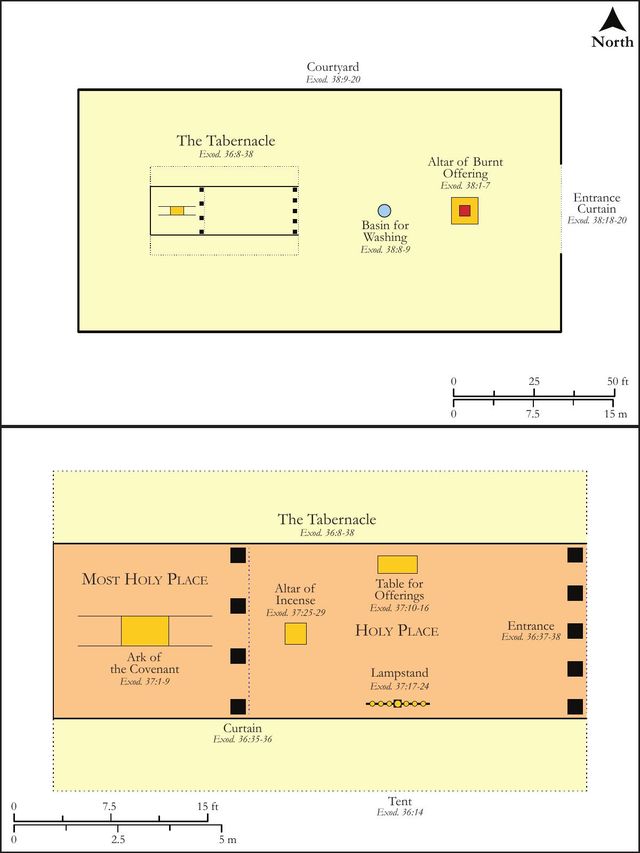
Exodus 36:23 meticulously records a specific detail in the construction of the Tabernacle: the fabrication of twenty sturdy boards for its south side. This seemingly minor architectural note serves as a powerful testament to the precise adherence of the skilled artisans, Bezalel and Aholiab, to the divine blueprint given by God to Moses. It underscores God's unwavering demand for order, perfection, and holiness in the sacred dwelling place ordained for His presence among the Israelites in the wilderness, establishing the foundational physical framework for His portable sanctuary.
Context
ShowHideLiterary Context
Exodus 36 is strategically positioned within the broader narrative of the Tabernacle's construction, bridging the detailed divine instructions (Exodus 25-31) and the final erection and dedication of the sanctuary (Exodus 39-40). This chapter marks a pivotal transition from God's command to human execution, highlighting the faithful and Spirit-empowered craftsmanship of Bezalel and Aholiab, alongside the willing contributions of the Israelite community, as detailed in Exodus 35:20-29. Verse 23 specifically describes the implementation of the structural plans previously outlined in Exodus 26:18, which explicitly states, "And for the south side southward there shall be twenty boards." The chapter's emphasis lies on the diligence and obedience of the people in meticulously fulfilling God's exact specifications for His dwelling place, demonstrating their commitment to the covenant.
Historical & Cultural Context
The Tabernacle was God's unique portable sanctuary, designed to accompany the Israelites throughout their wilderness wanderings. While temples were common among the nations, a divinely designed, portable dwelling was unprecedented, symbolizing God's active, intimate presence and continuous guidance among His chosen people. The materials, particularly acacia wood (often referred to as "shittim wood"), were indigenous to the desert environment and renowned for their exceptional durability and resistance to decay, signifying the enduring nature of God's covenant and His faithfulness. The meticulous detail, extending to the precise number and orientation of each board, stood in stark contrast to the often chaotic and anthropomorphic deities of the nations round about. This divine precision not only ensured the Tabernacle's structural integrity for transport and assembly but, more profoundly, conveyed the absolute holiness, transcendence, and perfect order of the God who condescended to dwell among His people, setting Him apart from pagan deities whose temples were often constructed according to human whims or local traditions.
Key Themes
ShowHideExodus 36:23 contributes significantly to several overarching themes within the book of Exodus and the Pentateuch. Foremost among these is the theme of Divine Presence and Dwelling, as the Tabernacle was the physical manifestation of God's desire to dwell among His people, a concept introduced powerfully in Exodus 25:8. The verse also highlights Divine Sovereignty and Meticulous Design, demonstrating that God's plans are precise and require exact adherence, leaving no room for human improvisation, a principle reiterated throughout the Tabernacle instructions (e.g., Exodus 25:9). Furthermore, it underscores Human Obedience and Skillful Craftsmanship, showcasing the willing and Spirit-empowered response of the Israelites and their artisans to God's commands, echoing the call for all to contribute their gifts to God's work (e.g., Exodus 35:30-35). The construction of the Tabernacle, down to its individual boards, embodies the sacred space where a holy God meets with His people, emphasizing the Holiness and Order required for such an encounter.
Exposition and Analysis
ShowHideKey Word Analysis
ShowHideThis verb (H6213) signifies more than simple creation; it denotes a comprehensive process of doing, making, accomplishing, and preparing. In the context of the Tabernacle, it implies the skilled and purposeful execution of God's detailed instructions. It encompasses the entire process of selecting, cutting, shaping, and finishing the acacia wood, transforming raw material into precisely crafted components. The use of this verb highlights the active and diligent work of Bezalel, Aholiab, and the craftsmen in bringing the divine blueprint to tangible reality.
This term (H7175) refers to the sturdy, upright planks or frames that formed the main structural walls of the Tabernacle. These were not merely flat pieces but meticulously engineered components of acacia wood, designed to interlock with tenons and sockets (as described in Exodus 26:17-19) to create a robust yet demountable structure. The term emphasizes their modular nature, facilitating the Tabernacle's portability. The quality and precision of these "boards" were paramount, as they bore the weight of the elaborate coverings and defined the sacred enclosure.
Derived from a root meaning "to dwell," this noun (H4908) literally refers to a dwelling place or residence. In this context, it specifically denotes the portable sanctuary, the "Tabernacle," which served as God's earthly dwelling among His people. The term itself underscores the central theological purpose of the structure: to be the place where God "tabernacled" or dwelt with Israel. The boards, therefore, were not just architectural elements but foundational components of the very place where the divine presence would reside.
Verse Breakdown
ShowHide"And he made boards for the tabernacle;"
This initial clause introduces the active construction phase, attributing the work to the lead craftsman, Bezalel, and his team (implied by "he," referring to the collective effort under Bezalel's Spirit-empowered leadership, as established in Exodus 36:1-2). The phrase emphasizes the careful fabrication of the "boards" (qeresh), which were the essential vertical elements designed to form the sacred enclosure where God's presence would manifest. This was not a casual assembly but a precise act of creation according to divine specifications.
"twenty boards for the south side southward:"
This specifies the exact quantity and precise orientation of these structural components. The number "twenty" is not arbitrary but divinely ordained, ensuring structural integrity and symmetrical design across the Tabernacle's sides, as previously commanded in Exodus 26:18. The repetition "south side southward" serves to eliminate any ambiguity regarding placement, emphasizing the meticulous adherence to the divine blueprint. This level of detail underscores God's absolute sovereignty over every aspect of worship and His desire for order, precision, and perfection in the sanctuary dedicated to Him.
Literary Devices
ShowHideExodus 36:23 employs several literary devices to convey its message of divine order and human obedience. The most prominent is Repetition, specifically in the phrase "south side southward." This seemingly redundant phrasing is a deliberate stylistic choice that serves to emphasize the extreme exactitude and specificity of God's instructions and, by extension, the meticulous obedience of the craftsmen. It reinforces the theme of divine order and the non-negotiable nature of the Tabernacle's design, leaving no room for human interpretation or deviation. Furthermore, the "boards" themselves, as components of the Tabernacle, carry significant Symbolism. Made of durable acacia wood, they symbolize the enduring nature of God's covenant and His steadfast presence. While not explicitly mentioned in this verse, these boards were later overlaid with gold (Exodus 26:29), adding a layer of symbolism representing divine glory, holiness, and preciousness. The entire act of constructing these boards according to a precise divine plan symbolizes the structured, holy, and covenantal relationship God desires with His people, where every detail matters in the establishment of sacred space and proper worship.
Theological and Thematic Connections
ShowHideExodus 36:23, though focused on an architectural detail, profoundly illustrates God's character and His relationship with humanity. It reveals a God who is meticulous, orderly, and demands precision in worship and service. The construction of the Tabernacle, down to the number and placement of each board, underscores the principle that God's dwelling place, and by extension, our approach to Him, must conform to His divine will, not human preference. This commitment to exactitude signifies the holiness of God and the seriousness of encountering His presence. The collective effort involved in bringing these boards to fruition also highlights the importance of communal participation and the contribution of individual gifts to the corporate worship and mission of God's people, demonstrating that every member's contribution, no matter how seemingly small, is vital to the whole.
Reflection and Application
ShowHideThe detailed account of the Tabernacle's construction, even in the specific mention of twenty boards for the south side, offers profound lessons for contemporary believers. It reminds us that God is a God of order, precision, and excellence, and He calls His people to reflect these attributes in their lives and service. Just as the craftsmen diligently followed every divine instruction, we are called to a life of obedient discipleship, recognizing that even the "small" details of our faith and conduct are significant in God's eyes. Our spiritual lives, our corporate worship, and our contributions to the body of Christ should be marked by intentionality and faithfulness to God's revealed will, rather than casual indifference or human expediency. This verse encourages us to consider how we are building our lives and our communities of faith, ensuring that every "board" and "component" aligns with God's divine blueprint for holiness and purpose, reflecting His character and honoring His presence among us.
Questions for Reflection
ShowHideFAQ
ShowHideWhy was such precise detail, like the number of boards, necessary for the Tabernacle?
ShowHideThe precise detail, including the exact number of twenty boards for the south side, was necessary for several profound reasons. Firstly, it demonstrated God's absolute sovereignty and meticulous nature; He is a God of perfect order, not chaos, and His dwelling place was to reflect His unblemished character. Secondly, this precision ensured the structural integrity and perfect symmetry of the Tabernacle, which was a portable sanctuary designed to be assembled and disassembled multiple times during the Israelites' arduous journeys. Every piece had to fit perfectly, as outlined in Exodus 26:15-25. Thirdly, it underscored the holiness and uniqueness of God's presence. Unlike human-designed structures, the Tabernacle was built entirely according to a divine blueprint, emphasizing that worship and access to God must be on His terms, not ours, a principle clearly stated in Exodus 25:9.
What was the significance of the materials used for the boards, particularly acacia wood?
ShowHideThe boards were made of acacia wood, also known as "shittim wood" (as mentioned in Exodus 26:15). This wood was highly significant because it was readily available in the wilderness where the Israelites were encamped. More importantly, acacia wood is exceptionally dense, durable, and resistant to decay, insects, and the harsh desert climate, making it an ideal material for a structure that needed to withstand the rigors of desert travel and last for decades. Its inherent strength provided the necessary stability for the Tabernacle's walls. While not explicitly mentioned in Exodus 36:23, these acacia boards were then overlaid with pure gold (Exodus 26:29), symbolizing the preciousness, holiness, and divine glory of God's presence. The combination of durable earthly material and precious divine overlay perfectly represented the nature of God's dwelling among His people: a holy, enduring presence in the midst of humanity.
Christ-Centered Fulfillment
ShowHideThe meticulous construction of the Tabernacle, with its precisely measured boards forming the very walls of God's dwelling, finds its ultimate and glorious fulfillment in Jesus Christ. The Tabernacle was a temporary, physical structure where God condescended to dwell among His people, serving as a tangible shadow of the perfect, eternal reality to come. Just as the twenty boards formed the stable framework of the south side, Christ is the foundational "board," the living stone, and the very cornerstone of God's eternal dwelling place, the Church, as powerfully articulated in Ephesians 2:20. The divine blueprint for the Tabernacle, with its emphasis on exactitude and holiness, perfectly foreshadows God's unblemished and sovereign plan of redemption, fully realized in Christ. In Jesus, God's presence is no longer confined to a tent or temple, but He "tabernacled" among us, full of grace and truth (John 1:14), becoming the ultimate embodiment of God's dwelling with humanity. The portability of the Tabernacle, symbolized by its modular boards designed for movement, hints at the universal reach of the Gospel, which is not confined to a single physical location but extends to all nations through Christ, building a spiritual temple comprised of believers from every tribe and tongue (1 Peter 2:5; Revelation 7:9). Thus, Exodus 36:23, in its detail about the Tabernacle's structure, points forward to the perfect, living temple that is Christ and His body, the Church, in whom God truly dwells.