


Exodus 36:22
Bible text: King James Version (1769 Blayney text) · Public domain
Bible text: Berean Standard Bible · Public domain
Bible text: American Standard Version (1901) · Public domain
Bible text: World English Bible, Messianic edition · Public domain
Bible text: Geneva Bible (1599) · Public domain
Bible text: Young's Literal Translation · Public domain
- שְׁתֵּיshe·TeitwoH8147Adj-fdcAdjective Numerical Dual Feminine Construct
- יָדֹתya·DothandsH3027N-cpNoun Plural common gender Absolute
- לַקֶּרֶשׁla·Ke·resh[belonged] to the frameH7175Prep-l ¦ N-msNoun Singular Masculine Absoluteלַ[belonged] to theקֶּרֶשׁframe
- הָאֶחָדha·'e·Chadthe oneH259Art ¦ Adj-fsAdjective Numerical Singular Feminine Absoluteהָtheאֶחָדone
- מְשֻׁלָּבֹתme·shu·la·VotjoinedH7947V-Pual-PassPrtcpl-fpVerb Pual Participle Passive Plural Feminine Absolute
- אַחַת'a·ChatoneH259Adj-fsAdjective Numerical Singular Feminine Absolute
- אֶל'eltoH413PrepPreposition
- אֶחָת'e·ChatoneH259Adj-fsAdjective Numerical Singular Feminine Absolute
- כֵּןkenthusH3651AdvAdverb
- עָשָׂה'a·Sahhe didH6213V-Qal-Perf-3msVerb Qal Perfect 3rd Singular Masculine
- לְכֹלle·Kholfor allH3605Prep-l ¦ N-mscNoun Singular Masculine Constructלְforכֹלall
- קַרְשֵׁיkar·Shei[the] frames ofH7175N-mpcNoun Plural Masculine Construct
- הַמִּשְׁכָּןha·mish·Kanthe tabernacleH4908Art ¦ N-msNoun Singular Masculine Absoluteהַtheמִּשְׁכָּןtabernacle
English is a literal word-by-word gloss of the Hebrew, not the KJV's wording. Why?
This is the original text the KJV's translators worked from — each Hebrew word with its own literal English meaning in this verse, prepared by scholars at Tyndale House, Cambridge. The KJV translates whole sentences, not word by word, so its wording differs: one Hebrew word can become several English words, and the KJV may choose “the LORD” where the gloss reads “Yahweh”. Both are faithful — they answer different questions. For the KJV's own rendering, switch to the KJV text.
Details
See on the biblical-era maps

Study this verse
Public-domain commentary
Matthew Henry
From his Commentary on the Whole Bible. Henry comments on passages, not single verses — this entry covers Exodus 36:14–34.
Here, 1. The shelter and special protection that the church is under are signified by the curtains of hair-cloth, which were spread over the tabernacle, and the covering of rams' skins and badgers' skins over them, Exo 36:14-19. God has provided for his people a shadow from the heat, and a covert from storm and rain, Isa 4:6. They are armed against all weathers; the sun and the moon shall not smite them: and they are protected from the storms of divine wrath, that hail which will sweep away the refuge of lies, Isa 28:17. Those that dwell in God's house shall find, be the tempest ever so violent, or the dropping ever so continual, it does not rain in. 2. The strength and stability of the church, though it is but a tabernacle, are signified by the boards and bars with which the curtains were borne up, Exo 36:20-34. The boards were coupled together and joined by the bars which shot through them; for the union of the church, and the hearty agreement of those that are its stays and supporters, contribute abundantly to its strength and establishment.
Continue studying Exodus 36:22 across the web’s major study libraries — every link below opens this exact verse, chapter, or book on the destination site.
Read & Compare
 BibleGatewayThis verse in more than 200 translations and 70 languages.
 Bible.comThe YouVersion reader — hundreds of translations, reading plans, and highlights.
 ESV.orgCrossway's official English Standard Version reader.
 NET BibleThe NET translation with 60,000+ translators' notes on every rendering decision.
 STEP BibleTyndale House's free study tool — original text, vocabulary, and scholarly resources.
 BibliaLogos Bible Software's free web reader.
 USCCBThe New American Bible (Revised Edition) with the U.S. bishops' study notes.
Commentaries
 BibleHub CommentariesDozens of classic commentaries on this verse, gathered on one page.
 StudyLightMore than 100 commentary sets — the largest collection on the web.
 BibleRefPlain-English commentary on what this verse means, verse by verse.
 Enduring WordDavid Guzik's free commentary on this chapter, widely used by Bible teachers.
 Bible Study ToolsVerse commentary alongside Greek and Hebrew study aids.
Original Language & Research
- BibleHub InterlinearThe verse word by word — original language, transliteration, and English.
- BibleHub LexiconEvery word's original-language definition and Strong's entry.
 Blue Letter BibleDeep-study tools — Strong's numbers, concordance, and word studies.
 SefariaThe Hebrew text with Rashi and centuries of Jewish commentary.
Sermons, Hymns & Audio


TrulyRandomVerse is not affiliated with these sites and doesn’t control their content. They’re linked because they’re genuinely useful.
Summary
Exodus 36:22 provides a precise architectural detail for the Tabernacle's construction, specifically describing the wooden boards that formed its walls. Each board was meticulously fashioned with two tenons, perfectly spaced to ensure a secure, stable, and unified interlocking system. This verse highlights the divine demand for exactness and order in the design of God's dwelling place, underscoring the faithful and precise execution of the divinely revealed blueprint by the skilled craftsmen, Bezalel and Aholiab, in every minute detail.
Context
ShowHideLiterary Context
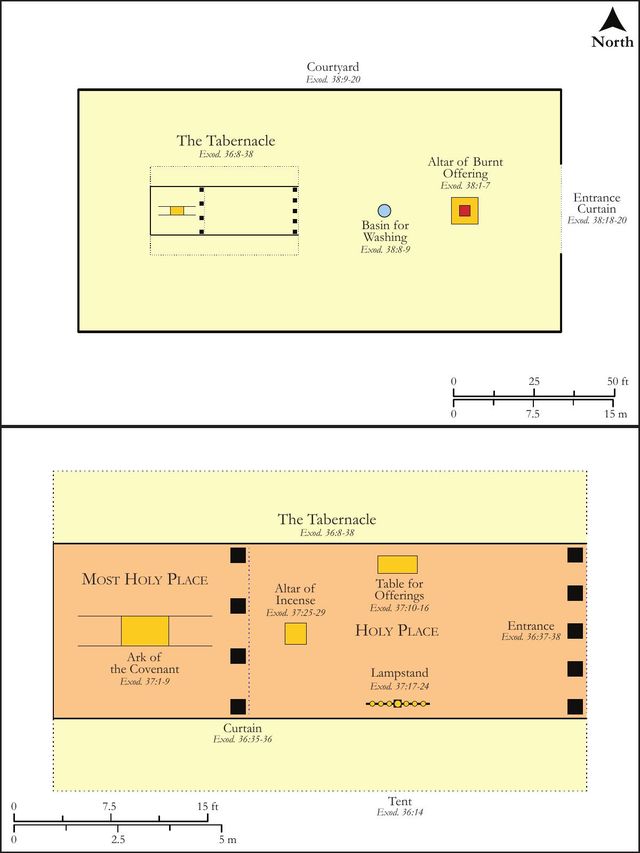
This verse is situated within the broader narrative of the Tabernacle's construction, a pivotal moment in Israel's wilderness journey. Following God's extensive and detailed instructions for the sanctuary's design in Exodus 25-31, Exodus 36 begins the account of their actual fabrication. Specifically, Exodus 36:8-38 focuses on the construction of the Tabernacle's main structural components, including the curtains, coverings, and the wooden boards. Verses 20-34 elaborate on these boards, detailing their material (acacia wood), precise dimensions, and the silver sockets designed to receive their tenons. Exodus 36:22, therefore, is a crucial detail within this section, emphasizing the meticulous craftsmanship applied to the foundational elements that ensured the Tabernacle's structural integrity and its ability to be both portable and robust. It underscores the transition from divine command to human obedience and skilled execution.
Historical & Cultural Context
The Tabernacle served as God's provisional dwelling place among the Israelites during their forty years of wilderness wandering, a tangible symbol of His covenant presence (as commanded in Exodus 25:8). Its construction was an unparalleled undertaking, requiring significant material contributions and highly skilled artisans, all provided through the freewill offerings of the Israelite community (detailed in Exodus 35:4-29). In a nomadic context, the Tabernacle's design prioritized both sacredness and practicality. The precise specifications for the boards, including the tenons and their "equally distant" spacing, were paramount for a structure that needed to be frequently dismantled, transported, and reassembled without compromising its structural integrity or sacred dimensions. This level of detail reflects not only divine architectural genius but also God's desire for order, beauty, and functional perfection in His sacred space, setting it apart from any human-devised structure and ensuring its stability amidst the rigors of the desert.
Key Themes
ShowHideExodus 36:22 contributes significantly to several key themes pervasive throughout the Tabernacle narrative. Foremost is the theme of Divine Precision and Order. God's instructions are not vague but incredibly detailed, down to the spacing of tenons, demonstrating His character as a God who values order and executes His plans with meticulous accuracy. This attention to detail underscores the Holiness and Sacredness of the Tabernacle; it is not merely a tent but a divinely ordained space reflecting divine perfection. The verse also highlights Faithful Obedience on the part of the craftsmen, who diligently followed every specification. The interlocking nature of the boards, secured by these tenons, subtly introduces the theme of Unity and Stability, essential for God's dwelling place among His people. This structural unity foreshadows the spiritual unity God desires for His people, as seen in the later development of the temple and ultimately the Church. The entire construction process, including this minute detail, emphasizes the Fulfillment of God's Will through human cooperation and skill, a testament to God's ability to equip and empower His people for His purposes, as seen in the anointing of Bezalel and Aholiab in Exodus 31:1-6.
Exposition and Analysis
ShowHideKey Word Analysis
ShowHideMeaning "a slab or plank." These were the primary structural components of the Tabernacle's walls, made of acacia wood and overlaid with gold. The term emphasizes their solid, foundational nature as individual units that, when joined, would form the sacred enclosure. The meticulous attention given to each "board" highlights its indispensable role in the overall integrity and divinely ordained dimensions of the sanctuary.
Literally meaning "a hand (the open one, indicating power, means, direction, etc.)." In this architectural context, "tenons" refers to the projecting pegs or tongues carved into the ends of the boards. The etymological connection to "hand" is highly suggestive, implying their function as grasping or interlocking elements. Just as hands provide connection, support, and stability, these tenons were critical for joining pieces of wood without nails, creating a strong, mortise-and-tenon joint that ensured the Tabernacle's walls would stand firm and unified.
Meaning "to space off; intensive (evenly) to make equidistant." This word emphasizes the precise, symmetrical spacing of the two tenons on each board. It underscores the divine demand for absolute accuracy and uniformity in the construction. This exact measurement was not arbitrary but crucial for ensuring that each board would align perfectly with its neighbors and sit flush within the corresponding silver sockets, guaranteeing the structural integrity and aesthetic harmony of the sacred dwelling.
Verse Breakdown
ShowHide"One board had two tenons"
This opening clause establishes the fundamental design principle for each individual Tabernacle board. The specification of "two tenons" instead of a single one was a critical engineering choice. A single tenon might allow for twisting or instability, whereas two tenons provided a balanced, robust connection, preventing rotational movement and ensuring a firm, non-wobbling fit into the corresponding silver sockets. This detail speaks to the inherent stability built into the Tabernacle's design.
"equally distant one from another"
This phrase further emphasizes the meticulous precision required in the craftsmanship. The exact, symmetrical spacing of these two tenons was paramount for ensuring that every board would align perfectly with its neighbors and sit flush within the silver sockets. This level of detail highlights the divine standard of order and perfection, where even seemingly minor measurements were vital for the overall structural integrity, aesthetic harmony, and symbolic purity of God's sacred dwelling. It implies a standard of uniformity across all boards.
"thus did he make for all the boards of the tabernacle."
This concluding statement confirms the universal application of this precise design principle. Every single board, without exception, was fashioned with these two equally spaced tenons. This highlights the consistency, uniformity, and comprehensive adherence to the divine blueprint in the construction. It reinforces the theme of faithful obedience from the builders and ensures that the entire Tabernacle structure was built to the same exacting divine specifications, reflecting God's unwavering commitment to order and His expectation of perfect execution for His sacred space.
Literary Devices
ShowHideExodus 36:22 masterfully employs Precision and Repetition to underscore the meticulous nature of the Tabernacle's construction and the divine character it reflects. The phrase "equally distant one from another" exemplifies the divine demand for exactness, highlighting God's nature as a God of order and intricate detail. This precision is not merely functional but also deeply symbolic, pointing to the perfect, unblemished, and unchangeable nature of the divine presence the Tabernacle was meant to house. Symbolism is also evident in the "tenons" themselves, which, derived from the Hebrew word for "hands" (yadot), symbolize the secure, interlocking unity and stability required for God's dwelling place. They represent the firm grasp and connection that holds the sacred structure together. The consistent application, "thus did he make for all the boards of the tabernacle," utilizes Repetition to emphasize the uniformity and universal adherence to the divine blueprint, reinforcing the themes of faithful obedience, comprehensive design, and the holistic integrity of God's sacred space. This consistent application ensures that no part of the Tabernacle was an afterthought, but each was perfectly integrated into the divine plan.
Theological and Thematic Connections
ShowHideExodus 36:22, in its detailed description of the Tabernacle boards and their precise tenons, speaks profoundly to God's character as a God of order, precision, and intentionality. Every detail, no matter how small, was divinely specified and critical to the sanctuary's integrity and function. This reflects a profound theological truth: God cares about the specifics, not just the generalities, in His plans for creation, redemption, and our lives. The interlocking tenons symbolize unity, stability, and mutual support, essential for a sacred space that would represent God's presence among a unified people. This foreshadows the New Testament concept of the church as a spiritual building, perfectly joined together and growing into a holy temple in the Lord, where each part contributes to the whole.
Reflection and Application
ShowHideThe meticulous detail in Exodus 36:22, focusing on the precisely crafted tenons of the Tabernacle boards, offers profound lessons for contemporary believers. It serves as a powerful reminder that God is a God of infinite detail, whose plans are executed with perfect precision and whose standards are unwavering. This should inspire us to approach our own lives, our service, and our spiritual disciplines with diligence, recognizing that even the seemingly small components of our obedience and faithfulness contribute to the larger, divinely ordained structure of His kingdom. Just as each board, with its perfectly crafted and "equally distant" tenons, was essential for the stability and unity of the Tabernacle, so too are individual believers, with their unique gifts and callings, vital for the health and strength of the Church, the living temple of God. Our interconnectedness, when rooted in God's design and empowered by His Spirit, creates a robust and unified witness to His glory, demonstrating the beauty and strength of a body working in harmony.
Questions for Reflection
ShowHideFAQ
ShowHideWhy did the Tabernacle boards need "two tenons, equally distant"?
ShowHideThe requirement for two tenons, precisely spaced and "equally distant," was absolutely crucial for the structural integrity and stability of the Tabernacle walls. A single tenon would have allowed the board to twist or pivot, compromising the rigidity and squareness of the entire structure. By contrast, two tenons, especially when "equally distant," ensured that each board was firmly anchored and perfectly aligned within its corresponding silver sockets (as described in Exodus 36:24). This sophisticated design prevented any lateral movement or rotational instability, maintaining the exact dimensions and perfect geometry of the sanctuary. This was essential for a portable dwelling that needed to be frequently dismantled, transported across rugged terrain, and reassembled without losing its structural integrity or sacred proportions. It vividly reflects God's demand for ultimate order and perfection in His sacred space, ensuring that everything was constructed "according to the pattern" He meticulously showed Moses on the mountain (as stated in Exodus 25:9).
Christ-Centered Fulfillment
ShowHideThe precise construction of the Tabernacle, particularly the interlocking boards with their perfectly spaced tenons, serves as a profound type foreshadowing the ultimate dwelling of God among humanity: Jesus Christ. While the Tabernacle was a temporary, physical structure housing God's presence, John 1:14 declares that "the Word became flesh and dwelt among us," using the Greek word eskēnōsen, which literally means "tabernacled" or "pitched His tent." Jesus is the true and perfect Tabernacle, the ultimate meeting place between God and humanity, embodying divine precision and perfect unity. Just as the Tabernacle boards were perfectly joined by their tenons, Christ perfectly unites divinity and humanity in His person, serving as the flawless mediator and the very presence of God with us. Furthermore, this imagery extends to the Church, which is described as a spiritual temple built on the foundation of the apostles and prophets, with Christ Jesus Himself as the chief cornerstone (as seen in Ephesians 2:19-22). Believers are "living stones" (from 1 Peter 2:4-5) perfectly fitted together by the Holy Spirit, reflecting the divine order and unity first seen in the Tabernacle's meticulous design. All these shadows find their substance and perfect fulfillment in Christ, our perfect High Priest and the reality to which the Tabernacle pointed (as explained in Hebrews 9:11-12).