


Exodus 36:21
Bible text: King James Version (1769 Blayney text) · Public domain
Bible text: Berean Standard Bible · Public domain
Bible text: American Standard Version (1901) · Public domain
Bible text: World English Bible, Messianic edition · Public domain
Bible text: Geneva Bible (1599) · Public domain
Bible text: Young's Literal Translation · Public domain
- עֶשֶׂר'E·ser[was] tenH6235N-mscNoun Singular Masculine Construct
- אַמֹּות'a·MotcubitsH520N-fpNoun Plural Feminine Absolute
- אֹרֶךְ'O·rekh[the] length ofH753N-mscNoun Singular Masculine Construct
- הַקָּרֶשׁha·Ka·reshthe frameH7175Art ¦ N-msNoun Singular Masculine Absoluteהַtheקָּרֶשׁframe
- וְאַמָּהve·'a·Mahand [was] a cubitH520Conj-w ¦ N-fsNoun Singular Feminine Absoluteוְandאַמָּה[was] a cubit
- וַחֲצִיva·cha·Tziand [the] half ofH2677Conj-w ¦ N-mscNoun Singular Masculine Constructוַandחֲצִי[the] half of
- הָאַמָּהha·'a·Mah<the> cubitH520Art ¦ N-fsNoun Singular Feminine Absoluteהָ<the>אַמָּהcubit
- רֹחַבRo·chav[the] breadth ofH7341N-mscNoun Singular Masculine Construct
- הַקֶּרֶשׁha·Ke·reshthe frameH7175Art ¦ N-msNoun Singular Masculine Absoluteהַtheקֶּרֶשׁframe
- הָאֶחָדha·'e·Chad<the> oneH259Art ¦ Adj-fsAdjective Numerical Singular Feminine Absoluteהָ<the>אֶחָדone
English is a literal word-by-word gloss of the Hebrew, not the KJV's wording. Why?
This is the original text the KJV's translators worked from — each Hebrew word with its own literal English meaning in this verse, prepared by scholars at Tyndale House, Cambridge. The KJV translates whole sentences, not word by word, so its wording differs: one Hebrew word can become several English words, and the KJV may choose “the LORD” where the gloss reads “Yahweh”. Both are faithful — they answer different questions. For the KJV's own rendering, switch to the KJV text.
Details
See on the biblical-era maps

Study this verse
Public-domain commentary
Matthew Henry
From his Commentary on the Whole Bible. Henry comments on passages, not single verses — this entry covers Exodus 36:14–34.
Here, 1. The shelter and special protection that the church is under are signified by the curtains of hair-cloth, which were spread over the tabernacle, and the covering of rams' skins and badgers' skins over them, Exo 36:14-19. God has provided for his people a shadow from the heat, and a covert from storm and rain, Isa 4:6. They are armed against all weathers; the sun and the moon shall not smite them: and they are protected from the storms of divine wrath, that hail which will sweep away the refuge of lies, Isa 28:17. Those that dwell in God's house shall find, be the tempest ever so violent, or the dropping ever so continual, it does not rain in. 2. The strength and stability of the church, though it is but a tabernacle, are signified by the boards and bars with which the curtains were borne up, Exo 36:20-34. The boards were coupled together and joined by the bars which shot through them; for the union of the church, and the hearty agreement of those that are its stays and supporters, contribute abundantly to its strength and establishment.
Continue studying Exodus 36:21 across the web’s major study libraries — every link below opens this exact verse, chapter, or book on the destination site.
Read & Compare
 BibleGatewayThis verse in more than 200 translations and 70 languages.
 Bible.comThe YouVersion reader — hundreds of translations, reading plans, and highlights.
 ESV.orgCrossway's official English Standard Version reader.
 NET BibleThe NET translation with 60,000+ translators' notes on every rendering decision.
 STEP BibleTyndale House's free study tool — original text, vocabulary, and scholarly resources.
 BibliaLogos Bible Software's free web reader.
 USCCBThe New American Bible (Revised Edition) with the U.S. bishops' study notes.
Commentaries
 BibleHub CommentariesDozens of classic commentaries on this verse, gathered on one page.
 StudyLightMore than 100 commentary sets — the largest collection on the web.
 BibleRefPlain-English commentary on what this verse means, verse by verse.
 Enduring WordDavid Guzik's free commentary on this chapter, widely used by Bible teachers.
 Bible Study ToolsVerse commentary alongside Greek and Hebrew study aids.
Original Language & Research
- BibleHub InterlinearThe verse word by word — original language, transliteration, and English.
- BibleHub LexiconEvery word's original-language definition and Strong's entry.
 Blue Letter BibleDeep-study tools — Strong's numbers, concordance, and word studies.
 SefariaThe Hebrew text with Rashi and centuries of Jewish commentary.
Sermons, Hymns & Audio


TrulyRandomVerse is not affiliated with these sites and doesn’t control their content. They’re linked because they’re genuinely useful.
Summary
Exodus 36:21 meticulously details the precise dimensions of the wooden boards that formed the structural framework of the Tabernacle, specifying each board's length as ten cubits and its breadth as one and a half cubits. This verse underscores the faithful and exact execution of God's divine blueprint by the skilled artisans, highlighting the unwavering adherence to the heavenly pattern for the portable sanctuary where the Lord would manifest His presence among His people in the wilderness.
Context
ShowHideLiterary Context
Exodus 36:21 is situated within the broader narrative of the Tabernacle's construction, specifically detailing the practical implementation of the divine instructions Moses received on Mount Sinai (Exodus 25-31). Following the enthusiastic freewill offerings from the Israelite community (Exodus 35:20-29) and the divine appointment of master craftsmen Bezalel and Oholiab, filled with the Spirit of God for this sacred task (Exodus 35:30-35), chapter 36 transitions from the command to the commencement and completion of the work. Verses 8-38 of Exodus 36 describe the fabrication of the Tabernacle's core components, including the intricate curtains, durable coverings, and crucially, the very wooden boards mentioned in this verse. These dimensions directly correspond to the initial divine specifications given in Exodus 26:16, emphasizing the unwavering fidelity of the builders to God's precise design. This section serves as a powerful testament to the meticulousness required for sacred worship and the physical manifestation of God's holy presence among His people.
Historical & Cultural Context
The Tabernacle served as the central, portable sanctuary for the Israelites during their forty-year nomadic journey through the wilderness. It was a tangible, visible symbol of God's covenant presence and His commitment to dwell among His chosen people. Among the nations, temples were often conceived as models of heaven and earth, reflecting divine order and the dwelling place of deities. However, the Tabernacle's unique feature was its inherent portability, designed for a people constantly on the move, and its function as a dwelling for Yahweh who chose to reside with His people, not merely above them or in an inaccessible realm. The "cubit" (Hebrew: ammah) was a standard unit of measurement among the nations, typically based on the length of a forearm from the elbow to the tip of the middle finger, varying slightly but generally around 18-21 inches (45-53 cm). The consistency and precision of these measurements were paramount for the structural integrity, uniformity, and proper assembly of the Tabernacle, ensuring that every piece fit together perfectly according to the "pattern shown... on the mountain" (as commanded in Exodus 25:9). This profound attention to detail reflects a cultural understanding that sacred spaces must be constructed with utmost care, reverence, and exactitude, mirroring divine perfection and authority.
Key Themes
ShowHideThis verse, by detailing the precise dimensions of the Tabernacle boards, contributes significantly to several overarching themes in Exodus and the Pentateuch. Firstly, it highlights the theme of Divine Sovereignty and Authority, demonstrating that God's will extends to the minutest details of worship and sacred space. The exactness of the measurements leaves no room for human improvisation, underscoring that the Tabernacle was entirely God's design, not man's. Secondly, it emphasizes Obedience and Faithfulness on the part of the Israelites, particularly the craftsmen. Their meticulous adherence to every specification, even seemingly mundane measurements, exemplifies the kind of faithful obedience God expects from His people in all areas of life, especially in matters of worship and covenant relationship (Deuteronomy 5:32). Thirdly, the precision points to the theme of Holiness and Perfection associated with God's presence. A dwelling for a holy God must be perfect in its construction, reflecting His character. This pursuit of perfection in the physical structure foreshadows the spiritual perfection required to approach God, ultimately fulfilled in Christ. Finally, it reinforces the theme of God's Dwelling Among His People, as these boards formed the very walls of the sanctuary where the glory of the Lord would reside (Exodus 40:34).
Exposition and Analysis
ShowHideKey Word Analysis
ShowHideMeaning "length." This term specifies the vertical dimension of the Tabernacle boards, indicating their height. The emphasis on "length" here is crucial as it defines the overall stature of the sanctuary's walls, contributing to its imposing presence in the wilderness. It signifies the fixed, unalterable height God prescribed for His dwelling.
Meaning "a slab or plank." This word refers to the upright wooden frames that constituted the primary structural elements of the Tabernacle's walls. These were not solid walls but precisely cut planks, likely made of acacia wood, designed to be interlocked. The term highlights the individual components that, when assembled with precision, formed a unified and stable structure.
Meaning "a unit of measure, or the fore-arm (below the elbow), i.e., a cubit." This is the standard unit of linear measurement used throughout the Tabernacle's construction. Its inclusion underscores the exactitude of God's instructions, communicating the precise dimensions in terms familiar to the ancient builders. The use of a standardized measure ensures uniformity and adherence to the divine blueprint, leaving no room for approximation.
Verse Breakdown
ShowHide"The length of a board [was] ten cubits"
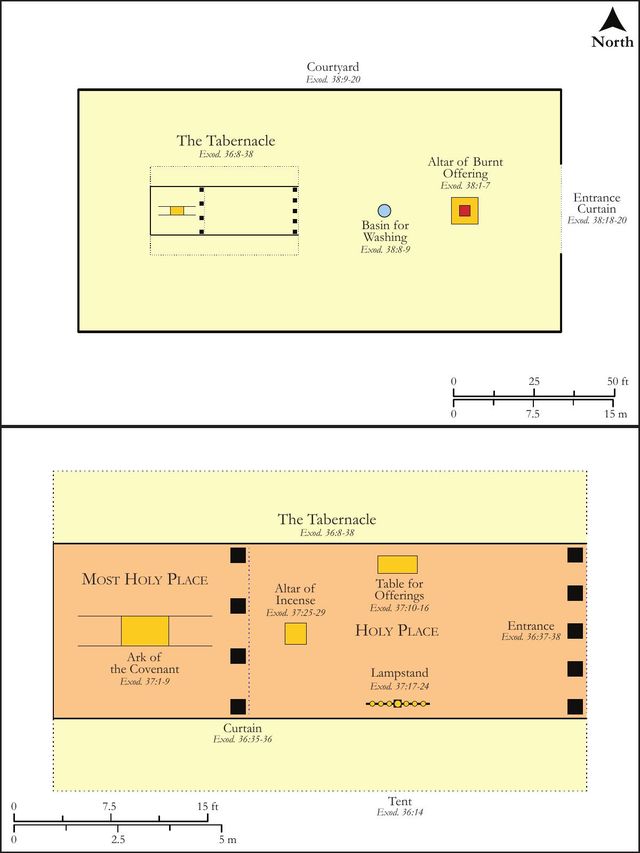
This clause specifies the height of each individual wooden board, which would stand upright to form the walls of the Tabernacle. Ten cubits (approximately 15-17.5 feet or 4.5-5.3 meters) was a significant height, imparting a sense of grandeur and sacredness to the portable sanctuary in the open wilderness. This uniform height was essential for the structural integrity and for supporting the various layers of curtains and coverings that formed the Tabernacle's roof and inner sanctum, ensuring a consistent and majestic appearance.
"and the breadth of a board one cubit and a half"
This clause provides the width of each board. One and a half cubits (approximately 27-31.5 inches or 68-80 centimeters) was a precise dimension crucial for the interlocking mechanism of the boards. These boards were designed with tenons at the bottom that fit into silver sockets, and their consistent width ensured a tight, stable, and rigid wall structure, preventing collapse and maintaining the integrity of the sacred space. This detail emphasizes the functional design, where every dimension served a specific purpose in the overall construction and stability of God's dwelling.
Literary Devices
ShowHideThe primary literary device at play in Exodus 36:21, and indeed throughout the Tabernacle construction narrative, is Precision. The exact numerical specifications for the boards' length and breadth are a powerful testament to the meticulous detail of God's instructions. This precision is not merely functional; it is deeply symbolic, conveying the divine demand for Order and Perfection in all things pertaining to God's dwelling and worship. The Repetition of these exact measurements, first given as commands in Exodus 26:16 and then reiterated in their execution in Exodus 36, reinforces the theme of faithful obedience to God's blueprint. This detailed enumeration also serves as a form of Emphasis, highlighting the sacredness and significance of every component of the Tabernacle, underscoring that nothing in God's plan is arbitrary or left to chance. The consistent use of specific measurements also creates a sense of Verisimilitude, lending credibility to the narrative as a factual account of construction.
Theological and Thematic Connections
ShowHideExodus 36:21, with its precise dimensions, powerfully conveys God's character as a God of order, holiness, and intentionality. The meticulous detail required for the Tabernacle's construction reflects that God cares deeply about how His presence is honored and how His worship is conducted. This precision is not arbitrary but points to the divine perfection and the sacredness of the space where God chose to dwell among His people. It teaches that obedience to God's specific commands, even in seemingly small details, is paramount in serving Him. The Tabernacle, built to exact specifications, prefigures a greater reality: God's desire to dwell perfectly among humanity and His demand for a worship that reflects His own ordered and holy nature. This attention to detail underscores that true worship is not haphazard but is offered according to divine prescription.
Reflection and Application
ShowHideThe exacting measurements of the Tabernacle boards in Exodus 36:21 offer profound lessons for contemporary believers. God's meticulous attention to every detail in His dwelling place reminds us that He is a God of order, precision, and intentionality. This should inspire us to approach our own lives, our worship, and our service to Him with similar care and faithfulness. Just as the craftsmen adhered strictly to the divine blueprint, we are called to live in obedience to God's Word, recognizing that our lives, individually and corporately as the Church, are now a spiritual dwelling for His Spirit. This verse challenges us to consider if we are building our "spiritual house" – our character, our relationships, our ministries, our communities – according to God's perfect design, or if we are cutting corners, relying on our own estimations, or neglecting the "small" details. It encourages us to pursue excellence, integrity, and careful adherence to biblical principles in all that we do, knowing that God values faithfulness in the seemingly insignificant details as much as in the grand plans. Our commitment to precision in discipleship and doctrine reflects our reverence for the God who is Himself precise and perfect.
Questions for Reflection
ShowHideFAQ
ShowHideWhy are these specific dimensions so important?
ShowHideThe specific dimensions of the Tabernacle boards are crucial for several profound reasons. Firstly, they unequivocally demonstrate the divine origin of the design; God, as the ultimate architect, provided precise measurements, leaving no room for human improvisation or subjective interpretation (as seen in Exodus 26:16). This underscores His absolute sovereignty and the sacredness of His dwelling. Secondly, these exact measurements were indispensable for the structural integrity and stability of the portable sanctuary. Every board had to fit perfectly, interlocking with other components, to support the heavy coverings and maintain the Tabernacle's form during assembly and disassembly, crucial for a nomadic people. Finally, the precision itself carries profound symbolic weight, representing God's perfect order, His inherent holiness, and His expectation of faithful, exact obedience from those who serve Him and approach His presence.
What is a "cubit" and why is it used here?
ShowHideA "cubit" (Hebrew: ammah) was a common ancient unit of linear measurement, typically defined as the length from the elbow to the tip of the middle finger. While its exact length could vary slightly depending on the region and period (ranging from approximately 18 to 21 inches or 45 to 53 centimeters), it was a widely understood and practical unit for construction among the nations. It is used here because it was the standard unit of measurement for the Israelites and the nations round about, making the divine instructions clear, unambiguous, and immediately actionable for the craftsmen responsible for building the Tabernacle. Its use highlights the practical nature of God's instructions, communicated in terms familiar and comprehensible to His people, ensuring no confusion regarding the sacred blueprint.
Christ-Centered Fulfillment
ShowHideThe precise dimensions of the Tabernacle boards, forming the very structure of God's dwelling among His people, find their ultimate Christ-centered fulfillment in Jesus Christ. The Tabernacle, with its meticulous design, was a temporary and shadow-like dwelling, pointing forward to the perfect and permanent reality of God's presence. Jesus is the true "Tabernacle" (or "tent") among us, for in Him, "the Word became flesh and dwelt among us" (John 1:14). Just as the Tabernacle boards were perfectly crafted according to a divine blueprint, Christ's humanity was perfectly formed and lived in absolute obedience to the Father's will, embodying divine perfection in every aspect of His life and ministry (Philippians 2:8). He is the ultimate foundation and cornerstone, the one upon whom the spiritual temple, the Church, is built, with believers themselves becoming living stones (Ephesians 2:20-22). The Tabernacle's purpose was to facilitate God's presence and atonement; Christ, through His perfect, once-for-all sacrifice, not only made atonement but also made it possible for God to dwell within believers through the Holy Spirit, transforming us into living temples (1 Corinthians 6:19). Thus, the physical precision of Exodus 36:21 foreshadows the spiritual perfection and eternal dwelling found in Christ, Immanuel, "God with us" (Matthew 1:23).