


Exodus 36:25
Bible text: King James Version (1769 Blayney text) · Public domain
Bible text: Berean Standard Bible · Public domain
Bible text: American Standard Version (1901) · Public domain
Bible text: World English Bible, Messianic edition · Public domain
Bible text: Geneva Bible (1599) · Public domain
Bible text: Young's Literal Translation · Public domain
- וּלְצֶלַעu·le·Tze·la'and for [the] side ofH6763Conj-w ¦ Prep-l ¦ N-fscNoun Singular Feminine Constructוּandלְforצֶלַע[the] side of
- הַמִּשְׁכָּןha·mish·Kanthe tabernacleH4908Art ¦ N-msNoun Singular Masculine Absoluteהַtheמִּשְׁכָּןtabernacle
- הַשֵּׁנִיתha·she·Nit<the> secondH8145Art ¦ Adj-fsAdjective Numerical Position Singular Feminine Absoluteהַ<the>שֵּׁנִיתsecond
- לִפְאַתlif·'Atto [the] side ofH6285Prep-l ¦ N-fscNoun Singular Feminine Constructלִtoפְאַת[the] side of
- צָפוֹןtza·Fon[the] northH6828N-fsNoun Singular Feminine Absolute
- עָשָׂה'a·Sahhe madeH6213V-Qal-Perf-3msVerb Qal Perfect 3rd Singular Masculine
- עֶשְׂרִים'es·RimtwentyH6242Adj-mpAdjective Numerical Plural Masculine Absolute
- קְרָשִׁיםke·ra·ShimframesH7175N-mpNoun Plural Masculine Absolute
English is a literal word-by-word gloss of the Hebrew, not the KJV's wording. Why?
This is the original text the KJV's translators worked from — each Hebrew word with its own literal English meaning in this verse, prepared by scholars at Tyndale House, Cambridge. The KJV translates whole sentences, not word by word, so its wording differs: one Hebrew word can become several English words, and the KJV may choose “the LORD” where the gloss reads “Yahweh”. Both are faithful — they answer different questions. For the KJV's own rendering, switch to the KJV text.
Details
See on the biblical-era maps

Study this verse
Public-domain commentary
Matthew Henry
From his Commentary on the Whole Bible. Henry comments on passages, not single verses — this entry covers Exodus 36:14–34.
Here, 1. The shelter and special protection that the church is under are signified by the curtains of hair-cloth, which were spread over the tabernacle, and the covering of rams' skins and badgers' skins over them, Exo 36:14-19. God has provided for his people a shadow from the heat, and a covert from storm and rain, Isa 4:6. They are armed against all weathers; the sun and the moon shall not smite them: and they are protected from the storms of divine wrath, that hail which will sweep away the refuge of lies, Isa 28:17. Those that dwell in God's house shall find, be the tempest ever so violent, or the dropping ever so continual, it does not rain in. 2. The strength and stability of the church, though it is but a tabernacle, are signified by the boards and bars with which the curtains were borne up, Exo 36:20-34. The boards were coupled together and joined by the bars which shot through them; for the union of the church, and the hearty agreement of those that are its stays and supporters, contribute abundantly to its strength and establishment.
Continue studying Exodus 36:25 across the web’s major study libraries — every link below opens this exact verse, chapter, or book on the destination site.
Read & Compare
 BibleGatewayThis verse in more than 200 translations and 70 languages.
 Bible.comThe YouVersion reader — hundreds of translations, reading plans, and highlights.
 ESV.orgCrossway's official English Standard Version reader.
 NET BibleThe NET translation with 60,000+ translators' notes on every rendering decision.
 STEP BibleTyndale House's free study tool — original text, vocabulary, and scholarly resources.
 BibliaLogos Bible Software's free web reader.
 USCCBThe New American Bible (Revised Edition) with the U.S. bishops' study notes.
Commentaries
 BibleHub CommentariesDozens of classic commentaries on this verse, gathered on one page.
 StudyLightMore than 100 commentary sets — the largest collection on the web.
 BibleRefPlain-English commentary on what this verse means, verse by verse.
 Enduring WordDavid Guzik's free commentary on this chapter, widely used by Bible teachers.
 Bible Study ToolsVerse commentary alongside Greek and Hebrew study aids.
Original Language & Research
- BibleHub InterlinearThe verse word by word — original language, transliteration, and English.
- BibleHub LexiconEvery word's original-language definition and Strong's entry.
 Blue Letter BibleDeep-study tools — Strong's numbers, concordance, and word studies.
 SefariaThe Hebrew text with Rashi and centuries of Jewish commentary.
Sermons, Hymns & Audio


TrulyRandomVerse is not affiliated with these sites and doesn’t control their content. They’re linked because they’re genuinely useful.
Summary
Exodus 36:25 meticulously records a specific detail in the construction of the Tabernacle: the fabrication of twenty boards for its north side. This verse is part of the larger narrative demonstrating the faithful and precise execution of God's divine blueprint for His portable sanctuary. It underscores the profound significance of every structural component in establishing a holy dwelling place, reflecting God's character of order and His desire for intimate communion with His people in the wilderness.
Context
ShowHideLiterary Context
Exodus 36:25 is situated within the comprehensive account of the Tabernacle's construction, spanning from Exodus 35 through Exodus 40. This section immediately follows the detailed divine instructions Moses received on Mount Sinai concerning the sanctuary's design (Exodus 25-31). Chapter 35 initiates the practical phase by calling for freewill offerings and identifying the divinely gifted artisans, Bezalel and Oholiab, who were "filled with the Spirit of God" for this sacred task (Exodus 35:30-35). Exodus 36 then transitions into the actual manufacturing process, beginning with the collection of materials and proceeding through the creation of the various components. Verse 25 specifically addresses the construction of the Tabernacle's wooden framework, following the completion of the curtains and coverings, and preceding the making of the Veil, screen, and furnishings. This particular verse, along with its parallel descriptions for the south and west sides, emphasizes the systematic and sequential nature of the building project, ensuring that every piece conformed precisely to the divine specifications outlined in Exodus 26.
Historical & Cultural Context
The construction of the Tabernacle occurred during the Israelites' transformative period as a nomadic people in the wilderness, following their miraculous exodus from Egypt. Their transient lifestyle necessitated a portable sanctuary that could be efficiently dismantled, transported, and reassembled, a design imperative that profoundly influenced the Tabernacle's structure, including its crucial wooden framework. In stark contrast to the monumental, fixed temples of surrounding pagan nations, which often housed idols, the Tabernacle symbolized Yahweh's dynamic, living presence "dwelling" (from the Hebrew root shakan, which gives us mishkan or "Tabernacle") intimately among His people wherever they journeyed. The extraordinary level of detail in God's instructions and the Israelites' meticulous execution, down to the exact number of boards, communicated profound theological truths: God's absolute holiness, His demand for ordered and reverent worship, and His unwavering covenant faithfulness. This divine precision also served to distinguish the worship of Yahweh from the often chaotic, arbitrary, and syncretistic practices of idolatrous cults, asserting that God's presence and worship were established solely on His perfect, revealed will, not human invention. The craftsmen, endowed with divine skill and wisdom, were not merely builders but instruments in God's redemptive plan, constructing the very place where atonement would be made and God's glory would manifest.
Key Themes
ShowHideExodus 36:25 contributes to several overarching themes within the book of Exodus and the Pentateuch. First, it highlights the theme of Divine Revelation and Obedience. God's detailed blueprint for the Tabernacle, as seen in Exodus 25-31, demanded precise obedience from the Israelites, which this verse exemplifies in its faithful execution. Second, the verse underscores the theme of God's Dwelling Among His People. The Tabernacle's very purpose was to provide a physical space for God's presence in the midst of Israel, a concept central to the covenant relationship. The twenty boards formed the very walls of this sacred "dwelling place" (Exodus 25:8). Third, the meticulous construction speaks to the theme of Holiness and Order in Worship. The precision required for each component, including the specific number of boards for the north side, reflects God's holy character and His demand for intentionality, beauty, and order in approaching Him. Finally, it subtly points to God's Faithfulness, as He provides the means and the blueprint for His people to draw near to Him, fulfilling His promise to be their God.
Exposition and Analysis
ShowHideKey Word Analysis
ShowHideThis term, derived from the root shakan ("to dwell"), refers to a "residence" or "dwelling place." In this context, it specifically denotes the portable sanctuary built by the Israelites, particularly its wooden walls. The use of "Tabernacle" emphasizes its primary purpose: to be God's earthly abode, signifying His desire to dwell intimately among His chosen people. The boards described in the verse form the very structure of this divine residence.
This primitive root is a broad verb meaning "to do or make" in its widest application. In Exodus 36:25, it signifies the active, purposeful construction by the skilled craftsmen, Bezalel and Oholiab, and their assistants. It highlights the transition from divine instruction to human execution, emphasizing the diligent labor and craftsmanship involved in bringing God's precise plans into physical reality.
This word refers to a "slab or plank." In the context of the Tabernacle, these were substantial, precisely cut planks of acacia wood, overlaid with gold. These boards were not merely decorative but were the fundamental structural components of the Tabernacle's walls, providing stability and defining the sacred space. Their construction from durable, incorruptible acacia wood underscores the enduring nature of God's presence and covenant.
Verse Breakdown
ShowHide"And for the other side of the tabernacle"
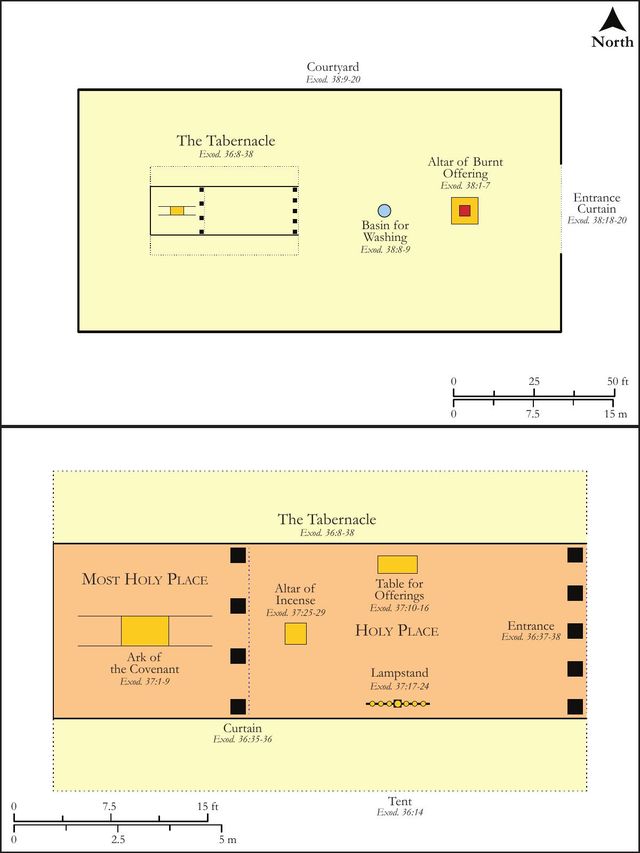
This phrase establishes the focus on one of the Tabernacle's two long walls, distinguishing it from the shorter western (rear) wall or the eastern (entrance) side. The Tabernacle's overall dimensions were 30 cubits long by 10 cubits wide, making these long sides critical structural elements. The use of "other" implies a preceding description of a similar side, likely the south side, maintaining a systematic account of the construction.
"[which is] toward the north corner"
This clause provides the precise orientation of the side being constructed. Given the Tabernacle's standard eastward orientation for its entrance, this refers to the long wall situated on the northern flank of the structure. This level of meticulous directional detail confirms that the builders were adhering to an exact, divinely revealed architectural plan, leaving no room for human estimation or deviation in the sanctuary's form or alignment.
"he made twenty boards"
This final clause specifies the exact quantity of structural boards required for the north wall. As stipulated in Exodus 26:18, the north side was indeed to have twenty boards. Since each board was 1.5 cubits wide, twenty boards would perfectly span 30 cubits, matching the specified length of the Tabernacle. This numerical precision highlights both the divine origin of the design and the faithful obedience of the craftsmen in its execution, ensuring the Tabernacle's structural integrity and adherence to God's sacred dimensions.
Literary Devices
ShowHideThe narrative of the Tabernacle's construction, exemplified by Exodus 36:25, is rich in Precision and Detail. The verse's explicit mention of "twenty boards" for the "north corner" is a prime example of the meticulousness with which God provided the blueprints for His dwelling place. This level of specificity is not merely descriptive; it is profoundly prescriptive, emphasizing that every component, regardless of its apparent size or significance, was integral to the whole and possessed a divine purpose. This is further reinforced by the pervasive Formulaic Language used throughout the construction accounts, where similar phrases are repeated for each side and each component, reinforcing the divine origin and the non-negotiable nature of the instructions. Furthermore, the "boards" themselves carry significant Symbolism. Crafted from incorruptible acacia wood and overlaid with pure gold, they symbolize the enduring, pure, and glorious nature of God's presence. As the foundational framework of the Tabernacle's walls, they represent the stability, steadfastness, and security of God's covenant with His people, forming the very structure within which divine-human encounter and atonement would take place.
Theological and Thematic Connections
ShowHideExodus 36:25, in its precise description of the Tabernacle's structure, illuminates several profound theological truths. Foremost is God's unwavering desire to dwell among His people. The very act of constructing a portable sanctuary, with every board and curtain meticulously crafted according to a divine blueprint, demonstrates God's initiative to bridge the gap between His transcendent holiness and humanity's sinfulness, providing a designated, holy space for encounter and atonement. This divine blueprint also underscores the paramount importance of obedience and faithfulness in worship; the Israelites' diligent adherence to the exact specifications reflects their commitment to God's revealed will and their understanding that true worship is an act of submission. The order and precision inherent in the Tabernacle's design speak volumes about God's character—He is a God of order, beauty, and intentionality, who demands excellence, reverence, and holiness in all aspects of worship and service.
Reflection and Application
ShowHideThe meticulous detail found in Exodus 36:25, describing the precise number of boards for the Tabernacle's north side, offers profound and enduring lessons for contemporary believers. It serves as a powerful reminder that God is a God of order, intentionality, and excellence, paying attention to even the seemingly minute components of His dwelling place. This challenges us to consider the intentionality, integrity, and precision with which we approach our own spiritual lives and communal worship. Just as these boards formed the stable and essential framework for God's manifest presence, our individual lives are called to be foundational elements in God's spiritual temple, the Church. Each believer, much like a carefully crafted and positioned board, has a specific place and purpose within the body of Christ, contributing uniquely to the strength, stability, and beauty of the collective. This passage encourages us to pursue faithfulness in the "small" details of our obedience, recognizing that every act of devotion, every commitment to truth, and every step of discipleship contributes to building a dwelling place for God's Spirit in and through us. It also invites us to reflect on the nature of our "sacred space"—whether our personal devotional life, our families, or our corporate gatherings—and to ask if they truly reflect the divine order, holiness, and intentionality that God desires.
Questions for Reflection
ShowHideFAQ
ShowHideWhy were exactly twenty boards needed for the north side?
ShowHideThe precise number of twenty boards for the north side (and similarly for the south side) was not arbitrary but was explicitly specified by God in His architectural blueprint for the Tabernacle, as meticulously recorded in Exodus 26:18. Each board was designed to be 1.5 cubits wide, and the Tabernacle's long sides were to be 30 cubits in length. Therefore, 20 boards multiplied by 1.5 cubits per board perfectly equals 30 cubits, ensuring the exact dimensions and structural integrity of the sacred tent. This divine precision underscores the Tabernacle's heavenly origin and the necessity of exact obedience in its construction, leaving no room for human estimation, improvisation, or deviation from God's perfect plan.
What was the significance of the materials used for these boards (acacia wood, gold overlay, silver sockets)?
ShowHideThe materials chosen for the Tabernacle boards carried profound symbolic meaning, each pointing to a spiritual truth. The core of the boards was acacia wood (often called shittim wood), a material readily available in the wilderness and renowned for its durability and resistance to decay. This symbolized the enduring, incorruptible nature of God's covenant and His eternal, unchanging presence. The gold overlay on the boards represented God's divine glory, purity, and preciousness. Gold, as the most valuable and untarnished metal, signified the sanctity and majesty of God's dwelling place, emphasizing His transcendence and perfect holiness. The boards rested in silver sockets, which were uniquely made from the atonement money collected from every Israelite—a half-shekel from each man, as commanded in Exodus 30:11-16. This meant that the very foundation of God's dwelling place among His people was literally rooted in redemption and atonement, symbolizing that access to God was made possible only through a sacrificial offering for sin, foreshadowing the ultimate sacrifice of Christ.
Christ-Centered Fulfillment
ShowHideThe meticulous construction of the Tabernacle, down to the precise number and placement of the twenty boards for its north side, finds its ultimate and perfect fulfillment in the person and work of Jesus Christ. The Tabernacle, as God's dwelling place among humanity, was a temporary and symbolic structure, a mere "copy and shadow of the heavenly things" (Hebrews 8:5). Jesus is the true and eternal "Tabernacle" of God, for in Him, "the Word became flesh and dwelt among us" (literally, "tabernacled among us," John 1:14). Just as the Tabernacle boards provided the solid, unshakeable framework for God's manifest presence, Christ is the unshakeable foundation upon whom God's spiritual temple, the Church, is built (1 Corinthians 3:11). His perfect humanity, symbolized by the incorruptible acacia wood, and His divine glory, represented by the pure gold overlay, are perfectly united in His singular person. He is the ultimate meeting place between a holy God and sinful humanity, far surpassing the physical structure of the Old Testament Tabernacle. Through His sacrificial death on the cross, which the Tabernacle's atonement rituals and the silver sockets foreshadowed, He established a new and living way for us to draw near to God with confidence (Hebrews 10:19-20). Thus, the precision, purpose, and symbolism of every Tabernacle board ultimately point to the perfect, divinely ordained person and redemptive work of Jesus Christ, in whom God's profound desire to dwell with His people is finally and eternally realized.