


Exodus 36:26
Bible text: King James Version (1769 Blayney text) · Public domain
Bible text: Berean Standard Bible · Public domain
Bible text: American Standard Version (1901) · Public domain
Bible text: World English Bible, Messianic edition · Public domain
Bible text: Geneva Bible (1599) · Public domain
Bible text: Young's Literal Translation · Public domain
- וְאַרְבָּעִיםve·'ar·ba·'Imand fortyH705Conj-w ¦ Adj-mpAdjective Numerical Plural Masculine Absoluteוְandאַרְבָּעִיםforty
- אַדְנֵיהֶם'ad·nei·Hemtheir basesH134N-mpc ¦ 3mpNoun Plural Masculine Constructאַדְנֵיbasesהֶםtheir
- כָּסֶףKa·sefsilverH3701N-msNoun Singular Masculine Absolute
- שְׁנֵיshe·NeitwoH8147Adj-cdcAdjective Numerical Dual common gender Construct
- אֲדָנִים'a·da·NimbasesH134N-mpNoun Plural Masculine Absolute
- תַּחַתTa·chat[were] underH8478N-mscNoun Singular Masculine Construct
- הַקֶּרֶשׁha·Ke·reshthe frameH7175Art ¦ N-msNoun Singular Masculine Absoluteהַtheקֶּרֶשׁframe
- הָאֶחָדha·'e·Chad<the> oneH259Art ¦ Adj-fsAdjective Numerical Singular Feminine Absoluteהָ<the>אֶחָדone
- וּשְׁנֵיu·she·Neiand twoH8147Conj-w ¦ Adj-cdcAdjective Numerical Dual common gender Constructוּandשְׁנֵיtwo
- אֲדָנִים'a·da·NimbasesH134N-mpNoun Plural Masculine Absolute
- תַּחַתTa·chat[were] underH8478N-mscNoun Singular Masculine Construct
- הַקֶּרֶשׁha·Ke·reshthe frameH7175Art ¦ N-msNoun Singular Masculine Absoluteהַtheקֶּרֶשׁframe
- הָאֶחָדha·'e·Chad<the> oneH259Art ¦ Adj-fsAdjective Numerical Singular Feminine Absoluteהָ<the>אֶחָדone
English is a literal word-by-word gloss of the Hebrew, not the KJV's wording. Why?
This is the original text the KJV's translators worked from — each Hebrew word with its own literal English meaning in this verse, prepared by scholars at Tyndale House, Cambridge. The KJV translates whole sentences, not word by word, so its wording differs: one Hebrew word can become several English words, and the KJV may choose “the LORD” where the gloss reads “Yahweh”. Both are faithful — they answer different questions. For the KJV's own rendering, switch to the KJV text.
Details
See on the biblical-era maps

Study this verse
Public-domain commentary
Matthew Henry
From his Commentary on the Whole Bible. Henry comments on passages, not single verses — this entry covers Exodus 36:14–34.
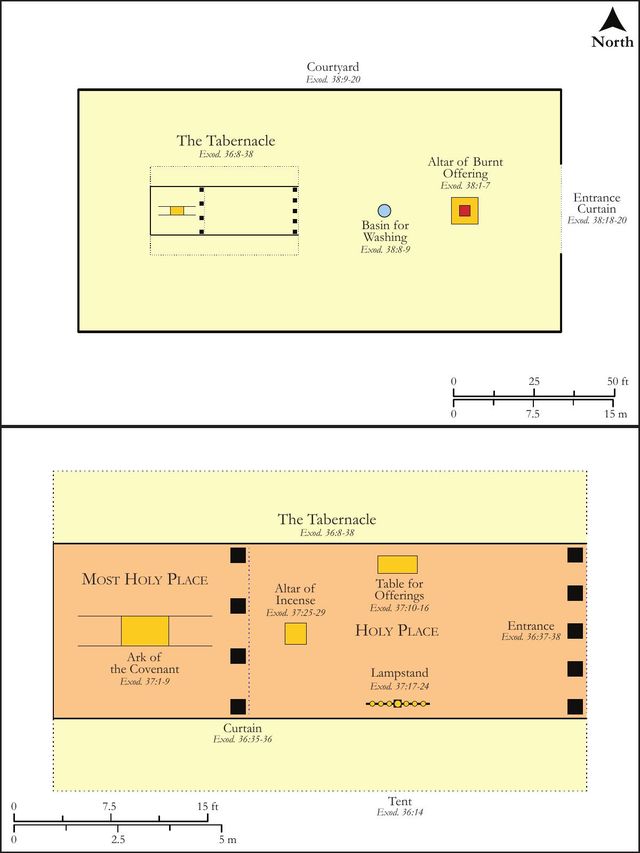
Here, 1. The shelter and special protection that the church is under are signified by the curtains of hair-cloth, which were spread over the tabernacle, and the covering of rams' skins and badgers' skins over them, Exo 36:14-19. God has provided for his people a shadow from the heat, and a covert from storm and rain, Isa 4:6. They are armed against all weathers; the sun and the moon shall not smite them: and they are protected from the storms of divine wrath, that hail which will sweep away the refuge of lies, Isa 28:17. Those that dwell in God's house shall find, be the tempest ever so violent, or the dropping ever so continual, it does not rain in. 2. The strength and stability of the church, though it is but a tabernacle, are signified by the boards and bars with which the curtains were borne up, Exo 36:20-34. The boards were coupled together and joined by the bars which shot through them; for the union of the church, and the hearty agreement of those that are its stays and supporters, contribute abundantly to its strength and establishment.
Continue studying Exodus 36:26 across the web’s major study libraries — every link below opens this exact verse, chapter, or book on the destination site.
Read & Compare
 BibleGatewayThis verse in more than 200 translations and 70 languages.
 Bible.comThe YouVersion reader — hundreds of translations, reading plans, and highlights.
 ESV.orgCrossway's official English Standard Version reader.
 NET BibleThe NET translation with 60,000+ translators' notes on every rendering decision.
 STEP BibleTyndale House's free study tool — original text, vocabulary, and scholarly resources.
 BibliaLogos Bible Software's free web reader.
 USCCBThe New American Bible (Revised Edition) with the U.S. bishops' study notes.
Commentaries
 BibleHub CommentariesDozens of classic commentaries on this verse, gathered on one page.
 StudyLightMore than 100 commentary sets — the largest collection on the web.
 BibleRefPlain-English commentary on what this verse means, verse by verse.
 Enduring WordDavid Guzik's free commentary on this chapter, widely used by Bible teachers.
 Bible Study ToolsVerse commentary alongside Greek and Hebrew study aids.
Original Language & Research
- BibleHub InterlinearThe verse word by word — original language, transliteration, and English.
- BibleHub LexiconEvery word's original-language definition and Strong's entry.
 Blue Letter BibleDeep-study tools — Strong's numbers, concordance, and word studies.
 SefariaThe Hebrew text with Rashi and centuries of Jewish commentary.
Sermons, Hymns & Audio


TrulyRandomVerse is not affiliated with these sites and doesn’t control their content. They’re linked because they’re genuinely useful.
Summary
Exodus 36:26 meticulously details a crucial foundational element of the Tabernacle's structure: the "forty sockets of silver," specifying that "two sockets under one board, and two sockets under another board" were used. This verse underscores the divine precision and order essential for constructing God's dwelling place, highlighting the robust stability provided by these heavy silver bases for the upright acacia wood boards. Beyond its architectural function, the silver, uniquely sourced from the atonement money of the Israelites, imbues the Tabernacle's very foundation with profound theological significance, emphasizing that access to God's holy presence is predicated upon the principle of redemption.
Context
ShowHideLiterary Context
Exodus 36:26 is situated within the extended narrative of the Tabernacle's construction, specifically detailing the execution of the divine blueprints given by God to Moses on Mount Sinai (e.g., the detailed instructions in Exodus 25-30). Chapters 35-40 describe the actual building process, with skilled artisans like Bezalel and Oholiab leading the work according to God's precise commands. This particular verse focuses on the foundational elements of the Tabernacle's walls—the upright boards and their silver bases. It follows the description of the acacia wood boards themselves (Exodus 36:20-25) and precedes the details of the veils and screens (Exodus 36:35-38), showcasing the systematic, sequential, and highly ordered nature of the construction process. The meticulous enumeration of each component underscores the divine origin of the design and the absolute necessity of adhering to every specification for the sacred space.
Historical & Cultural Context
The construction of the Tabernacle occurred during Israel's wilderness wanderings, a period of nomadic existence following their exodus from Egyptian bondage. As a portable sanctuary, the Tabernacle served as the central point of worship and the tangible symbol of God's presence among His people, reinforcing their identity as a covenant community. Among the nations, temples were common, but Israel's Tabernacle was unique in its portability and its emphasis on God's immanence among a moving people. Crucially, the silver used for these sockets was specifically derived from the "atonement money" collected from a census of all Israelite males aged twenty and above, as commanded in Exodus 30:11-16. Each man was to give half a shekel of silver "as an offering to the Lord, to make atonement for yourselves" (Exodus 30:15). This collection, totaling 100 talents and 1,775 shekels (approximately 7,500 pounds) of silver, was then melted down to cast the 100 sockets for the boards and the pillars of the veil (Exodus 38:27). Thus, the very foundation of God's dwelling was literally built upon the redemption of His people, symbolizing that access to His holy presence was through atonement.
Key Themes
ShowHideThis verse contributes significantly to several key themes prevalent in the book of Exodus and the broader Pentateuch. Firstly, it highlights the theme of Divine Precision and Order, demonstrating God's meticulous attention to detail in the design of His dwelling, leaving no aspect to human improvisation. Secondly, the origin of the silver from atonement money underscores the profound theme of Atonement and Redemption, establishing that God's presence among His people is founded upon a propitiatory act that covers their sin. This theme is central to the sacrificial system detailed in Leviticus and the ongoing relationship between God and Israel. Thirdly, the stability provided by the sockets contributes to the theme of God's Enduring Presence; the Tabernacle, though portable, was designed for unwavering stability, symbolizing the steadfastness of God's covenant with His redeemed people. Finally, it reinforces the theme of Holiness and Separation, as the precise construction and sacred materials set apart the Tabernacle as a unique space for divine encounter.
Exposition and Analysis
ShowHideKey Word Analysis
ShowHideThe Hebrew word אֶדֶן (ʼeden', H134) refers to a "basis" or "foundation," derived from a root suggesting strength. In the context of the Tabernacle, these were heavy, cast silver blocks into which the tenons (projections) at the bottom of the acacia wood boards were inserted. The term conveys the idea of something solid and supportive upon which a structure securely rests. The use of ʼeden' here emphasizes the critical role these silver bases played in providing stability and uprightness to the entire framework of the Tabernacle, ensuring it could withstand the rigors of being dismantled, transported, and reassembled in the wilderness.
The Hebrew word כֶּסֶף (keçeph', H3701) refers to "silver," often by implication "money." In the Tabernacle's construction, silver held particular significance beyond its material value. As detailed in the historical context, this silver was specifically derived from the "atonement money" collected from every Israelite male (Exodus 30:11-16). This unique origin imbues the silver sockets with profound symbolic meaning, linking the physical foundation of God's dwelling place directly to the concept of redemption and atonement for sin. It suggests that the very ground upon which God's presence rested among His people was consecrated by the principle of propitiation, making it a sacred and holy foundation.
Verse Breakdown
ShowHide"And their forty sockets of silver;"
This clause specifies the total number and precious material of the foundational elements for the Tabernacle's main structure. The "forty sockets" refer to the bases for the twenty boards on the north side and twenty boards on the south side of the Tabernacle (Exodus 36:20-25). The sheer weight and quantity of silver (100 talents, or roughly 7,500 pounds, for all 100 sockets, including those for the veil) underscore the substantial investment and the preciousness of the Tabernacle's foundation. The silver's origin in the atonement money is crucial, signifying that the stability and holiness of God's dwelling were literally built upon the redemption of His people, making the very ground of His presence a testament to His grace.
"two sockets under one board, and two sockets under another board."
This detailed instruction reveals the precise manner in which the boards were secured. Each upright acacia wood board had two tenons at its base, which fit into two corresponding silver sockets. This double-socket arrangement for each board provided exceptional stability and ensured the upright posture and structural integrity of the Tabernacle walls. The repetition of "two sockets under one board, and two sockets under another board" emphasizes the consistency and meticulousness of the divine design, highlighting God's desire for perfect order, unwavering support, and absolute precision in His sacred dwelling. This structural integrity was vital for a portable sanctuary that would be frequently dismantled and reassembled.
Literary Devices
ShowHideThe verse employs several literary devices to convey its meaning and significance, even in its technical description. Repetition is prominently evident in the phrase "two sockets under one board, and two sockets under another board." This repetition serves to emphasize the consistent and meticulous nature of the divine instructions and the resulting structural stability of the Tabernacle. It underscores the precision required in building God's dwelling and the uniformity of its foundational support. Symbolism is profoundly present, particularly with the "silver sockets." Silver, derived from the atonement money, symbolizes redemption, purification, and the propitiatory basis of God's relationship with His people. The sockets themselves symbolize the foundational support, stability, and unshakeable nature necessary for God's holy presence to dwell securely among Israel. Furthermore, the entire detailed description of the Tabernacle's construction, including these seemingly mundane details, functions as a form of typology, where the physical structure and its components foreshadow greater spiritual realities, particularly concerning Christ and the Church as the true dwelling place of God.
Theological and Thematic Connections
ShowHideExodus 36:26, though a seemingly technical detail of construction, carries profound theological weight. It reveals God's meticulous care for order and precision, even in the physical construction of His dwelling place. More significantly, the silver sockets, derived from the atonement money, highlight that the very foundation of God's presence among His people is rooted in redemption. This underscores the fundamental biblical principle that access to God is not earned through human merit or effort but is graciously provided through a substitutionary act, foreshadowing the ultimate act of atonement. The stability provided by these sockets also speaks to the firm and unshakeable nature of God's covenant and His enduring presence among a redeemed people, a presence made possible only through His provision for sin.
Reflection and Application
ShowHideThe detailed account of the Tabernacle's construction, especially the seemingly mundane details like the silver sockets, offers profound insights for our spiritual lives. Just as the Tabernacle required a precise and stable foundation built on redemption, so too must our faith and lives be firmly grounded. This verse reminds us that God is a God of meticulous detail, caring about every aspect of His creation and our lives, even those we might consider insignificant, hidden, or foundational. His attention to the "sockets" encourages us to trust in His comprehensive care and to pursue faithfulness in every detail of our obedience, knowing that even the unseen elements contribute to the overall integrity of our spiritual walk. Moreover, the origin of the silver from atonement money serves as a powerful and humbling reminder that our standing with God, our access to His presence, and the very foundation of our hope are entirely dependent on His redemptive work, not on our own merit or performance. This truth should cultivate deep humility, profound gratitude for His grace, and a deeper reliance on His finished work. It calls us to build our lives on the unshakable foundation of Christ's atonement.
Questions for Reflection
ShowHideFAQ
ShowHideWhy were the sockets made of silver, and what is the significance of "forty" sockets?
ShowHideThe silver for the sockets was highly significant because it was derived directly from the "atonement money" collected from every Israelite male aged twenty and above, as commanded in Exodus 30:11-16. Each man gave half a shekel "as an offering to the Lord, to make atonement for yourselves." This means the very foundation of God's dwelling place among His people was literally built upon the principle of redemption and atonement for sin. It symbolized that access to God's holy presence was only possible through a propitiatory act. The "forty sockets" specifically refer to the twenty boards on the north side and twenty boards on the south side of the Tabernacle, each requiring two sockets. The number forty here is primarily a functional count for structural stability, ensuring each board had a firm, double base. While forty often carries symbolic weight in biblical narratives (e.g., forty years in the wilderness, forty days of flood), in this precise architectural context, it emphasizes the exactness, completeness, and robust foundational support of the Tabernacle's structure, ensuring its stability as God's portable sanctuary.
Christ-Centered Fulfillment
ShowHideExodus 36:26, with its focus on the silver sockets as the stable, atonement-funded foundation of God's dwelling, finds its ultimate and glorious fulfillment in Jesus Christ. The Tabernacle, as God's temporary dwelling among His people, was a profound type and shadow of a greater spiritual reality. The silver, derived from the atonement money, pointed forward to the perfect and singular atonement accomplished by Christ. Just as these heavy sockets provided an unshakeable base for the Tabernacle's walls, so Christ is the eternal and unshakeable foundation upon whom God's true dwelling place, the Church, is built (1 Corinthians 3:11). He is the ultimate "Lamb of God, who takes away the sin of the world" (John 1:29), whose once-for-all sacrifice provides the true and eternal "atonement money" for humanity, securing our access to God. Through His atoning work on the cross, the veil separating humanity from God's presence was miraculously torn from top to bottom (Matthew 27:51), granting us direct and confident access to the Most Holy Place, not through a physical structure, but through His blood (Hebrews 10:19-20). The meticulous design of the Tabernacle, with its divinely appointed foundational elements, foreshadowed the perfect, divine plan for redemption realized in Christ, who, as the Word made flesh, "dwelt among us" (John 1:14), becoming the true and living Tabernacle, the very embodiment of God's presence among humanity.