


Exodus 36:14
Bible text: King James Version (1769 Blayney text) · Public domain
Bible text: Berean Standard Bible · Public domain
Bible text: American Standard Version (1901) · Public domain
Bible text: World English Bible, Messianic edition · Public domain
Bible text: Geneva Bible (1599) · Public domain
Bible text: Young's Literal Translation · Public domain
- וַיַּעַשׂvai·Ya·'asand he madeH6213Conj-w ¦ V-Qal-ConsecImperf-3msVerb Qal Consecutive Imperfect 3rd Singular Masculineוַandיַּעַשׂhe made
- יְרִיעֹתye·ri·'Otcurtains ofH3407N-fpcNoun Plural Feminine Construct
- עִזִּים'i·Zimgoat hair<s>H5795N-mpNoun Plural Masculine Absolute
- לְאֹהֶלle·'O·helinto a tentH168Prep-l ¦ N-msNoun Singular Masculine Absoluteלְintoאֹהֶלa tent
- עַל'aloverH5921PrepPreposition
- הַמִּשְׁכָּןha·mish·Kanthe tabernacleH4908Art ¦ N-msNoun Singular Masculine Absoluteהַtheמִּשְׁכָּןtabernacle
- עַשְׁתֵּי'ash·teione [plus]H6249Adj-csAdjective Numerical Singular common gender Absolute
- עֶשְׂרֵה'es·RehtenH6240Adj-csAdjective Numerical Singular common gender Absolute
- יְרִיעֹתye·ri·'OtcurtainsH3407N-fpNoun Plural Feminine Absolute
- עָשָׂה'a·Sahhe madeH6213V-Qal-Perf-3msVerb Qal Perfect 3rd Singular Masculine
- אֹתָם'o·Tam<obj.> themH853DirObjM ¦ 3mpParticle Object Indicatorאֹתָ<obj.>םthem
English is a literal word-by-word gloss of the Hebrew, not the KJV's wording. Why?
This is the original text the KJV's translators worked from — each Hebrew word with its own literal English meaning in this verse, prepared by scholars at Tyndale House, Cambridge. The KJV translates whole sentences, not word by word, so its wording differs: one Hebrew word can become several English words, and the KJV may choose “the LORD” where the gloss reads “Yahweh”. Both are faithful — they answer different questions. For the KJV's own rendering, switch to the KJV text.
Details
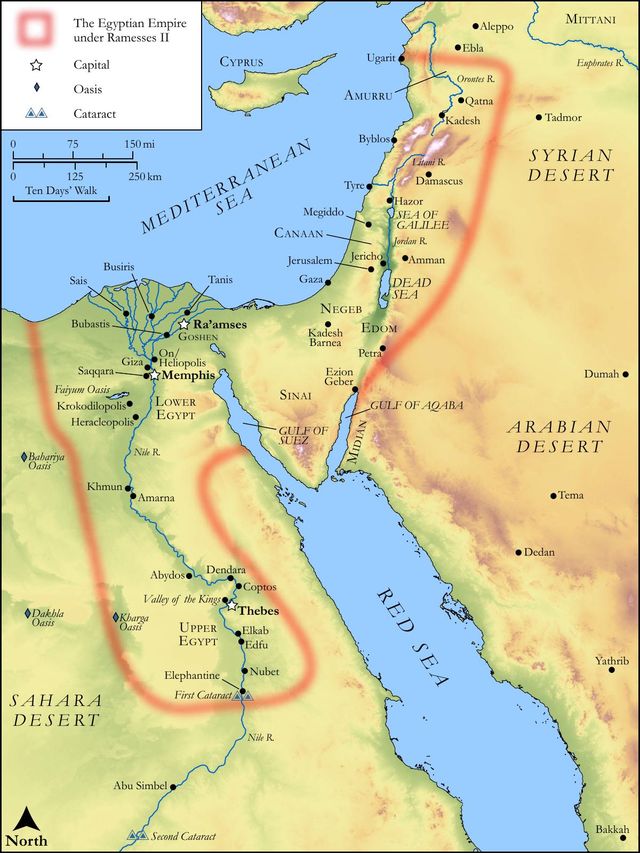
See on the biblical-era maps
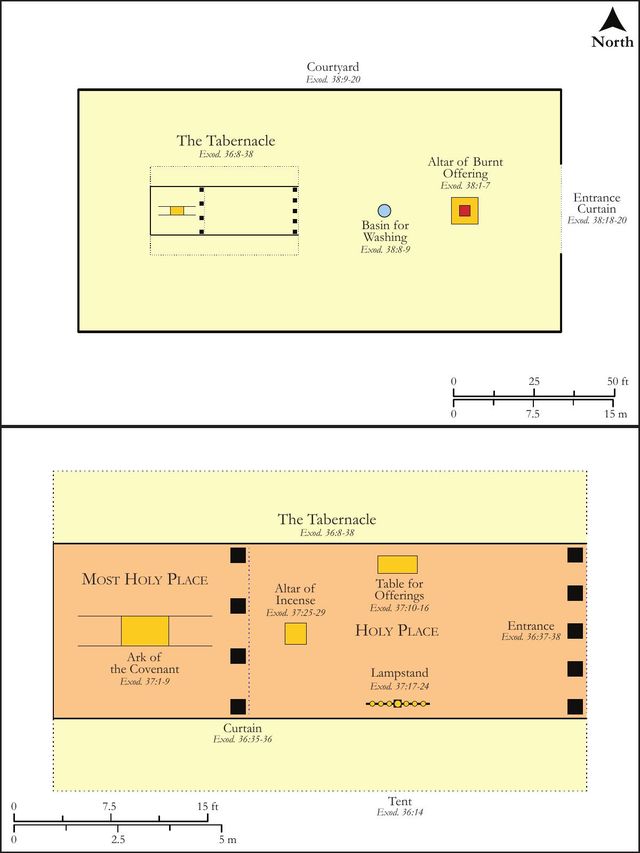
Study this verse
Public-domain commentary
Matthew Henry
From his Commentary on the Whole Bible. Henry comments on passages, not single verses — this entry covers Exodus 36:14–34.
Here, 1. The shelter and special protection that the church is under are signified by the curtains of hair-cloth, which were spread over the tabernacle, and the covering of rams' skins and badgers' skins over them, Exo 36:14-19. God has provided for his people a shadow from the heat, and a covert from storm and rain, Isa 4:6. They are armed against all weathers; the sun and the moon shall not smite them: and they are protected from the storms of divine wrath, that hail which will sweep away the refuge of lies, Isa 28:17. Those that dwell in God's house shall find, be the tempest ever so violent, or the dropping ever so continual, it does not rain in. 2. The strength and stability of the church, though it is but a tabernacle, are signified by the boards and bars with which the curtains were borne up, Exo 36:20-34. The boards were coupled together and joined by the bars which shot through them; for the union of the church, and the hearty agreement of those that are its stays and supporters, contribute abundantly to its strength and establishment.
Continue studying Exodus 36:14 across the web’s major study libraries — every link below opens this exact verse, chapter, or book on the destination site.
Read & Compare
 BibleGatewayThis verse in more than 200 translations and 70 languages.
 Bible.comThe YouVersion reader — hundreds of translations, reading plans, and highlights.
 ESV.orgCrossway's official English Standard Version reader.
 NET BibleThe NET translation with 60,000+ translators' notes on every rendering decision.
 STEP BibleTyndale House's free study tool — original text, vocabulary, and scholarly resources.
 BibliaLogos Bible Software's free web reader.
 USCCBThe New American Bible (Revised Edition) with the U.S. bishops' study notes.
Commentaries
 BibleHub CommentariesDozens of classic commentaries on this verse, gathered on one page.
 StudyLightMore than 100 commentary sets — the largest collection on the web.
 BibleRefPlain-English commentary on what this verse means, verse by verse.
 Enduring WordDavid Guzik's free commentary on this chapter, widely used by Bible teachers.
 Bible Study ToolsVerse commentary alongside Greek and Hebrew study aids.
Original Language & Research
- BibleHub InterlinearThe verse word by word — original language, transliteration, and English.
- BibleHub LexiconEvery word's original-language definition and Strong's entry.
 Blue Letter BibleDeep-study tools — Strong's numbers, concordance, and word studies.
 SefariaThe Hebrew text with Rashi and centuries of Jewish commentary.
Sermons, Hymns & Audio


TrulyRandomVerse is not affiliated with these sites and doesn’t control their content. They’re linked because they’re genuinely useful.
Summary
Exodus 36:14 meticulously records the construction of the second layer of the Tabernacle's coverings: eleven curtains woven from goats' hair, specifically designed to form the protective "tent" over the sacred dwelling. This verse underscores the faithful execution of God's precise architectural blueprint by the divinely gifted artisans, highlighting both the practical necessity of a durable outer layer for the wilderness sanctuary and the Israelites' unwavering obedience to the divine instructions for constructing God's earthly abode.
Context
ShowHideLiterary Context
Exodus 36:14 is situated within the extensive narrative detailing the construction of the Tabernacle (Exodus 35-40), which serves as the practical fulfillment of God's detailed instructions given to Moses on Mount Sinai (Exodus 25-31). Specifically, this verse describes the artisans' diligent work in fabricating the second layer of the Tabernacle's coverings, directly executing the command outlined in Exodus 26:7. The immediate preceding verses in Exodus 36:8-13 describe the creation of the innermost linen curtains, establishing a deliberate sequence of construction from the interior to the exterior. This meticulous account emphasizes the complete and precise adherence to God's divine pattern, showcasing the Israelites' corporate obedience and the supernatural enablement of individuals like Bezalel and Oholiab. The entire section from Exodus 35 through Exodus 40 is a testament to the community's unified effort in establishing God's dwelling place among them.
Historical & Cultural Context
Among nomadic peoples, goats' hair was an exceptionally common and highly valued material for crafting durable tent coverings. Its inherent properties—remarkable strength, natural water resistance, and excellent insulating capabilities—made it an ideal choice for protection against the severe and unpredictable desert climate, which included intense solar radiation, strong winds, and infrequent but heavy rains. The selection of goats' hair for the outer "tent" layer of the Tabernacle, distinct from the more decorative inner "dwelling place," highlights God's practical wisdom in providing for both the sacred integrity and the physical preservation of His sanctuary. This material would have been readily available to the Israelites, who departed Egypt with substantial flocks, as noted in Exodus 12:38. The intricate craftsmanship involved in spinning, weaving, and joining these coarse hairs into eleven precisely measured curtains speaks to a highly developed skill set and a monumental communal effort, all essential for constructing a portable sanctuary robust enough to endure the rigors of their wilderness journey.
Key Themes
ShowHideExodus 36:14 contributes significantly to several overarching themes within the book of Exodus and the broader Pentateuch. Firstly, it powerfully illustrates the theme of Divine Design and Human Obedience. God provides an incredibly detailed blueprint for the Tabernacle, and the Israelites' faithful execution of every specification, even down to the material and number of these practical curtains, underscores the importance of obedience to divine revelation. Secondly, the verse highlights God's Presence and Provision. The Tabernacle's construction, including its protective layers, signifies God's desire to dwell among His people (Exodus 25:8). The use of durable goats' hair demonstrates God's foresight in providing a secure and protected dwelling place for His holiness in the harsh wilderness environment. Lastly, the layered structure of the Tabernacle, with the rugged exterior protecting the glorious interior, subtly introduces the theme of Holiness and Separation. The outer layers serve as a barrier, safeguarding the sacred inner spaces from the common and the elements, foreshadowing the progressive levels of access to God's presence. This theme of careful separation and protection is also seen in the instructions for the priests and their garments, ensuring proper reverence for God's holiness (Exodus 28).
Exposition and Analysis
ShowHideKey Word Analysis
ShowHideThis term (H3407) refers to a "hanging" or "curtain," often implying something tremulous or swaying. In the context of the Tabernacle, these were large, woven cloths designed to form the walls and roof of the sanctuary. The use of this specific word emphasizes their function as a flexible, protective enclosure. Here, it denotes the second layer of the Tabernacle's covering, distinct from the inner linen curtains, highlighting their role in forming the "tent" structure.
The word (H5795) specifically means "she-goat" but is used here in its plural form (which can be masculine) to refer to the hair of goats. This material was chosen for its practical properties: durability, water resistance, and insulating qualities, making it ideal for the outer protective layer of a nomadic dwelling. Its selection underscores the functional and resilient nature of this particular set of curtains, designed to withstand the harsh desert environment.
This term (H168) denotes a "tent" or "covering," emphasizing its role as a conspicuous, protective dwelling. While "Tabernacle" (mishkân) refers to the sacred dwelling place of God, ʼôhel here specifically designates the outer, functional tent structure that enveloped the inner sanctuary. This distinction highlights the dual nature of the Tabernacle: a sacred abode for God's presence and a practical, portable shelter for the wilderness journey, with the goat hair curtains forming this vital protective layer.
Verse Breakdown
ShowHide"And he made curtains [of] goats' [hair]"
This opening clause attributes the manufacturing of these specific curtains to the skilled craftsmen, particularly Bezalel and Oholiab, who were supernaturally endowed for this intricate work. The material, "goats' hair," immediately signals the practical, robust, and protective nature of this layer, chosen for its resilience against the elements in the wilderness. It contrasts sharply with the fine, ornate linen of the inner curtains, emphasizing a functional purpose.
"for the tent over the tabernacle"
This phrase precisely defines the purpose and strategic placement of these curtains. They were designed to form the "tent" (ʼôhel), serving as the primary outer covering. This "tent" was situated directly "over the tabernacle" (mishkân), which refers to the more sacred inner structure where God's presence resided. This layering system provided both structural integrity and a symbolic progression from the common (outer protection) to the sacred (inner dwelling).
"eleven curtains he made them"
This concluding detail highlights the meticulous adherence to God's exact specifications. The divine instruction for eleven curtains, found in Exodus 26:7-8, was faithfully executed. This precise number was crucial for the Tabernacle's design, allowing one curtain to be folded over at the front (creating a double layer over the entrance) and another portion to hang down at the back, ensuring complete enclosure and additional protection for the sacred mishkân.
Literary Devices
ShowHideThe primary literary device at play in Exodus 36:14, and indeed throughout the Tabernacle construction accounts, is Precision and Repetition. The verse's exact detailing of the material ("goats' hair") and the precise quantity ("eleven curtains") directly mirrors and confirms the highly specific instructions previously given by God in Exodus 26:7-8. This meticulous repetition of divine command followed by human execution emphasizes the sacredness of the task, the absolute necessity of obedience to God's blueprint, and the divine enablement of the craftsmen. It underscores that every detail, no matter how seemingly minor, holds significance in God's plan. Furthermore, there is a strong element of Symbolism embedded in the materials themselves. The rugged, practical goats' hair contrasts sharply with the fine, embroidered linen of the inner curtains, symbolizing the multifaceted nature of God's dwelling: both a glorious, holy sanctuary and a practical, protected shelter for His people in a fallen world. This layering speaks to the progressive revelation of God's holiness and the necessary separation between the common and the sacred, all while providing a means for His presence to dwell among humanity.
Theological and Thematic Connections
ShowHideExodus 36:14, in its description of the goat hair curtains, profoundly illustrates several theological themes. Firstly, it underscores the divine meticulousness and comprehensive provision for His people's needs, encompassing both the spiritual and the practical. God's blueprint for the Tabernacle was not merely aesthetically pleasing but also functionally robust, accounting for the harsh realities of the wilderness environment to ensure His dwelling was not only holy but also securely protected from the elements. Secondly, the verse powerfully exemplifies the theme of human obedience and faithfulness in executing God's specific commands. The craftsmen's precise adherence to the "eleven curtains" made of "goats' hair" demonstrates a profound commitment to divine authority, recognizing that every detail, no matter how seemingly mundane, contributed to the sacred purpose of establishing God's dwelling. Finally, the layered nature of the Tabernacle's coverings, with the rugged exterior protecting the glorious interior, symbolizes the progressive revelation of God's holiness and the necessary separation between the common and the sacred, while simultaneously providing a tangible means for His presence to dwell among His people.
Reflection and Application
ShowHideThe detailed account of the Tabernacle's construction, including what might seem like the mundane detail of goat hair curtains, serves as a powerful and enduring reminder of the importance of faithfulness, diligence, and precision in all aspects of our service to God. Just as every piece of the Tabernacle, from the most ornate to the most functional, was absolutely essential for its purpose of providing a dwelling place for God among His people, so too are all our efforts valuable when done according to His divine design and for His glory. This verse encourages us to embrace tasks that might appear ordinary or less "spiritual" with extraordinary dedication and excellence, understanding that even the most practical elements contribute significantly to a larger, sacred purpose. It also speaks profoundly to God's comprehensive provision, ensuring that His dwelling—and by extension, His people—are both holy and protected. We are called to be good stewards of the resources, talents, and gifts God provides, applying ourselves with precision, obedience, and a spirit of excellence to build up His kingdom, knowing that every detail truly matters in His divine economy and contributes to His overarching redemptive plan.
Questions for Reflection
ShowHideFAQ
ShowHideWhy were eleven curtains made of goats' hair, when only ten were made of fine linen for the inner layer?
ShowHideThe instruction for eleven goat hair curtains is explicitly given by God in Exodus 26:7-8. The reason for this specific number, one more than the inner linen curtains, was both practical and symbolic. When the eleven curtains were joined together, they formed a single, continuous covering that was significantly longer and wider than the inner linen curtains. This design allowed for one curtain to be folded over at the front of the Tabernacle, creating a double layer over the entrance, which provided enhanced protection and a specific aesthetic. Additionally, a portion of the goat hair covering would hang down at the back, ensuring complete enclosure and offering additional protection for the sacred inner structure. This meticulous design ensured that the inner, more sacred linen curtains were fully covered and shielded from the harsh desert elements, emphasizing God's foresight and precise blueprint for both the holiness and the practical preservation of His dwelling place.
Christ-Centered Fulfillment
ShowHideThe goat hair curtains, serving as the durable, protective outer layer of the Tabernacle, powerfully foreshadow Christ's multifaceted role as our ultimate covering, protector, and the very dwelling place of God. Just as these rugged curtains shielded the sacred dwelling from the harsh wilderness elements, so Jesus Christ provides complete spiritual protection and security for those who are "in Him" (Romans 8:1). He is the one who covers our sin and shame, allowing us to stand righteous before a holy God, much like the outer layers protected the inner sanctity. Furthermore, the Tabernacle itself, as God's temporary dwelling place among His people, finds its ultimate and perfect fulfillment in Christ, who is "God with us" (Matthew 1:23) and in whom "all the fullness of the Deity lives in bodily form" (Colossians 2:9). The very purpose of the Tabernacle's elaborate construction—to make a tangible place for God to dwell among humanity—is perfectly realized in Jesus, who is the true and living Temple, providing direct access to God's presence not through animal skins or woven hair, but through His own perfect, once-for-all sacrifice on the cross (Hebrews 10:19-20). His death, symbolized by the tearing of the temple veil from top to bottom (Matthew 27:51), opened the way into the Most Holy Place, fulfilling and superseding the protective and mediating functions symbolized by every layer of the Tabernacle, including the humble goat hair curtains.