


Exodus 36:13
Bible text: King James Version (1769 Blayney text) · Public domain
Bible text: Berean Standard Bible · Public domain
Bible text: American Standard Version (1901) · Public domain
Bible text: World English Bible, Messianic edition · Public domain
Bible text: Geneva Bible (1599) · Public domain
Bible text: Young's Literal Translation · Public domain
- וַיַּעַשׂvai·Ya·'asand he madeH6213Conj-w ¦ V-Qal-ConsecImperf-3msVerb Qal Consecutive Imperfect 3rd Singular Masculineוַandיַּעַשׂhe made
- חֲמִשִּׁיםcha·mi·ShimfiftyH2572Adj-mpAdjective Numerical Plural Masculine Absolute
- קַרְסֵיkar·Seihooks ofH7165N-mpcNoun Plural Masculine Construct
- זָהָבza·HavgoldH2091N-msNoun Singular Masculine Absolute
- וַיְחַבֵּרvay·cha·Berand he joinedH2266Conj-w ¦ V-Piel-ConsecImperf-3msVerb Piel Consecutive Imperfect 3rd Singular Masculineוַandיְחַבֵּרhe joined
- אֶת'et<obj.>H853DirObjMParticle Object Indicator
- הַיְרִעֹתhay·ri·'Otthe curtainsH3407Art ¦ N-fpNoun Plural Feminine Absoluteהַtheיְרִעֹתcurtains
- אַחַת'a·ChatoneH259Adj-fsAdjective Numerical Singular Feminine Absolute
- אֶל'eltoH413PrepPreposition
- אַחַת'a·ChatoneH259Adj-fsAdjective Numerical Singular Feminine Absolute
- בַּקְּרָסִיםba·ke·ra·Simwith the hooksH7165Prep-b ¦ N-mpNoun Plural Masculine Absoluteבַּwith theקְּרָסִיםhooks
- וַיְהִיvay·Hiand it wasH1961Conj-w ¦ V-Qal-ConsecImperf-3msVerb Qal Consecutive Imperfect 3rd Singular Masculineוַandיְהִיit was
- הַמִּשְׁכָּןha·mish·Kanthe tabernacleH4908Art ¦ N-msNoun Singular Masculine Absoluteהַtheמִּשְׁכָּןtabernacle
- אֶחָד'e·ChadoneH259Adj-fsAdjective Numerical Singular Feminine Absolute
English is a literal word-by-word gloss of the Hebrew, not the KJV's wording. Why?
This is the original text the KJV's translators worked from — each Hebrew word with its own literal English meaning in this verse, prepared by scholars at Tyndale House, Cambridge. The KJV translates whole sentences, not word by word, so its wording differs: one Hebrew word can become several English words, and the KJV may choose “the LORD” where the gloss reads “Yahweh”. Both are faithful — they answer different questions. For the KJV's own rendering, switch to the KJV text.
Details
See on the biblical-era maps

Study this verse
Public-domain commentary
Matthew Henry
From his Commentary on the Whole Bible. Henry comments on passages, not single verses — this entry covers Exodus 36:8–13.
The first work they set about was the framing of the house, which must be done before the furniture of it was prepared. This house was not made of timber or stone, but of curtains curiously embroidered and coupled together. This served to typify the state of the church in this world, the palace of God's kingdom among men. 1. Though it is upon the earth, yet its foundation is not in the earth, as that of a house is; no, Christ's kingdom is not of this world, nor founded in it. 2. It is mean and mutable, and in a militant state; shepherds dwelt in tents, and God is the Shepherd of Israel; soldiers dwelt in tents, and the Lord is a man of war, and his church marches through an enemy's country, and must fight its way. The kings of the earth enclose themselves in cedar (Jer 22:15), but the ark of God was lodged in curtains only. 3. Yet there is a beauty in holiness; the curtains were embroidered, so is the church adorned with the gifts and graces of the Spirit, that raiment of needle-work, Psa 45:14. 4. The several societies of believers are united in one, and, as here, all become one tabernacle; for there is one Lord, one faith, and one baptism.
Historical interpretation
Historical reception
1 surviving comment on this verse from the historical church.
Since the number fifty designates true rest in the Holy Spirit, and a ring seems to have neither beginning nor end, and gold is the most precious of metals, excelling all others in its brightness, what is expressed in the fifty golden rings except the perpetual brightness and bright perpetuity of the highest repose? And the rings grip the loops of the curtains in such a way that one tabernacle might be made out of them all when the glory of the heavenly kingdom graciously pours itself into the pure minds of the faithful, so that with the glue of such healing inspiration the church is made perfect out of the two peoples, or perhaps we should say out of all Christ’s elect.
Continue studying Exodus 36:13 across the web’s major study libraries — every link below opens this exact verse, chapter, or book on the destination site.
Read & Compare
 BibleGatewayThis verse in more than 200 translations and 70 languages.
 Bible.comThe YouVersion reader — hundreds of translations, reading plans, and highlights.
 ESV.orgCrossway's official English Standard Version reader.
 NET BibleThe NET translation with 60,000+ translators' notes on every rendering decision.
 STEP BibleTyndale House's free study tool — original text, vocabulary, and scholarly resources.
 BibliaLogos Bible Software's free web reader.
 USCCBThe New American Bible (Revised Edition) with the U.S. bishops' study notes.
Commentaries
 BibleHub CommentariesDozens of classic commentaries on this verse, gathered on one page.
 StudyLightMore than 100 commentary sets — the largest collection on the web.
 BibleRefPlain-English commentary on what this verse means, verse by verse.
 Enduring WordDavid Guzik's free commentary on this chapter, widely used by Bible teachers.
 Bible Study ToolsVerse commentary alongside Greek and Hebrew study aids.
Original Language & Research
- BibleHub InterlinearThe verse word by word — original language, transliteration, and English.
- BibleHub LexiconEvery word's original-language definition and Strong's entry.
 Blue Letter BibleDeep-study tools — Strong's numbers, concordance, and word studies.
 SefariaThe Hebrew text with Rashi and centuries of Jewish commentary.
Sermons, Hymns & Audio


TrulyRandomVerse is not affiliated with these sites and doesn’t control their content. They’re linked because they’re genuinely useful.
Summary
Exodus 36:13 describes a crucial step in the construction of the Tabernacle: the precise joining of the two large sets of linen curtains using fifty golden clasps, or "taches." This act transformed disparate fabric panels into a single, unified sacred covering, essential for the Tabernacle's function as God's portable dwelling place among His people. The verse underscores the meticulous adherence to divine instruction and the skilled craftsmanship required to manifest a coherent and holy sanctuary.
Context
ShowHideLiterary Context
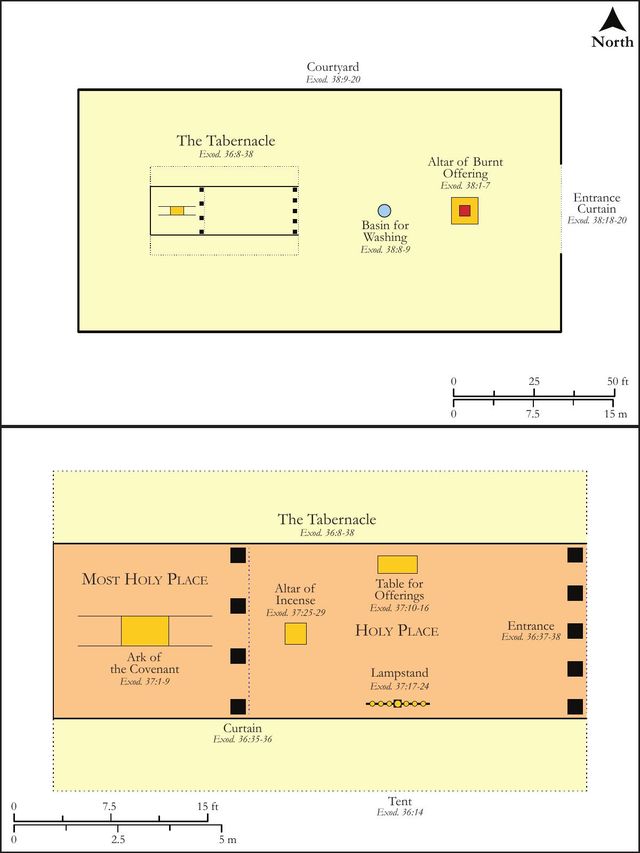
Exodus 36:13 is situated within the detailed execution phase of the Tabernacle's construction, specifically following the collection of materials and the divine appointment of master craftsmen like Bezalel and Oholiab, as outlined in Exodus 35. Chapters Exodus 35-40 meticulously describe the fulfillment of the intricate instructions given to Moses on Mount Sinai in Exodus 25-31. This particular verse directly references the implementation of the design for the Tabernacle's innermost covering, first commanded in Exodus 26:6. The narrative progresses from the general call for contributions and skilled workers to the specific fabrication of each component, emphasizing the divine origin of the blueprint and the human obedience in constructing God's earthly dwelling. The joining of the curtains is a critical step, as it forms the very "skin" of the sanctuary, defining its interior sacred space and holiness.
Historical & Cultural Context
The construction of the Tabernacle occurred during Israel's forty-year wilderness wandering, a foundational period for the nascent nation. As a nomadic people, they required a portable sanctuary that could accompany them on their journey, symbolizing God's continuous, dynamic presence in their midst. The Tabernacle was not merely a tent but a pattern of heavenly things, representing God's throne room and the designated place where He would meet with His people, as commanded in Exodus 25:8. The meticulous detail, including the use of precious materials like gold for even functional items like the taches, reflected the supreme value and holiness attributed to God's presence. In a culture where temples were central to religious life, the Tabernacle provided a unique, divinely ordained structure that set Israel apart from surrounding pagan nations, emphasizing a transcendent yet immanent God who desired to dwell uniquely among His chosen people.
Key Themes
ShowHideThis verse contributes significantly to several key themes within the book of Exodus and the Pentateuch. Foremost is the theme of Divine Presence and Dwelling, as the Tabernacle's construction directly facilitates God's presence among His people, fulfilling His promise to "dwell among them" (Exodus 29:45). The meticulous detail and precise measurements, including the exact number of taches, highlight the theme of Divine Order and Perfection. God's design is flawless, and its execution must reflect that perfection. The act of joining disparate parts into "one tabernacle" underscores the theme of Unity and Wholeness, not only for the physical structure but also for the community of Israel, called to be a unified people under God. Finally, the use of precious materials like gold, even for functional clasps, emphasizes the Holiness and Glory of God, signifying that everything associated with His presence must be set apart and reflect His inherent worth.
Exposition and Analysis
ShowHideKey Word Analysis
ShowHideThis word refers to a "knob or belaying-pin (from its swelling form)." In the context of the Tabernacle, these were specifically designed clasps or hooks. The choice of gold (zâhâb) for these functional items elevates their significance beyond mere utility, imbuing them with the symbolic value of divinity, purity, and preciousness. Their purpose was not merely to connect, but to do so in a manner befitting the sacredness of God's dwelling, ensuring structural integrity and symbolic unity.
A primitive root meaning "to join (literally or figuratively); specifically (by means of spells) to fascinate." In this context, it emphasizes the action of bringing two distinct entities into a cohesive whole. In Exodus 36:13, it signifies the deliberate and effective act of uniting the two large sets of curtains, transforming them from separate components into a single, continuous covering. This "coupling" was essential for the Tabernacle to function as a unified, enclosed sacred space, highlighting the importance of integration and seamless connection in divine design.
Verse Breakdown
ShowHide"And he made fifty taches of gold"
This clause highlights the precise adherence to divine instruction. The "he" refers to Bezalel, the chief craftsman, acting under divine inspiration and guidance, as appointed by God. The number "fifty" is specific, indicating exactness in the divine blueprint (Exodus 26:6). The material, "gold," signifies the immense value, purity, and sacredness attributed to every component of God's dwelling. These taches were not merely functional but were crafted from the most precious metal, underscoring the glory and worthiness of the One for whom the Tabernacle was built.
"and coupled the curtains one unto another with the taches"
This describes the crucial action of unification. Two large sets of linen curtains, each composed of multiple panels, were brought together at their designated edges. The taches served as the vital links, physically joining the two halves. This act of "coupling" was not arbitrary but followed the divine pattern, ensuring that the Tabernacle's inner covering was continuous and complete, forming a secure and sacred enclosure. It speaks to the practical necessity of these clasps for the structural integrity and functionality of the sanctuary, enabling it to fulfill its purpose as a unified sacred space.
"so it became one tabernacle"
This concluding phrase reveals the transformative outcome of the coupling. The individual sets of curtains, once separate and distinct, were now integrated into a singular, unified structure. This unity was essential for the Tabernacle to fulfill its purpose as a coherent and holy dwelling place for God. It signifies the successful completion of a critical stage in the construction, where distinct parts coalesce into a single, divinely ordained entity, ready to house the glory of the Lord and serve as a focal point for Israel's worship and relationship with God.
Literary Devices
ShowHideExodus 36:13 primarily employs Symbolism and Metaphor. The "taches of gold" are not merely functional clasps; they profoundly symbolize the preciousness and divine nature of the unity they create. Gold, throughout Scripture, is a powerful Metaphor for divinity, purity, enduring value, and God's glory, thus elevating the significance of these humble connectors from mere utility to sacred instruments. The act of "coupling" the curtains, resulting in "one tabernacle," is a profound Metaphor for divine unity and cohesion. It visually represents how disparate parts, when divinely ordered and joined, form a perfect and singular whole. This also carries a subtle Synecdoche, where the specific action of joining the curtains with taches represents the broader principle of divine design bringing about perfect integration and harmonious function in the entire Tabernacle structure and, by extension, in God's relationship with His people.
Theological and Thematic Connections
ShowHideExodus 36:13 profoundly illustrates God's meticulous design and His desire for unity and wholeness in His dwelling place. The transformation of separate curtain sets into "one tabernacle" through the golden taches speaks to the divine principle of bringing disparate elements into a cohesive and sacred whole. This unity is not merely structural but reflects the very nature of God, who is one, and His desire for His people to be united in purpose and fellowship. The Tabernacle, in its perfection and unity, foreshadows the ultimate dwelling of God among humanity and the organic unity of His people, the Church.
Reflection and Application
ShowHideThe meticulous detail and profound emphasis on unity in Exodus 36:13 offer timeless lessons for contemporary believers. Just as the Tabernacle's curtains needed to be perfectly joined by precious golden clasps to form a single, sacred space for God's dwelling, so too are we, as the spiritual temple of God and members of His body, called to strive for unity. This verse reminds us that every part, no matter how seemingly small or functional, is essential for the integrity and effective function of the whole. Our individual contributions, when joined together in obedience to God's divine design, create a cohesive and effective witness to His presence in the world. It challenges us to examine where we might be fragmented or disconnected, either personally or corporately, and to actively pursue reconciliation, collaboration, and harmonious living within the body of Christ. Recognizing that our collective unity glorifies God and enables His Spirit to work powerfully among us, we are called to be "taches" of connection, bringing together diverse gifts and personalities for a singular, sacred purpose.
Questions for Reflection
ShowHideFAQ
ShowHideWhat exactly were "taches" in the Tabernacle's construction?
ShowHideIn the context of the Tabernacle, "taches" (from the Hebrew qereç) were specific clasps or hooks, made of gold, used to join the two large sets of linen curtains that formed the innermost covering of the sanctuary. These curtains were divided into two sections, and the fifty golden taches were essential for coupling them together, ensuring the Tabernacle's structural integrity and symbolic unity as a single, sacred dwelling place for God, as precisely commanded in Exodus 26:6.
Why were the taches made of gold, given their functional purpose?
ShowHideThe use of gold for the taches, despite their functional role, was highly significant. Gold in biblical symbolism often represents divinity, purity, preciousness, and enduring value. By making these connectors out of gold, God underscored the sacredness of every component of His dwelling and the immense value He placed on the unity and perfection of the Tabernacle. It elevated a practical item to a symbol of divine worthiness and glory, reflecting the nature of the God who would dwell within and emphasizing that even the seemingly small details of His sanctuary were to reflect His majesty.
What is the significance of the Tabernacle becoming "one tabernacle" after the curtains were joined?
ShowHideThe phrase "so it became one tabernacle" emphasizes the transformative outcome of the curtains being coupled. Before this, they were two separate sets of fabric; afterward, they formed a single, unified, and complete enclosure. This unity was crucial for the Tabernacle to function as a coherent and holy space for God's presence. Theologically, it symbolizes God's desire for unity and wholeness, not only in His dwelling place but also among His people, Israel. It foreshadows the profound unity found in Christ and the Church, where diverse members are brought together to form one body, as further expounded in passages like Ephesians 4:3.
Christ-Centered Fulfillment
ShowHideThe unity achieved in Exodus 36:13, where disparate curtains become "one tabernacle" through the golden taches, finds its ultimate and most profound fulfillment in Jesus Christ. The Tabernacle was a temporary dwelling place for God's glory, a shadow of the reality to come. Jesus is the true and eternal Tabernacle, the very "Word made flesh, who dwelt among us" (John 1:14). In Him, God's presence is not merely symbolized but fully embodied. Furthermore, Christ is the ultimate "tache" or "clasp" that unites humanity to God and brings together all believers into one spiritual body, the Church. Just as the golden clasps brought two halves into a single sanctuary, Christ, through His atoning sacrifice, breaks down the dividing wall of hostility and unifies Jew and Gentile, making them one new humanity in Himself (Ephesians 2:14-16). He is the head who perfectly joins and holds together His diverse body, the Church, enabling it to function as a unified dwelling place for the Holy Spirit (Ephesians 1:22-23 and Ephesians 4:15-16). The meticulous design for unity in the Tabernacle ultimately points to the perfect, indissoluble unity found in Christ and His redeemed people, anticipating the day when God will fully dwell with His people in the new heaven and new earth, as revealed in Revelation 21:3.