


Exodus 36:12
Bible text: King James Version (1769 Blayney text) · Public domain
Bible text: King James Version with Strong's numbers · Public domain
Bible text: Berean Standard Bible · Public domain
Bible text: American Standard Version (1901) · Public domain
Bible text: World English Bible, Messianic edition · Public domain
Bible text: Geneva Bible (1599) · Public domain
Bible text: Young's Literal Translation · Public domain
- חֲמִשִּׁיםcha·mi·ShimfiftyH2572Adj-mpAdjective Numerical Plural Masculine Absolute
- לֻלָאֹתlu·la·'OtloopsH3924N-fpNoun Plural Feminine Absolute
- עָשָׂה'a·Sahhe madeH6213V-Qal-Perf-3msVerb Qal Perfect 3rd Singular Masculine
- בַּיְרִיעָהbay·ri·'Ahon the curtainH3407Prep-b ¦ N-fsNoun Singular Feminine Absoluteבַּon theיְרִיעָהcurtain
- הָאֶחָתha·'e·Chat<the> oneH259Art ¦ Adj-fsAdjective Numerical Singular Feminine Absoluteהָ<the>אֶחָתone
- וַחֲמִשִּׁיםva·cha·mi·Shimand fiftyH2572Conj-w ¦ Adj-mpAdjective Numerical Plural Masculine Absoluteוַandחֲמִשִּׁיםfifty
- לֻלָאֹתlu·la·'OtloopsH3924N-fpNoun Plural Feminine Absolute
- עָשָׂה'a·Sahhe madeH6213V-Qal-Perf-3msVerb Qal Perfect 3rd Singular Masculine
- בִּקְצֵהbik·Tzehon [the] edge ofH7097Prep-b ¦ N-mscNoun Singular Masculine Constructבִּonקְצֵה[the] edge of
- הַיְרִיעָהhay·ri·'Ahthe curtainH3407Art ¦ N-fsNoun Singular Feminine Absoluteהַtheיְרִיעָהcurtain
- אֲשֶׁר'a·SherwhichH834RelParticle Relative
- בַּמַּחְבֶּרֶתba·mach·Be·ret[was] in the joined setH4225Prep-b ¦ N-fsNoun Singular Feminine Absoluteבַּ[was] in theמַּחְבֶּרֶתjoined set
- הַשֵּׁנִיתha·she·Nit<the> secondH8145Art ¦ Adj-fsAdjective Numerical Position Singular Feminine Absoluteהַ<the>שֵּׁנִיתsecond
- מַקְבִּילֹתmak·bi·Lot[were] oppositeH6901V-Hiphil-Prtcpl-fpVerb Hiphil Participle Plural Feminine Absolute
- הַלֻּלָאֹתha·Lu·la·'Otthe loopsH3924Art ¦ N-fpNoun Plural Feminine Absoluteהַtheלֻּלָאֹתloops
- אַחַת'a·ChatoneH259Adj-fsAdjective Numerical Singular Feminine Absolute
- אֶל'eltoH413PrepPreposition
- אֶחָת'e·ChatoneH259Adj-fsAdjective Numerical Singular Feminine Absolute
English is a literal word-by-word gloss of the Hebrew, not the KJV's wording. Why?
This is the original text the KJV's translators worked from — each Hebrew word with its own literal English meaning in this verse, prepared by scholars at Tyndale House, Cambridge. The KJV translates whole sentences, not word by word, so its wording differs: one Hebrew word can become several English words, and the KJV may choose “the LORD” where the gloss reads “Yahweh”. Both are faithful — they answer different questions. For the KJV's own rendering, switch to the KJV text.
Details
See on the biblical-era maps

Study this verse
Public-domain commentary
Matthew Henry
From his Commentary on the Whole Bible. Henry comments on passages, not single verses — this entry covers Exodus 36:8–13.
The first work they set about was the framing of the house, which must be done before the furniture of it was prepared. This house was not made of timber or stone, but of curtains curiously embroidered and coupled together. This served to typify the state of the church in this world, the palace of God's kingdom among men. 1. Though it is upon the earth, yet its foundation is not in the earth, as that of a house is; no, Christ's kingdom is not of this world, nor founded in it. 2. It is mean and mutable, and in a militant state; shepherds dwelt in tents, and God is the Shepherd of Israel; soldiers dwelt in tents, and the Lord is a man of war, and his church marches through an enemy's country, and must fight its way. The kings of the earth enclose themselves in cedar (Jer 22:15), but the ark of God was lodged in curtains only. 3. Yet there is a beauty in holiness; the curtains were embroidered, so is the church adorned with the gifts and graces of the Spirit, that raiment of needle-work, Psa 45:14. 4. The several societies of believers are united in one, and, as here, all become one tabernacle; for there is one Lord, one faith, and one baptism.
Continue studying Exodus 36:12 across the web’s major study libraries — every link below opens this exact verse, chapter, or book on the destination site.
Read & Compare
 BibleGatewayThis verse in more than 200 translations and 70 languages.
 Bible.comThe YouVersion reader — hundreds of translations, reading plans, and highlights.
 ESV.orgCrossway's official English Standard Version reader.
 NET BibleThe NET translation with 60,000+ translators' notes on every rendering decision.
 STEP BibleTyndale House's free study tool — original text, vocabulary, and scholarly resources.
 BibliaLogos Bible Software's free web reader.
 USCCBThe New American Bible (Revised Edition) with the U.S. bishops' study notes.
Commentaries
 BibleHub CommentariesDozens of classic commentaries on this verse, gathered on one page.
 StudyLightMore than 100 commentary sets — the largest collection on the web.
 BibleRefPlain-English commentary on what this verse means, verse by verse.
 Enduring WordDavid Guzik's free commentary on this chapter, widely used by Bible teachers.
 Bible Study ToolsVerse commentary alongside Greek and Hebrew study aids.
Original Language & Research
- BibleHub InterlinearThe verse word by word — original language, transliteration, and English.
- BibleHub LexiconEvery word's original-language definition and Strong's entry.
 Blue Letter BibleDeep-study tools — Strong's numbers, concordance, and word studies.
 SefariaThe Hebrew text with Rashi and centuries of Jewish commentary.
Sermons, Hymns & Audio


TrulyRandomVerse is not affiliated with these sites and doesn’t control their content. They’re linked because they’re genuinely useful.
Summary
Exodus 36:12 meticulously details the construction of the Tabernacle's inner curtains, specifically focusing on the creation of fifty loops on the edge of each of the two main curtain sets. This precise instruction highlights the divine blueprint for the desert sanctuary, ensuring that these elaborate curtains, made of fine twined linen with cherubim, could be perfectly joined together to form a unified and sacred enclosure for the dwelling place of God's presence among His people. The verse underscores the exactitude required in executing God's commands, emphasizing that even the smallest components were vital for the structural integrity and symbolic completeness of the Tabernacle.
Context
ShowHideLiterary Context
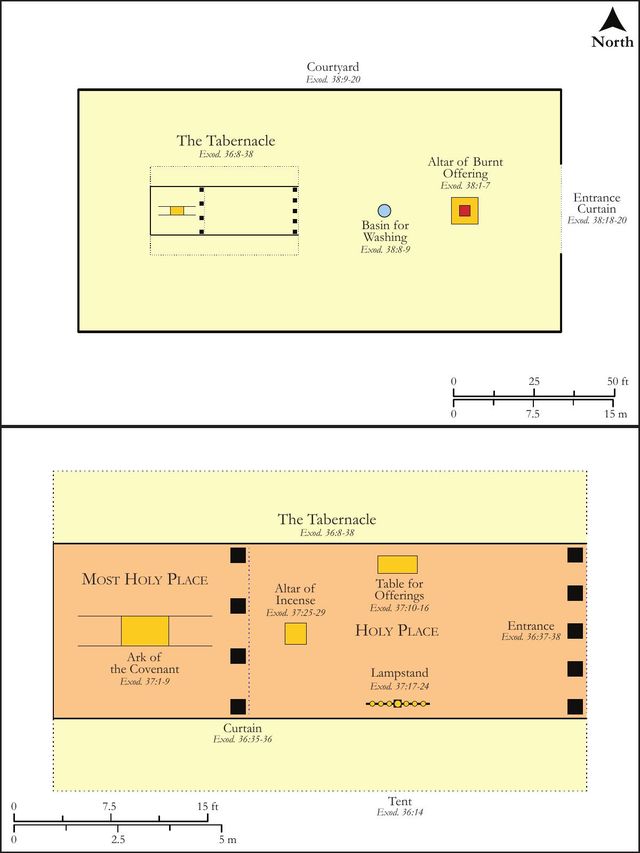
This verse is situated within the comprehensive narrative of the Tabernacle's construction, spanning Exodus chapters 35-39. Following God's detailed instructions given to Moses on Mount Sinai (recorded in Exodus 25-31), this section describes the actual execution of the work by Bezalel, Aholiab, and other divinely gifted craftsmen. Exodus 35:31 explicitly states that these artisans were "filled with the spirit of God, in wisdom, in understanding, and in knowledge, and in all manner of workmanship." Specifically, Exodus 36:8 introduces the making of the ten inner curtains of fine twined linen, dyed blue, purple, and scarlet, with cherubim skillfully woven into them. Verse 12 then focuses on the precise mechanism for joining these curtains, reiterating the divine command first given in Exodus 26:5, which specified the exact number and placement of these loops. This repetition underscores the importance of strict adherence to the divine blueprint.
Historical & Cultural Context
The construction of the Tabernacle occurred during Israel's forty-year wilderness wandering, a period of nomadic existence following their exodus from Egypt. In this context, a portable sanctuary was essential for maintaining God's presence at the center of their encampment. Unlike the fixed temples of the pagan nations round about, the Tabernacle was designed for mobility, necessitating a modular and precisely engineered structure. The meticulous details, such as the loops and clasps, ensured that the Tabernacle could be disassembled, transported, and reassembled without compromising its structural integrity or its sacred function. This emphasis on divine instruction and precise execution contrasted sharply with the often chaotic or anthropocentric designs of pagan worship sites, highlighting God's order, holiness, and His desire for a specific, divinely ordained dwelling place among His chosen people. The Tabernacle served as a tangible symbol of God's covenant presence, a visible reminder that He journeyed with them.
Key Themes
ShowHideThis verse contributes significantly to several key themes prevalent in Exodus. Foremost is the theme of Divine Revelation and Instruction, where God provides incredibly detailed blueprints for His dwelling, emphasizing His meticulous nature and His desire for worship to be conducted according to His precise will. Closely related is the theme of Obedience and Faithful Execution, as Bezalel and Aholiab, empowered by the Spirit, diligently follow every command, demonstrating the importance of human responsiveness to divine directives. The intricate design of the Tabernacle, including these loops, also highlights the theme of God's Holy Presence and Dwelling, establishing a sacred space where a holy God could reside among an unholy people, mediated by specific rituals and structures. Finally, the "coupling" of the curtains to form a unified whole foreshadows the theme of Unity and Community, which is central to God's design for His people, as seen throughout the biblical narrative, from the formation of Israel to the New Testament church, where believers are called to be one body in Christ.
Exposition and Analysis
ShowHideKey Word Analysis
ShowHideDerived from a root suggesting twisting or winding, this term (H3924) refers to the specific eyelets or fasteners meticulously crafted on the edge of the Tabernacle curtains. Their precise number (fifty on each main curtain set) and placement were critical for the seamless joining of the two large curtain sections, ensuring the structural integrity and aesthetic perfection of the sanctuary's covering. The emphasis on these small, yet vital, components highlights God's demand for absolute precision and excellence in all aspects of His worship and dwelling place.
This noun (H4225) refers to a "junction" or "seam," indicating the point where two things are joined together. In the context of Exodus 36:12, it specifically denotes the mechanism by which the two large sets of Tabernacle curtains were united to form a single, continuous covering. This term emphasizes the successful outcome of bringing disparate parts into a cohesive whole, symbolizing the unity and coherence necessary for God's dwelling place and, by extension, within the community of faith.
This verb (H6901) means "to admit," "take," "receive," or "hold." In this verse, it describes the active function of the loops, which, once interlocked by the golden clasps (mentioned in the subsequent verse), effectively "held" or "joined" the two large curtain sections together. This word underscores the practical and essential role of these seemingly small details in achieving the overall divine design, ensuring the stability and integrity of the sacred structure.
Verse Breakdown
ShowHide"Fifty loops made he in one curtain"
This clause specifies the exact number of loops crafted along the edge of the first main curtain section. The number "fifty" is not arbitrary but a divinely commanded quantity, underscoring the absolute precision and adherence to the blueprint required of the craftsmen. "He" refers to Bezalel and the skilled artisans working under divine inspiration, highlighting their faithful execution of God's instructions.
"and fifty loops made he in the edge of the curtain which [was] in the coupling of the second"
This parallels the first clause, indicating that an identical set of fifty loops was made on the corresponding edge of the second main curtain section. The phrase "in the coupling of the second" clarifies the purpose and placement of these loops – they were specifically designed to interact with and join the first set of loops, forming a complete and unified structure. This emphasizes the interdependency of the parts.
"the loops held one [curtain] to another"
This final clause describes the successful outcome and function of these loops. Once the golden clasps (mentioned in Exodus 36:13) were inserted through these opposing loops, they effectively "held" or "joined" the two large curtain sections, transforming them from separate pieces into a single, cohesive covering for the Tabernacle. This highlights the practical and essential role of these seemingly small details in achieving the overall divine design.
Literary Devices
ShowHideExodus 36:12 employs several literary devices to convey its message. Repetition is evident in the phrase "fifty loops made he," which appears twice, emphasizing the exactitude and adherence to the divine blueprint. This numerical precision highlights God's demand for order and the craftsmen's faithful obedience. The verse also utilizes Synecdoche, where the "loops" represent the entire intricate system of connection, implicitly including the golden clasps mentioned in the subsequent verse, which were essential for the "coupling." Furthermore, the meticulous description of these small components contributes to the overall Symbolism of the Tabernacle itself: every part, no matter how minor, was crucial for the whole to function as a unified dwelling place for God. The joining of the curtains through these loops serves as a powerful symbol of unity and the bringing together of disparate elements to form a cohesive, sacred whole, reflecting God's desire for order and coherence in His presence.
Theological and Thematic Connections
ShowHideExodus 36:12, in its precise description of the Tabernacle's construction, reveals profound theological truths about God's character and His relationship with humanity. The meticulous detail in the creation of the loops underscores God's demand for order, excellence, and faithful obedience in all matters pertaining to His worship and dwelling place. Every component, no matter how small, was divinely specified and essential for the Tabernacle's integrity and sacred purpose. This attention to detail reflects God's own perfect design and His desire for a holy and unblemished sanctuary. Furthermore, the "coupling" of the two curtain sets to form a single covering powerfully symbolizes unity – both the unity of the divine dwelling and, by extension, the unity God desires for His people. Just as the physical structure required perfect alignment and connection, so too is the spiritual community called to be one, reflecting the cohesive nature of God's design.
Reflection and Application
ShowHideThe seemingly mundane detail of fifty loops in Exodus 36:12 offers profound lessons for contemporary believers. It reminds us that God is a God of order and precision, valuing excellence in every aspect of our lives, especially in our service to Him. Just as the Tabernacle's effectiveness depended on the perfect execution of every small part, our spiritual lives and ministries are enriched when we commit to faithfulness and diligence in seemingly minor tasks. This verse challenges us to consider whether we approach our responsibilities, gifts, and relationships with the same meticulous care and obedience demonstrated by Bezalel and Aholiab. Moreover, the function of the loops in creating unity from separate pieces serves as a powerful metaphor for the body of Christ. Each believer, like a loop, has a unique and essential role, and our interconnectedness and willingness to "couple" with one another in love and service are vital for the church to function as a unified, effective dwelling place for God's Spirit in the world. We are called to actively pursue unity, recognizing that our collective strength and witness depend on our seamless connection to one another and to Christ, our head.
Questions for Reflection
ShowHideFAQ
ShowHideWhy were there exactly fifty loops on each curtain?
ShowHideThe specific number "fifty" was not arbitrary but was a precise divine instruction given by God to Moses, as detailed in Exodus 26:5. This exact quantity was crucial for the structural integrity and perfect alignment of the two main curtain sections. It underscores God's demand for absolute precision and meticulous adherence to His blueprint for the Tabernacle, emphasizing that every detail, no matter how small, was significant for the sacred dwelling place.
What was the purpose of these loops in the Tabernacle's construction?
ShowHideThe primary purpose of the loops was to facilitate the "coupling" or joining of the two large sets of inner curtains, transforming them from separate pieces into a single, unified covering for the Tabernacle. As described in Exodus 36:13, golden clasps were inserted through the fifty loops on one curtain and the fifty loops on the other, interlocking them to create a seamless and secure enclosure. This mechanism was vital for forming the structural integrity and sacred space of God's dwelling among His people in the wilderness.
How does this seemingly small detail relate to the overall significance of the Tabernacle?
ShowHideThis detail highlights the profound theological principle that every aspect of God's design is important and contributes to the whole. The Tabernacle was not merely a tent but a meticulously designed sanctuary symbolizing God's holy presence among His people. The loops, though small, were indispensable for the curtains to function as a unified barrier, separating the holy space from the common. This teaches us that God cares about precision and excellence in all things done for His glory, and that even the smallest acts of obedience and faithfulness contribute to the larger divine purpose.
Christ-Centered Fulfillment
ShowHideThe meticulous detail of the loops and their function in "coupling" the Tabernacle curtains finds its ultimate Christ-centered fulfillment in the person and work of Jesus Christ. The Tabernacle, with its precise design and unified structure, served as a tangible shadow of the true dwelling place of God. In Christ, God's presence no longer dwells in a tent made with human hands, but in the person of Jesus, the Word made flesh, in whom "all the fullness of the Deity lives in bodily form" (Colossians 2:9). Just as the loops joined two curtain sections into one, Christ, through His atoning sacrifice, perfectly "couples" humanity to God, bridging the chasm of sin. He is the ultimate "coupling" mechanism, breaking down the dividing wall of hostility and creating one new humanity, uniting Jew and Gentile in Himself (Ephesians 2:14-16). The Tabernacle's unified covering foreshadowed the perfect and complete access to God that is now available to all who are "in Christ," made possible by the tearing of the temple veil at His death (Matthew 27:51), opening a new and living way into the Most Holy Place (Hebrews 10:19-20). Thus, the humble loops point to the glorious reality of union with God through our Lord Jesus Christ.