


Exodus 36:8
Bible text: King James Version (1769 Blayney text) · Public domain
Bible text: King James Version with Strong's numbers · Public domain
Bible text: Berean Standard Bible · Public domain
Bible text: American Standard Version (1901) · Public domain
Bible text: World English Bible, Messianic edition · Public domain
Bible text: Geneva Bible (1599) · Public domain
Bible text: Young's Literal Translation · Public domain
- וַיַּעֲשׂוּvai·ya·'a·Suand they madeH6213Conj-w ¦ V-Qal-ConsecImperf-3mpVerb Qal Consecutive Imperfect 3rd Plural Masculineוַandיַּעֲשׂוּthey made
- כָלkholeveryH3605N-mscNoun Singular Masculine Construct
- חֲכַםcha·kham[person] skillful ofH2450Adj-mscAdjective Singular Masculine Construct
- לֵבlevheartH3820N-msNoun Singular Masculine Absolute
- בְּעֹשֵׂיbe·'o·Seiamong [those who] didH6213Prep-b ¦ V-Qal-Prtcpl-mpVerb Qal Participle Plural Masculine Constructבְּamongעֹשֵׂי[those who] did
- הַמְּלָאכָהha·me·la·Khah<of> the workH4399Art ¦ N-fsNoun Singular Feminine Absoluteהַ<of> theמְּלָאכָהwork
- אֶת'et<obj.>H853DirObjMParticle Object Indicator
- הַמִּשְׁכָּןha·mish·Kanthe tabernacleH4908Art ¦ N-msNoun Singular Masculine Absoluteהַtheמִּשְׁכָּןtabernacle
- עֶשֶׂר'E·sertenH6235N-mscNoun Singular Masculine Construct
- יְרִיעֹתye·ri·'OtcurtainsH3407N-fpNoun Plural Feminine Absolute
- שֵׁשׁsheshfine linenH8336N-msNoun Singular Masculine Absolute
- מָשְׁזָרma·she·ZartwistedH7806V-Hophal-PassPrtcpl-msVerb Hophal Participle Passive Singular Masculine Absolute
- וּתְכֵלֶתu·te·Khe·letand violet stuffH8504Conj-w ¦ N-fsNoun Singular Feminine Absoluteוּandתְכֵלֶתviolet stuff
- וְאַרְגָּמָןve·'ar·ga·Manand purpleH713Conj-w ¦ N-msNoun Singular Masculine Absoluteוְandאַרְגָּמָןpurple
- וְתוֹלַעַתve·to·La·'atand scarlet stuff ofH8438Conj-w ¦ N-fscNoun Singular Feminine Constructוְandתוֹלַעַתscarlet stuff of
- שָׁנִיsha·NiscarletH8144N-msNoun Singular Masculine Absolute
- כְּרֻבִיםke·ru·VimcherubimH3742N-mpNoun Plural Masculine Absolute
- מַעֲשֵׂהma·'a·Seh[the] work ofH4639N-mscNoun Singular Masculine Construct
- חֹשֵׁבcho·Sheva skillful workerH2803V-Qal-Prtcpl-msVerb Qal Participle Singular Masculine Absolute
- עָשָׂה'a·Sahhe madeH6213V-Qal-Perf-3msVerb Qal Perfect 3rd Singular Masculine
- אֹתָם'o·Tam<obj.> themH853DirObjM ¦ 3mpParticle Object Indicatorאֹתָ<obj.>םthem
English is a literal word-by-word gloss of the Hebrew, not the KJV's wording. Why?
This is the original text the KJV's translators worked from — each Hebrew word with its own literal English meaning in this verse, prepared by scholars at Tyndale House, Cambridge. The KJV translates whole sentences, not word by word, so its wording differs: one Hebrew word can become several English words, and the KJV may choose “the LORD” where the gloss reads “Yahweh”. Both are faithful — they answer different questions. For the KJV's own rendering, switch to the KJV text.
Details
See on the biblical-era maps

Study this verse
Public-domain commentary
Matthew Henry
From his Commentary on the Whole Bible. Henry comments on passages, not single verses — this entry covers Exodus 36:8–13.
The first work they set about was the framing of the house, which must be done before the furniture of it was prepared. This house was not made of timber or stone, but of curtains curiously embroidered and coupled together. This served to typify the state of the church in this world, the palace of God's kingdom among men. 1. Though it is upon the earth, yet its foundation is not in the earth, as that of a house is; no, Christ's kingdom is not of this world, nor founded in it. 2. It is mean and mutable, and in a militant state; shepherds dwelt in tents, and God is the Shepherd of Israel; soldiers dwelt in tents, and the Lord is a man of war, and his church marches through an enemy's country, and must fight its way. The kings of the earth enclose themselves in cedar (Jer 22:15), but the ark of God was lodged in curtains only. 3. Yet there is a beauty in holiness; the curtains were embroidered, so is the church adorned with the gifts and graces of the Spirit, that raiment of needle-work, Psa 45:14. 4. The several societies of believers are united in one, and, as here, all become one tabernacle; for there is one Lord, one faith, and one baptism.
Continue studying Exodus 36:8 across the web’s major study libraries — every link below opens this exact verse, chapter, or book on the destination site.
Read & Compare
 BibleGatewayThis verse in more than 200 translations and 70 languages.
 Bible.comThe YouVersion reader — hundreds of translations, reading plans, and highlights.
 ESV.orgCrossway's official English Standard Version reader.
 NET BibleThe NET translation with 60,000+ translators' notes on every rendering decision.
 STEP BibleTyndale House's free study tool — original text, vocabulary, and scholarly resources.
 BibliaLogos Bible Software's free web reader.
 USCCBThe New American Bible (Revised Edition) with the U.S. bishops' study notes.
Commentaries
 BibleHub CommentariesDozens of classic commentaries on this verse, gathered on one page.
 StudyLightMore than 100 commentary sets — the largest collection on the web.
 BibleRefPlain-English commentary on what this verse means, verse by verse.
 Enduring WordDavid Guzik's free commentary on this chapter, widely used by Bible teachers.
 Bible Study ToolsVerse commentary alongside Greek and Hebrew study aids.
Original Language & Research
- BibleHub InterlinearThe verse word by word — original language, transliteration, and English.
- BibleHub LexiconEvery word's original-language definition and Strong's entry.
 Blue Letter BibleDeep-study tools — Strong's numbers, concordance, and word studies.
 SefariaThe Hebrew text with Rashi and centuries of Jewish commentary.
Sermons, Hymns & Audio


TrulyRandomVerse is not affiliated with these sites and doesn’t control their content. They’re linked because they’re genuinely useful.
Summary
Exodus 36:8 marks the commencement of the physical construction of the Tabernacle, specifically detailing the creation of its innermost and most sacred coverings. This verse highlights the pivotal role of divinely gifted artisans, referred to as "wise-hearted men," who meticulously crafted ten elaborate curtains. These curtains were fashioned from luxurious materials—fine twined linen, interwoven with threads of blue, purple, and scarlet—and adorned with intricate cherubim, demonstrating exceptional "cunning work." It signifies a crucial transition from the divine blueprint and communal provision of materials to the inspired and skillful execution of God's precise architectural design for His dwelling place among His people.
Context
ShowHideLiterary Context
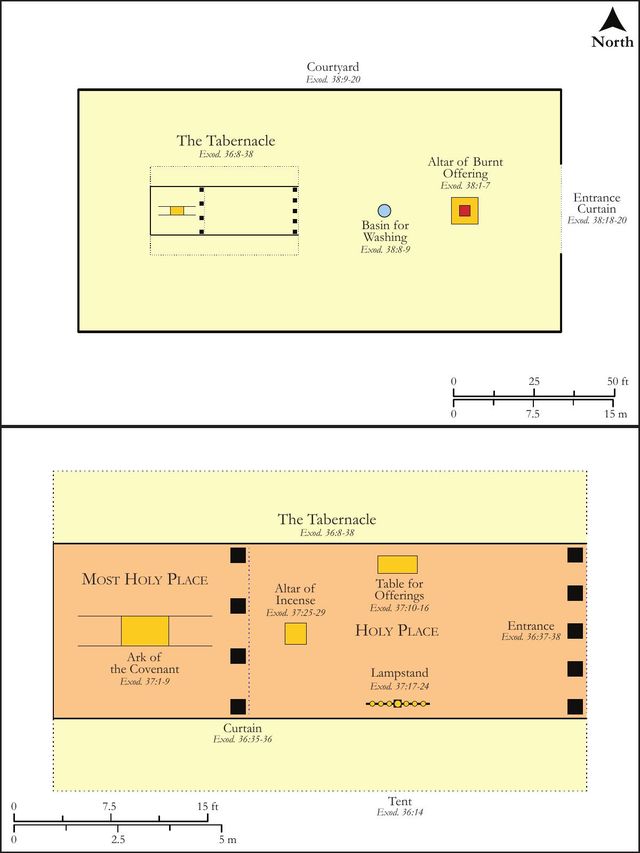
Exodus 36:8 is situated at a critical juncture in the narrative of the Tabernacle's construction, following a detailed sequence of divine instruction and communal response. Chapters Exodus 25-31 meticulously lay out God's precise commands regarding every aspect of the sanctuary, from its materials to its dimensions and furnishings. Immediately preceding this verse, Exodus 35 records the overwhelming generosity of the Israelites in bringing their freewill offerings, exceeding what was needed, and crucially, the divine appointment and empowerment of Bezalel and Aholiab, along with other skilled artisans, with the Spirit of God for this very work (Exodus 35:30-35). Thus, Exodus 36:8 serves as the narrative pivot, signaling the transition from the planning and preparation stages to the actual, physical manifestation of God's dwelling, underscoring the community's obedient and enthusiastic response to the divine call.
Historical & Cultural Context
The construction of the Tabernacle took place in the challenging wilderness environment, during Israel's nomadic period after their liberation from Egypt. This portable sanctuary was not merely a building but the central symbol of God's tangible presence among His people, a stark contrast to the fixed temples of the pagan gods among the nations. The materials specified—fine linen, and the rare and expensive blue, purple, and scarlet dyes—were highly valued and often associated with royalty, divinity, and sacred spaces among the nations, emphasizing the supreme honor due to Yahweh. The "cunning work" of weaving intricate cherubim required specialized, high-level craftsmanship, which the text explicitly states was divinely imparted (Exodus 31:3). This highlights that human talent, when consecrated and divinely enabled, becomes a vessel for sacred purpose. The entire project was a profound act of communal worship, obedience, and the establishment of foundational patterns for Israelite spirituality and their unique covenant relationship with God.
Key Themes
ShowHideThis verse contributes significantly to several overarching themes within Exodus and the broader Pentateuch. It powerfully illustrates the theme of Divine Presence and Dwelling, as the Tabernacle is the tangible manifestation of God's desire to reside among His people. It underscores Divine Empowerment for Service, emphasizing that the skills and wisdom required for sacred work are not merely natural abilities but divine endowments, as seen in the "wise-hearted men" (Exodus 31:3 and Exodus 35:31). The meticulous detail and precious materials highlight the theme of Excellence and Holiness in Worship, demonstrating that God demands the highest quality and reverence in all that pertains to His glory. Finally, the communal effort involved reflects the theme of Covenant Obedience and Community Participation, as the entire nation contributes their resources and skills in a unified act of worship and obedience to God's commands.
Exposition and Analysis
ShowHideKey Word Analysis
ShowHideDerived from a root meaning "to be wise," this term signifies not merely intellectual acumen but practical wisdom, discernment, and skill. In the context of the Tabernacle, it denotes a divinely imparted ability to execute intricate and artistic work with understanding and precision. These individuals possessed a wisdom that enabled them to translate divine instructions into tangible, beautiful craftsmanship.
In biblical Hebrew, "heart" (lêb) is far more comprehensive than merely the seat of emotions. It encompasses the intellect, will, conscience, and the very core of one's being, including practical skill and understanding. Thus, "wise-hearted" (châkâm lêb) indicates that the artisans' wisdom was not just theoretical but deeply integrated into their practical abilities and their very nature, making them uniquely suited for the sacred task.
This primitive root means "to plait or interpenetrate," leading to concepts like "to weave," "to fabricate," or "to contrive." When applied to "work" (maʻăseh, H4639), "cunning work" (maʻăseh châshab) refers to highly intricate, skillfully designed, and artfully executed craftsmanship, particularly in weaving. It implies complex patterns, like the cherubim, woven directly into the fabric rather than merely embroidered on top, requiring immense foresight and mastery.
Verse Breakdown
ShowHide"And every wise hearted man among them that wrought the work of the tabernacle"
This opening clause immediately draws attention to the human agents divinely empowered for the task. The phrase "wise-hearted man" (châkâm lêb) signifies individuals not only intellectually astute but also possessing practical skill, discernment, and the ability to apply knowledge effectively, all of which are divinely endowed for the sacred work. It emphasizes that the construction was a communal effort, involving numerous skilled individuals, all working under divine enablement for the singular purpose of building God's dwelling.
"made ten curtains [of] fine twined linen, and blue, and purple, and scarlet"
This specifies the primary materials and colors of the innermost layer of the Tabernacle's covering. The "ten curtains" formed the ceiling and inner walls of both the Holy Place and the Most Holy Place. "Fine twined linen" (shêsh) symbolized purity and righteousness, reflecting the holiness of God. The vibrant colors carried profound symbolism: "blue" (tᵉkêleth) represented heaven and the divine nature; "purple" (ʼargâmân) signified royalty and kingship; and "scarlet" (shânîy tôwlâʻ) pointed to atonement, sacrifice, and life, often associated with blood. These materials and colors created a visually stunning and symbolically rich enclosure, underscoring the majesty and holiness of the God who would dwell within.
"[with] cherubims of cunning work made he them"
This clause details the intricate design woven into the fabric of the curtains. Cherubim (kᵉrûwb) are angelic beings associated with guarding God's holiness and presence, as seen in their role guarding the Garden of Eden (Genesis 3:24). Their presence on the inner curtains reinforced the sacredness of the Tabernacle as God's dwelling place, reminding those who entered of the divine presence and the need for reverence. The "cunning work" (maʻăseh châshab) signifies the extraordinary skill required to weave such complex, artistic figures directly into the very structure of the fabric, demonstrating the highest level of craftsmanship dedicated to God's glory.
Literary Devices
ShowHideExodus 36:8 employs several significant literary devices to convey its profound meaning. Symbolism is paramount, as every material and color used in the Tabernacle's construction carries deep theological significance. The "fine twined linen" symbolizes purity, the "blue" represents the heavens and God's divinity, "purple" signifies royalty and majesty, and "scarlet" points to life, blood, and atonement. The Cherubim themselves are potent symbols of God's holy presence and guardianship, recalling their role as guardians of sacred space. The phrase "wise hearted man" uses Metonymy, where "heart" stands for the entire inner person—intellect, will, and practical skill—emphasizing that the artisans' abilities were not merely physical but divinely inspired and spiritually attuned. The meticulous detail in this verse, consistent with the preceding chapters, also serves as a form of Emphasis, underscoring the importance of precise obedience to God's commands and the divine standard of excellence required for His sacred dwelling.
Theological and Thematic Connections
ShowHideExodus 36:8 powerfully illustrates the principle of divine empowerment for sacred service. God not only provides the blueprint and the materials but also gifts and enables His people with the necessary skills and wisdom to accomplish His work. This highlights that all true ability for God's kingdom initiatives originates from Him, calling His people to offer their best in worship and service. The meticulous craftsmanship and precious materials underscore God's demand for excellence and beauty in all that pertains to His glory, reflecting His own perfect character. The Tabernacle, with its rich symbolism, served as a tangible representation of God's desire to dwell among His people, foreshadowing a deeper, more intimate indwelling that would ultimately be realized in the New Covenant.
Reflection and Application
ShowHideExodus 36:8 offers profound insights for contemporary believers, reminding us that God continues to equip His people with diverse gifts and talents for the building of His spiritual house, the church. Just as the "wise-hearted men" were divinely enabled for the Tabernacle's construction, so too are believers empowered by the Holy Spirit for various forms of service, whether in teaching, administration, music, hospitality, creative arts, or even in their secular vocations. This verse challenges us to recognize that our skills and abilities are not merely our own but are divine endowments meant to be consecrated for God's glory and the advancement of His kingdom. It calls us to approach all tasks, especially those undertaken for the Lord, with excellence, diligence, and a heart of worship, understanding that our work, however seemingly small, contributes to God's ongoing redemptive purposes in the world. The meticulous detail, precious materials, and the divine standard of excellence observed in the Tabernacle's construction serve as a timeless reminder that God deserves our very best, not merely our leftovers or half-hearted efforts.
Questions for Reflection
ShowHideFAQ
ShowHideWhat is the significance of the "wise-hearted" artisans mentioned in this verse?
ShowHideThe "wise-hearted" artisans were individuals whom God had specifically gifted and empowered with the necessary skills, understanding, and knowledge for the intricate work of constructing the Tabernacle. This was not merely natural talent but a divine endowment, as explicitly stated in Exodus 31:3 and Exodus 35:31. Their "wisdom of heart" (châkâm lêb) indicates a practical, spiritual aptitude for craftsmanship, highlighting that all true ability for God's work comes from Him and is consecrated for His purposes, demonstrating that divine enablement is crucial for sacred service.
Why were the materials (linen, blue, purple, scarlet) for the curtains so specific and symbolically rich?
ShowHideThe materials and colors were chosen by divine command and carried profound symbolic meaning, reflecting God's nature and His plan of salvation. "Fine twined linen" symbolized purity and righteousness, befitting the holiness of God's dwelling. "Blue" represented heaven and the divine nature of God, connecting the earthly sanctuary to the heavenly realm. "Purple" signified royalty and kingship, acknowledging God as the supreme sovereign. "Scarlet" pointed to atonement, sacrifice, and life, often associated with blood, foreshadowing the means by which humanity could approach a holy God. Together, these elements created a visual theological statement about the God who was dwelling among His people and the way to approach Him.
What was the purpose of the cherubim on the Tabernacle curtains?
ShowHideThe cherubim, intricately woven into the curtains, served as powerful symbols of God's holy presence and His guardianship. Their presence recalled their role in guarding the tree of life after humanity's expulsion from Eden (Genesis 3:24), emphasizing the sacredness and restricted access to God's immediate presence. In the Tabernacle, they visually reinforced the holiness of the inner sanctuary, reminding those who entered that they were in the presence of the Almighty God, who is both majestic and unapproachable apart from His prescribed means. They served as a constant reminder of the awesome holiness of God and the need for reverence in His presence.
Christ-Centered Fulfillment
ShowHideExodus 36:8, detailing the meticulous construction of the Tabernacle's inner curtains, finds its ultimate and glorious fulfillment in Jesus Christ. The Tabernacle itself was a temporary dwelling place for God among His people, a "shadow of the good things to come" (Hebrews 10:1), pointing to the reality of God's ultimate dwelling with humanity in the person of Jesus, "God with us" (Matthew 1:23). The "fine twined linen" symbolizing purity points to Christ's sinless life and perfect righteousness, the spotless Lamb of God who knew no sin (Hebrews 4:15 and 2 Corinthians 5:21). The "blue" representing heaven and divinity speaks to Christ's divine origin and His being the Son of God who descended from heaven (John 3:13). The "purple" signifying royalty proclaims Him as the King of Kings and Lord of Lords, who holds all authority (Revelation 19:16 and Matthew 28:18). Most profoundly, the "scarlet" pointing to atonement and sacrifice finds its complete realization in Christ's shed blood on the cross, which provides the perfect and final sacrifice for the forgiveness of sins, making access to God possible (Hebrews 9:22 and Ephesians 1:7). The cherubim, guarding God's holiness and restricting access, are now superseded by Christ, who, through His torn body (symbolized by the torn veil of the temple at His death), has opened a new and living way into the Most Holy Place, granting believers direct access to God's presence (Hebrews 10:19-20). The "cunning work" of the artisans foreshadows the infinitely greater "cunning work" of God's redemptive plan, perfectly executed in Christ, making Him the ultimate and perfect Tabernacle where God truly dwells among His people forever.