


Exodus 36:15
Bible text: King James Version (1769 Blayney text) · Public domain
Bible text: King James Version with Strong's numbers · Public domain
Bible text: Berean Standard Bible · Public domain
Bible text: American Standard Version (1901) · Public domain
Bible text: World English Bible, Messianic edition · Public domain
Bible text: Geneva Bible (1599) · Public domain
Bible text: Young's Literal Translation · Public domain
- אֹרֶךְ'O·rekh[the] length ofH753N-mscNoun Singular Masculine Construct
- הַיְרִיעָהhay·ri·'Ahthe curtainH3407Art ¦ N-fsNoun Singular Feminine Absoluteהַtheיְרִיעָהcurtain
- הָאַחַתha·'a·Chat<the> oneH259Art ¦ Adj-fsAdjective Numerical Singular Feminine Absoluteהָ<the>אַחַתone
- שְׁלֹשִׁיםshe·lo·Shim[was] thirtyH7970Adj-mpAdjective Numerical Plural Masculine Absolute
- בָּאַמָּהba·'a·Mahby the cubitH520Prep-b ¦ N-fsNoun Singular Feminine Absoluteבָּby theאַמָּהcubit
- וְאַרְבַּעve·'ar·Ba'and [was] fourH702Conj-w ¦ Adj-csAdjective Numerical Singular common gender Absoluteוְandאַרְבַּע[was] four
- אַמּוֹת'a·MotcubitsH520N-fpNoun Plural Feminine Absolute
- רֹחַבRo·chav[the] breadth ofH7341N-mscNoun Singular Masculine Construct
- הַיְרִיעָהhay·ri·'Ahthe curtainH3407Art ¦ N-fsNoun Singular Feminine Absoluteהַtheיְרִיעָהcurtain
- הָאֶחָתha·'e·Chat<the> oneH259Art ¦ Adj-fsAdjective Numerical Singular Feminine Absoluteהָ<the>אֶחָתone
- מִדָּהmi·DahsizeH4060N-fsNoun Singular Feminine Absolute
- אַחַת'a·ChatoneH259Adj-fsAdjective Numerical Singular Feminine Absolute
- לְעַשְׁתֵּיle·'ash·Tei[belonged] to one [plus]H6249Prep-l ¦ Adj-cscAdjective Numerical Singular common gender Constructלְ[belonged] toעַשְׁתֵּיone [plus]
- עֶשְׂרֵה'es·RehtenH6240Adj-csAdjective Numerical Singular common gender Absolute
- יְרִיעֹתye·ri·'OtcurtainsH3407N-fpNoun Plural Feminine Absolute
English is a literal word-by-word gloss of the Hebrew, not the KJV's wording. Why?
This is the original text the KJV's translators worked from — each Hebrew word with its own literal English meaning in this verse, prepared by scholars at Tyndale House, Cambridge. The KJV translates whole sentences, not word by word, so its wording differs: one Hebrew word can become several English words, and the KJV may choose “the LORD” where the gloss reads “Yahweh”. Both are faithful — they answer different questions. For the KJV's own rendering, switch to the KJV text.
Details
See on the biblical-era maps

Study this verse
Public-domain commentary
Matthew Henry
From his Commentary on the Whole Bible. Henry comments on passages, not single verses — this entry covers Exodus 36:14–34.
Here, 1. The shelter and special protection that the church is under are signified by the curtains of hair-cloth, which were spread over the tabernacle, and the covering of rams' skins and badgers' skins over them, Exo 36:14-19. God has provided for his people a shadow from the heat, and a covert from storm and rain, Isa 4:6. They are armed against all weathers; the sun and the moon shall not smite them: and they are protected from the storms of divine wrath, that hail which will sweep away the refuge of lies, Isa 28:17. Those that dwell in God's house shall find, be the tempest ever so violent, or the dropping ever so continual, it does not rain in. 2. The strength and stability of the church, though it is but a tabernacle, are signified by the boards and bars with which the curtains were borne up, Exo 36:20-34. The boards were coupled together and joined by the bars which shot through them; for the union of the church, and the hearty agreement of those that are its stays and supporters, contribute abundantly to its strength and establishment.
Continue studying Exodus 36:15 across the web’s major study libraries — every link below opens this exact verse, chapter, or book on the destination site.
Read & Compare
 BibleGatewayThis verse in more than 200 translations and 70 languages.
 Bible.comThe YouVersion reader — hundreds of translations, reading plans, and highlights.
 ESV.orgCrossway's official English Standard Version reader.
 NET BibleThe NET translation with 60,000+ translators' notes on every rendering decision.
 STEP BibleTyndale House's free study tool — original text, vocabulary, and scholarly resources.
 BibliaLogos Bible Software's free web reader.
 USCCBThe New American Bible (Revised Edition) with the U.S. bishops' study notes.
Commentaries
 BibleHub CommentariesDozens of classic commentaries on this verse, gathered on one page.
 StudyLightMore than 100 commentary sets — the largest collection on the web.
 BibleRefPlain-English commentary on what this verse means, verse by verse.
 Enduring WordDavid Guzik's free commentary on this chapter, widely used by Bible teachers.
 Bible Study ToolsVerse commentary alongside Greek and Hebrew study aids.
Original Language & Research
- BibleHub InterlinearThe verse word by word — original language, transliteration, and English.
- BibleHub LexiconEvery word's original-language definition and Strong's entry.
 Blue Letter BibleDeep-study tools — Strong's numbers, concordance, and word studies.
 SefariaThe Hebrew text with Rashi and centuries of Jewish commentary.
Sermons, Hymns & Audio


TrulyRandomVerse is not affiliated with these sites and doesn’t control their content. They’re linked because they’re genuinely useful.
Summary
Exodus 36:15 details the precise dimensions of the eleven goat-hair curtains intended for the Tabernacle's outermost covering, specifying their exact length and breadth. This verse is part of the narrative describing the meticulous execution of God's divine blueprint by the skilled artisans Bezalel and Aholiab, ensuring that every component of the wilderness sanctuary adhered to the divinely ordained pattern for God's dwelling among His people.
Context
ShowHideLiterary Context
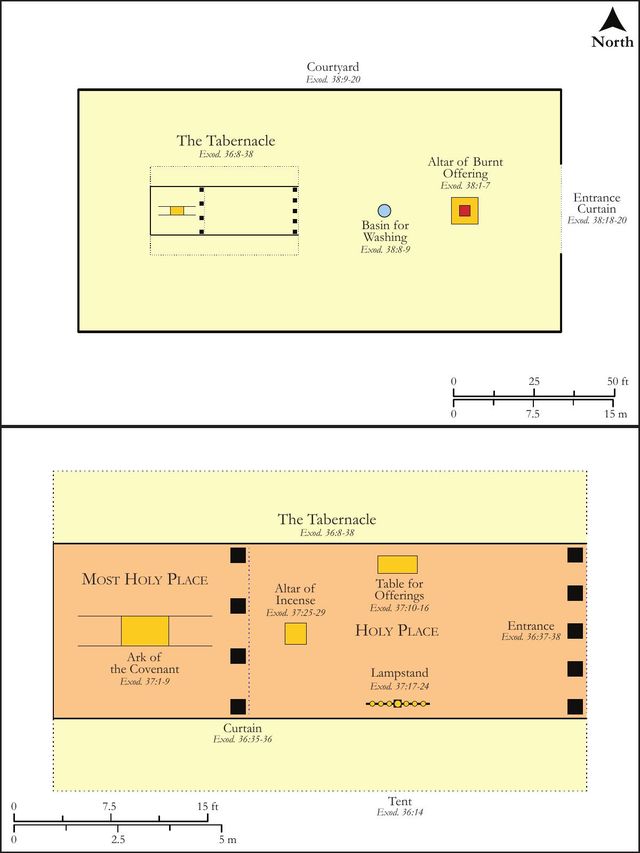
This verse is situated within the detailed account of the Tabernacle's construction, specifically concerning the outer coverings. Following the initial divine commands and architectural specifications given to Moses in Exodus 25 through Exodus 31, chapter 36 shifts to the actual fabrication phase. Verses 8-19 describe the making of the Tabernacle's various curtain layers. Specifically, Exodus 26:7-13 provides the initial instructions for these eleven goat-hair curtains, which formed the second, protective layer over the inner fine linen curtains. Exodus 36:15 confirms the faithful adherence of the craftsmen to these precise dimensions, underscoring the theme of obedience and the divine enablement of human skill in fulfilling God's sacred directives.
Historical & Cultural Context
The Tabernacle served as God's portable dwelling place among the Israelites during their wilderness journey after the Exodus from Egypt. Among the nations, temples and sacred spaces were often constructed with great precision and symbolic significance, reflecting the perceived order and majesty of the deities. The "cubit" was a standard unit of measurement, typically representing the length from the elbow to the tip of the middle finger, roughly 18-21 inches (45-53 cm). The use of goat hair for these outer curtains was practical for a nomadic people, as it was durable, water-resistant, and readily available. The meticulous detail in the divine instructions, and their equally meticulous execution by craftsmen like Bezalel and Aholiab, who were explicitly "filled with the Spirit of God" for this task (as noted in Exodus 31:1-6), underscored the unique holiness and specific demands of the God of Israel.
Key Themes
ShowHideThis verse, embedded in the Tabernacle's construction narrative, highlights several key themes. Firstly, Divine Precision and Order are paramount, as God's detailed instructions for His dwelling place, found throughout Exodus 25-31, leave no room for human improvisation, emphasizing His nature as a God of order. Secondly, Human Obedience and Faithfulness are showcased by the artisans' meticulous adherence to the divine blueprint, demonstrating that true worship involves diligent execution of God's commands. Thirdly, the theme of Divine Presence and Holiness is central, as the Tabernacle's construction ensures a fitting and sacred space for God to dwell among His people, setting Israel apart. Finally, the Divine Enablement of Human Skill is evident, as craftsmen like Bezalel and Aholiab are supernaturally gifted to fulfill these intricate tasks, as seen in Exodus 31:1-6, underscoring that God equips those He calls for His service.
Exposition and Analysis
ShowHideKey Word Analysis
ShowHideThis term (H520) refers to the primary unit of linear measurement in ancient Israel, derived from the forearm. Its consistent use throughout the Tabernacle instructions emphasizes the precise, divinely ordained dimensions for every component, leaving no room for human improvisation in the construction of God's dwelling. The exactitude highlights God's demand for order and perfection in worship.
This term (H3407) specifically refers to the large fabric panels used for the Tabernacle's coverings. In this context, it denotes the eleven goat-hair curtains that formed the second, outer layer of the sanctuary. The repetition of "one curtain" and "the eleven curtains" underscores their individual integrity while also stressing their collective uniformity, essential for creating a seamless and protective enclosure.
This term (H4060) denotes the extension, height, or breadth of an object, referring to its specific measurement or standard. In this verse, it emphasizes the absolute uniformity of all eleven curtains, ensuring they were precisely identical. This consistency was crucial for their seamless joining and proper function as a protective covering for the Tabernacle, highlighting God's demand for precision and order in sacred work.
Verse Breakdown
ShowHide"The length of one curtain [was] thirty cubits"
This clause specifies the vertical dimension of each individual goat-hair curtain. At approximately 45-53 cm per cubit, this translates to a length of roughly 13.5 to 15.9 meters (44-52 feet), indicating substantial fabric panels designed to drape over the Tabernacle frame.
"and four cubits [was] the breadth of one curtain"
This clause provides the horizontal dimension of each curtain. At approximately 1.8 to 2.1 meters (6-7 feet) wide, these panels, when sewn together, would form the extensive covering. The precise measurements highlight the engineering required to create a functional and aesthetically pleasing structure.
"the eleven curtains [were] of one size"
This crucial phrase emphasizes the absolute uniformity of all eleven curtains. This consistency was vital for the curtains to be joined together seamlessly (as described in Exodus 26:9), ensuring a snug and protective fit over the Tabernacle. It speaks to the divine principle of order and the necessity of precision in sacred work.
Literary Devices
ShowHideThe verse primarily employs Precision and Repetition to convey its message. The exact numerical specifications ("thirty cubits," "four cubits," "eleven curtains," "one size") are a form of precision, emphasizing the meticulous nature of the divine blueprint and the faithful execution by the artisans. This precision elevates the act of construction from mere craftsmanship to a sacred task, reflecting the divine attribute of order. The repetition of "one curtain" and the collective "eleven curtains" reinforces the uniformity and individual importance of each component. Furthermore, the overall narrative of the Tabernacle's construction, of which this verse is a part, functions as an extended Symbolism, where every detail, including the dimensions of the curtains, points to deeper theological truths about God's character, His presence, and the path to His holiness.
Theological and Thematic Connections
ShowHideExodus 36:15, with its emphasis on precise measurements and uniformity, underscores the divine demand for order, exactness, and faithfulness in all matters pertaining to God's worship and dwelling. This meticulous attention to detail in the Tabernacle's construction reflects God's own character—a God of order, beauty, and intentionality, who is not haphazard in His dealings with humanity. It teaches that even seemingly minute details in our service and obedience are significant in His eyes, contributing to the overall integrity and function of His sacred purposes. The uniformity of the curtains also foreshadows the unity and cohesion required within God's people, where each part, though distinct, functions in harmony to fulfill a collective purpose.
Reflection and Application
ShowHideThe meticulous detail in Exodus 36:15 serves as a profound reminder that God cares about the specifics. Just as every cubit and every curtain was essential for the Tabernacle's integrity and function, so too are the seemingly small acts of obedience, faithfulness, and service in our lives. This verse challenges us to consider the quality and intentionality of our spiritual walk and our contributions to the body of Christ. Are we striving for excellence and precision in our devotion, knowing that even the smallest details contribute to the larger picture of God's kingdom? The uniformity of the curtains also speaks to the importance of unity and cohesion within the church. Each believer, like each curtain, has a unique purpose and dimension, yet we are called to be "of one size" in our commitment to Christ and to one another, fitting together seamlessly to form a dwelling place for God's Spirit. This calls for humility, cooperation, and a shared vision for God's glory.
Questions for Reflection
ShowHideFAQ
ShowHideWhat was the purpose of the eleven curtains mentioned in Exodus 36:15?
ShowHideThe eleven curtains described in Exodus 36:15 were specifically the outer covering for the Tabernacle, made of goat hair. As detailed in Exodus 26:7-13, these curtains formed the second layer of the sanctuary's roof, providing protection from the elements and contributing to the overall structure. They were designed to be joined together to form a single, large tent-like covering, ensuring the sacred space was properly enclosed and shielded.
Why were the dimensions so specific, and what does "cubit" mean?
ShowHideThe dimensions were divinely ordained and highly specific because the Tabernacle was God's dwelling place, and every detail was meant to reflect His holiness, order, and precise instructions. This emphasis on exactness underscored the seriousness and sacredness of the work. A "cubit" was an ancient unit of measurement, typically based on the length of a forearm from the elbow to the tip of the middle finger. While its exact modern equivalent varied slightly by region and time, it was generally around 18-21 inches (approximately 45-53 centimeters). The consistency of this measurement across all eleven curtains, as stated in Exodus 36:15, was crucial for their proper assembly and the structural integrity of the Tabernacle.
Christ-Centered Fulfillment
ShowHideExodus 36:15, with its emphasis on the precise construction and uniformity of the Tabernacle curtains, finds its ultimate fulfillment in Jesus Christ. The Tabernacle, as God's dwelling place among His people, was a temporary shadow pointing to the permanent reality of God's presence. Just as the curtains provided a covering and defined the sacred space, Christ is the ultimate "covering" for humanity, offering protection and access to God. His perfect obedience to the Father's divine blueprint, from His incarnation to His atoning death, mirrors the meticulous adherence of the artisans to the Tabernacle's specifications. He is the perfectly "sized" and "uniform" Lamb of God, whose sacrifice flawlessly fulfills every detail of God's redemptive plan (Hebrews 10:1-10). Moreover, Christ Himself is the true temple, the dwelling place of God among us, as John 1:14 declares, "The Word became flesh and made his dwelling among us." Through Him, believers become part of a spiritual temple, "built on the foundation of the apostles and prophets, with Christ Jesus himself as the chief cornerstone" (Ephesians 2:20). The unity and "one size" of the curtains prefigure the unity of believers in Christ, forming His body, the church, where each member, perfectly fitted, contributes to the whole, becoming a dwelling in which God lives by His Spirit (Ephesians 2:21-22).