


Exodus 21:34
- בַּעַלBa·'al[the] owner ofH1167N-mscNoun Singular Masculine Construct
- הַבּוֹרha·bOrthe pitH953Art ¦ N-msNoun Singular Masculine Absoluteהַtheבּוֹרpit
- יְשַׁלֵּםye·sha·Lemhe will make compensationH7999V-Piel-Imperf-3msVerb Piel Imperfect 3rd Singular Masculine
- כֶּסֶףKe·sefsilverH3701N-msNoun Singular Masculine Absolute
- יָשִׁיבya·Shivhe will repayH7725V-Hiphil-Imperf-3msVerb Hiphil Imperfect 3rd Singular Masculine
- לִבְעָלָיוliv·'a·Lavto its owner<s>H1167Prep-l ¦ N-mpc ¦ 3msNoun Plural Masculine Constructלִtoבְעָלָיowner<s>וits
- וְהַמֵּתve·ha·Metand the dead [animal]H4191Conj-w ¦ Art ¦ V-Qal-Prtcpl-msVerb Qal Participle Singular Masculine Absoluteוְandהַtheמֵּתdead [animal]
- יִהְיֶהyih·yehit will be[long]H1961V-Qal-Imperf-3msVerb Qal Imperfect 3rd Singular Masculine
- לּוֹloto <the> himPrep-l ¦ 3msSuffix Personal 3rd Singular Masculineלּto <the>וֹhim
English is a literal word-by-word gloss of the Hebrew, not the KJV's wording. Why?
This is the original text the KJV's translators worked from — each Hebrew word with its own literal English meaning in this verse, prepared by scholars at Tyndale House, Cambridge. The KJV translates whole sentences, not word by word, so its wording differs: one Hebrew word can become several English words, and the KJV may choose “the LORD” where the gloss reads “Yahweh”. Both are faithful — they answer different questions. For the KJV's own rendering, switch to the KJV text.
Details
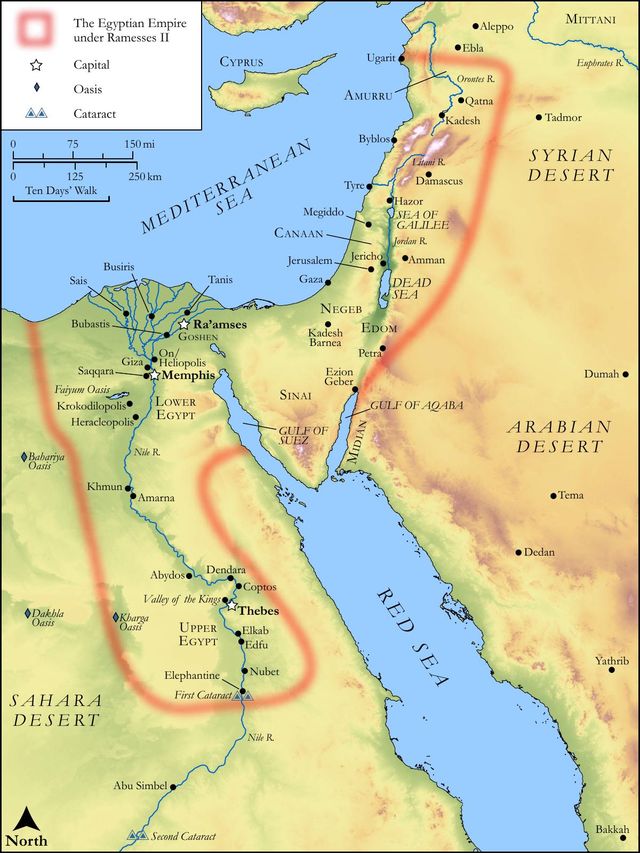
See on the biblical-era map
Study this verse
Public-domain commentary
Matthew Henry
From his Commentary on the Whole Bible. Henry comments on passages, not single verses — this entry covers Exodus 21:22–36. His three-level outline is real structure in the source text, so it is rendered as structure.
Observe here,
I.The particular care which the law took of women with child, that no hurt should be done them which might occasion their mis-carrying.
The law of nature obliges us to be very tender in that case, lest the tree and fruit be destroyed together, Exo 21:22, Exo 21:23. Women with child, who are thus taken under the special protection of the law of God, if they live in his fear, may still believe themselves under the special protection of the providence of God, and hope that they shall be saved in child-bearing. On this occasion comes in that general law of retaliation which our Saviour refers to, Mat 5:38, An eye for an eye. Now,
1.The execution of this law is not hereby put into the hands of private persons, as if every man might avenge himself, which would introduce universal confusion, and make men like the fishes of the sea. The tradition of the elders seems to have put this corrupt gloss upon it, in opposition to which our Saviour commands us to forgive injuries, and not to meditate revenge, Mat 5:39.
2.God often executes it in the course of his providence, making the punishment, in many cases, to answer to the sin, as Jdg 1:7; Isa 33:1; Hab 2:13; Mat 26:52.
3.Magistrates ought to have an eye to this rule in punishing offenders, and doing right to those that are injured. Consideration must be had of the nature, quality, and degree of the wrong done, that reparation may be made to the party injured, and others deterred from doing the like; either an eye shall go for an eye, or the forfeited eye shall be redeemed by a sum of money. Note, He that does wrong must expect one way or other to receive according to the wrong he has done, Col 3:25. God sometimes brings men's violent dealings upon their own heads (Psa 7:16); and magistrates are in this the ministers of the justice, that they are avengers (Rom 13:4), and they shall not bear the sword in vain.
II.The care God took of servants.
If their masters maimed them, though it was only striking out a tooth, that should be their discharge, Exo 21:26, Exo 21:27. This was intended,
1.To prevent their being abused; masters would be careful not to offer them any violence, lest they should lose their service.
2.To comfort them if they were abused; the loss of a limb should be the gaining of their liberty, which would do something towards balancing both the pain and disgrace they underwent. Nay,
III.Does God take care for oxen? Yes, it appears by the following laws in this chapter that he does, for our sakes, Co1 9:9, Co1 9:10. The Israelites are here directed what to do,
1.In case of hurt done by oxen, or any other brute-creature; for the law, doubtless, was designed to extend to all parallel cases.
(1.)As an instance of God's care of the life of man (though forfeited a thousand times into the hands of divine justice), and in token of his detestation of the sin of murder. If an ox killed any man, woman, or child, the ox was to be stoned (Exo 21:28); and, because the greatest honour of the inferior creatures is to be serviceable to man, the criminal is denied that honour: his flesh shall not be eaten. Thus God would keep up in the minds of his people a rooted abhorrence of the sin of murder and every thing that was barbarous.
(2.)To make men careful that none of their cattle might do hurt, but that, by all means possible, mischief might be prevented. If the owner of the beast knew that he was mischievous, he must answer for the hurt done, and, according as the circumstances of the case proved him to be more or less accessory, he must either be put to death or ransom his life with a sum of money, Exo 21:29-32. Some of our ancient books make this felony, by the common law of England, and give this reason, "The owner, by suffering his beast to go at liberty when he knew it to be mischievous, shows that he was very willing that hurt should be done." Note, It is not enough for us not to do mischief ourselves, but we must take care that no mischief be done by those whom it is in our power to restrain, whether man or beast.
2.In case of hurt done to oxen, or other cattle.
(1.)If they fall into a pit, and perish there, he that opened the pit must make good the loss, Exo 21:33, Exo 21:34. Note, We must take heed not only of doing that which will be hurtful, but of doing that which may be so. It is not enough not to design and devise mischief, but we must contrive to prevent mischief, else we become accessory to our neighbours' damage. Mischief done in malice is the great transgression; but mischief done through negligence, and for want of due care and consideration, is not without fault, but ought to be reflected upon with great regret, according as the degree of the mischief is: especially we must be careful that we do nothing to make ourselves accessory to the sins of others, by laying an occasion of offence in our brother's way, Rom 14:13.
(2.)If cattle fight, and one kill another, the owners shall equally share in the loss, Exo 21:35. Only if the beast that had done the harm was known to the owner to have been mischievous he shall answer for the damage, because he ought either to have killed him or kept him up, Exo 21:36. The determinations of these cases carry with them the evidence of their own equity, and give such rules of justice as were then, and are still, in use, for the decision of similar controversies that arise between man and man. But I conjecture that these cases might be specified, rather than others (though some of them seem minute), because they were then cases in fact actually depending before Moses; for in the wilderness where they lay closely encamped, and had their flocks and herds among them, such mischiefs as these last mentioned were likely enough to occur. That which we are taught by these laws is that we should be very careful to do no wrong, either directly or indirectly; and that, if we have done wrong, we must be very willing to make satisfaction, and desirous that nobody may lose by us.
Continue studying Exodus 21:34 across the web’s major study libraries — every link below opens this exact verse, chapter, or book on the destination site.
Read & Compare
 BibleGatewayThis verse in more than 200 translations and 70 languages.
 Bible.comThe YouVersion reader — hundreds of translations, reading plans, and highlights.
 ESV.orgCrossway's official English Standard Version reader.
 NET BibleThe NET translation with 60,000+ translators' notes on every rendering decision.
 STEP BibleTyndale House's free study tool — original text, vocabulary, and scholarly resources.
 BibliaLogos Bible Software's free web reader.
 USCCBThe New American Bible (Revised Edition) with the U.S. bishops' study notes.
Commentaries
 BibleHub CommentariesDozens of classic commentaries on this verse, gathered on one page.
 StudyLightMore than 100 commentary sets — the largest collection on the web.
 BibleRefPlain-English commentary on what this verse means, verse by verse.
 Enduring WordDavid Guzik's free commentary on this chapter, widely used by Bible teachers.
 Bible Study ToolsVerse commentary alongside Greek and Hebrew study aids.
Original Language & Research
- BibleHub InterlinearThe verse word by word — original language, transliteration, and English.
- BibleHub LexiconEvery word's original-language definition and Strong's entry.
 Blue Letter BibleDeep-study tools — Strong's numbers, concordance, and word studies.
 SefariaThe Hebrew text with Rashi and centuries of Jewish commentary.
Sermons, Hymns & Audio


TrulyRandomVerse is not affiliated with these sites and doesn’t control their content. They’re linked because they’re genuinely useful.
Summary
Exodus 21:34, a precise legal statute within the broader "Book of the Covenant," meticulously outlines the liability and required restitution for property damage resulting from negligence, specifically concerning an uncovered pit. This law mandates that the individual responsible for the unmaintained pit must fully compensate the owner of any livestock that perishes as a result, ensuring both justice for the injured party and a clear framework for accountability within the Israelite community. It exemplifies God's commitment to social order, ethical conduct, and the restoration of what is lost due to human oversight.
Context
ShowHideLiterary Context
Exodus 21:34 is situated within the extensive collection of civil and criminal laws known as the "Book of the Covenant," spanning Exodus 20:22-23:33. This legal corpus serves as a practical exposition and application of the foundational moral principles articulated in the Ten Commandments, which immediately precede it. Chapter 21 specifically delves into various scenarios concerning personal injury, property rights, and social interactions, establishing a comprehensive legal framework for the nascent Israelite nation. The laws are presented in a casuistic (case-by-case) style, typically beginning with a conditional "If..." or "When..." clause followed by a prescribed legal consequence. The specific unit of Exodus 21:33-34 forms a cohesive legal precedent addressing damage caused by an unsealed pit, illustrating how the overarching principles of justice, responsibility, and restitution are applied to specific, everyday situations, ensuring order and fairness in communal life.
Historical & Cultural Context
Ancient Israel was predominantly an agrarian and pastoral society, where livestock—such as cattle, donkeys, sheep, and goats—constituted a primary form of wealth, economic stability, and social status. The unexpected loss of an animal due to negligence could inflict severe economic hardship upon a family or individual. Pits were ubiquitous features in the ancient Near Eastern landscape, serving diverse purposes like water cisterns, storage pits, or even traps for wild animals. An uncovered or poorly maintained pit, therefore, represented a significant and foreseeable hazard, particularly to wandering livestock. This statute directly addresses these practical realities of daily life, where such accidents were common. By holding the pit owner strictly accountable, the law aimed to foster diligence, promote communal safety, and protect private property, thereby contributing to the overall social harmony and economic viability of the community. The emphasis on monetary compensation, rather than solely punitive measures, aligns with broader ancient Near Eastern legal traditions that prioritized restoration and making the injured party whole.
Key Themes
ShowHideThis seemingly minor civil law powerfully underscores several foundational theological and narrative themes prevalent throughout the Pentateuch and beyond. Firstly, it highlights the theme of personal responsibility and accountability, demonstrating God's expectation that individuals be answerable for their actions and inactions, especially when they cause harm to others. Secondly, the law emphasizes justice and equitable restitution, ensuring that victims are compensated for their losses and that wrongs are appropriately righted, reflecting God's own righteous character. This concern for fairness is echoed in other laws concerning property and injury, such as those found in Deuteronomy 22:1-4. Thirdly, it speaks to the theme of social order and communal well-being, as the diligent application of such laws fosters a stable and just society where individuals are encouraged to act with care and consideration for their neighbors' welfare, contributing to the broader concept of shalom (peace and wholeness) within the community, a theme evident throughout the Law.
Exposition and Analysis
ShowHideKey Word Analysis
ShowHideDerived from the root meaning "to master" or "to possess," this term denotes not merely possession but also the inherent responsibility and authority that comes with it. In this context, it clearly identifies the individual with ultimate control and hence, liability, over the pit. The use of baʻal underscores that ownership is intrinsically linked to accountability for the property's impact on others.
This word refers to a hole dug in the ground, commonly a cistern for water collection or a well. However, its usage here specifically points to an excavation that has become a hazard due to neglect. The term highlights the specific nature of the danger—a hidden, unsealed opening—and thus the specific context of negligence that the law addresses.
This verb carries the profound sense of completion, restoration, or making whole. It implies not just a payment, but a full restitution that aims to return the injured party to their original state before the damage occurred. The root of shâlam is famously connected to "shalom" (peace), suggesting that proper restitution is a means of restoring order, harmony, and peace to a disrupted situation, both for the victim and the broader community.
Verse Breakdown
ShowHide"The owner of the pit shall make [it] good"
This opening clause immediately assigns unequivocal responsibility to the individual who owns or is otherwise accountable for the pit. The phrase "make [it] good" (from shâlam) signifies a non-negotiable obligation to provide full and complete compensation for the damage caused. This establishes the foundational principle of accountability for one's property and the consequences of one's negligence.
"[and] give money unto the owner of them;"
This specifies the precise form of restitution required: monetary payment. The phrase "owner of them" refers to the owner of the deceased livestock, clearly indicating that the compensation is for the financial loss incurred due to the animal's death. This provision ensures that the victim is not left to bear the financial burden of another's oversight, promoting honest dealing.
"and the dead [beast] shall be his."
This concluding clause dictates that the carcass of the deceased animal becomes the property of the negligent pit owner. This serves a dual purpose: it provides a clear and final transfer of ownership and liability, preventing further disputes, and it allows the responsible party to potentially salvage some residual value from the carcass (e.g., hide, or meat if still usable), thereby slightly offsetting their financial loss from the compensation. It brings a definitive closure to the transaction of restitution.
Literary Devices
ShowHideExodus 21:34 is a quintessential example of Casuistic Law, a prevalent legal form in the ancient Near East. This device structures legal pronouncements as specific cases, typically employing an "if-then" or "when-then" formula. Here, the implied "if a man opens a pit... and does not cover it... and an ox or a donkey falls into it," is followed by the explicit consequence: "the owner of the pit shall make [it] good..." This structure provides clear, practical guidelines for judicial resolution and social conduct. The law also subtly embodies the principle of Proportionality in justice, where the restitution demanded directly corresponds to the damage inflicted, aiming for an equitable outcome rather than excessive punishment. While not an exact "eye for an eye" (lex talionis) in its application, it reflects the same underlying spirit of ensuring that the compensation fits the loss. Furthermore, the repeated use of "owner" (of the pit, of the beast) serves as a form of Emphasis, clearly delineating roles, responsibilities, and the parties involved in the transaction, reinforcing the clarity of the legal framework.
Theological and Thematic Connections
ShowHideThis seemingly straightforward civil law reveals profound theological truths about God's character and His divine blueprint for human society. It unequivocally underscores the divine principles of personal responsibility and accountability, demonstrating that God holds individuals answerable for their actions and, crucially, their inactions, particularly when such negligence results in harm to others. The emphasis on restitution and compensation illuminates God's deep concern for justice and fairness, ensuring that victims are made whole and that wrongs are righted in a tangible manner. This law reflects God's desire for an orderly, righteous, and compassionate community where property is respected, diligence is practiced, and the vulnerable are protected from preventable harm. It teaches that true peace (shalom) within a community is often achieved through the restoration of what is broken or lost, a principle that permeates the entire biblical narrative concerning God's redemptive work.
Reflection and Application
ShowHideWhile the specific scenario of uncovered pits and lost livestock may seem far removed from our modern context, the enduring principles embedded in Exodus 21:34 remain profoundly relevant for contemporary life. This passage calls us to cultivate a posture of vigilant diligence and conscientious care in all our spheres of influence, recognizing that our actions, or indeed our failures to act, inevitably have consequences for others. Whether it involves maintaining our personal property, fulfilling our professional duties with integrity, or engaging responsibly in community life, we are divinely called to act with foresight and prudence to prevent foreseeable harm. Furthermore, this law serves as a powerful reminder of the imperative for accountability when negligence does lead to damage. When harm occurs through our oversight or inaction, God's righteous standard demands that we take full responsibility and earnestly seek to provide appropriate restitution, striving to make whole those who have been wronged. This commitment fosters a society built upon integrity, empathy, and a steadfast dedication to justice, thereby reflecting God's own character in our daily interactions and relationships.
Questions for Reflection
ShowHideFAQ
ShowHideWhy does the owner of the pit receive the dead beast after paying compensation?
ShowHideThis provision serves as a practical and equitable measure to ensure a complete and final transfer of ownership and liability. Once the pit owner has "made good" by paying the full monetary value of the deceased animal, the carcass legally becomes their property. This prevents any lingering claims or disputes from the original owner regarding the animal and allows the negligent party to potentially salvage some residual value from the carcass (e.g., for its hide, bones, or meat if it was not diseased and still usable). This slight mitigation of their financial loss, combined with the clear delineation of ownership, demonstrates a legal system designed for definitive resolution and the prevention of ongoing contention, bringing closure to the transaction.
Christ-Centered Fulfillment
ShowHideExodus 21:34, like the entirety of God's perfect Law, serves as a profound pointer beyond itself to its ultimate fulfillment in the person and work of Jesus Christ. This law, which demands full restitution for damage caused by negligence, beautifully foreshadows the greatest "making good" in all of history. Humanity, through its sin and rebellion, has effectively dug a "pit" of spiritual separation and death, causing immeasurable and irreparable harm to its relationship with a holy God. We, in our fallen state, are utterly incapable of "making good" or providing adequate restitution for this cosmic negligence. It is precisely at this point of human inadequacy that Christ steps in. As the sinless Lamb of God who takes away the sin of the world, He bore the full consequences of our spiritual negligence and sin. Through His atoning sacrifice on the cross, He paid the ultimate "money"—His own precious life—to "make good" the damage caused by sin, fully satisfying divine justice and reconciling us to God (2 Corinthians 5:21). He did not merely compensate; He fully restored, bringing true peace (shalom) where there was brokenness and enmity. Just as the pit owner took possession of the dead beast, Christ, in His death and glorious resurrection, took upon Himself the "dead beast" of our sin and its devastating consequences, triumphing over it and offering us new, eternal life (Romans 6:23). Thus, this ancient law, by highlighting the inherent need for perfect restitution and accountability, ultimately directs our gaze to the One who perfectly fulfilled the Law's demands and provided the complete and eternal "making good" for all who place their faith in Him (Matthew 5:17).