


Exodus 18:8
Bible text: King James Version (1769 Blayney text) · Public domain
Bible text: King James Version with Strong's numbers · Public domain
Bible text: Berean Standard Bible · Public domain
Bible text: American Standard Version (1901) · Public domain
Bible text: World English Bible, Messianic edition · Public domain
Bible text: Geneva Bible (1599) · Public domain
Bible text: Young's Literal Translation · Public domain
- וַיְסַפֵּרvay·sa·Perand he recountedH5608Conj-w ¦ V-Piel-ConsecImperf-3msVerb Piel Consecutive Imperfect 3rd Singular Masculineוַandיְסַפֵּרhe recounted
- מֹשֶׁהmo·ShehMosesH4872N-proper-mNoun Proper Masculine
- לְחֹתְנוֹle·Cho·te·Noto his father-in-lawH2859Prep-l ¦ V-Qal-Prtcpl-ms ¦ 3msVerb Qal Participle Singular Masculine Constructלְtoחֹתְנfather-in-lawוֹhis
- אֵת'et<obj.>H853DirObjMParticle Object Indicator
- כָּלkolallH3605N-msNoun Singular Masculine Absolute
- אֲשֶׁר'a·SherthatH834RelParticle Relative
- עָשָׂה'a·Sahhe had doneH6213V-Qal-Perf-3msVerb Qal Perfect 3rd Singular Masculine
- יְהוָהYah·wehYahwehH3068N-properNoun Proper Title
- לְפַרְעֹהle·far·'Ohto PharaohH6547Prep-l ¦ N-msNoun Title Singular Masculine AbsoluteלְtoפַרְעֹהPharaoh
- וּלְמִצְרַיִםu·le·mitz·Ra·yimand to EgyptH4714Conj-w ¦ Prep-l ¦ N-properNoun Proper LocationוּandלְtoמִצְרַיִםEgypt
- עַל'alonH5921PrepPreposition
- אוֹדֹת'o·Dot[the] causes ofH182N-fpcNoun Plural Feminine Construct
- יִשְׂרָאֵלYis·ra·'ElIsraelH3478N-properNoun Proper Location
- אֵת'et<obj.>H853DirObjMParticle Object Indicator
- כָּלkolallH3605N-mscNoun Singular Masculine Construct
- הַתְּלָאָהha·te·la·'Ahthe hardshipH8513Art ¦ N-fsNoun Singular Feminine Absoluteהַtheתְּלָאָהhardship
- אֲשֶׁר'a·SherwhichH834RelParticle Relative
- מְצָאָתַםme·tza·'A·tamit had come upon themH4672V-Qal-Perf-3fs ¦ 3mpVerb Qal Perfect 3rd Singular Feminineמְצָאָתַit had come uponםthem
- בַּדֶּרֶךְba·De·rekhon the journeyH1870Prep-b ¦ N-csNoun Singular common gender Absoluteבַּon theדֶּרֶךְjourney
- וַיַּצִּלֵםvai·ya·tzi·Lemand he had delivered themH5337Conj-w ¦ V-Hiphil-ConsecImperf-3ms ¦ 3mpVerb Hiphil Consecutive Imperfect 3rd Singular Masculineוַandיַּצִּלֵhe had deliveredםthem
- יְהוָהYah·wehYahwehH3068N-properNoun Proper Title
English is a literal word-by-word gloss of the Hebrew, not the KJV's wording. Why?
This is the original text the KJV's translators worked from — each Hebrew word with its own literal English meaning in this verse, prepared by scholars at Tyndale House, Cambridge. The KJV translates whole sentences, not word by word, so its wording differs: one Hebrew word can become several English words, and the KJV may choose “the LORD” where the gloss reads “Yahweh”. Both are faithful — they answer different questions. For the KJV's own rendering, switch to the KJV text.
Details
See on the biblical-era maps

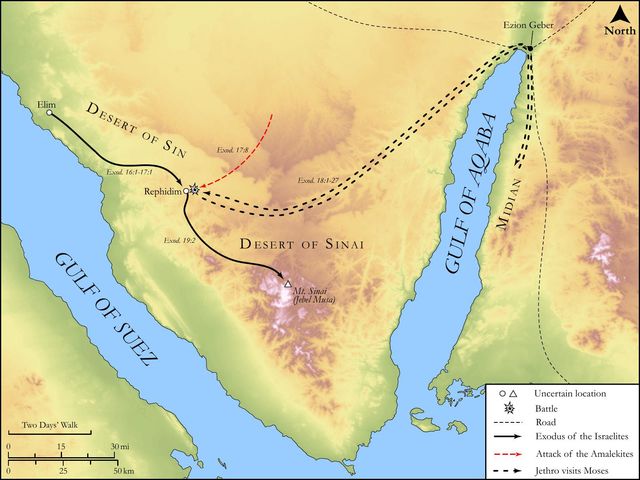
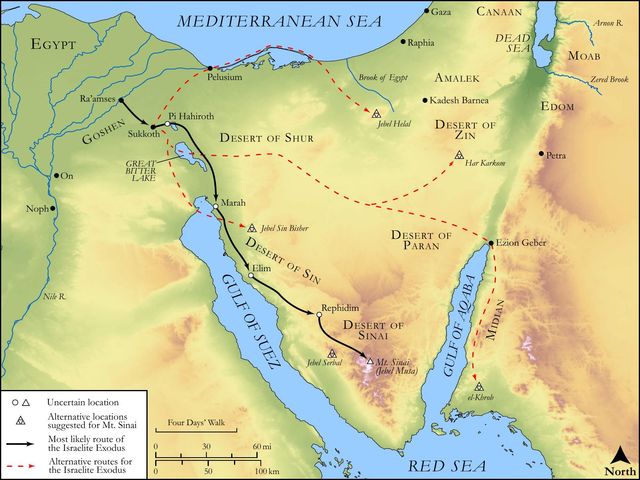
Study this verse
Public-domain commentary
Matthew Henry
From his Commentary on the Whole Bible. Henry comments on passages, not single verses — this entry covers Exodus 18:7–12. His three-level outline is real structure in the source text, so it is rendered as structure.
Observe here, I. The kind greeting that took place between Moses and his father-in-law, Exo 18:7. Though Moses was a prophet of the Lord, a great prophet, and king in Jeshurun, yet he showed a very humble respect to his father-in-law. However God in his providence is pleased to advance us, we must make conscience of giving honour to whom honour is due, and never look with disdain upon our poor relations. Those that stand high in the favour of God are not thereby discharged from the duty they owe to men, nor will that justify them in a stately haughty carriage. Moses went out to meet Jethro, did homage to him, and kissed him. Religion does not destroy good manners. They asked each other of their welfare. Even the kind How-do-you-do's that pass between them are taken notice of, as the expressions and improvements of mutual love and friendship.
II.The narrative that Moses gave his father-in-law of the great things God had done for Israel, Exo 18:8.
This was one thing Jethro came for, to know more fully and particularly what he had heard the general report of. Note, Conversation concerning God's wondrous works is profitable conversation; it is good, and to the use of edifying, Psa 105:2. Compare Psa 145:11, Psa 145:12. Asking and telling news, and discoursing of it, are not only an allowable entertainment of conversation, but are capable of being tuned to a very good account, by taking notice of God's providence, and the operations and tendencies of that providence, in all occurrences.
III.The impressions this narrative made upon Jethro.
1.He congratulated God's Israel: Jethro rejoiced, Exo 18:9. He not only rejoiced in the honour done to his son-in-law, but in all the goodness done to Israel, Exo 18:9. Note, Public blessings are the joy of public spirits. While the Israelites were themselves murmuring, notwithstanding all God's goodness to them, here was a Midianite rejoicing. This was not the only time that the faith of the Gentiles shamed the unbelief of the Jews; see Mat 8:10. Standers-by were more affected with the favours God had shown to Israel than those were that received them.
2.He gave the glory to Israel's God (Exo 18:10): "Blessed be Jehovah" (for by that name he is now known), "who hath delivered you, Moses and Aaron, out of the hand of Pharaoh, so that though he designed your death he could not effect it, and by your ministry has delivered the people." Note, Whatever we have the joy of God must have the praise of.
3.His faith was hereby confirmed, and he took this occasion to make a solemn profession of it: Now know I that Jehovah is greater than all gods, Exo 18:11. Observe,
(1.)The matter of his faith: that the God of Israel is greater than all pretenders, all false and counterfeit-deities, that usurp divine honours; he silences them, subdues them, and is too hard for them all, and therefore is himself the only living and true God. He is also higher than all princes and potentates (who are called gods), and has both an incontestable authority over them and an irresistible power to control and over-rule them; he manages them all as he pleases, and gets honour upon them, how great soever they are.
(2.)The confirmation and improvement of his faith: Now know I; he knew it before, but now he knew it better; his faith great up to a full assurance, upon this fresh evidence. Those obstinately shut their eyes against the clearest light who do not know that the Lord is greater than all gods.
(3.)The ground and reason upon which he built it: For wherein they dealt proudly, the magicians, and the idols which the Egyptians worshipped, or Pharaoh and his grandees (they both opposed God and set up in competition with him), he was above them. The magicians were baffled, the idols shaken, Pharaoh humbled, his powers broken, and, in spite of all their confederacies, God's Israel was rescued out of their hands. Note, Sooner or later, God will show himself above those that by their proud dealings contest with him. He that exalts himself against God shall be abased.
IV.The expressions of their joy and thankfulness.
They had communion with each other both in a feast and in a sacrifice, Exo 18:12. Jethro, being hearty in Israel's interests, was cheerfully admitted though a Midianite, into fellowship with Moses and the elders of Israel, forasmuch as he also was a son of Abraham, though of a younger house.
1.They joined in a sacrifice of thanksgiving: Jethro took burnt offerings for God, and probably offered them himself, for he was a priest in Midian, and a worshipper of the true God, and the priesthood was not yet settled in Israel. Note, Mutual friendship is sanctified by joint-worship. It is a very good thing for relations and friends, when they come together, to join in the spiritual sacrifice of prayer and praise, as those that meet in Christ the centre of unity.
2.They joined in a feast of rejoicing, a feast upon the sacrifice. Moses, upon this occasion, invited his relations and friends to an entertainment in his own tent, a laudable usage among friends, and which Christ himself, not only warranted, but recommended, by his acceptance of such invitations. This was a temperate feast: They did eat bread; this bread, we may suppose, was manna. Jethro must see and taste that bread from heaven, and, though a Gentile, is as welcome to it as any Israelite; the Gentiles still are so to Christ the bread of life. It was a feast kept after a godly sort: They did eat bread before God, soberly, thankfully, in the fear of God; and their table-talk was such as became saints. Thus we must eat and drink to the glory of God, behaving ourselves at our tables as those who believe that God's eye is upon us.
Continue studying Exodus 18:8 across the web’s major study libraries — every link below opens this exact verse, chapter, or book on the destination site.
Read & Compare
 BibleGatewayThis verse in more than 200 translations and 70 languages.
 Bible.comThe YouVersion reader — hundreds of translations, reading plans, and highlights.
 ESV.orgCrossway's official English Standard Version reader.
 NET BibleThe NET translation with 60,000+ translators' notes on every rendering decision.
 STEP BibleTyndale House's free study tool — original text, vocabulary, and scholarly resources.
 BibliaLogos Bible Software's free web reader.
 USCCBThe New American Bible (Revised Edition) with the U.S. bishops' study notes.
Commentaries
 BibleHub CommentariesDozens of classic commentaries on this verse, gathered on one page.
 StudyLightMore than 100 commentary sets — the largest collection on the web.
 BibleRefPlain-English commentary on what this verse means, verse by verse.
 Enduring WordDavid Guzik's free commentary on this chapter, widely used by Bible teachers.
 Bible Study ToolsVerse commentary alongside Greek and Hebrew study aids.
Original Language & Research
- BibleHub InterlinearThe verse word by word — original language, transliteration, and English.
- BibleHub LexiconEvery word's original-language definition and Strong's entry.
 Blue Letter BibleDeep-study tools — Strong's numbers, concordance, and word studies.
 SefariaThe Hebrew text with Rashi and centuries of Jewish commentary.
Sermons, Hymns & Audio


TrulyRandomVerse is not affiliated with these sites and doesn’t control their content. They’re linked because they’re genuinely useful.
Summary
Exodus 18:8 presents a tender yet profound moment where Moses meticulously recounts to his father-in-law, Jethro, the comprehensive narrative of God's miraculous interventions and steadfast faithfulness on behalf of Israel. This pivotal verse encapsulates the spectacular acts of divine judgment against Egypt that secured Israel's liberation, the arduous trials and "travail" endured during their wilderness journey, and the consistent, powerful demonstration of the LORD's delivering hand through every challenge, culminating in a powerful testimony to God's unwavering presence.
Context
ShowHideLiterary Context
This verse is strategically placed within a significant narrative interlude in the book of Exodus, following the dramatic events of the Red Sea crossing, the miraculous provision of manna and water, and the victory over Amalek, detailed in earlier chapters such as Exodus 14-17. Moses is reunited with his wife Zipporah and his two sons, Gershom and Eliezer, who have been brought to him by his father-in-law, Jethro, a priest of Midian. The preceding verses (Exodus 18:1-7) describe Jethro's journey to meet Moses and the initial greetings. Verse 8 marks the commencement of Moses' detailed explanation of the momentous events that have transpired since he last saw his family, setting the stage for Jethro's profound response of worship and his subsequent wise counsel regarding the organization of Israel's judicial system (Exodus 18:13-26). This personal recounting is crucial, as it provides Jethro with the essential theological foundation for understanding God's unique and active relationship with Israel.
Historical & Cultural Context
The Israelites had recently been liberated from over four centuries of brutal slavery in Egypt, an event marked by a series of devastating plagues and the miraculous parting of the Red Sea, acts of divine power unparalleled in ancient history. Their subsequent journey through the wilderness was fraught with challenges, including scarcity of water and food, and hostile encounters like the attack by the Amalekites (Exodus 17:8-16). Moses' recounting to Jethro, a priest of Midian, served not merely as a family update but as a powerful theological declaration. In a polytheistic world, where various gods were worshipped and regional deities were common, Moses' testimony would have presented a compelling case for the supremacy and unique character of YHWH, the covenant God of Israel. Jethro's subsequent response of acknowledging YHWH's greatness (Exodus 18:9-12) demonstrates the evangelistic power of witnessing to God's mighty acts, even across significant cultural and religious divides.
Key Themes
ShowHideExodus 18:8 contributes significantly to several overarching themes in the book of Exodus and the broader Pentateuch. Primarily, it underscores the sovereignty and faithfulness of God (YHWH), who actively intervenes in human history to fulfill His covenant promises. The recounting highlights God's redemptive power, demonstrated in the liberation from Egypt and the sustained provision through wilderness "travail." It also emphasizes the importance of testimony and remembrance, as Moses' sharing of God's deeds serves to glorify God and instruct others. The inclusion of "travail" introduces the theme of God's presence in suffering and hardship, showing that divine deliverance is not always the absence of difficulty, but God's sustaining power through it. This verse also subtly introduces the theme of intercultural witness, as a Midianite priest comes to acknowledge the God of Israel, foreshadowing the universal scope of God's redemptive plan, a theme that echoes throughout the biblical narrative, from the call of Abraham in Genesis 12:3 to the Great Commission in Matthew 28:19-20.
Exposition and Analysis
ShowHideKey Word Analysis
ShowHideThe capitalized "LORD" in the KJV translates the Tetragrammaton, YHWH (H3068), the personal, covenantal name of God revealed to Moses at the burning bush (Exodus 3:14-15). This name signifies God's self-existence, eternal nature, and His faithful, active presence with His people. The repeated use of "the LORD" in this verse emphasizes that all the mighty deeds against Pharaoh and the deliverances in the wilderness were not by human strength or chance, but by the sovereign will and power of the covenant-keeping God, underscoring His unique identity as the true and living God.
This term (H8513) denotes distress, weariness, hardship, or the arduous nature of a journey. It acknowledges the genuine difficulties and suffering Israel endured in the wilderness—the hunger, thirst, and battles with hostile groups. Moses does not gloss over these challenges but includes them as an integral part of the complete narrative, highlighting that God's deliverance was not only from external enemies but also through internal struggles and environmental hardships, demonstrating His comprehensive care.
This verb (H5337) conveys the idea of being snatched away, rescued, or pulled out from danger. It implies a strong, decisive, and active intervention by God to save His people. It is not merely an escape, but a powerful act of salvation, underscoring God's dynamic involvement in the historical events and His unwavering commitment to preserving Israel through all their trials and tribulations.
Verse Breakdown
ShowHide"And Moses told his father in law"
This phrase establishes the intimate and personal nature of the recounting. Moses, the divinely appointed leader of a nascent nation, takes the time to share his profound experiences and God's mighty acts with Jethro, a respected family member and spiritual figure, demonstrating the importance of personal testimony and intergenerational sharing of faith and divine revelation.
"all that the LORD had done unto Pharaoh and to the Egyptians for Israel's sake"
This refers to the dramatic and devastating series of plagues inflicted upon Egypt, culminating in the death of the firstborn and the miraculous parting of the Red Sea. These acts were not random but specifically orchestrated by God to liberate His chosen people from centuries of bondage, fulfilling His ancient covenant promises to Abraham, Isaac, and Jacob, and demonstrating His supreme power over all earthly rulers and deities.
"and all the travail that had come upon them by the way"
This acknowledges the significant hardships and trials Israel faced during their journey from Egypt through the wilderness. This includes the lack of water and food, the murmuring of the people, and the physical conflict with the Amalekites. Moses' inclusion of these difficulties provides a realistic and comprehensive picture of their journey, showing that God's faithfulness extends even through periods of intense struggle.
"and [how] the LORD delivered them"
This concluding clause powerfully reaffirms the central theme of divine sovereignty and salvation. Despite all the formidable opposition from Egypt and the severe "travail" in the wilderness, it was consistently the LORD (YHWH) who brought them through. This emphasizes God's unwavering faithfulness, His continuous provision, and His ultimate power to save and sustain His people through every conceivable challenge, highlighting that deliverance is always His work.
Literary Devices
ShowHideExodus 18:8 functions primarily as a powerful testimony, a concise yet comprehensive narrative summary of God's mighty acts. Moses' recounting is a deliberate act of witness, designed to inform and impress Jethro with the reality and supreme power of YHWH. The verse employs repetition through the recurring emphasis on "the LORD had done" and "the LORD delivered them," which serves to underscore divine agency and sovereignty as the singular force behind all the events. This repetition acts as a refrain, reinforcing the theological truth that God alone is the Deliverer and Sustainer. Furthermore, there is a subtle but significant contrast presented between the external threat of Pharaoh and Egypt and the internal/environmental "travail" experienced in the wilderness. Yet, in both scenarios, the ultimate outcome is the same: the LORD's unwavering deliverance. The verse's conciseness is also noteworthy; it distills years of dramatic and complex history into a potent, memorable statement of God's active and faithful involvement in the lives of His people.
Theological and Thematic Connections
ShowHideExodus 18:8 profoundly illustrates God's active involvement in human history, His unwavering covenant faithfulness, and the vital role of testimony in recognizing and proclaiming His deeds. It reveals a God who is not distant or passive but intimately engaged in the liberation and preservation of His people, not only from external oppressors but also through internal hardships and environmental challenges. Moses' recounting highlights that salvation is entirely God's work, a powerful demonstration of His sovereignty and redemptive power. The "travail" acknowledged in the verse reminds us that God's deliverance often occurs not by removing all difficulties, but by sustaining His people through them, proving His faithfulness even in the midst of trials. This passage also underscores the importance of sharing our experiences of God's faithfulness, as Moses' testimony leads Jethro to worship and acknowledge YHWH's supremacy, serving as a model for intergenerational and cross-cultural witness.
Reflection and Application
ShowHideMoses' detailed and heartfelt recounting of God's mighty acts to Jethro serves as a powerful model for believers today. It calls us to cultivate a posture of intentional remembrance, diligently recalling and articulating the myriad ways God has intervened in our lives, both in grand, miraculous deliverances and in sustaining us through periods of "travail." This practice not only deepens and strengthens our own faith but also provides a compelling witness to others, inviting them to acknowledge God's sovereign power and profound goodness. In a world prone to attributing success to human effort, chance, or impersonal forces, Moses' repeated emphasis on "the LORD had done" and "the LORD delivered" compels us to humbly recognize God's active, providential hand in every blessing, every breakthrough, and every moment of endurance. Furthermore, the inclusion of "travail" reminds us that genuine faith does not exempt us from hardship; rather, it assures us of God's unwavering presence and ultimate deliverance through hardship, transforming our trials into platforms for His glory and opportunities for deeper reliance on Him.
Questions for Reflection
ShowHideFAQ
ShowHideWhy was it important for Moses to tell Jethro these things?
ShowHideIt was crucial for several profound reasons. Firstly, Jethro was Moses' father-in-law and a priest of Midian, representing a spiritual authority outside of Israel's direct covenant. Moses' testimony served as a powerful witness to the supremacy of YHWH, the God of Israel, over all other gods, potentially leading Jethro to a deeper faith in the one true God, which indeed happened as Jethro blessed the LORD and offered sacrifices (Exodus 18:9-12). Secondly, it provided Jethro with the necessary context to understand the immense burden and overwhelming responsibility Moses carried as the leader of a vast, newly liberated nation. This understanding then enabled Jethro to offer wise and practical counsel regarding the delegation of judicial duties, which significantly impacted the organizational structure of Israel (Exodus 18:13-26). It was a sharing of both divine acts and personal burdens within a trusted family context.
What does "for Israel's sake" imply about God's actions?
ShowHideThe phrase "for Israel's sake" underscores God's unwavering covenantal faithfulness and His overarching redemptive purpose. It means that all the powerful judgments against Pharaoh and the Egyptians were not arbitrary acts of destruction but were specifically designed and executed to liberate Israel, fulfill God's ancient promises to their ancestors (Genesis 12:1-3), and establish them as His chosen people, a nation set apart for His glory. It highlights that God's actions are purposeful, driven by His steadfast love and His commitment to His covenant people, demonstrating His character as a God who keeps His word.
Christ-Centered Fulfillment
ShowHideExodus 18:8, with its profound emphasis on the LORD's powerful deliverance and steadfast presence through "travail," finds its ultimate and most glorious fulfillment in the person and redemptive work of Jesus Christ. Moses, as the great deliverer of Israel from physical bondage and the one who led them through wilderness trials, serves as a powerful type and foreshadowing of Christ, the ultimate Deliverer from the bondage of sin and death. Just as the LORD "had done" mighty acts against Egypt for Israel's sake, so God, in Christ, "has done" the decisive and comprehensive work of salvation for humanity's sake, culminating in the cross and resurrection. Jesus' journey to accomplish this salvation was marked by profound "travail"—His agonizing prayer in Gethsemane (Luke 22:44), His suffering and rejection (Isaiah 53:3-5), and His bearing of the world's sin on the cross. Yet, through this ultimate "travail," "the LORD delivered" us, raising Him from the dead and securing eternal life and justification for all who believe (Romans 4:25). Believers are now called to bear witness to this greater deliverance, sharing the "good news" of Christ's finished work, just as Moses recounted God's mighty deeds to Jethro, inviting others into the saving knowledge of the true God and His Son (Acts 1:8).