


Exodus 12:28
- וַיֵּלְכוּvai·ye·le·Khuand they wentH1980Conj-w ¦ V-Qal-ConsecImperf-3mpVerb Qal Consecutive Imperfect 3rd Plural Masculineוַandיֵּלְכוּthey went
- וַיַּעֲשׂוּvai·ya·'a·Suand they didH6213Conj-w ¦ V-Qal-ConsecImperf-3mpVerb Qal Consecutive Imperfect 3rd Plural Masculineוַandיַּעֲשׂוּthey did
- בְּנֵיbe·Nei[the] people ofH1121N-mpcNoun Plural Masculine Construct
- יִשְׂרָאֵלYis·ra·'ElIsraelH3478N-properNoun Proper Location
- כַּאֲשֶׁרka·'a·Sherjust asH834Prep-k ¦ RelParticle Relativeכַּjustאֲשֶׁרas
- צִוָּהtzi·Vahhe had commandedH6680V-Piel-Perf-3msVerb Piel Perfect 3rd Singular Masculine
- יְהוָהYah·wehYahwehH3068N-properNoun Proper Title
- אֶת'et<obj.>H853DirObjMParticle Object Indicator
- מֹשֶׁהmo·ShehMosesH4872N-proper-mNoun Proper Masculine
- וְאַהֲרֹןve·'a·ha·Ronand AaronH175Conj-w ¦ N-proper-mNoun Proper MasculineוְandאַהֲרֹןAaron
- כֵּןkensoH3651AdvAdverb
- עָשׂוּ'a·Suthey didH6213V-Qal-Perf-3cpVerb Qal Perfect 3rd Plural common gender
English is a literal word-by-word gloss of the Hebrew, not the KJV's wording. Why?
This is the original text the KJV's translators worked from — each Hebrew word with its own literal English meaning in this verse, prepared by scholars at Tyndale House, Cambridge. The KJV translates whole sentences, not word by word, so its wording differs: one Hebrew word can become several English words, and the KJV may choose “the LORD” where the gloss reads “Yahweh”. Both are faithful — they answer different questions. For the KJV's own rendering, switch to the KJV text.
Details
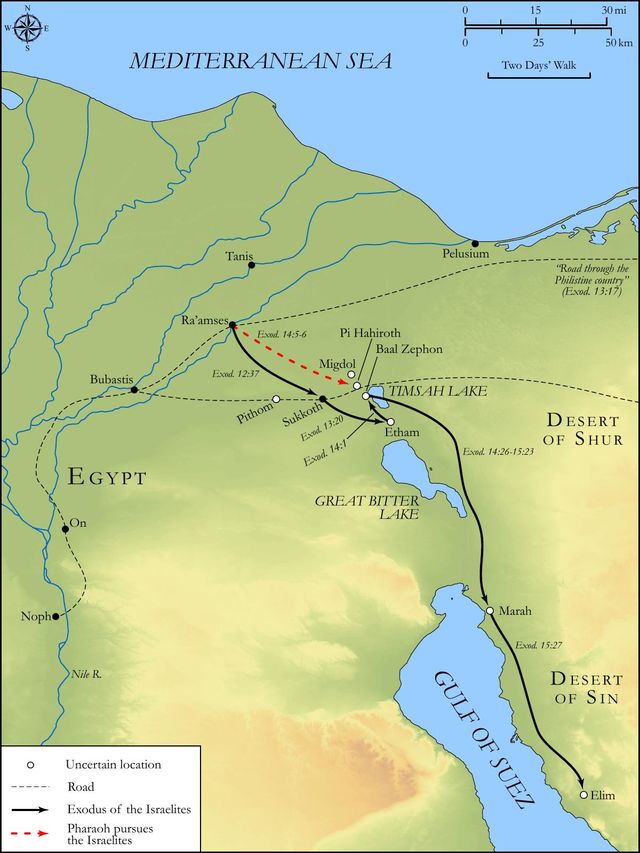
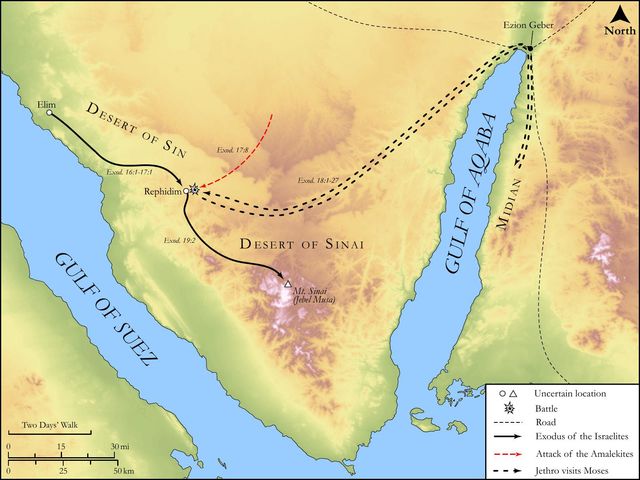
See on the biblical-era maps

Study this verse
Public-domain commentary
Matthew Henry
From his Commentary on the Whole Bible. Henry comments on passages, not single verses — this entry covers Exodus 12:21–28. His four-level outline is real structure in the source text, so it is rendered as structure.
I.Moses is here, as a faithful steward in God's house, teaching the children of Israel to observe all things which God had commanded him; and no doubt he gave the instructions as largely as he received them, though they are not so largely recorded. It is here added,
1.That this night, when the first-born were to be destroyed, no Israelite must stir out of doors till morning, that is, till towards morning, when they would be called to march out of Egypt, Exo 12:22. Not but that the destroying angel could have known an Israelite from an Egyptian in the street; but God would intimate to them that their safety was owing to the blood of sprinkling; if they put themselves from under the protection of that, it was at their peril. Those whom God has marked for himself must not mingle with evil doers: see Isa 26:20, Isa 26:21. They must not go out of the doors, lest they should straggle and be out of the way when they should be summoned to depart: they must stay within, to wait for the salvation of the Lord, and it is good to do so.
2.That hereafter they should carefully teach their children the meaning of this service, Exo 12:26, Exo 12:27. Observe,
(1.)The question which the children would ask concerning this solemnity (which they would soon take notice of in the family): "What mean you by this service? What is he meaning of all this care and exactness about eating this lamb, and this unleavened bread, more than about common food? Why such a difference between this meal and other meals?" Note,
[1.]It is a good thing to see children inquisitive about the things of God; it is to be hoped that those who are careful to ask for the way will find it. Christ himself, when a child, heard and asked questions, Luk 2:46.
[2.]It concerns us all rightly to understand the meaning of those holy ordinances wherein we worship God, what is the nature and what the end of them, what is signified and what intended, what is the duty expected from us in them and what are the advantages to be expected by us. Every ordinance has a meaning; some ordinances, as sacraments, have not their meaning so plain and obvious as others have; therefore we are concerned to search, that we may not offer the blind for sacrifice, but may do a reasonable service. If either we are ignorant of, or mistake about, the meaning of holy ordinances, we can neither please God nor profit ourselves.
(2.)The answer which the parents were to return to this question (Exo 12:27): You shall say, It is the sacrifice of the Lord's passover, that is, "By the killing and sacrificing of this lamb, we keep in remembrance the work of wonder and grace which God did for our fathers, when," [1.] "To make way for our deliverance out of bondage, he slew the firstborn of the Egyptians, so compelling them to sign our discharge;" and, [2.] "Though there were with us, even with us, sins against the Lord our God, for which the destroying angel, when he was abroad doing execution, might justly have destroyed our first-born too, yet God graciously appointed and accepted the family-sacrifice of a lamb, instead of the first-born, as, of old, the ram instead of Isaac, and in every house where the lamb was slain the first-born were saved." The repetition of this solemnity in the return of every year was designed, First, To look backward as a memorial, that in it they might remember what great things God had done for them and their fathers. The word pesach signifies a leap, or transition; it is a passing over; for the destroying angel passed over the houses of the Israelites, and did not destroy their first-born. When God brings utter ruin upon his people he says, I will not pass by them any more (Amo 7:8; Amo 8:2), intimating how often he had passed by them, as now when the destroying angel passed over their houses. Note, 1. Distinguishing mercies lay under peculiar obligations. When a thousand fall at our side, and ten thousand at our right hand, and yet we are preserved, and have our lives given us for a prey, this should greatly affect us, Psa 91:7. In war or pestilence, if the arrow of death have passed by us, passed over us, hit the next to us and just missed us, we must not say it was by chance that we were preserved but by the special providence of our God. 2. Old mercies to ourselves, or to our fathers, must not be forgotten, but be had in everlasting remembrance, that God may be praised, our faith in him encouraged, and our hearts enlarged in his service. Secondly, It was designed to look forward as an earnest of the great sacrifice of the Lamb of God in the fulness of time, instead of us and our first-born. We were obnoxious to the sword of the destroying angel, but Christ our passover was sacrificed for us, his death was our life, and thus he was the Lamb slain from the foundation of the world, from the foundation of the Jewish church: Moses kept the passover by faith in Christ, for Christ was the end of the law for righteousness.
II.The people received these instructions with reverence and ready obedience.
1.They bowed the head and worshipped (Exo 12:27): they hereby signified their submission to this institution as a law, and their thankfulness for it as a favour and privilege. Note, When God gives law to us, we must give honour to him; when he speaks, we must bow our heads and worship.
2.They went away and did as they were commanded, Exo 12:23. Here was none of that discontent and murmuring among them which we read of, Exo 5:20, Exo 5:21. The plagues of Egypt had done them good, and raised their expectations of a glorious deliverance, which before they despaired of; and now they went forth to meet it in the way appointed. Note, The perfecting of God's mercies to us must be waited for in a humble observance of his institutions.
Continue studying Exodus 12:28 across the web’s major study libraries — every link below opens this exact verse, chapter, or book on the destination site.
Read & Compare
 BibleGatewayThis verse in more than 200 translations and 70 languages.
 Bible.comThe YouVersion reader — hundreds of translations, reading plans, and highlights.
 ESV.orgCrossway's official English Standard Version reader.
 NET BibleThe NET translation with 60,000+ translators' notes on every rendering decision.
 STEP BibleTyndale House's free study tool — original text, vocabulary, and scholarly resources.
 BibliaLogos Bible Software's free web reader.
 USCCBThe New American Bible (Revised Edition) with the U.S. bishops' study notes.
Commentaries
 BibleHub CommentariesDozens of classic commentaries on this verse, gathered on one page.
 StudyLightMore than 100 commentary sets — the largest collection on the web.
 BibleRefPlain-English commentary on what this verse means, verse by verse.
 Enduring WordDavid Guzik's free commentary on this chapter, widely used by Bible teachers.
 Bible Study ToolsVerse commentary alongside Greek and Hebrew study aids.
Original Language & Research
- BibleHub InterlinearThe verse word by word — original language, transliteration, and English.
- BibleHub LexiconEvery word's original-language definition and Strong's entry.
 Blue Letter BibleDeep-study tools — Strong's numbers, concordance, and word studies.
 SefariaThe Hebrew text with Rashi and centuries of Jewish commentary.
Sermons, Hymns & Audio


TrulyRandomVerse is not affiliated with these sites and doesn’t control their content. They’re linked because they’re genuinely useful.
Summary
Exodus 12:28 records the immediate and complete obedience of the Israelites to the LORD's precise instructions for the first Passover. This pivotal moment highlights their profound trust in divine command and their readiness to act upon it, which was a prerequisite for their protection from the final plague and their ultimate deliverance from Egyptian bondage.
Context
ShowHideLiterary Context
This verse is strategically positioned at the culmination of the detailed Passover instructions and immediately precedes the devastating tenth plague—the death of the firstborn throughout Egypt. The preceding verses in Exodus 12:1-27 meticulously lay out the LORD's commands to Moses and Aaron concerning the selection and sacrifice of the Passover lamb, the application of its blood to the doorposts and lintels, and the specific manner of consuming the roasted lamb with unleavened bread and bitter herbs. The obedience described in Exodus 12:28 is the crucial human response that activates the divine promise for the destroyer to "pass over" their homes (Exodus 12:23), setting the stage for the dramatic Exodus from Egypt that follows. It serves as a narrative bridge between divine command and its miraculous outcome.
Historical & Cultural Context
In the ancient Near East, divine commands were typically mediated through authoritative figures like prophets or kings, and strict obedience was considered paramount for securing divine favor and averting wrath. The plagues inflicted upon Egypt were not merely natural phenomena but direct assaults on the pantheon of Egyptian gods and Pharaoh's perceived divinity, unequivocally demonstrating Yahweh's supreme power and sovereignty. The Passover ritual, with its central act of applying blood to the doorposts, would have resonated within a cultural milieu where blood held profound symbolic significance—often associated with atonement, purification, or powerful protection. This act of "passing over" was understood as a direct, salvific intervention by God, demanding a faith-filled human response expressed through precise ritual adherence. It was not a suggestion but a life-or-death decree, carrying absolute authority within the cultural framework of divine pronouncements.
Key Themes
ShowHideExodus 12:28 powerfully contributes to several overarching themes in the book of Exodus and the broader Pentateuch. It underscores the theme of Divine Sovereignty and Authority, demonstrating that God's commands are absolute and must be obeyed without question. It highlights Obedience as an Expression of Faith, showing that the Israelites' compliance was a tangible act of trusting God's promise of protection amidst a terrifying judgment. This verse also reinforces the theme of Deliverance through Divine Initiative and Human Response, emphasizing that while God initiates salvation, He often requires a specific human action to actualize it. Furthermore, it foreshadows the importance of Covenant Faithfulness, where adherence to God's instructions is integral to maintaining the covenant relationship, a theme deeply explored throughout the giving of the Law on Mount Sinai. The meticulous nature of the instructions and the Israelites' precise adherence also introduce the theme of Specificity in Worship and Ritual, which will become a hallmark of the Mosaic Law.
Exposition and Analysis
ShowHideExodus 12:28, though remarkably concise, is replete with theological significance, powerfully conveying the Israelites' decisive and thorough response to God's life-saving command.
Key Word Analysis
ShowHideThis Hebrew verb signifies a strong, authoritative, and specific instruction, rather than a mere suggestion or request. It denotes a direct, non-negotiable order from a superior, demanding full and immediate compliance. The use of tsâvâh here underscores the divine origin and absolute nature of the Passover instructions, highlighting that these were decrees from the sovereign God, essential for the Israelites' very survival and deliverance.
This verb means "to do," "to make," or "to perform." Its emphatic repetition in the phrase "did as the LORD had commanded... so did they" profoundly emphasizes the active, complete, and precise execution of the divine mandate. It conveys not just passive reception of the command but active, meticulous, and thorough performance of every detail. This word highlights the Israelites' practical and faithful response.
This is God's covenant name, revealing His personal, relational, and unchanging character. When the text states "the LORD had commanded," it emphasizes that the instructions originated from the God who had entered into a covenant with Abraham, Isaac, and Jacob, and who was now actively intervening to deliver His people. His commands are rooted in His unwavering covenant faithfulness and His supreme, benevolent authority.
Verse Breakdown
ShowHide"And the children of Israel went away,"
This opening clause conveys immediate and resolute action. There was no hesitation, debate, or delay among the people. Upon receiving the instructions from Moses and Aaron, the people dispersed to their homes to prepare for the Passover. This "going away" suggests a collective, unified movement towards obedience, indicating a shared understanding of the gravity and urgency of the command.
"and did as the LORD had commanded Moses and Aaron,"
This is the core statement of the Israelites' obedience. It explicitly states that their actions were not arbitrary but were in direct and precise alignment with the specific, detailed instructions given by God through His appointed leaders. This phrase underscores the exactness and faithfulness of their compliance, emphasizing that they did not invent their own methods or deviate from the divinely prescribed pattern. Their actions were a direct reflection of God's will.
"so did they."
This concluding phrase serves as an emphatic confirmation and summation of the preceding statement. The repetition of the verb "did" (from ʻâsâh') reinforces the completeness, thoroughness, and exactness of their obedience. It leaves no room for doubt: every instruction was followed precisely, without omission or alteration. This meticulous adherence was absolutely crucial, as their very lives and the lives of their firstborn depended entirely upon it.
Literary Devices
ShowHideThe most prominent literary device employed in Exodus 12:28 is repetition, specifically the reiteration of the verb "did" ("and did as... so did they"). This powerful repetition serves to profoundly emphasize the thoroughness, exactness, and completeness of the Israelites' obedience. It highlights that their compliance was not partial, reluctant, or haphazard, but full, precise, and immediate, underscoring the critical, life-or-death nature of their response. This literary choice underscores the divine expectation for absolute adherence to God's commands.
Theological and Thematic Connections
ShowHideExodus 12:28 encapsulates several profound theological truths that resonate throughout biblical theology. It fundamentally teaches that God's commands, communicated through His chosen servants, are to be received with absolute authority and acted upon without reservation. God's word is not mere counsel but divine decree, demanding a faith-filled response. The Israelites' immediate and precise obedience was a tangible demonstration of their faith in God's promise of protection amidst a terrifying plague, illustrating that true faith is always expressed through action. This verse establishes a foundational principle: God's deliverance and blessing are often contingent upon a responsive human action to His divine initiatives and promises. The meticulous nature of the Passover instructions and the Israelites' exact adherence also highlight that God's commands are frequently specific, and our obedience is to be equally precise, a theme that permeates the entire Mosaic Law.
This verse connects to the broader biblical narrative by establishing a pattern of divine instruction leading to human response, which is crucial for experiencing God's blessing and deliverance. This pattern is seen from:
Reflection and Application
ShowHideExodus 12:28 stands as a timeless and powerful reminder of the profound importance of obedience to God's word in our lives today. Just as the Israelites found safety and deliverance through their precise adherence to God's specific commands, believers today are called to trust and obey God's will, even when the reasons are not fully understood, the commands seem counter-intuitive, or the circumstances are challenging. Our obedience is not merely a burdensome duty but a vibrant expression of our faith and often a prerequisite for experiencing God's blessings, protection, and provision in our daily lives. This verse encourages us to respond to God's revealed truth with decisive action, knowing that His commands are always for our ultimate good and salvation, reflecting a heart that trusts implicitly in His wisdom, love, and sovereign plan. In a world that often questions authority, seeks to redefine truth, and prioritizes personal autonomy, the Israelites' immediate and complete obedience stands as a compelling and counter-cultural example of faithful submission to divine authority.
Questions for Reflection
ShowHideFAQ
ShowHideWhy was such precise and immediate obedience necessary for the Passover?
ShowHideThe precision and immediacy of obedience were absolutely crucial for the Passover because it was a matter of divine judgment and a singular act of salvation, literally a life-or-death situation for every Israelite household. God's command was a test of faith and the divinely appointed means by which He would distinguish His people from the Egyptians. Any deviation or delay in applying the blood or consuming the lamb as instructed could have resulted in the death of the firstborn, signifying a lack of trust in God's specific instructions for protection. It underscored that salvation was by God's grace through a divinely appointed means, requiring a specific human response of faith and obedience. The detail of the command mirrored the detail of God's judgment and deliverance, leaving no room for human improvisation.
Does God still require such specific obedience from believers today?
ShowHideWhile the specific ritual commands of the Old Testament Law (such as animal sacrifice or the application of blood to doorposts) are fulfilled in Christ, the underlying principle of specific obedience to God's revealed will remains profoundly relevant. God still calls us to obey His moral laws, His commands regarding love for God and neighbor (Matthew 22:37-40), justice, worship, and discipleship as revealed comprehensively in the Bible. Our obedience is now rooted in a New Covenant relationship with Christ, empowered by the Holy Spirit (Romans 8:4), and expressed through faith and love (John 14:15). The emphasis shifts from external ritual to internal transformation and a heart devoted to Christ, but the call to precise obedience to God's revealed character and will is unwavering.
Christ-Centered Fulfillment
ShowHideExodus 12:28, detailing Israel's immediate and precise obedience to the Passover command, finds its ultimate fulfillment and reinterpretation in the person and work of Jesus Christ. The Passover itself is a profound type of Christ, foreshadowing His salvific mission. Just as the blood of a spotless lamb, applied in obedience, secured deliverance from death for Israel, so too the blood of Jesus, the perfect and spotless Lamb of God who takes away the sin of the world, secures eternal deliverance from the power of sin, death, and the wrath of God for all who believe. Jesus's entire earthly life was characterized by perfect and complete obedience to the will of His Father, culminating in His sacrificial death on the cross. Where Israel's obedience was often imperfect, temporary, and external, Jesus's obedience was absolute, eternal, and from the heart (Philippians 2:8). He perfectly "did as the LORD had commanded," not merely in ritual, but in fulfilling the entire Law and prophets, providing the righteousness that humanity could never achieve on its own (Romans 5:19). His obedience stands as the ultimate act of faith, providing the very basis for our salvation. Therefore, the deliverance experienced by Israel through their obedience to the Passover instructions points forward to the infinitely greater salvation offered through Christ's perfect obedience and His shed blood. We are "passed over" from God's righteous judgment, not by our own works or rituals, but by faith in the finished work of Christ, the true Passover Lamb (1 Corinthians 5:7). Our obedience now flows from gratitude for His saving work and a Spirit-empowered desire to follow Him, rather than as a condition for earning salvation.