


Deuteronomy 2:16
- וַיְהִיvay·Hiand it wasH1961Conj-w ¦ V-Qal-ConsecImperf-3msVerb Qal Consecutive Imperfect 3rd Singular Masculineוַandיְהִיit was
- כַאֲשֶׁרkha·'a·Sherjust whenH834Prep-k ¦ RelParticle Relativeכַjustאֲשֶׁרwhen
- תַּמּוּTa·muthey had finishedH8552V-Qal-Perf-3cpVerb Qal Perfect 3rd Plural common gender
- כָּלkolallH3605N-mscNoun Singular Masculine Construct
- אַנְשֵׁי'an·Shei[the] men ofH582N-mpcNoun Plural Masculine Construct
- הַמִּלְחָמָהha·mil·cha·Mah<the> warH4421Art ¦ N-fsNoun Singular Feminine Absoluteהַ<the>מִּלְחָמָהwar
- לָמוּתla·Mutto dieH4191Prep-l ¦ V-Qal-InfVerb Qal Infinitive Constructלָtoמוּתdie
- מִקֶּרֶבmi·Ke·revfrom [the] midst ofH7130Prep-m ¦ N-mscNoun Singular Masculine Constructמִfromקֶּרֶב[the] midst of
- הָעָםha·'Amthe peopleH5971Art ¦ N-msNoun Singular Masculine Absoluteהָtheעָםpeople
English is a literal word-by-word gloss of the Hebrew, not the KJV's wording. Why?
This is the original text the KJV's translators worked from — each Hebrew word with its own literal English meaning in this verse, prepared by scholars at Tyndale House, Cambridge. The KJV translates whole sentences, not word by word, so its wording differs: one Hebrew word can become several English words, and the KJV may choose “the LORD” where the gloss reads “Yahweh”. Both are faithful — they answer different questions. For the KJV's own rendering, switch to the KJV text.
Details
See on the biblical-era map
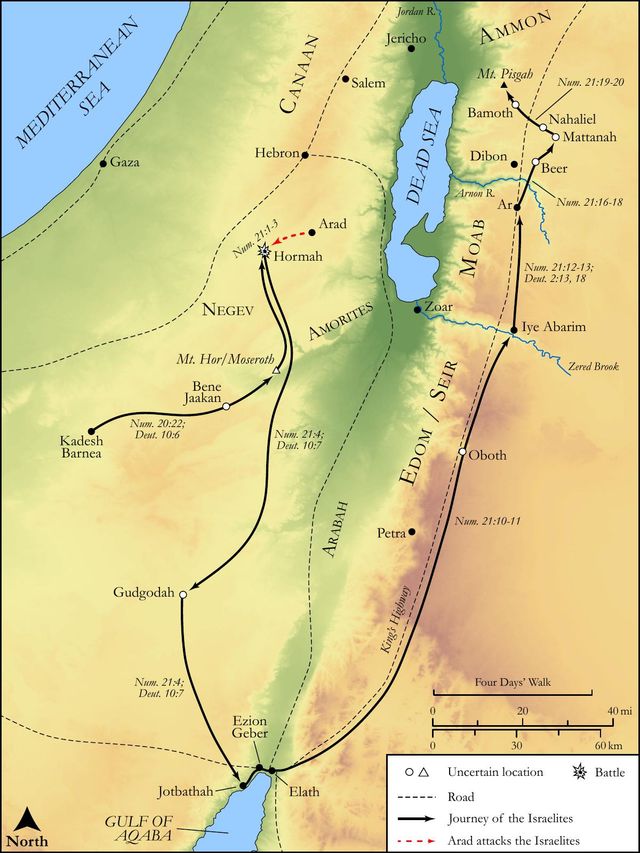
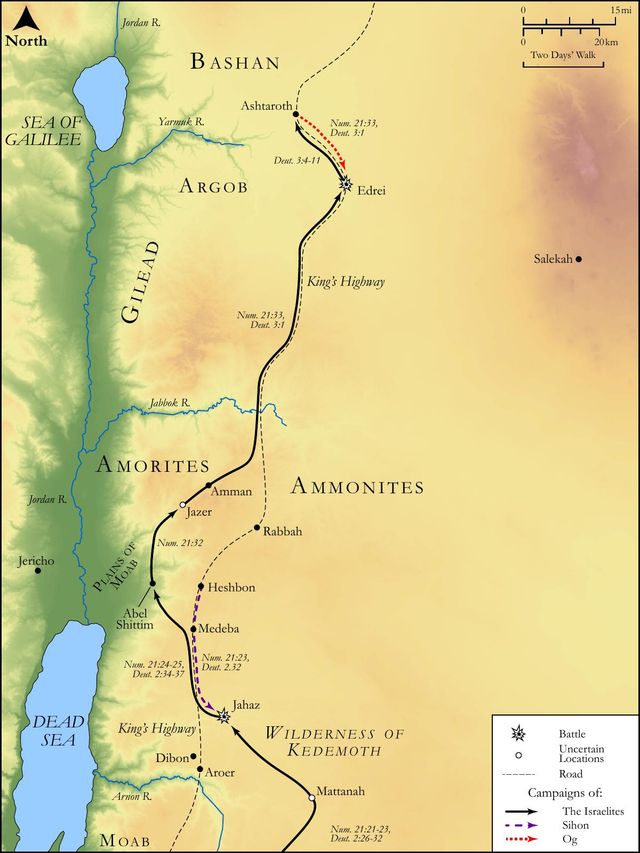
Study this verse
Public-domain commentary
Matthew Henry
From his Commentary on the Whole Bible. Henry comments on passages, not single verses — this entry covers Deuteronomy 2:8–23. His three-level outline is real structure in the source text, so it is rendered as structure.
It is observable here that Moses, speaking of the Edomites (Deu 2:8), calls them, "our brethren, the children of Esau." Though they had been unkind to Israel, in refusing them a peaceable passage through their country, yet he calls them brethren. For, though our relations fail in their duty to us, we must retain a sense of the relation, and not be wanting in our duty to them, as there is occasion. Now in these verses we have,
I.The account which Moses gives of the origin of the nations of which he had here occasion to speak, the Moabites, Edomites, and Ammonites.
We know very well, from other parts of his history, whose posterity they were; but here he tells us how they came to those countries in which Israel found them; they were not the aborigines, or first planters. But,
1.The Moabites dwelt in a country which had belonged to a numerous race of giants, called Emim (that is, terrible ones), as tall as the Anakim, and perhaps more fierce, Deu 2:10, Deu 2:11.
2.The Edomites in like manner dispossessed the Horim from Mount Seir, and took their country (Deu 2:12. and again Deu 2:22), of which we read, Gen 36:20.
3.The Ammonites likewise got possession of a country that had formerly been inhabited by giants, called Zamzummim, crafty men, or wicked men (Deu 2:20, Deu 2:21), probably the same that are called Zuzim, Gen 14:5. He illustrates these remarks by an instance older than any of these; the Caphtorim (who were akin to the Philistines, Gen 10:14) drove the Avim out of their country, and took possession of it, Deu 2:23. The learned bishop Patrick supposes these Avites, being expelled hence, to have settled in Assyria, and to be the same people we read of under that name, Kg2 17:31. Now these revolutions are recorded,
(1.)To show how soon the world was peopled after the flood, so well peopled that, when a family grew numerous, they could not find a place to settle in, at least in that part of the world, but they must drive out those that were already settled.
(2.)To show that the race is not to the swift, nor the battle to the strong. Giants were expelled by those of ordinary stature; for probably these giants, like those before the flood (Gen 6:4), were notorious for impiety and oppression, which brought the judgments of God upon them, against which their great strength would be on defence.
(3.)To show what uncertain things worldly possessions are, and how often they change their owners; it was so of old, and ever will be so. Families decline, and from them estates are transferred to families that increase; so little constancy or continuance is there in these things.
(4.)To encourage the children of Israel, who were now going to take possession of Canaan, against the difficulties they would meet with, and to show the unbelief of those that were afraid of the sons of Anak, to whom the giants, here said to be conquered, are compared, Deu 2:11, Deu 2:21. If the providence of God had done this for the Moabites and Ammonites, much more would his promise do it for Israel his peculiar people.
II.The advances which Israel made towards Canaan.
They passed by the way of the wilderness of Moab (Deu 2:8), and then went over the brook or vale of Zered (Deu 2:13), and there Moses takes notice of the fulfilling of the word which God had spoken concerning them, that none of those that were numbered at Mount Sinai should see the land that God had promised, Num 14:23. According to that sentence, now that they began to set their faces towards Canaan, and to have it in their eye, notice is taken of their being all destroyed and consumed, and not a man of them left, Deu 2:14. Common providence, we may observe, in about thirty-eight years, ordinarily raises a new generation, so that in that time few remain of the old one; but here it was entirely new, and none at all remained but Caleb and Joshua: for indeed the hand of the Lord was against them, v. 15. Those cannot but waste, until they were consumed, who have the hand of God against them. Observe, Israel is not called to engage with the Canaanites till all the men of war, the veteran regiments, that had been used to hardship, and had learned the art of war from the Egyptians, were consumed and dead from among the people (v. 16), that the conquest of Canaan, being effected by a host of new-raised men, trained up in a wilderness, the excellency of the power might the more plainly appear to be of God and not of men.
III.The caution given them not to meddle with the Moabites or Ammonites, whom they must not disseize, nor so much as disturb in their possessions: Distress them not, nor contend with them, v. 9. Though the Moabites aimed to ruin Israel (Num 22:6), yet Israel must not aim to ruin them. If others design us a mischief, this will not justify us in designing them a mischief. But why must not the Moabites and Ammonites be meddled with? 1. Because they were the children of Lot (v. 9, 19), righteous Lot, who kept his integrity in Sodom. Note, Children often fare the better in this world for the piety of their ancestors: the seed of the upright, though they degenerate, yet are blessed with temporal good things. 2. Because the land they were possessed of was what God had given them, and he did not design it for Israel. Even wicked men have a right to their worldly possessions, and must not be wronged. The tares are allowed their place in the field, and must not be rooted out until the harvest. God gives and preserves outward blessings to wicked men, to show that these are not the best things, but he has better in store for his own children.
Continue studying Deuteronomy 2:16 across the web’s major study libraries — every link below opens this exact verse, chapter, or book on the destination site.
Read & Compare
 BibleGatewayThis verse in more than 200 translations and 70 languages.
 Bible.comThe YouVersion reader — hundreds of translations, reading plans, and highlights.
 ESV.orgCrossway's official English Standard Version reader.
 NET BibleThe NET translation with 60,000+ translators' notes on every rendering decision.
 STEP BibleTyndale House's free study tool — original text, vocabulary, and scholarly resources.
 BibliaLogos Bible Software's free web reader.
 USCCBThe New American Bible (Revised Edition) with the U.S. bishops' study notes.
Commentaries
 BibleHub CommentariesDozens of classic commentaries on this verse, gathered on one page.
 StudyLightMore than 100 commentary sets — the largest collection on the web.
 BibleRefPlain-English commentary on what this verse means, verse by verse.
 Enduring WordDavid Guzik's free commentary on this chapter, widely used by Bible teachers.
 Bible Study ToolsVerse commentary alongside Greek and Hebrew study aids.
Original Language & Research
- BibleHub InterlinearThe verse word by word — original language, transliteration, and English.
- BibleHub LexiconEvery word's original-language definition and Strong's entry.
 Blue Letter BibleDeep-study tools — Strong's numbers, concordance, and word studies.
 SefariaThe Hebrew text with Rashi and centuries of Jewish commentary.
Sermons, Hymns & Audio


TrulyRandomVerse is not affiliated with these sites and doesn’t control their content. They’re linked because they’re genuinely useful.
Summary
Deuteronomy 2:16 marks a pivotal and somber moment in Israel's wilderness journey, declaring the definitive end of the generation that had rebelled against God at Kadesh-Barnea. This verse signifies the complete and divinely orchestrated demise of the "men of war"—those twenty years and older who had been condemned for their profound unbelief and disobedience—thereby clearing the path for a new, faithful generation to finally enter and inherit the long-promised land. It underscores the unwavering nature of God's judgment while simultaneously setting the stage for the fulfillment of His covenant promises.
Context
ShowHideLiterary Context
Deuteronomy 2:16 is strategically situated within Moses' expansive farewell address to the new generation of Israelites, delivered on the plains of Moab as they stand poised to enter Canaan. Following a recounting of the journey from Horeb (Mount Sinai) and the pivotal failure at Kadesh-Barnea in chapter 1, Moses transitions in chapter 2 to narrate the subsequent forty years of wilderness wandering. Verses 14-15 explicitly detail that this prolonged period was a direct consequence of God's solemn decree, ensuring the complete perishing of the rebellious "men of war." Therefore, Deuteronomy 2:16 serves as the climactic declaration of this divine sentence's full execution, marking the definitive closure of one era—characterized by judgment and wandering—and the immediate prelude to the conquest narratives that dominate the remainder of Deuteronomy and the book of Joshua. It powerfully underscores the narrative's critical pivot from divine discipline to renewed promise and imminent fulfillment.
Historical & Cultural Context
The term "men of war" specifically designates Israelite males aged twenty years and older who were deemed fit for military service at the time of the exodus and the critical incident at Kadesh-Barnea (as outlined in Numbers 1:3). This generation had been direct witnesses to God's awe-inspiring acts of deliverance from Egyptian bondage, His miraculous provision in the wilderness, and the profound covenant established at Sinai. However, their faith catastrophically failed at Kadesh-Barnea when, after receiving the spies' report, they succumbed to fear and rebelled against God's command to enter the Promised Land (a detailed account is found in Numbers 13 and Numbers 14). In response to their profound unbelief, God swore an oath that none of that rebellious generation, with the notable exceptions of Caleb and Joshua, would enter the land, condemning them to die in the wilderness over the course of forty years (Numbers 14:29-35). Deuteronomy 2:16 thus confirms the precise and total execution of this divine sentence, serving as a stark historical reminder of the severe consequences of corporate unbelief and disobedience within the covenant community.
Key Themes
ShowHideDeuteronomy 2:16 powerfully encapsulates several foundational themes that resonate throughout the book of Deuteronomy and the broader Pentateuch. Primarily, it stands as a stark testament to Divine Judgment and Faithfulness, demonstrating God's unwavering commitment to His spoken word—both in the execution of His promises and the imposition of His consequences. The complete demise of the rebellious generation underscores the profound seriousness of sin and unbelief, particularly when directly confronting God's explicit commands and promises. Simultaneously, this verse ushers in the crucial theme of a New Beginning and Divine Perseverance. With the old generation now "consumed and dead," the path is irrevocably cleared for the new generation, born and raised under the crucible of wilderness discipline, to step into their rightful inheritance. This transition emphatically highlights that God's ultimate redemptive plans for His people are never ultimately thwarted by human failure, though they may be significantly delayed. This narrative pivot underscores God's immense patience and His steadfast commitment to His covenant promises, even as they are forged and realized through the painful process of judgment, a theme consistently woven throughout Deuteronomy.
Exposition and Analysis
ShowHideKey Word Analysis
ShowHideThis verb signifies completion, termination, or being brought to an end, often with a sense of finality or exhaustion. In this context, it emphasizes the absolute and exhaustive nature of the divine judgment. It implies that the process of their dying out was not merely a natural attrition but a divinely orchestrated, purposeful "consumption" that reached its definitive conclusion. Not a single individual from the condemned group remained.
This is a primitive root meaning "to die," whether literally or figuratively, and can also mean "to kill" in a causative sense. Paired with "consumed," it serves as a straightforward and undeniable declaration of physical death. The combination "consumed and dead" creates a powerful, emphatic statement of total eradication, leaving no ambiguity about the literal cessation of life for the entire cohort.
Derived from a root meaning "to fight," this noun refers to a battle, an engagement, or generally, warfare. The phrase "men of war" is a poignant designation because these were the very individuals who, at Kadesh-Barnea, had refused to engage in the "war" of faith to claim the Promised Land, demonstrating a profound lack of trust in God's ability to grant them victory. Their designation as "men of war" who were "consumed" without ever fighting for the land highlights the bitter irony of their fate—they were conquered by the wilderness and divine judgment, not by external enemies.
Verse Breakdown
ShowHide"So it came to pass,"
This opening phrase functions as a narrative marker, signaling the culmination of a significant, divinely ordained event. It indicates that what follows is the definitive fulfillment of a prophecy or a decree, emphasizing God's sovereign hand in the precise unfolding of history and His commitment to His word.
"when all the men of war were consumed and dead"
This is the core declaration of the verse, emphasizing both the totality ("all") and the finality ("consumed and dead") of God's judgment. It leaves no room for exceptions (save Joshua and Caleb, who are implicitly excluded by their faithfulness and prior divine declaration) and underscores the severity and completeness of the divine sentence pronounced forty years prior.
"from among the people,"
This phrase clarifies that the judgment was specifically targeted at a particular segment of the Israelite community—the adult males of the rebellious generation. It highlights that while a severe judgment, it was also a precise and discriminating one, distinguishing the condemned from the new generation who would inherit the land and continue God's covenant purposes.
Literary Devices
ShowHideDeuteronomy 2:16 primarily employs Fulfillment as its central literary device. The verse serves as a definitive statement of the complete and precise fulfillment of God's forty-year judgment pronounced in Numbers 14, bringing a long period of divine discipline to a decisive close. The repetition and pairing of "consumed and dead" create a strong sense of Emphasis and Hyperbole, underscoring the absolute, comprehensive, and undeniable nature of this judgment. This stark declaration also functions as a form of Narrative Closure, drawing a clear line under the era of wilderness wandering and preparing the reader for the imminent transition to the conquest of Canaan. There is also an implicit Contrast between the faithless generation that perished and the new, hopeful generation poised to enter the land, highlighting the consequences of unbelief versus the rewards of obedience.
Theological and Thematic Connections
ShowHideDeuteronomy 2:16 is a profound theological statement on God's justice, holiness, and unwavering faithfulness to His word. It underscores that while God is infinitely merciful and patient, He is also righteous and holds His covenant people accountable for their unbelief and disobedience. The complete demise of the rebellious generation serves as a stark reminder that sin has severe consequences, and that God's promises, while ultimately sure, are often contingent upon a posture of faith and obedience. This event cleansed the nation, preparing a new generation, forged in the crucible of the wilderness, to enter the Promised Land with a renewed spirit of trust and obedience, highlighting God's commitment to His redemptive purposes even through the painful process of judgment. It exemplifies the principle that God's character demands both grace and justice.
Reflection and Application
ShowHideDeuteronomy 2:16 offers timeless lessons for believers today, serving as both a sober warning and a profound encouragement. It reminds us that while God is infinitely gracious and patient, He also takes our faith and obedience seriously. The fate of the "men of war" underscores the destructive power of unbelief and the necessity of trusting God's promises, even when circumstances seem daunting or require significant personal sacrifice. We are called to learn from their mistakes, actively avoiding the patterns of complaint, rebellion, and spiritual apathy that can hinder our own progress in the spiritual journey and prevent us from experiencing the fullness of God's blessings. Just as a new generation was required to enter the physical Promised Land, believers today are called to walk in newness of life, empowered by the Spirit, to enter into the spiritual rest and inheritance that God has prepared for those who believe and obey. This verse challenges us to examine our own hearts: Are we trusting God fully, or are we allowing fear, doubt, or past failures to consume our spiritual vitality and prevent us from moving forward into God's purposes?
Questions for Reflection
ShowHideFAQ
ShowHideWho exactly were the "men of war" mentioned in Deuteronomy 2:16?
ShowHideThe "men of war" refers to the Israelite males who were twenty years old or older at the time of the exodus from Egypt and the rebellion at Kadesh-Barnea. These were the individuals eligible for military service, who, despite witnessing God's miraculous deliverance and provision, demonstrated a profound lack of faith and outright rebellion when they refused to enter the Promised Land after hearing the spies' report (see Numbers 13 and Numbers 14). God decreed that this entire generation, with the exceptions of Joshua and Caleb, would perish in the wilderness over a period of forty years, never entering the land of promise.
Why did God allow this entire generation to die in the wilderness?
ShowHideGod allowed this generation to die as a direct consequence of their profound unbelief, rebellion, and refusal to trust His promise to give them the land. Their actions at Kadesh-Barnea were a direct challenge to God's authority and faithfulness, demonstrating a hardened heart despite overwhelming evidence of His power and care. This judgment served to demonstrate God's holiness, His justice, and the seriousness of covenant disobedience. It was a necessary cleansing to prepare a new, more obedient generation, born and raised in the wilderness, to inherit the land and fulfill His covenant purposes. While severe, it underscored that God's promises are conditional on faith and obedience, and that He will not tolerate persistent rebellion within His covenant people. This act of judgment ultimately paved the way for the fulfillment of His greater redemptive plan.
Christ-Centered Fulfillment
ShowHideDeuteronomy 2:16, while describing a historical judgment, prefigures profound spiritual truths ultimately fulfilled in Christ. The physical death of the "men of war" in the wilderness due to their unbelief serves as a powerful type for spiritual death and the inability to enter God's true rest apart from Christ. Just as the old generation could not enter the earthly promised land, humanity, enslaved by sin and spiritual unbelief, cannot enter God's true spiritual rest and inheritance without a new birth and a new covenant. Jesus Christ is the ultimate "new beginning," the one through whom a "new creation" is formed (2 Corinthians 5:17). He leads His people not into a temporal land, but into an eternal, spiritual inheritance, the true "rest" that the earthly Canaan foreshadowed (Hebrews 4:1-11). The judgment on the rebellious generation highlights the severity of sin and the absolute necessity of faith, pointing to Christ's atoning sacrifice as the means by which the penalty for our unbelief is paid, allowing us to enter into a new covenant relationship with God and inherit eternal life, a promise far greater than any earthly land (John 3:16). Through Him, we are no longer "consumed and dead" in our sins, but are given new life and the promise of an eternal dwelling with God, a spiritual reality secured by His resurrection (Romans 6:4).