


Deuteronomy 2:17
Bible text: King James Version (1769 Blayney text) · Public domain
Bible text: American Standard Version (1901) · Public domain
Bible text: World English Bible, Messianic edition · Public domain
Bible text: Geneva Bible (1599) · Public domain
Bible text: Young's Literal Translation · Public domain
- וַיְדַבֵּרvay·da·Berand he spokeH1696Conj-w ¦ V-Piel-ConsecImperf-3msVerb Piel Consecutive Imperfect 3rd Singular Masculineוַandיְדַבֵּרhe spoke
- יְהוָהYah·wehYahwehH3068N-properNoun Proper Title
- אֵלַי'e·Laito meH413Prep ¦ 1csPrepositionאֵלַtoיme
- לֵאמֹרle·Mor<to> sayingH559Prep-l ¦ V-Qal-InfVerb Qal Infinitive Constructלֵ<to>אמֹרsaying
English is a literal word-by-word gloss of the Hebrew, not the KJV's wording. Why?
This is the original text the KJV's translators worked from — each Hebrew word with its own literal English meaning in this verse, prepared by scholars at Tyndale House, Cambridge. The KJV translates whole sentences, not word by word, so its wording differs: one Hebrew word can become several English words, and the KJV may choose “the LORD” where the gloss reads “Yahweh”. Both are faithful — they answer different questions. For the KJV's own rendering, switch to the KJV text.
Details
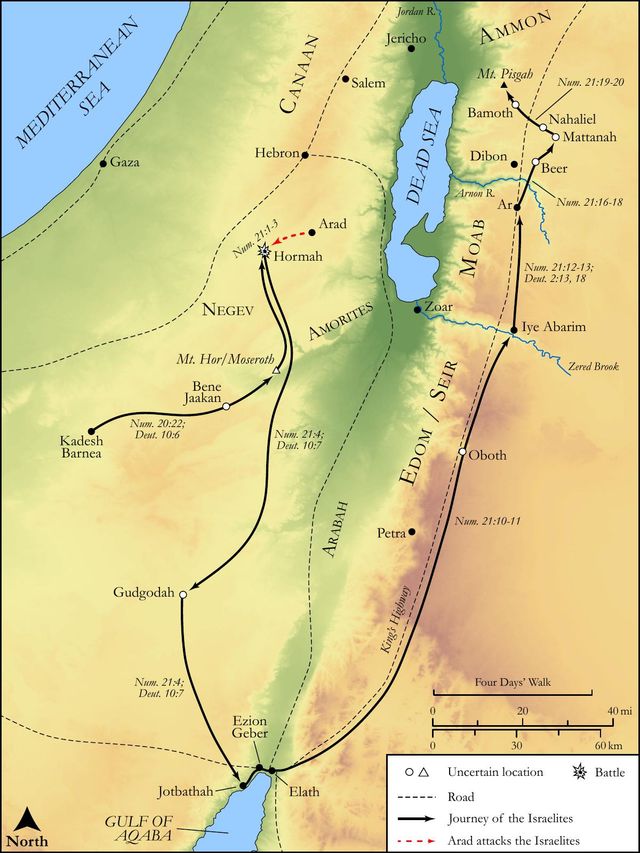
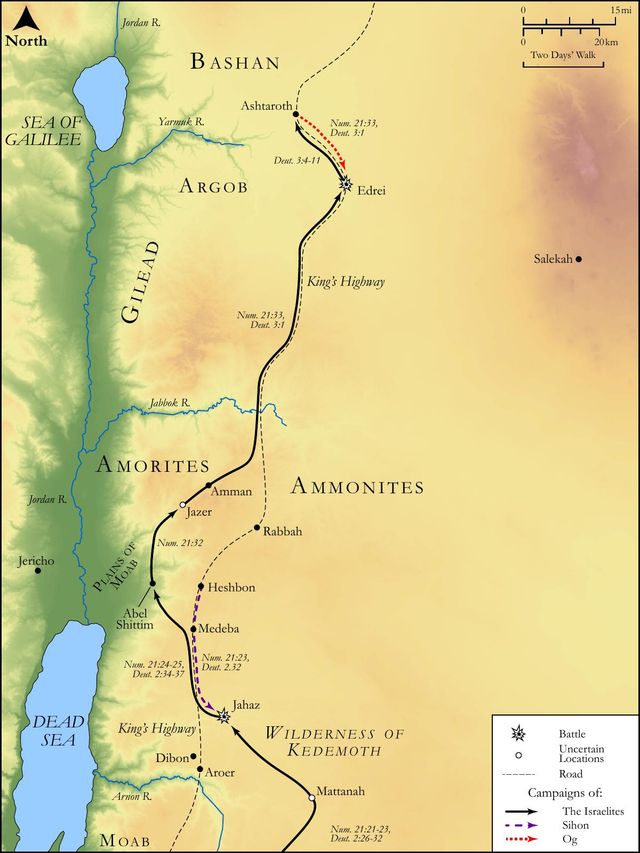
See on the biblical-era maps
Study this verse
Public-domain commentary
Matthew Henry
From his Commentary on the Whole Bible. Henry comments on passages, not single verses — this entry covers Deuteronomy 2:8–23. His three-level outline is real structure in the source text, so it is rendered as structure.
It is observable here that Moses, speaking of the Edomites (Deu 2:8), calls them, "our brethren, the children of Esau." Though they had been unkind to Israel, in refusing them a peaceable passage through their country, yet he calls them brethren. For, though our relations fail in their duty to us, we must retain a sense of the relation, and not be wanting in our duty to them, as there is occasion. Now in these verses we have,
I.The account which Moses gives of the origin of the nations of which he had here occasion to speak, the Moabites, Edomites, and Ammonites.
We know very well, from other parts of his history, whose posterity they were; but here he tells us how they came to those countries in which Israel found them; they were not the aborigines, or first planters. But,
1.The Moabites dwelt in a country which had belonged to a numerous race of giants, called Emim (that is, terrible ones), as tall as the Anakim, and perhaps more fierce, Deu 2:10, Deu 2:11.
2.The Edomites in like manner dispossessed the Horim from Mount Seir, and took their country (Deu 2:12. and again Deu 2:22), of which we read, Gen 36:20.
3.The Ammonites likewise got possession of a country that had formerly been inhabited by giants, called Zamzummim, crafty men, or wicked men (Deu 2:20, Deu 2:21), probably the same that are called Zuzim, Gen 14:5. He illustrates these remarks by an instance older than any of these; the Caphtorim (who were akin to the Philistines, Gen 10:14) drove the Avim out of their country, and took possession of it, Deu 2:23. The learned bishop Patrick supposes these Avites, being expelled hence, to have settled in Assyria, and to be the same people we read of under that name, Kg2 17:31. Now these revolutions are recorded,
(1.)To show how soon the world was peopled after the flood, so well peopled that, when a family grew numerous, they could not find a place to settle in, at least in that part of the world, but they must drive out those that were already settled.
(2.)To show that the race is not to the swift, nor the battle to the strong. Giants were expelled by those of ordinary stature; for probably these giants, like those before the flood (Gen 6:4), were notorious for impiety and oppression, which brought the judgments of God upon them, against which their great strength would be on defence.
(3.)To show what uncertain things worldly possessions are, and how often they change their owners; it was so of old, and ever will be so. Families decline, and from them estates are transferred to families that increase; so little constancy or continuance is there in these things.
(4.)To encourage the children of Israel, who were now going to take possession of Canaan, against the difficulties they would meet with, and to show the unbelief of those that were afraid of the sons of Anak, to whom the giants, here said to be conquered, are compared, Deu 2:11, Deu 2:21. If the providence of God had done this for the Moabites and Ammonites, much more would his promise do it for Israel his peculiar people.
II.The advances which Israel made towards Canaan.
They passed by the way of the wilderness of Moab (Deu 2:8), and then went over the brook or vale of Zered (Deu 2:13), and there Moses takes notice of the fulfilling of the word which God had spoken concerning them, that none of those that were numbered at Mount Sinai should see the land that God had promised, Num 14:23. According to that sentence, now that they began to set their faces towards Canaan, and to have it in their eye, notice is taken of their being all destroyed and consumed, and not a man of them left, Deu 2:14. Common providence, we may observe, in about thirty-eight years, ordinarily raises a new generation, so that in that time few remain of the old one; but here it was entirely new, and none at all remained but Caleb and Joshua: for indeed the hand of the Lord was against them, v. 15. Those cannot but waste, until they were consumed, who have the hand of God against them. Observe, Israel is not called to engage with the Canaanites till all the men of war, the veteran regiments, that had been used to hardship, and had learned the art of war from the Egyptians, were consumed and dead from among the people (v. 16), that the conquest of Canaan, being effected by a host of new-raised men, trained up in a wilderness, the excellency of the power might the more plainly appear to be of God and not of men.
III.The caution given them not to meddle with the Moabites or Ammonites, whom they must not disseize, nor so much as disturb in their possessions: Distress them not, nor contend with them, v. 9. Though the Moabites aimed to ruin Israel (Num 22:6), yet Israel must not aim to ruin them. If others design us a mischief, this will not justify us in designing them a mischief. But why must not the Moabites and Ammonites be meddled with? 1. Because they were the children of Lot (v. 9, 19), righteous Lot, who kept his integrity in Sodom. Note, Children often fare the better in this world for the piety of their ancestors: the seed of the upright, though they degenerate, yet are blessed with temporal good things. 2. Because the land they were possessed of was what God had given them, and he did not design it for Israel. Even wicked men have a right to their worldly possessions, and must not be wronged. The tares are allowed their place in the field, and must not be rooted out until the harvest. God gives and preserves outward blessings to wicked men, to show that these are not the best things, but he has better in store for his own children.
Continue studying Deuteronomy 2:17 across the web’s major study libraries — every link below opens this exact verse, chapter, or book on the destination site.
Read & Compare
 BibleGatewayThis verse in more than 200 translations and 70 languages.
 Bible.comThe YouVersion reader — hundreds of translations, reading plans, and highlights.
 ESV.orgCrossway's official English Standard Version reader.
 NET BibleThe NET translation with 60,000+ translators' notes on every rendering decision.
 STEP BibleTyndale House's free study tool — original text, vocabulary, and scholarly resources.
 BibliaLogos Bible Software's free web reader.
 USCCBThe New American Bible (Revised Edition) with the U.S. bishops' study notes.
Commentaries
 BibleHub CommentariesDozens of classic commentaries on this verse, gathered on one page.
 StudyLightMore than 100 commentary sets — the largest collection on the web.
 BibleRefPlain-English commentary on what this verse means, verse by verse.
 Enduring WordDavid Guzik's free commentary on this chapter, widely used by Bible teachers.
 Bible Study ToolsVerse commentary alongside Greek and Hebrew study aids.
Original Language & Research
- BibleHub InterlinearThe verse word by word — original language, transliteration, and English.
- BibleHub LexiconEvery word's original-language definition and Strong's entry.
 Blue Letter BibleDeep-study tools — Strong's numbers, concordance, and word studies.
 SefariaThe Hebrew text with Rashi and centuries of Jewish commentary.
Sermons, Hymns & Audio


TrulyRandomVerse is not affiliated with these sites and doesn’t control their content. They’re linked because they’re genuinely useful.
Summary
Deuteronomy 2:17 serves as a concise but profoundly significant transitional statement within Moses' valedictory address to the Israelites, marking a pivotal moment of divine intervention and renewed instruction. It emphatically declares that the subsequent narrative and directives concerning Israel's interaction with the nations of Edom and Moab are not human counsel but direct, authoritative revelation from Yahweh Himself, underscoring the divine origin and binding nature of the commands that follow.
Context
ShowHideLiterary Context
This verse appears at a crucial juncture in Moses' recounting of Israel's wilderness journey, specifically following the somber conclusion of the previous generation's demise, as detailed in Deuteronomy 2:16. Having described the long years of wandering and the perishing of the fighting men who had rebelled, Moses now pivots to new divine directives for the new generation poised to enter the Promised Land. Deuteronomy 2:17 acts as an immediate preface to God's specific instructions regarding Edom and Moab, establishing the divine authority for the commands that begin in Deuteronomy 2:18. It frames the subsequent narrative as direct divine communication, reinforcing the covenant relationship and God's ongoing guidance as Israel prepares to enter the land of Canaan.
Historical & Cultural Context
Moses delivers these speeches on the plains of Moab, just before the Israelites are to cross the Jordan River and enter Canaan. The audience is primarily the new generation, those who grew up in the wilderness and did not witness the Exodus or the giving of the Law at Sinai firsthand. Moses' address, often called "the second law," serves to reiterate and expound upon the covenant, reminding this generation of God's faithfulness, their history, and their responsibilities as they prepare for nationhood in the land. Culturally, direct divine speech to a prophet like Moses was the supreme form of authority, validating all subsequent commands and ensuring their obedience. The instructions concerning Edom and Moab were critical for Israel's immediate future, as these nations were their kin (descendants of Esau and Lot, respectively) and occupied strategic territories that Israel would need to navigate to reach the Promised Land.
Key Themes
ShowHideThe primary theme underscored by Deuteronomy 2:17 is Divine Revelation and Authority. The phrase "the LORD spake unto me" unequivocally establishes that the entire narrative and subsequent laws are founded on God's direct communication, not human wisdom or tradition. This emphasizes God's active, personal involvement in the history and destiny of Israel, reinforcing His role as the sovereign guide and lawgiver, a theme prevalent throughout the Pentateuch, from the initial call of Abraham in Genesis 12:1 to the giving of the Law in Exodus 20. Another key theme is God's Active Guidance and Providence, demonstrating that God was not a distant deity but intimately involved in the Israelites' journey, leading them step by step and giving specific instructions for their interactions with other nations, a testament to His constant presence and guidance, as seen in the pillar of cloud and fire in Exodus 13:21. Finally, the verse highlights Moses' Role as Mediator and Prophet, affirming his unique position as the divinely appointed conduit through whom God's word was conveyed to His people, reinforcing his prophetic authority as described in Deuteronomy 18:18.
Exposition and Analysis
ShowHideKey Word Analysis
ShowHideThis is the Tetragrammaton, YHWH (H3068), the personal covenant name of God, often rendered "LORD" in English translations. Its use here emphasizes the relational and covenantal nature of the communication. It is the same God who made promises to Abraham, delivered Israel from Egypt, and established the covenant at Sinai. The use of this specific name underscores the faithfulness, immutability, and ultimate authority of the God who is speaking, grounding the subsequent commands in His very being.
The verb "spake" (H1696, dâbar) signifies a direct, articulate, and intentional verbal communication. It is not a mere impression, a dream, or a vision, but a clear, spoken word. This emphasizes the clarity and authority of God's message to Moses, indicating a direct, personal encounter where God conveyed specific instructions. This form of communication establishes the divine origin and binding nature of the subsequent commands, highlighting God's active engagement with His people through His chosen prophet.
The participle "saying" (H559, ʼâmar) functions to introduce direct speech, indicating that what follows is a verbatim quotation of God's words. While dâbar emphasizes the act of speaking, ʼâmar points to the content of the utterance. Its inclusion here reinforces the precise nature of the divine revelation, assuring the audience that Moses is relaying God's exact instructions without alteration or interpretation, thus lending absolute veracity to the forthcoming directives.
Verse Breakdown
ShowHide"That the LORD spake unto me"
This phrase immediately asserts the divine origin of the message that follows. Moses, the narrator and speaker, is explicitly stating that the words he is about to utter are not his own thoughts, decisions, or historical recollections, but a direct, personal revelation from Yahweh, the covenant God of Israel. This establishes the ultimate authority and truthfulness of the instructions, grounding them in the very character and will of God. It also reinforces Moses' unique and divinely appointed role as the mediator, receiving direct communication from God on behalf of the people.
"saying,"
This simple yet crucial word indicates that the following content is a direct quotation of God's words to Moses. It transitions from the declaration of divine speech to the precise content of that speech. It sets the stage for the specific commands and explanations that God gave Moses regarding Israel's conduct towards the Edomites and Moabites, ensuring that the audience understands they are hearing God's precise instructions, not Moses' interpretation or summary. This direct discourse highlights the imperative nature of the upcoming commands.
Literary Devices
ShowHideDeuteronomy 2:17 primarily employs Direct Discourse, where the narrative voice (Moses) explicitly introduces the words of God as a direct quotation ("the LORD spake unto me, saying,"). This device immediately establishes the divine authority and veracity of the subsequent commands and narrative. It functions as a Framing Device within Moses' larger farewell address, signaling a shift from historical recounting to specific divine directives. The verse also utilizes Authoritative Declaration, as Moses, the divinely appointed leader, unequivocally states the source of his instructions, thereby lending indisputable weight and legitimacy to what he is about to convey to the new generation of Israelites. This declaration serves to underscore the covenantal nature of their relationship with Yahweh and the imperative of obedience to His revealed will.
Theological and Thematic Connections
ShowHideDeuteronomy 2:17, though brief, is profoundly significant because it grounds all of Moses' subsequent instructions in divine authority. It reminds the reader that the foundation of Israel's faith, their law, and their understanding of God's will comes from His direct, personal revelation. This verse underscores the active and communicative nature of God, who is not silent but intimately involved in the affairs of His people, guiding their steps and providing specific instructions for their journey through life and history. For the Israelites, this meant their entire national identity and future were predicated on heeding the voice of Yahweh. The principle of divine revelation as the basis for human conduct and national identity is a recurring theme throughout Scripture, emphasizing that true wisdom and guidance originate from God, who sovereignly directs the course of history and the lives of His covenant people.
Reflection and Application
ShowHideDeuteronomy 2:17 serves as a powerful reminder that the bedrock of our faith and the source of true guidance is God's revealed Word. Just as God spoke directly to Moses, providing clear and authoritative instructions for Israel's journey, so too has He provided us with His inspired Scriptures, which are "profitable for doctrine, for reproof, for correction, for instruction in righteousness" (2 Timothy 3:16). This verse calls us to a posture of humility and attentiveness, recognizing that God's voice, though not always audible in the same way it was to Moses, is nonetheless accessible and authoritative through the Bible. It challenges us to actively seek and diligently heed God's instructions, knowing that His commands are not arbitrary but are for our good, our flourishing, and His glory. In a world filled with competing voices and confusing paths, the divine origin of God's Word offers an unwavering compass, ensuring that our steps are ordered by His wisdom and our lives aligned with His perfect will.
Questions for Reflection
ShowHideFAQ
ShowHideWhy is such a short verse like Deuteronomy 2:17 considered significant?
ShowHideDespite its brevity, Deuteronomy 2:17 is profoundly significant because it acts as a critical pivot point and an authoritative declaration. It explicitly states that the instructions and narrative that immediately follow are not Moses' own ideas or historical recollections, but direct, verbal communication from "the LORD" (Yahweh) Himself. This establishes the divine authority and binding nature of all subsequent commands and explanations regarding Israel's interactions with Edom and Moab. It underscores the theme of divine revelation as the foundation for Israel's laws and actions, reminding the new generation that their entire existence as a covenant people is predicated on God's active guidance and revealed will, as seen throughout the Pentateuch, for instance, in the giving of the Law at Mount Sinai and the detailed covenant stipulations in Deuteronomy 5.
Christ-Centered Fulfillment
ShowHideDeuteronomy 2:17, with its emphasis on God's direct speech to Moses, foreshadows the ultimate and most complete revelation of God in the person of Jesus Christ. While God "spake unto" Moses and the prophets in various ways throughout the Old Testament, Hebrews 1:1-2 declares that "in these last days he has spoken to us by his Son." Jesus is the living Word of God (John 1:1), the perfect embodiment of divine communication, through whom God's character, will, and redemptive plan are fully revealed. The specific instructions given to Moses in Deuteronomy 2:17 were for the temporal guidance of Israel in their journey to the Promised Land, but Christ's words and life provide eternal guidance for all humanity, leading to salvation and abundant life (John 14:6). Just as Israel was to heed Moses' divinely-inspired words, so too are believers called to listen to and obey the voice of Christ, the Good Shepherd (John 10:27), who perfectly mediates God's truth and grace to us, fulfilling the promise of a prophet like Moses (Deuteronomy 18:18) and ushering in a new covenant based on His perfect sacrifice (Hebrews 8:6).