


Deuteronomy 2:13
Bible text: King James Version (1769 Blayney text) · Public domain
Bible text: Berean Standard Bible · Public domain
Bible text: American Standard Version (1901) · Public domain
Bible text: World English Bible, Messianic edition · Public domain
Bible text: Geneva Bible (1599) · Public domain
Bible text: Young's Literal Translation · Public domain
- עַתָּה'a·TahnowH6258AdvAdverb
- קֻמוּKu·muariseH6965V-Qal-Imp-2mpVerb Qal Imperative 2nd Plural Masculine
- וְעִבְרוּve·'iv·Ruand pass overH5674Conj-w ¦ V-Qal-Imp-2mpVerb Qal Imperative 2nd Plural Masculineוְandעִבְרוּpass over
- לָכֶםla·Khem<for> yourselvesPrep-l ¦ 2mpSuffix Personal 2nd Plural Masculineלָ<for>כֶםyourselves
- אֶת'et<obj.>H853DirObjMParticle Object Indicator
- נַחַלNa·chal[the] wadi ofH5158N-mscNoun Singular Masculine Construct
- זָרֶדZa·redZeredH2218N-properNoun Proper Location
- וַנַּעֲבֹרva·na·'a·Vorand we passed overH5674Conj-w ¦ V-Qal-ConsecImperf-1cpVerb Qal Consecutive Imperfect 1st Plural common genderוַandנַּעֲבֹרwe passed over
- אֶת'et<obj.>H853DirObjMParticle Object Indicator
- נַחַלNa·chal[the] wadi ofH5158N-mscNoun Singular Masculine Construct
- זָרֶדZa·redZeredH2218N-properNoun Proper Location
English is a literal word-by-word gloss of the Hebrew, not the KJV's wording. Why?
This is the original text the KJV's translators worked from — each Hebrew word with its own literal English meaning in this verse, prepared by scholars at Tyndale House, Cambridge. The KJV translates whole sentences, not word by word, so its wording differs: one Hebrew word can become several English words, and the KJV may choose “the LORD” where the gloss reads “Yahweh”. Both are faithful — they answer different questions. For the KJV's own rendering, switch to the KJV text.
Details
See on the biblical-era maps
Study this verse
Public-domain commentary
Matthew Henry
From his Commentary on the Whole Bible. Henry comments on passages, not single verses — this entry covers Deuteronomy 2:8–23. His three-level outline is real structure in the source text, so it is rendered as structure.
It is observable here that Moses, speaking of the Edomites (Deu 2:8), calls them, "our brethren, the children of Esau." Though they had been unkind to Israel, in refusing them a peaceable passage through their country, yet he calls them brethren. For, though our relations fail in their duty to us, we must retain a sense of the relation, and not be wanting in our duty to them, as there is occasion. Now in these verses we have,
I.The account which Moses gives of the origin of the nations of which he had here occasion to speak, the Moabites, Edomites, and Ammonites.
We know very well, from other parts of his history, whose posterity they were; but here he tells us how they came to those countries in which Israel found them; they were not the aborigines, or first planters. But,
1.The Moabites dwelt in a country which had belonged to a numerous race of giants, called Emim (that is, terrible ones), as tall as the Anakim, and perhaps more fierce, Deu 2:10, Deu 2:11.
2.The Edomites in like manner dispossessed the Horim from Mount Seir, and took their country (Deu 2:12. and again Deu 2:22), of which we read, Gen 36:20.
3.The Ammonites likewise got possession of a country that had formerly been inhabited by giants, called Zamzummim, crafty men, or wicked men (Deu 2:20, Deu 2:21), probably the same that are called Zuzim, Gen 14:5. He illustrates these remarks by an instance older than any of these; the Caphtorim (who were akin to the Philistines, Gen 10:14) drove the Avim out of their country, and took possession of it, Deu 2:23. The learned bishop Patrick supposes these Avites, being expelled hence, to have settled in Assyria, and to be the same people we read of under that name, Kg2 17:31. Now these revolutions are recorded,
(1.)To show how soon the world was peopled after the flood, so well peopled that, when a family grew numerous, they could not find a place to settle in, at least in that part of the world, but they must drive out those that were already settled.
(2.)To show that the race is not to the swift, nor the battle to the strong. Giants were expelled by those of ordinary stature; for probably these giants, like those before the flood (Gen 6:4), were notorious for impiety and oppression, which brought the judgments of God upon them, against which their great strength would be on defence.
(3.)To show what uncertain things worldly possessions are, and how often they change their owners; it was so of old, and ever will be so. Families decline, and from them estates are transferred to families that increase; so little constancy or continuance is there in these things.
(4.)To encourage the children of Israel, who were now going to take possession of Canaan, against the difficulties they would meet with, and to show the unbelief of those that were afraid of the sons of Anak, to whom the giants, here said to be conquered, are compared, Deu 2:11, Deu 2:21. If the providence of God had done this for the Moabites and Ammonites, much more would his promise do it for Israel his peculiar people.
II.The advances which Israel made towards Canaan.
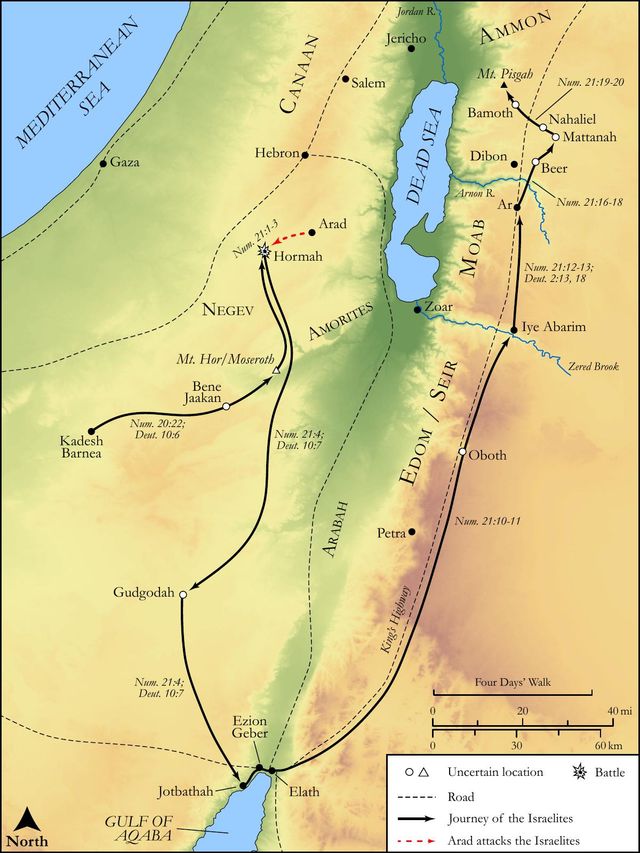
They passed by the way of the wilderness of Moab (Deu 2:8), and then went over the brook or vale of Zered (Deu 2:13), and there Moses takes notice of the fulfilling of the word which God had spoken concerning them, that none of those that were numbered at Mount Sinai should see the land that God had promised, Num 14:23. According to that sentence, now that they began to set their faces towards Canaan, and to have it in their eye, notice is taken of their being all destroyed and consumed, and not a man of them left, Deu 2:14. Common providence, we may observe, in about thirty-eight years, ordinarily raises a new generation, so that in that time few remain of the old one; but here it was entirely new, and none at all remained but Caleb and Joshua: for indeed the hand of the Lord was against them, v. 15. Those cannot but waste, until they were consumed, who have the hand of God against them. Observe, Israel is not called to engage with the Canaanites till all the men of war, the veteran regiments, that had been used to hardship, and had learned the art of war from the Egyptians, were consumed and dead from among the people (v. 16), that the conquest of Canaan, being effected by a host of new-raised men, trained up in a wilderness, the excellency of the power might the more plainly appear to be of God and not of men.
III.The caution given them not to meddle with the Moabites or Ammonites, whom they must not disseize, nor so much as disturb in their possessions: Distress them not, nor contend with them, v. 9. Though the Moabites aimed to ruin Israel (Num 22:6), yet Israel must not aim to ruin them. If others design us a mischief, this will not justify us in designing them a mischief. But why must not the Moabites and Ammonites be meddled with? 1. Because they were the children of Lot (v. 9, 19), righteous Lot, who kept his integrity in Sodom. Note, Children often fare the better in this world for the piety of their ancestors: the seed of the upright, though they degenerate, yet are blessed with temporal good things. 2. Because the land they were possessed of was what God had given them, and he did not design it for Israel. Even wicked men have a right to their worldly possessions, and must not be wronged. The tares are allowed their place in the field, and must not be rooted out until the harvest. God gives and preserves outward blessings to wicked men, to show that these are not the best things, but he has better in store for his own children.
Continue studying Deuteronomy 2:13 across the web’s major study libraries — every link below opens this exact verse, chapter, or book on the destination site.
Read & Compare
 BibleGatewayThis verse in more than 200 translations and 70 languages.
 Bible.comThe YouVersion reader — hundreds of translations, reading plans, and highlights.
 ESV.orgCrossway's official English Standard Version reader.
 NET BibleThe NET translation with 60,000+ translators' notes on every rendering decision.
 STEP BibleTyndale House's free study tool — original text, vocabulary, and scholarly resources.
 BibliaLogos Bible Software's free web reader.
 USCCBThe New American Bible (Revised Edition) with the U.S. bishops' study notes.
Commentaries
 BibleHub CommentariesDozens of classic commentaries on this verse, gathered on one page.
 StudyLightMore than 100 commentary sets — the largest collection on the web.
 BibleRefPlain-English commentary on what this verse means, verse by verse.
 Enduring WordDavid Guzik's free commentary on this chapter, widely used by Bible teachers.
 Bible Study ToolsVerse commentary alongside Greek and Hebrew study aids.
Original Language & Research
- BibleHub InterlinearThe verse word by word — original language, transliteration, and English.
- BibleHub LexiconEvery word's original-language definition and Strong's entry.
 Blue Letter BibleDeep-study tools — Strong's numbers, concordance, and word studies.
 SefariaThe Hebrew text with Rashi and centuries of Jewish commentary.
Sermons, Hymns & Audio


TrulyRandomVerse is not affiliated with these sites and doesn’t control their content. They’re linked because they’re genuinely useful.
Summary
Deuteronomy 2:13 marks a pivotal moment in Israel's wilderness journey, signifying the divinely ordained conclusion of a 38-year period of judgment and wandering, and the decisive commencement of their final advance toward the Promised Land. This verse highlights the renewed obedience of the new generation as they cross the brook Zered, a significant geographical and symbolic boundary, underscoring God's unwavering faithfulness to His covenant promises despite the previous generation's rebellion and the enduring consequences of their sin.
Context
ShowHideLiterary Context
Deuteronomy 2:13 is situated within Moses's extensive retrospective address to the new generation of Israelites, delivered on the plains of Moab as they prepare to enter Canaan. The preceding verses (Deuteronomy 2:1-12) recount the Israelites' prolonged detour around the territories of Edom and Moab, emphasizing God's explicit command to avoid conflict with these nations, as their lands were not part of Israel's divinely appointed inheritance. This command to cross the Zered follows a period characterized by stagnation and aimless wandering (compare Deuteronomy 2:1-3) and immediately precedes the narrative detailing the final eradication of the rebellious generation (Deuteronomy 2:14-15) and subsequent encounters with the Amorites. The verse functions as a critical narrative pivot, transitioning the historical account from the consequences of past disobedience to the renewed and purposeful march towards their divine destiny, thereby reinforcing the overarching themes of God's patient guidance, His righteous judgment, and the nation's readiness for a new phase of covenant fulfillment.
Historical & Cultural Context
The 38 years of wilderness wandering, culminating just prior to the crossing of the Zered (Deuteronomy 2:14), were a direct and severe consequence of Israel's profound rebellion and lack of faith following the disheartening report of the spies at Kadesh-barnea (as detailed in Numbers 13-14). During this extended punitive period, the entire generation of fighting men who had refused to enter the Promised Land, with the notable exceptions of Joshua and Caleb, had perished, thus fulfilling God's solemn judgment (compare Numbers 14:29-35). The "brook Zered" (identified with the modern Wadi al-Hasa) was a significant wadi, or seasonal riverbed, that historically served as a natural and recognized border, likely separating the territories of Moab and Edom. The act of crossing it carried immense geographical and chronological weight, marking a definitive boundary that signified the end of the punitive wilderness wandering and the beginning of the final, purposeful advance into the land of Canaan. Culturally, the act of crossing such a significant natural boundary frequently held deep symbolic meaning, representing a profound transition from one state, phase, or even identity to another.
Key Themes
ShowHideDeuteronomy 2:13 powerfully encapsulates several core theological and narrative themes. Firstly, it profoundly underscores Divine Command and Obedience, as God's clear and urgent instruction to "rise up" and cross the brook is met with immediate and collective compliance by the Israelites. This stands in stark contrast to the pervasive disobedience that characterized their predecessors' generation (compare with Numbers 14:1-4). Secondly, the verse unequivocally signifies the End of an Era and a New Beginning. The crossing of Zered definitively closes the long and difficult chapter of wilderness judgment and marks a fresh, redemptive start for the nation, now purged of the rebellious generation and poised to inherit the land God had promised. This transition serves as a powerful symbol of moving forward from past failures and consequences into God's future plans, echoing the broader biblical narrative of redemption, restoration, and new creation. Thirdly, it highlights God's Faithfulness and Perfect Timing. Even after decades of wandering due to human sin and rebellion, God remains steadfast and true to His covenant promises. He patiently guides His people, providing the precise command and timing for their next crucial move, ensuring they are prepared to fulfill His sovereign purpose, a testament to His patient leading and testing in the wilderness as described in Deuteronomy 8:2.
Exposition and Analysis
ShowHideKey Word Analysis
ShowHideThis Hebrew verb is presented in the imperative, conveying a direct, urgent command for action. It signifies a profound shift from a state of rest or stagnation to one of active, purposeful movement. In this context, it is not merely a physical act but a spiritual and national summons for Israel to shake off the lethargy and the lingering consequences of their past rebellion, initiating a new, divinely directed phase of their journey. It implies readiness, resolve, and a decisive break from the previous punitive period.
This primitive root verb carries a broad semantic range, fundamentally meaning "to cross over." It encompasses any form of transition, whether literal or figurative, and implies movement from one side or state to another. Here, it denotes the physical act of traversing the brook Zered, but also, by strong implication, the symbolic transition from the era of judgment and wandering to the era of purposeful advance and eventual inheritance of the Promised Land. It signifies passage, progression, and the overcoming of a boundary.
The term "nachal" refers to a wadi, a seasonal riverbed that is typically dry for much of the year but can become a significant torrent during the rainy season. "Zered" itself is derived from a root meaning "to be exuberant in growth" or "lined with shrubbery," suggesting a verdant or notable feature. Geographically, the brook Zered (Wadi al-Hasa) served as a critical natural boundary, likely separating the territory of Moab from Edom. Symbolically, its crossing represents a definitive demarcation point—the physical and temporal boundary marking the precise end of the 38-year period of divine judgment and the beginning of the final, decisive phase of the journey towards the Promised Land. It is a tangible marker of a profound and divinely orchestrated transition.
Verse Breakdown
ShowHide"Now rise up, [said I], and get you over the brook Zered."
This clause presents Moses relaying God's direct, urgent, and authoritative command to the Israelites. The imperative "rise up" demands immediate and decisive action, signaling an end to their prolonged encampment and aimless wandering. It initiates a new, purposeful phase of their journey. The subsequent command to "get you over the brook Zered" specifies the immediate objective and the geographical boundary they are to cross, marking a clear and definitive break from their past trajectory of judgment. This is a divine imperative for forward movement, transition, and renewed purpose.
"And we went over the brook Zered."
This clause concisely records the immediate, collective, and obedient response of the Israelites to the divine command. The use of the first-person plural pronoun "we" ("we went over") signifies the unity and collective action of the entire nation, particularly the new generation, in their compliance. The successful crossing of the brook Zered confirms their obedience and marks the tangible transition from the period of judgment and aimless wandering to a new era of purposeful progression toward their inheritance. This simple, declarative statement of fact powerfully underscores the effectiveness of God's command and Israel's renewed willingness to follow His leading.
Literary Devices
ShowHideThe verse employs several significant literary devices to convey its profound message. Symbolism is prominently featured, with the "brook Zered" serving as a powerful and multi-layered symbol. It is not merely a geographical feature but represents the definitive boundary between the past era of divine judgment and the future era of promised inheritance. Crossing it symbolizes leaving behind the consequences of rebellion and stepping into a new season of God's favor and purpose. The Divine Imperative ("rise up," "get you over") emphasizes God's active, sovereign role in guiding His people and initiating their next crucial steps, highlighting His authority and the necessity of human obedience. Furthermore, the Repetition of "the brook Zered" within the short verse underscores its immense importance as a critical landmark and a pivotal moment in the narrative, cementing its significance in the reader's mind and emphasizing the finality of the transition. The concise, declarative statement of action ("And we went over...") creates a strong sense of Narrative Progression and decisive movement, reflecting the turning point in Israel's journey.
Theological and Thematic Connections
ShowHideDeuteronomy 2:13 illustrates profound theological truths about God's enduring character and His covenant relationship with His people. It underscores that even in the midst of divine judgment for sin, God's faithfulness to His covenant promises remains steadfast and unwavering. The 38 years of wandering were a direct consequence of disobedience, yet God did not abandon His people. Instead, He patiently waited for a new generation to rise, then commanded them to move forward, demonstrating His redemptive purpose and His commitment to bringing His plans to fruition. This transition from stagnation to purposeful movement, from a period of judgment to renewed opportunity, powerfully reflects God's desire for His people to always be advancing in His will, leaving behind the old patterns of sin and embracing new life and obedience. It teaches that God's grace often manifests as a clear call to action, to "rise up" and cross the boundaries that separate us from His intended path and blessings.
Reflection and Application
ShowHideDeuteronomy 2:13 offers a compelling and deeply relevant spiritual lesson for believers today. Just as Israel was commanded by God to "rise up" and cross the brook Zered, we too are frequently called by God to move past periods of stagnation, past failures, or difficult, unproductive seasons in our lives. This verse serves as a powerful encouragement to recognize when God is signaling an end to a particular phase and calling us into a new one. It is a divine invitation to leave behind the "wilderness" of past mistakes, limiting beliefs, unproductive habits, or even lingering guilt, and to step with faith and obedience into the new opportunities, directions, and purposes God has prepared for us. It underscores the vital importance of listening intently to God's precise instructions and trusting His perfect timing, even when the path ahead requires courage, a willingness to leave the familiar behind, and a readiness to embrace the unknown. Our spiritual journey, by God's design, is not meant for endless wandering but for purposeful progression towards His ultimate design and glorious destiny for our lives.
Questions for Reflection
ShowHideFAQ
ShowHideWhat is the significance of the "brook Zered" in the narrative?
ShowHideThe "brook Zered" (identified with the modern Wadi al-Hasa) holds both geographical and profound symbolic significance in the narrative of Deuteronomy. Geographically, it served as a natural and recognized boundary, likely separating the territories of Moab and Edom, marking a distinct and critical point in Israel's long journey. Symbolically, its crossing represented the definitive and divinely ordained end of the 38-year period of wilderness wandering that was a direct consequence of Israel's disobedience and lack of faith at Kadesh-barnea (see Numbers 14). It marked the crucial transition from a time of divine judgment and aimless movement to a new phase of purposeful progression towards the Promised Land, signifying a fresh start and a renewed covenant relationship for the new generation.
Why did the Israelites wander for 38 years before crossing the Zered?
ShowHideThe 38 years of wandering, which concluded precisely at the crossing of the Zered, were a direct and severe consequence of the previous generation's rebellion and profound lack of faith. After the spies returned from Canaan with a negative report, inciting fear and rebellion among the people (see Numbers 13), the Israelites grumbled against God and refused to enter the Promised Land. As a result, God decreed that all the fighting men of that rebellious generation, with the exception of Joshua and Caleb, would die in the wilderness. Their children would then wander for 40 years, one year for each day the spies explored the land (see Numbers 14:33-35). The crossing of the Zered marked the precise point where this period of punitive wandering effectively ended, as the entire rebellious generation had finally passed away, fulfilling God's righteous judgment.
Christ-Centered Fulfillment
ShowHideDeuteronomy 2:13, with its powerful emphasis on the end of an old era of judgment and the beginning of a new, purposeful journey into promised inheritance, finds profound Christ-centered fulfillment in the New Testament. The "brook Zered" serves as a compelling type of the decisive boundary crossed through the redemptive work of Jesus Christ. Humanity, much like the rebellious generation of Israel, was under a sentence of divine judgment due to sin, wandering aimlessly in a spiritual wilderness, "dead in trespasses and sins" (compare Ephesians 2:1-3). Jesus Christ, through His sacrificial death and glorious resurrection, became the ultimate "crossing over" point for all who believe. His crucifixion marked the definitive end of the old covenant era, the curse of the Law, and the dominion of sin over those who are in Him (see Romans 6:4-6). Just as the new generation of Israel was called to "rise up" and enter a new land of promise, Christ calls us to "rise up" to newness of life, having been crucified with Him and now living by faith in Him, the Son of God (see Galatians 2:20). He is the true Lamb of God who takes away the sin of the world (see John 1:29), providing the only means to cross from spiritual death to eternal life, from divine judgment to abundant grace, and from a wilderness of spiritual wandering into the true rest and eternal inheritance found exclusively in Him (see Hebrews 4:9-10). He fulfills the promise of a new creation, where "the old has passed away; behold, the new has come" (see 2 Corinthians 5:17), leading us not merely to a physical land but to an eternal spiritual inheritance in God's glorious presence.