


2 Samuel 3:6
Bible text: King James Version (1769 Blayney text) · Public domain
Bible text: Berean Standard Bible · Public domain
Bible text: American Standard Version (1901) · Public domain
Bible text: World English Bible, Messianic edition · Public domain
Bible text: Geneva Bible (1599) · Public domain
Bible text: Young's Literal Translation · Public domain
- וַיְהִיvay·Hiand it wasH1961Conj-w ¦ V-Qal-ConsecImperf-3msVerb Qal Consecutive Imperfect 3rd Singular Masculineוַandיְהִיit was
- בִּהְיוֹתbih·yOtwhen wasH1961Prep-b ¦ V-Qal-InfVerb Qal Infinitive Constructבִּwhenהְיוֹתwas
- הַמִּלְחָמָהha·mil·cha·Mah<the> warH4421Art ¦ N-fsNoun Singular Feminine Absoluteהַ<the>מִּלְחָמָהwar
- בֵּיןbeinbetweenH996Adj-mscAdjective Numerical Singular Masculine Construct
- בֵּיתbeit[the] house ofH1004N-mscNoun Singular Masculine Construct
- שָׁאוּלsha·'UlSaulH7586N-proper-mNoun Proper Masculine
- וּבֵיןu·Veinand betweenH996Conj-w ¦ Adj-mscAdjective Numerical Singular Masculine Constructוּandבֵיןbetween
- בֵּיתbeit[the] house ofH1004N-mscNoun Singular Masculine Construct
- דָּוִדda·VidDavidH1732N-proper-mNoun Proper Masculine
- וְאַבְנֵרve·'av·Nerand AbnerH74Conj-w ¦ N-proper-mNoun Proper MasculineוְandאַבְנֵרAbner
- הָיָהha·Yahhe wasH1961V-Qal-Perf-3msVerb Qal Perfect 3rd Singular Masculine
- מִתְחַזֵּקmit·cha·Zekstrengthening himselfH2388V-Hithpael-Prtcpl-msVerb Hithpael Participle Singular Masculine Absolute
- בְּבֵיתbe·Veitin [the] house ofH1004Prep-b ¦ N-mscNoun Singular Masculine Constructבְּinבֵית[the] house of
- שָׁאוּלsha·'UlSaulH7586N-proper-mNoun Proper Masculine
English is a literal word-by-word gloss of the Hebrew, not the KJV's wording. Why?
This is the original text the KJV's translators worked from — each Hebrew word with its own literal English meaning in this verse, prepared by scholars at Tyndale House, Cambridge. The KJV translates whole sentences, not word by word, so its wording differs: one Hebrew word can become several English words, and the KJV may choose “the LORD” where the gloss reads “Yahweh”. Both are faithful — they answer different questions. For the KJV's own rendering, switch to the KJV text.
Details
See on the biblical-era maps

Study this verse
Public-domain commentary
Matthew Henry
From his Commentary on the Whole Bible. Henry comments on passages, not single verses — this entry covers 2 Samuel 3:1–6. His two-level outline is real structure in the source text, so it is rendered as structure.
Here is, I. The struggle that David had with the house of Saul before his settlement in the throne was completed, Sa2 3:1. 1. Both sides contested. Saul's house, though beheaded and diminished, would not fall tamely. It is not strange between them, but one would wonder it should be a long war, when David's house had right on its side, and therefore God on its side; but, though truth and equity will triumph at last, God made for wise and holy ends prolonged the conflict. The length of this war tried the faith and patience of David, and made his establishment at last the more welcome to him. 2. David's side got ground. The house of Saul waxed weaker and weaker, lost places, lost men, sunk in its reputation, grew less considerable, and was foiled in every engagement. But the house of David grew stronger and stronger. Many deserted the declining cause of Saul's house, and prudently came into David's interest, being convinced that he would certainly win the day. The contest between grace and corruption in the hearts of believers, who are sanctified but in part, may fitly be compared to this recorded here. There is a long war between them, the flesh lusted against the spirit and the spirit against the flesh; but, as the work of sanctification is carried on, corruption, like the house of Saul, grows weaker and weaker; while grace, like the house of David, grows stronger and stronger, till it come to a perfect man, and judgment be brought forth unto victory.
II.The increase of his own house.
Here is an account of six sons he had by six several wives, in the seven years he reigned in Hebron. Perhaps this is here mentioned as that which strengthened David's interest. Every child, whose welfare was embarked in the common safety, was a fresh security given to the commonwealth for his care of it. He that has his quiver filled with these arrows shall speak with his enemy in the gate, Psa 127:5. As the death of Saul's sons weakened his interest, so the birth of David's strengthened his.
1.It was David's fault thus to multiply wives, contrary to the law (Deu 17:17), and it was a bad example to his successors.
2.It does not appear that in these seven years he had above one son by each of these wives; some have had as numerous a progeny, and with much more honour and comfort, by one wife.
3.We read not that any of these sons came to be famous (three of them were infamous, Amnon, Absalom, and Adonijah); we have therefore reason to rejoice with trembling in the building up of our families.
4.His son by Abigail is called Chileab (Sa2 3:3), whereas (Ch1 3:1) he is called Daniel. Bishop Patrick mentions the reason which the Hebrew doctors give for these names, that his first name was Daniel - God has judged me (namely, against Nabal), but David's enemies reproached him, and said, "It is Nabal's son, and not David's," to confute which calumny Providence so ordered it that, as he grew up, he became, in his countenance and features, extremely like David, and resembled him more than any of his children, upon which he gave him the name of Chileab, which signifies, like his father, or the father's picture.
5.Absalom's mother is said to be the daughter of Talmai king of Geshur, a heathen prince. Perhaps David thereby hoped to strengthen his interest, but the issue of the marriage was one that proved his grief and shame.
6.The last is called David's wife, which therefore, some think, was Michal, his first and most rightful wife, called here by another name; and, though she had no child after she mocked David, she might have had before.
Thus was David's house strengthened; but it was Abner that made himself strong for the house of Saul, which is mentioned (Sa2 3:6) to show that, if he failed them, they would fall of course.
Continue studying 2 Samuel 3:6 across the web’s major study libraries — every link below opens this exact verse, chapter, or book on the destination site.
Read & Compare
 BibleGatewayThis verse in more than 200 translations and 70 languages.
 Bible.comThe YouVersion reader — hundreds of translations, reading plans, and highlights.
 ESV.orgCrossway's official English Standard Version reader.
 NET BibleThe NET translation with 60,000+ translators' notes on every rendering decision.
 STEP BibleTyndale House's free study tool — original text, vocabulary, and scholarly resources.
 BibliaLogos Bible Software's free web reader.
 USCCBThe New American Bible (Revised Edition) with the U.S. bishops' study notes.
Commentaries
 BibleHub CommentariesDozens of classic commentaries on this verse, gathered on one page.
 StudyLightMore than 100 commentary sets — the largest collection on the web.
 BibleRefPlain-English commentary on what this verse means, verse by verse.
 Enduring WordDavid Guzik's free commentary on this chapter, widely used by Bible teachers.
 Bible Study ToolsVerse commentary alongside Greek and Hebrew study aids.
Original Language & Research
- BibleHub InterlinearThe verse word by word — original language, transliteration, and English.
- BibleHub LexiconEvery word's original-language definition and Strong's entry.
 Blue Letter BibleDeep-study tools — Strong's numbers, concordance, and word studies.
 SefariaThe Hebrew text with Rashi and centuries of Jewish commentary.
Sermons, Hymns & Audio


TrulyRandomVerse is not affiliated with these sites and doesn’t control their content. They’re linked because they’re genuinely useful.
Summary
2 Samuel 3:6 encapsulates a pivotal moment in the protracted civil war that erupted following the demise of King Saul, vividly portraying the ongoing struggle for legitimate kingship between the nascent "house of David" in Judah and the remnants of the "house of Saul" in the northern tribes. This verse specifically highlights the formidable influence and strategic actions of Abner, Saul's former army commander, who actively and forcefully strengthened the position of Saul's surviving son, Ish-bosheth, thereby prolonging the national division and fierce resistance to David's eventual, divinely appointed reign over all Israel.
Context
ShowHideLiterary Context
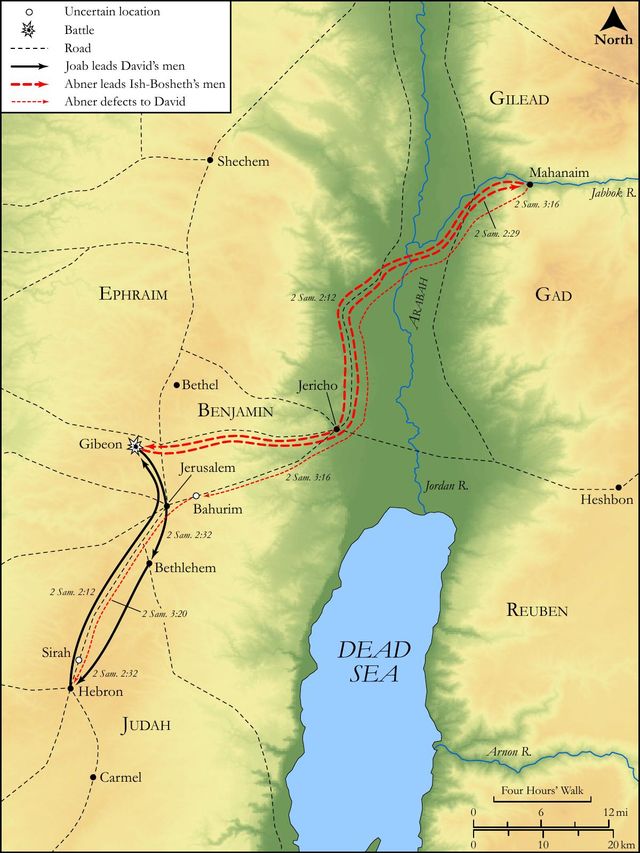
This verse is strategically placed early in 2 Samuel, immediately following the tragic deaths of Saul and his sons at Gilboa and David's anointing as king over Judah in Hebron. The preceding chapter, 2 Samuel 2, details Abner's decisive action to establish Ish-bosheth, Saul's surviving son, as king over the northern tribes of Israel, creating a divided kingdom. Thus, 2 Samuel 3:6 functions as a concise summary statement of the prevailing political and military reality: a nation deeply fractured and embroiled in active conflict, with Abner serving as the primary architect and enforcer of the Saulide resistance. It effectively sets the stage for the subsequent narrative, which will detail Abner's growing power, his eventual dramatic defection to David, and the gradual, divinely orchestrated consolidation of David's kingdom over all Israel.
Historical & Cultural Context
The period immediately following a king's death in ancient Israel, particularly one as calamitous as Saul's demise at Gilboa (1 Samuel 31:6), frequently led to power vacuums and intense succession struggles. In this specific instance, the conflict was exacerbated by deep-seated tribal loyalties, with Judah staunchly supporting David and the northern tribes, under Abner's formidable influence, clinging to the remnants of the Saulide dynasty. Abner, as the former commander of Saul's army, wielded immense military and political authority, effectively acting as a king-maker and the true power behind the figurehead Ish-bosheth. This turbulent era vividly reflects the nature of early monarchies, where personal influence, military might, and entrenched tribal allegiances heavily dictated the course of national leadership, often resulting in prolonged periods of internal strife and civil war.
Key Themes
ShowHide2 Samuel 3:6 explicitly highlights the pervasive theme of Civil War and Division, clearly stating "war between the house of Saul and the house of David," which underscores the profound national schism and the brutal struggle for the throne of Israel. It also emphatically emphasizes Abner's Influence and Power, as the phrase "Abner made himself strong for the house of Saul" reveals his immense authority and strategic importance in sustaining the rival kingdom. This period of intense conflict, though marked by human ambition and suffering, ultimately serves as a necessary prelude to the Struggle for Unification under David's kingship (2 Samuel 5:1), a crucial part of God's overarching plan for Israel's monarchy. The narrative also subtly introduces the profound theme of Divine Sovereignty working through human political maneuvering and conflict to establish God's chosen king, even amidst resistance.
Exposition and Analysis
ShowHideKey Word Analysis
ShowHideThis word denotes a battle, an engagement, or generally, warfare. In 2 Samuel 3:6, it signifies not merely sporadic skirmishes but a sustained, active, and pervasive state of military conflict between the two rival factions. It underscores the deep-seated animosity and the violent means by which the succession struggle was being contested, highlighting the national tragedy of Israel fighting against itself.
This term extends beyond a physical dwelling to represent a family, a lineage, a dynasty, or even a kingdom. The repeated phrase "the house of Saul and the house of David" in 2 Samuel 3:6 emphasizes that the conflict was not just between two individuals but between two competing dynastic claims to the throne of Israel. It highlights the deeply entrenched loyalties and the comprehensive nature of the political and tribal division.
This primitive root means to fasten upon, to seize, to be strong, courageous, or to strengthen. In this context, "Abner made himself strong" conveys his active, deliberate, and assertive efforts to fortify and sustain the position of Saul's lineage. It is not a passive state of strength but an energetic exertion of influence, military might, and political maneuvering to ensure the continuance of the rival house. Abner was not merely a supporter; he was the driving force, actively consolidating power and resources to resist David's claim to the throne of all Israel.
Verse Breakdown
ShowHide"And it came to pass, while there was war between the house of Saul and the house of David,"
This opening clause establishes the overarching context and the primary conflict of the period. The phrase "it came to pass" (וַיְהִי, wayhî) is a common Hebrew narrative transition, signaling the unfolding of events. It immediately immerses the reader in the reality of a divided kingdom, where a direct and ongoing civil conflict raged between two competing dynastic claims: the "house of Saul" representing the remnants of the old regime, primarily the northern tribes under Ish-bosheth's nominal rule, and the "house of David" referring to David's emerging kingdom in Judah. This was a brutal struggle for control of the entire nation.
"that Abner made himself strong for the house of Saul."
This is the core assertion of the verse, identifying the key actor and his strategic objective. Abner, as Saul's former commander-in-chief and cousin, was the real power behind Ish-bosheth, who was merely a figurehead. The phrase "made himself strong" (from the Hebrew verb ḥāzaq) indicates his proactive, forceful, and sustained efforts to consolidate power, gather military support, and maintain political readiness on behalf of the Saulide dynasty. This was a deliberate and determined campaign to resist David's ascendancy and preserve the existing, albeit diminished, rule of Saul's house, making Abner the central figure in the opposition to David's unification of Israel.
Literary Devices
ShowHide2 Samuel 3:6 masterfully employs several effective literary devices. Repetition is prominently featured in the recurring phrases "the house of Saul" and "the house of David," which starkly highlights the binary opposition and the core conflict of the narrative—a civil war not just between individual leaders, but between two competing dynastic claims. This repetition underscores the deep and tragic schism within Israel. Characterization is also key, as the verse immediately establishes Abner as a powerful, decisive, and formidable figure. The active verb "made himself strong" portrays him as the primary agent and driving force behind the resistance, rather than merely a loyal subordinate. This sets the stage for his significant and pivotal role in the unfolding events of 2 Samuel 3. Furthermore, the verse functions as a powerful form of Foreshadowing, as it succinctly summarizes the ongoing conflict that will inevitably lead to a series of dramatic events, including Abner's eventual shift in allegiance and the ultimate collapse of the house of Saul, thereby paving the way for David's unified kingship over all Israel.
Theological and Thematic Connections
ShowHideThis verse, though describing a period of intense human conflict and political maneuvering, subtly yet profoundly points to the overarching theme of God's sovereignty working through human affairs. The arduous struggle between the "house of Saul" and the "house of David" was not merely a contest of wills between powerful men, but a necessary stage in God's meticulously orchestrated plan to establish His chosen king, David, over all Israel. Even amidst the chaos of civil war, tribal loyalties, and Abner's determined resistance, God's divine purposes for His people were being inexorably advanced. This period of division highlights the profound human cost of unrighteous leadership and the formidable challenges inherent in transitioning to God's divinely appointed order. Ultimately, the strength Abner amassed for Saul's house would prove futile against the immutable divine decree that David, God's anointed, would reign over a unified Israel.
Reflection and Application
ShowHideThe narrative of 2 Samuel 3:6 offers profound and enduring insights for contemporary reflection and application. It serves as a potent reminder that periods of significant transition—whether in leadership, organizations, communities, or even within our personal lives—can often be marked by intense struggle, deep division, and the determined efforts of those who resist change or seek to maintain the status quo. Abner's actions powerfully illustrate how influential individuals, driven by complex motivations such as loyalty, ambition, or a misguided sense of duty, can significantly impact the course of events, prolonging conflict and shaping the destinies of many. For believers, this verse invites us to contemplate how God's overarching and sovereign plan often unfolds amidst human conflict, intricate political maneuvering, and even outright opposition. Just as God ultimately brought about a unified kingdom under David, His chosen one, He continues to work His purposes in the world, even through challenging circumstances and the persistent resistance of human wills. We are called to discern God's hand in history, to trust implicitly in His ultimate sovereignty, and to fervently pray for unity, reconciliation, and righteous leadership, even when faced with pervasive division and strife.
Questions for Reflection
ShowHideFAQ
ShowHideWho was Abner and why was he so important in this period?
ShowHideAbner, son of Ner, was King Saul's cousin and, crucially, the commander of his army. After Saul's tragic death, he emerged as the most powerful and influential figure in the remnants of Saul's kingdom. He was of paramount importance because he took Saul's surviving son, Ish-bosheth, and strategically made him king over Israel (excluding Judah, which had already anointed David in 2 Samuel 2:4). Abner effectively served as the true power behind Ish-bosheth's throne, leading the military efforts and political resistance against David's legitimate claim to the kingship of all Israel. His actions directly prolonged the civil war between the "house of Saul" and the "house of David," making him a pivotal and central figure in this tumultuous transitional period of Israelite history.
Christ-Centered Fulfillment
ShowHideThe protracted and often violent struggle between the "house of Saul" and the "house of David," vividly epitomized by Abner's determined efforts to strengthen the former, finds its ultimate resolution and perfect fulfillment in the undisputed and eternal reign of Jesus Christ. While David's kingdom was eventually unified, it remained a temporal, earthly kingdom, perpetually plagued by internal strife, human sin, and the limitations of mortal rulers. Jesus, the true Son of David (Matthew 1:1), comes not to establish a kingdom through human warfare, political maneuvering, or the might of armies, but through His unparalleled self-sacrifice on the cross and the divine power of His resurrection. He is the Prince of Peace, who decisively breaks down the dividing walls of hostility (Ephesians 2:14), uniting all who believe into one spiritual "house" or family under His supreme headship. Unlike Abner, who fought to maintain a fading earthly dynasty, Christ's strength is for the establishment of an eternal, heavenly kingdom that will never be divided, overthrown, or come to an end (Luke 1:33). The struggle for earthly dominion depicted in 2 Samuel 3:6 thus powerfully foreshadows the far greater spiritual battle against sin, death, and division, which Christ decisively won, establishing His righteous reign as the King of kings and Lord of lords over a people reconciled, unified, and eternally secure in Him.