


2 Samuel 14:9
- וַתֹּאמֶרva·To·merand she saidH559Conj-w ¦ V-Qal-ConsecImperf-3fsVerb Qal Consecutive Imperfect 3rd Singular Feminineוַandתֹּאמֶרshe said
- הָאִשָּׁהha·'i·Shahthe womanH802Art ¦ N-fsNoun Singular Feminine Absoluteהָtheאִשָּׁהwoman
- הַתְּקוֹעִיתha·te·ko·'It<the> TekoiteH8621Art ¦ N-fsNoun Gentilic Singular Feminine Absoluteהַ<the>תְּקוֹעִיתTekoite
- אֶל'eltoH413PrepPreposition
- הַמֶּלֶךְha·Me·lekhthe kingH4428Art ¦ N-msNoun Singular Masculine Absoluteהַtheמֶּלֶךְking
- עָלַי'a·Lai[be] on meH5921Prep ¦ 1csPreposition Definiteעָלַ[be] onיme
- אֲדֹנִי'a·do·Nimy O lordH113N-msc ¦ 1csNoun Singular Masculine ConstructאֲדֹנִO lordיmy
- הַמֶּלֶךְha·Me·lekhthe kingH4428Art ¦ N-msNoun Singular Masculine Absoluteהַtheמֶּלֶךְking
- הֶעָוֹןhe·'a·Vonthe iniquityH5771Art ¦ N-msNoun Singular Masculine Absoluteהֶtheעָוֹןiniquity
- וְעַלve·'aland onH5921Conj-w ¦ PrepPrepositionוְandעַלon
- בֵּיתbeit[the] house ofH1004N-mscNoun Singular Masculine Construct
- אָבִי'a·Vimy fatherH1N-msc ¦ 1csNoun Singular Masculine Constructאָבִfatherיmy
- וְהַמֶּלֶךְve·ha·Me·lekhand the kingH4428Conj-w ¦ Art ¦ N-msNoun Singular Masculine Absoluteוְandהַtheמֶּלֶךְking
- וְכִסְאוֹve·khis·'Oand his throneH3678Conj-w ¦ N-msc ¦ 3msNoun Singular Masculine Constructוְandכִסְאthroneוֹhis
- נָקִיna·Ki[be] innocentH5355Adj-msAdjective Singular Masculine Absolute
English is a literal word-by-word gloss of the Hebrew, not the KJV's wording. Why?
This is the original text the KJV's translators worked from — each Hebrew word with its own literal English meaning in this verse, prepared by scholars at Tyndale House, Cambridge. The KJV translates whole sentences, not word by word, so its wording differs: one Hebrew word can become several English words, and the KJV may choose “the LORD” where the gloss reads “Yahweh”. Both are faithful — they answer different questions. For the KJV's own rendering, switch to the KJV text.
Details
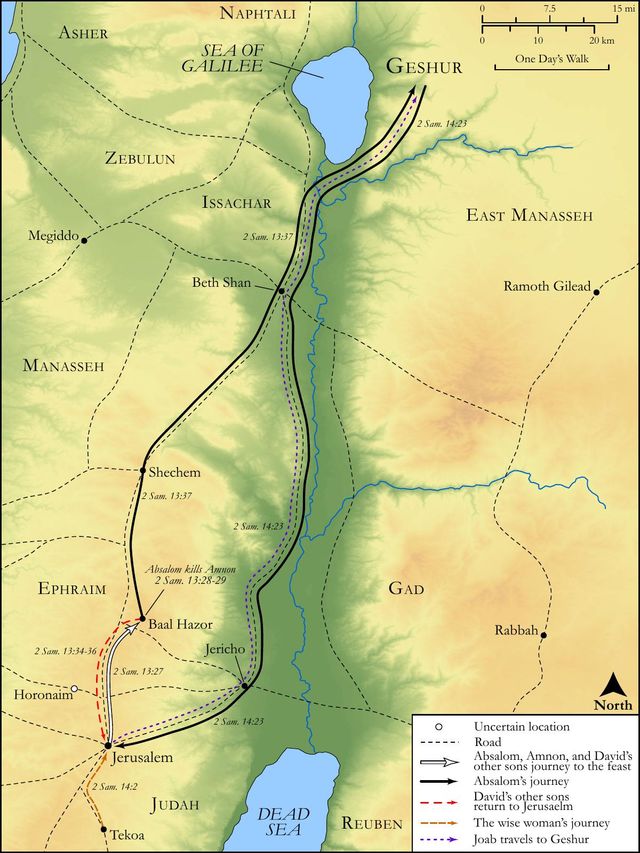
See on the biblical-era map

Study this verse
Public-domain commentary
Matthew Henry
From his Commentary on the Whole Bible. Henry comments on passages, not single verses — this entry covers 2 Samuel 14:1–20. His three-level outline is real structure in the source text, so it is rendered as structure.
Here is, I. Joab's design to get Absalom recalled out of banishment, his crime pardoned, and his attainder reversed, Sa2 14:1. Joab made himself very busy in this affair. 1. As a courtier that was studious, by all ways possible, to ingratiate himself with his prince and improve his interest in his favour: He perceived that the king's heart was towards Absalom, and that, the heat of his displeasure being over, he still retained his old affection for him, and only wanted a friend to court him to be reconciled, and to contrive for him how he might do it without impeaching the honour of his justice. Joab, finding how David stood affected, undertook this good office. 2. As a friend to Absalom, for whom perhaps he had a particular kindness, whom at least he looked upon as the rising sun, to whom it was his interest to recommend himself. He plainly foresaw that his father would at length be reconciled to him, and therefore thought he should make both his friends if he were instrumental to bring it about. 3. As a statesman, and one concerned for the public welfare. He knew how much Absalom was the darling of the people, and, if David should die while he was in banishment, it might occasion a civil war between those that were for him and those that were against him; for it is probable that though all Israel loved his person, yet they were much divided upon his case. 4. As one who was himself a delinquent, by the murder of Abner. He was conscious to himself of the guilt of blood, and that he was himself obnoxious to public justice, and therefore whatever favour he could procure to be shown to Absalom would corroborate his reprieve.
II.His contrivance to do it by laying somewhat of a parallel case before the king, which was done so dexterously by the person he employed that the king took it for a real case, and gave judgment upon it, as he had done upon Nathan's parable; and, the judgment being in favour of the criminal, the manager might, by that, discover his sentiments so far as to venture upon the application of it, and to show that it was the case of his own family, which, it is probable, she was instructed not to proceed to if the king's judgment upon her case should be severe.
1.The person he employed is not named, but she is said to be a woman of Tekoah, one whom he knew to be fit for such an undertaking: and it was requisite that the scene should be laid at a distance, that David might not think it strange that he had not heard of the case before. It is said, She was a wise woman, one that had a quicker wit and a readier tongue than most of her neighbours, Sa2 14:2. The truth of the story would be the less suspected when it came, as was supposed, from the person's own mouth.
2.The character she put on was that of a disconsolate widow, Sa2 14:2. Joab knew such a one would have an easy access to the king, who was always ready to comfort the mourners, especially the mourning widows, having himself mentioned it among the titles of God's honour that he is a Judge of the widows, Psa 68:5. God's ear, no doubt, is more open to the cries of the afflicted, and his heart too, than that of the most merciful princes on earth can be.
3.It was a case of compassion which she had to represent to the king, and a case in which she could have no relief but from the chancery in the royal breast, the law (and consequently the judgment of all the inferior courts) being against her. She tells the king that she had buried her husband (Sa2 14:5), - that she had two sons that were the support and comfort of her widowed state, - that these two (as young men are apt to do) fell out and fought, and one of them unhappily killed the other (Sa2 14:6), - that, for her part, she was desirous to protect the manslayer (for, as Rebekah argued concerning her two sons, Why should she be deprived of them both in one day? Gen 27:45), but though she, who was nearest of kin to the slain, was willing to let fall the demands of an avenger of blood, yet the other relations insisted upon it that the surviving brother should be put to death according to law, not out of any affection either to justice or to the memory of the slain brother, but that, by destroying the heir (which they had the impudence to own was the thing they aimed at), the inheritance might be theirs: and thus they would cut off, (1.) Her comfort: "They shall quench my coal, deprive me of the only support of my old age, and put a period to all my joy in this world, which is reduced to this one coal." (2.) Her husband's memory: "His family will be quite extinct, and they will leave him neither name nor remainder," Sa2 14:7.
4.The king promised her his favour and a protection for her son. Observe how she improved the king's compassionate concessions.
(1.)Upon the representation of her case he promised to consider of it and to give orders about it, Sa2 14:8. This was encouraging, that he did not dismiss her petition with "Currat lex - Let the law take its course; blood calls for blood, and let it have what it calls for:" but he will take time to enquire whether the allegations of her petition be true.
(2.)The woman was not content with this, but begged that he would immediately give judgment in her favour; and if the matter of fact were not as she represented it, and consequently a wrong judgment given upon it, let her bear the blame, and free the king and his throne from guilt, Sa2 14:9. Yet her saying this would not acquit the king if he should pass sentence without taking due cognizance of the case.
(3.)Being thus pressed, he made a further promise that she should not be injured nor insulted by her adversaries, but he would protect her from all molestation, Sa2 14:10. Magistrates ought to be the patrons of oppressed widows.
(4.)Yet this does not content her, unless she can get her son's pardon, and protection for him too. Parents are not easy, unless their children be safe, safe for both worlds: "Let not the avenger of blood destroy my son (Sa2 14:11), for I am undone if I lose him; as good take my life as his. Therefore let the king remember the Lord thy God," that is, [1.] "Let him confirm this merciful sentence with an oath, making mention of the Lord our God, by way of appeal to him, that the sentence may be indisputable and irreversible; and then I shall be easy." See Heb 6:17, Heb 6:18. [2.] "Let him consider what good reason there is for this merciful sentence, and then he himself will be confirmed in it. Remember how gracious and merciful the Lord thy God is, how he bears long with sinners and does not deal with them according to their deserts, but is ready to forgive. Remember how the Lord thy God spared Cain, who slew his brother, and protected him from the avengers of blood, Gen 4:15. Remember how the Lord thy God forgave thee the blood of Uriah, and let the king, that has found mercy, show mercy." Note, Nothing is more proper, nor more powerful, to engage us to every duty, especially to all acts of mercy and kindness, than to remember the Lord our God.
(5.)This importunate widow, by pressing the matter thus closely, obtains at last a full pardon for her son, ratified with an oath as she desired: As the Lord liveth, there shall not one hair of thy son fall to the earth, that is, "I will undertake he shall come to no damage upon this account." The Son of David has assured all that put themselves under his protection that, though they should be put to death for his sake, not a hair of their head shall perish (Luk 21:16-18), though they should lose for him, they shall not lose by him. Whether David did well this to undertake the protection of a murderer, whom the cities of refuge would not protect, I cannot say. But, as the matter of fact appeared to him, there was not only great reason for compassion to the mother, but room enough for a favourable judgment concerning the son: he had slain his brother, but he hated him not in time past; it was upon a sudden provocation, and, for aught that appeared, it might be done in his own defence. He pleaded not this himself, but the judge must be of counsel for the prisoner; and therefore, Let mercy at this time rejoice against judgment.
5.The case being thus adjudged in favour of her son, it is now time to apply it to the king's son, Absalom. The mask here begins to be thrown off, and another scene opened. The king is surprised, but not at all displeased, to find his humble petitioner, of a sudden, become his reprover, his privy-counsellor, an advocate for the prince his son, and the mouth of the people, undertaking to represent to him their sentiments. She begs his pardon, and his patience, for what she had further to say (Sa2 14:12), and has leave to say it, the king being very well pleased with her wit and humour.
(1.)She supposes Absalom's case to be, in effect, the same with that which she had put as her son's; and therefore, if the king would protect her son, though he had slain his brother, much more ought he to protect his own, and to fetch home his banished, Sa2 14:13. Mutato nomine, de te fabula narratur - Change but the name, to you the tale belongs. She names not Absalom, nor needed she to name him. David longed so much after him, and had him so much in his thoughts, that he was soon aware whom she meant by his banished. And in those two words were two arguments which the king's tender spirit felt the force of: "He is banished, and has for three years undergone the disgrace and terror, and all the inconveniences, of banishment. Sufficient to such a one is this punishment. But he is thy banished, thy own son, a piece of thyself, thy dear son, whom thou lovest." It is true, Absalom's case differed very much from that which she had put. Absalom did not slay his brother upon a hasty passion, but maliciously, and upon an old grudge; not in the field, where there were no witnesses, but at table, before all his guests. Absalom was not an only son, as hers was; David had many more, and one lately born, more likely to be his successor than Absalom, for he was called Jedidiah, because God loved him. But David was himself too well affected to the cause to be critical in his remarks upon the disparity of the cases, and was more desirous than she could be to bring that favourable judgment to his own son which he had given concerning hers.
(2.)She reasons upon it with the king, to persuade him to recall Absalom out of banishment, give him his pardon, and take him into his favour again. [1.] She pleads the interest which the people of Israel had in him. "What is done against him is done against the people of God, who have their eye upon him as heir of the crown, at least have their eye upon the house of David in general, with which the covenant is made, and which therefore they cannot tamely see the diminution and decay of by the fall of so many of its branches in the flower of their age. Therefore the king speaks as one that is faulty, for he will provide that my husband's name and memory be not cut off, and yet takes no care though his own be in danger, which is of more value and importance than ten thousand of ours." [2.] She pleads man's mortality (Sa2 14:14): "We must needs die. Death is appointed for us; we cannot avoid the thing itself, nor defer it till another time. We are all under a fatal necessity of dying; and, when we are dead, we are past recall, as water spilt upon the ground; nay, even while we are alive, we are so, we have lost our immortality, past retrieve. Amnon must have died, some time, if Absalom had not killed him; and, if Absalom be now put to death for killing him, that will not bring him to life again." This was poor reasoning, and would serve against the punishment of any murderer: but, it should seem, Amnon was a man little regarded by the people and his death little lamented, and it was generally thought hard that so dear a life as Absalom's should go for one so little valued as Amnon's. [3.] She pleads God's mercy and his clemency towards poor guilty sinners: "God does not take away the soul, or life, but devises means that his banished, his children that have offended him, and are obnoxious to his justice, as Absalom is to thine, be not for ever expelled from him," Sa2 14:14. Here are two great instances of the mercy of God to sinners, properly urged as reasons for showing mercy: - First, The patience he exercises towards them. His law is broken, yet he does not immediately take away the life of those that break it, does not strike sinners dead, as justly he might, in the act of sin, but bears with them, and waits to be gracious. God's vengeance had suffered Absalom to live; why then should not David's justice suffer him? Secondly, The provision he has made for their restoration to his favour, that though by sin they have banished themselves from him, yet they might not be expelled, or cast off, for ever. Atonement might be made for sinners by sacrifice. Lepers, and others ceremonially unclean, were banished, but provision was made for their cleansing, that, though for a time excluded, they might not be finally expelled. The state of sinners is a state of banishment from God. Poor banished sinners are likely to be for ever expelled from God if some course be not taken to prevent it. It is against the mind of God that they should be so, for he is not willing that any should perish. Infinite wisdom has devised proper means to prevent it; so that it is the sinners' own fault if they be cast off. This instance of God's good-will toward us all should incline us to be merciful and compassionate one towards another, Mat 18:32, Mat 18:33.
6.She concludes her address with high compliments to the king, and strong expressions of her assurance that he would do what was just and kind both in the one case and in the other (Sa2 14:15-17); for, as if the case had been real, still she pleads for herself and her son, yet meaning Absalom.
(1.)She would not have troubled the king thus but that the people made her afraid. Understanding it of her own case, all her neighbours made her apprehensive of the ruin she and her son were upon the brink of, from the avengers of blood, the terror of which made her thus bold in her application to the king himself. Understanding it of Absalom's case, she gives the king to understand, what he did not know before, that the nation was disgusted at his severity towards Absalom to such a degree that she was really afraid it would occasion a general mutiny or insurrection, for the preventing of which great mischief she ventured to speak to the king himself. The fright she was in must excuse her rudeness.
(2.)She applied to him with a great confidence in his wisdom and clemency: "I said, I will speak to the king myself, and ask nobody to speak for me; for the king will hear reason, even from so mean a creature as I am, will hear the cries of the oppressed, and will not suffer the poorest of his subjects to be destroyed out of the inheritance of God," that is, "driven out of the land of Israel, to seek for shelter among the uncircumcised, as Absalom is, whose case is so much the worse, that, being shut out of the inheritance of God, he wants God's law and ordinances, which might help to bring him to repentance, and is in danger of being infected with the idolatry of the heathen among whom he sojourns, and of bringing home the infection." To engage the king to grant her request, she expressed a confident hope that his answer would be comfortable, and such as angels bring (as bishop Patrick explains it), who are messengers of divine mercy. What this woman says by way of compliment the prophet says by way of promise (Zac 12:8), that, when the weak shall be as David, the house of David shall be as the angel of the Lord. "And, in order to this, the Lord thy God will be with thee, to assist thee in this and every judgment thou givest." Great expectations are great engagements, especially to persons of honour, to do their utmost not to disappoint those that depend upon them.
7.The hand of Joab is suspected by the king, and acknowledged by the woman, to be in all this, Sa2 14:18-20.
(1.)The king soon suspected it. For he could not think that such a woman as this would appeal to him, in a matter of such moment, of her own accord; and he knew none so likely to set her on as Joab, who was a politic man and a friend of Absalom.
(2.)The woman very honestly owned it: "Thy servant Joab bade me. If it be well done, let him have the thanks; if ill, let him bear the blame." Though she found it very agreeable to the king, yet she would not take the praise of it to herself, but speaks the truth as it was, and gives us an example to do likewise, and never to tell a lie for the concealing of a well-managed scheme. Dare to be true; nothing can need a lie.
Continue studying 2 Samuel 14:9 across the web’s major study libraries — every link below opens this exact verse, chapter, or book on the destination site.
Read & Compare
 BibleGatewayThis verse in more than 200 translations and 70 languages.
 Bible.comThe YouVersion reader — hundreds of translations, reading plans, and highlights.
 ESV.orgCrossway's official English Standard Version reader.
 NET BibleThe NET translation with 60,000+ translators' notes on every rendering decision.
 STEP BibleTyndale House's free study tool — original text, vocabulary, and scholarly resources.
 BibliaLogos Bible Software's free web reader.
 USCCBThe New American Bible (Revised Edition) with the U.S. bishops' study notes.
Commentaries
 BibleHub CommentariesDozens of classic commentaries on this verse, gathered on one page.
 StudyLightMore than 100 commentary sets — the largest collection on the web.
 BibleRefPlain-English commentary on what this verse means, verse by verse.
 Enduring WordDavid Guzik's free commentary on this chapter, widely used by Bible teachers.
 Bible Study ToolsVerse commentary alongside Greek and Hebrew study aids.
Original Language & Research
- BibleHub InterlinearThe verse word by word — original language, transliteration, and English.
- BibleHub LexiconEvery word's original-language definition and Strong's entry.
 Blue Letter BibleDeep-study tools — Strong's numbers, concordance, and word studies.
 SefariaThe Hebrew text with Rashi and centuries of Jewish commentary.
Sermons, Hymns & Audio


TrulyRandomVerse is not affiliated with these sites and doesn’t control their content. They’re linked because they’re genuinely useful.
Summary
In 2 Samuel 14:9, the astute woman of Tekoah, acting as an emissary for Joab, presents a carefully constructed appeal to King David. Her pivotal declaration, "My lord, O king, the iniquity [be] on me, and on my father's house: and the king and his throne [be] guiltless," serves as a masterful rhetorical maneuver. By offering to personally and corporately assume any potential moral culpability or negative repercussions arising from her petition, she strategically seeks to alleviate David's conscience and free him from any perceived blame. This calculated gesture is designed to pave the way for a merciful judgment that subtly mirrors and addresses his own profound dilemma concerning his banished son, Absalom.
Context
ShowHideLiterary Context
This verse is a crucial turning point within the broader narrative of David's fractured family and kingdom in 2 Samuel. It immediately follows the period of Absalom's banishment to Geshur, a consequence of his vengeful murder of his half-brother Amnon for the rape of Tamar (2 Samuel 13:28). Despite the severity of Absalom's crime, King David, though initially incensed, harbored a deep and persistent longing for his son's return (2 Samuel 13:39). Recognizing this profound paternal yearning juxtaposed with David's judicial responsibilities, Joab, the king's astute and often manipulative commander, devises an elaborate plan. He dispatches a "wise woman" from Tekoah to present a hypothetical legal case to David, a parable carefully crafted to mirror the king's own predicament regarding Absalom. The woman's eloquent and emotionally charged narrative, culminating in the strategic declaration of this verse, is designed to elicit a compassionate judgment from David that can then be applied directly to Absalom's situation, thereby softening the king's resolve and providing a path for reconciliation.
Historical & Cultural Context
The setting is the Israelite monarchy, where the king held multifaceted roles as supreme military commander, political head, and ultimate judicial authority. Crucially, the king was also seen as God's anointed, embodying divine justice and righteousness for the nation. The concept of "iniquity" (Hebrew: 'avon) was deeply embedded in Israelite thought, encompassing not only the act of sin but also the resulting guilt, culpability, and the punishment due. For a king to be considered "guiltless" (naqi) was paramount to his legitimacy, the stability of his reign, and the well-being of the nation; any moral stain or perceived injustice could invite divine judgment upon himself and his people. The strategic deployment of a "wise woman" from Tekoah is significant, as Tekoah was renowned for its inhabitants' wisdom and rhetorical skill, as evidenced elsewhere in prophetic literature (Jeremiah 6:1). Such women often served as respected mediators or counselors. Her willingness to rhetorically assume the "iniquity" upon herself reflects a sophisticated understanding of the king's moral burden and represents a common, though often manipulative, rhetorical device employed in ancient Near Eastern appeals to authority figures.
Key Themes
ShowHideThis passage powerfully illuminates several profound themes central to the book of Samuel and the broader biblical narrative. Intercession and advocacy are prominently displayed, with the woman of Tekoah serving as a skilled intermediary, artfully pleading a case designed to sway the king's judgment. Her rhetorical offer to bear the "iniquity" underscores the theme of vicarious responsibility, albeit a performative one, aimed at clearing a moral path for a desired outcome. This maneuver directly engages with the complex nature of justice and mercy in kingship, as David is forced to confront the tension between upholding the strictures of the law (punishing Absalom for murder) and extending compassion (restoring his beloved son). The narrative also powerfully highlights the power of persuasion and wisdom, exemplified by Joab's cunning orchestration and the woman's eloquent, strategic execution of the plan, revealing how political maneuvering and astute communication could profoundly influence even the most powerful rulers in ancient Israel.
Exposition and Analysis
ShowHideKey Word Analysis
ShowHideThis term (H5771, עָוֹן) signifies perversity, moral evil, fault, or the punishment due for sin. It denotes not merely an isolated act of transgression, but the inherent crookedness or distortion of character that gives rise to such acts, and, crucially, the culpability and consequences that inevitably follow. By stating "the iniquity [be] on me," the woman is offering to accept the full burden of moral responsibility and any resulting divine or legal repercussions for the king's decision, thereby attempting to absolve David of any blame.
The Hebrew word (H5355, נָKִי) means "innocent," "blameless," "clean," "free from punishment," or "acquitted." It denotes a state of being morally pure and legally unblemished. The woman's plea is meticulously designed to ensure that David's character, his judicial integrity, and the sanctity of his "throne" (representing his reign and dynasty) remain untarnished, even if he were to make a decision that might otherwise be perceived as compromising or controversial by his subjects or by divine standards.
Verse Breakdown
ShowHide"And the woman of Tekoah said unto the king, My lord, O king"
This opening establishes the speaker's identity and her profound deference to King David. The respectful address, intensified by the repetition of "O king," underscores her humility and the gravity of her appeal. This carefully chosen salutation sets a tone of submission and respect, which was absolutely essential for a commoner approaching a monarch with such a sensitive and unusual request.
"the iniquity [be] on me, and on my father's house"
This clause represents the strategic core of her rhetorical maneuver. The woman is offering to personally and corporately (extending to her entire family, "her father's house") bear the full responsibility and consequences for any perceived wrong, moral compromise, or divine displeasure that might arise from the king's favorable judgment in her hypothetical case. This is a powerful, albeit manipulative, gesture calculated to remove any moral impediment, fear of divine retribution, or political backlash from David's mind, making it easier for him to grant mercy.
"and the king and his throne [be] guiltless"
This clause articulates the precise desired outcome of her audacious offer. By rhetorically taking the "iniquity" upon herself, she aims to ensure that David, in his supreme role as judge and embodiment of justice, remains morally pure and free from any blame or stain. The specific mention of "his throne" extends this desired "guiltlessness" beyond David himself to encompass his entire reign and the stability of his dynasty, emphasizing the profound political and theological implications of his judicial decisions and assuring him that a merciful ruling will not compromise his integrity or the future of his kingdom.
Literary Devices
ShowHideThe verse is rich with several significant literary devices that contribute to its persuasive power and thematic depth. The most prominent is Rhetorical Appeal, where the woman's declaration is not a literal assumption of sin but a sophisticated persuasive tactic designed to manipulate David's conscience and sense of royal responsibility. Her statement functions as a form of Intercession, as she positions herself as a mediator between the king and a difficult moral and legal dilemma, attempting to clear the moral path for a desired outcome. There is also a subtle layer of Irony at play, as the woman's fabricated scenario is intended to absolve David of hypothetical guilt, while the real-life situation with Absalom is fraught with genuine guilt and the profound need for true atonement. Finally, the phrase "his throne" functions as a powerful Metonymy, where the physical object of the throne stands in for the king's ultimate authority, the legitimacy of his reign, and the enduring stability of his dynasty, thereby emphasizing the far-reaching implications of his judicial decisions.
Theological and Thematic Connections
ShowHideThe woman of Tekoah's rhetorical offer to bear "iniquity" for the king and his throne touches upon profound theological themes of responsibility, intercession, and the transfer of guilt. While her act is a shrewd human maneuver, it resonates with deeper biblical principles concerning the burden of sin and the concept of one bearing consequences for another. This idea finds its ultimate and perfect expression in the divine plan of atonement. The passage highlights the ancient Israelite understanding that sin incurs a debt and that justice demands accountability, yet it also subtly introduces the possibility of mercy and a path to reconciliation, often facilitated by an intermediary. This human illustration, therefore, serves as a poignant shadow, pointing forward to a greater divine reality where the perfect intercessor bears the ultimate burden of humanity's sin.
Reflection and Application
ShowHideThis verse, though deeply embedded in a narrative of ancient political intrigue and family dysfunction, offers profound insights into the timeless dynamics of responsibility, the art of persuasion, and the universal human desire for moral clarity and integrity. The woman's audacious, rhetorical willingness to "take on" the iniquity for the king serves as a powerful reminder of the profound impact of intercession and advocacy in our own lives, whether we are pleading for individuals, seeking justice, or seeking reconciliation in fractured relationships. It challenges us to consider what burdens we might be called to bear—figuratively through empathy and support, or literally through self-sacrifice—for the sake of others or for the advancement of truth and healing in our communities. Furthermore, David's inherent concern for his "guiltlessness" and the sanctity of his "throne" speaks to the universal human desire for a clear conscience and moral uprightness, particularly for those in positions of leadership or influence. It encourages us to strive for integrity in our own spheres, understanding that our decisions have far-reaching ripple effects, and to diligently seek wisdom in navigating complex ethical dilemmas, always aiming for outcomes that honor truth, foster reconciliation, and promote the well-being of all.
Questions for Reflection
ShowHideFAQ
ShowHideWhat was the "iniquity" the woman of Tekoah was offering to bear?
ShowHideThe "iniquity" (Hebrew: 'avon, H5771) the woman of Tekoah offered to bear was not a literal sin she had personally committed, but rather any perceived moral or legal culpability, public criticism, or even divine displeasure that might fall upon King David or his royal "throne" (representing his authority and dynasty) if he were to grant her unusual request. Her carefully constructed, fabricated story was designed to mirror David's real-life dilemma concerning his banished son, Absalom, and aimed to elicit a judgment of mercy rather than strict justice. By rhetorically offering to take this "iniquity" upon herself and her "father's house," she was strategically attempting to absolve David of any potential blame or negative consequences that might arise from a decision to show mercy in a case that otherwise demanded strict justice (such as Absalom's murder of Amnon in 2 Samuel 13:28). It was a sophisticated rhetorical and political maneuver to clear David's conscience and protect his reputation and the legitimacy of his rule.
Christ-Centered Fulfillment
ShowHideThe woman of Tekoah's rhetorical offer to take the "iniquity" upon herself, so that the king and his throne might be "guiltless," serves as a poignant, albeit imperfect, shadow of the ultimate Christ-centered fulfillment. In her strategic plea, we witness a human attempt to transfer blame and absorb consequence in order to facilitate reconciliation and clear a path for mercy. This human act profoundly foreshadows the divine reality of Jesus Christ, who, unlike the woman's performative offer, genuinely and actually took upon Himself the full weight of humanity's "iniquity." As the Lamb of God, Jesus truly bore the sin of the world (John 1:29), enduring the full consequences of our transgressions on the cross, as prophesied in Isaiah 53:6. Through His perfect, sacrificial death, He became sin for us, "so that in him we might become the righteousness of God" (2 Corinthians 5:21). His unparalleled sacrifice ensures that God, the ultimate and perfectly just King, remains righteous, while simultaneously making us, the truly guilty, "guiltless" and fully reconciled to Him (Romans 5:8-10). Thus, the woman's strategic, human intercession points directly to the divine, redemptive intercession of Christ, who truly bore our iniquity so that we might stand righteous and unblemished before the throne of God for eternity.