


Jeremiah 6:1
Bible text: King James Version (1769 Blayney text) · Public domain
Bible text: King James Version with Strong's numbers · Public domain
Bible text: Berean Standard Bible · Public domain
Bible text: American Standard Version (1901) · Public domain
Bible text: World English Bible, Messianic edition · Public domain
Bible text: Geneva Bible (1599) · Public domain
Bible text: Young's Literal Translation · Public domain
- הָעִזוּha·'I·zuflee for refugeH5756V-Hiphil-Imp-2mpVerb Hiphil Imperative 2nd Plural Masculine
- בְּנֵיbe·NeiO people ofH1121N-mpcNoun Plural Masculine Construct
- בִניָמִןvi·n·ya·MinBenjaminH1144N-proper-mNoun Proper Masculine
- מִקֶּרֶבmi·Ke·revfrom [the] midst ofH7130Prep-m ¦ N-mscNoun Singular Masculine Constructמִfromקֶּרֶב[the] midst of
- יְרוּשָׁלִַםye·Ru·sha·LimJerusalemH3389N-properNoun Proper Location
- וּבִתְקוֹעַu·vit·Ko·a'and in TekoaH8620Conj-w ¦ Prep-b ¦ N-properNoun Proper LocationוּandבִinתְקוֹעַTekoa
- תִּקְעוּtik·'UblowH8628V-Qal-Imp-2mpVerb Qal Imperative 2nd Plural Masculine
- שׁוֹפָרsho·Fara trumpetH7782N-msNoun Singular Masculine Absolute
- וְעַלve·'aland atH5921Conj-w ¦ PrepPrepositionוְandעַלat
- בֵּיתbeitBethH1021N-properNoun Proper Location
- הַכֶּרֶםha·Ke·remHakkeremH1021N-properNoun Proper Location
- שְׂאוּse·'UraiseH5375V-Qal-Imp-2mpVerb Qal Imperative 2nd Plural Masculine
- מַשְׂאֵתmas·'Eta signalH4864N-fsNoun Singular Feminine Absolute
- כִּיkiforH3588PrtParticle Conditional
- רָעָהra·'AhcalamityH7451N-fsNoun Singular Feminine Absolute
- נִשְׁקְפָהnish·ke·Fahit has looked downH8259V-Niphal-Perf-3fsVerb Niphal Perfect 3rd Singular Feminine
- מִצָּפוֹןmi·tza·Fonfrom [the] northH6828Prep-m ¦ N-fsNoun Singular Feminine Absoluteמִfromצָּפוֹן[the] north
- וְשֶׁבֶרve·She·verand destructionH7667Conj-w ¦ N-msNoun Singular Masculine Absoluteוְandשֶׁבֶרdestruction
- גָּדוֹלga·DolgreatH1419Adj-msAdjective Singular Masculine Absolute
English is a literal word-by-word gloss of the Hebrew, not the KJV's wording. Why?
This is the original text the KJV's translators worked from — each Hebrew word with its own literal English meaning in this verse, prepared by scholars at Tyndale House, Cambridge. The KJV translates whole sentences, not word by word, so its wording differs: one Hebrew word can become several English words, and the KJV may choose “the LORD” where the gloss reads “Yahweh”. Both are faithful — they answer different questions. For the KJV's own rendering, switch to the KJV text.
Details
See on the biblical-era map
Study this verse
Public-domain commentary
Matthew Henry
From his Commentary on the Whole Bible. Henry comments on passages, not single verses — this entry covers Jeremiah 6:1–8. His four-level outline is real structure in the source text, so it is rendered as structure.
Here is I. Judgment threatened against Judah and Jerusalem. The city and the country were at this time secure and under no apprehension of danger; they saw no cloud gathering, but every thing looked safe and serene: but the prophet tells them that they shall shortly be invaded by a foreign power, an army shall be brought against them from the north, which shall lay all waste, and shall cause not only a general consternation, but a general desolation. It is here foretold,
1.That the alarm of this should be loud and terrible. This is represented, Jer 6:1. The children of Benjamin, in which tribe part of Jerusalem lay, are here called to shift for their own safety in the country; for the city (to which it was first thought advisable for them to flee, Jer 4:5, Jer 4:6) would soon be made too hot for them, and they would find it the wisest course to flee out of the midst of it. It is common, in public frights, for the people to think any place safer than that in which they are; and therefore those in the city are for shifting into the country, in hopes there to escape out of danger, and those in the country are for shifting into the city, in hopes there to make head against the danger; but it is all in vain when evil pursues sinners with commission. They are told to send the alarm into the country, and to do what they can for their own safety: Blow the trumpet in Tekoa, a city which lay twelve miles north from Jerusalem. Let them be stirred up to stand upon their guard: Set up a sign of fire (that is, kindle the beacons) in Beth-haccerem, the house of the vineyard, which lay on a hill between Jerusalem and Tekoa. Prepare to make a vigorous resistance, for the evil appears out of the north. This may be taken ironically: "Betake yourselves to the best methods you can think of for your own preservation, but all shall be in vain; for, when you have done your best, it will be a great destruction, for it is in vain to contend with God's judgments."
2.That the attempt upon them should be bold and formidable and such as they should be a very unequal match for.
(1.)See what the daughter of Zion is, on whom the assault is made. She is compared to a comely and delicate woman (Jer 6:2), bred up in every thing that is nice and soft, that will not set so much as the sole of her foot to the ground for tenderness and delicacy (Deu 28:56), nor suffer the wind to blow upon her; and, not being accustomed to hardship, she will be the less able either to resist the enemy (for those that make war must endure hardness) or to bear the destruction with that patience which is necessary to make it tolerable. The more we indulge ourselves in the pleasures of this life the more we disfit ourselves for the troubles of this life.
(2.)See what the daughter of Babylon is, by whom the assault is made. The generals and their armies are compared to shepherds and their flocks (Jer 6:3), in such numbers and in such order did they come, the soldiers following their leaders as the sheep their shepherds. The daughter of Zion dwelt at home (so some read it), expecting to be courted with love, but was invaded with fury. This comparing of the enemies to shepherds inclines me to embrace another reading, which some give of Jer 6:2, The daughter of Zion is like a comely pasture-ground and a delicate land, which invite the shepherds to bring their flocks thither to graze; and as the shepherds easily make themselves masters of an open field, which (as was then usual in some parts) lies common, owned by none, pitch their tents in it, and their flocks quickly eat it bare, so shall the Chaldean army easily break in upon the land of Judah, force for themselves a free quarter where they please, and in a little time devour all. For the further illustration of this he shows,
[1.]How God shall commission them to make this destruction even of the holy land and the holy city, which were his own possession. It is he that says (Jer 6:4), Prepare you war against her; for he is the Lord of hosts, that has all hosts at his command, and he has said (Jer 6:6), Hew you down trees, and cast a mount against Jerusalem, in order to the attacking of it. The Chaldeans have great power against Judah and Jerusalem, and yet they have no power but what is given them from above. God has marked out Jerusalem for destruction. He has said, "This is the city to be visited, visited in wrath, visited by the divine justice, and this is the time of her visitation." The day is coming when those that are careless and secure in sinful ways will certainly be visited.
[2.]How they shall animate themselves and one another to execute that commission. God's counsels being against Jerusalem, which cannot be altered or disannulled, the councils of war which the enemies held are made to agree with his counsels. God having said, Prepare war against her, their determinations are made subservient to his; and, notwithstanding the distance of place and the many difficulties that lay in the way, it is soon resolved, nemine contradicente - unanimously. Arise, and let us go. Note, It is good to see how the counsel and decree of God are pursued and executed in the devices and designs of men, even theirs that know him not, Isa 10:6, Isa 10:7. In this campaign, First, They resolve to be very expeditious. They have no sooner resolved upon it than they address themselves to it; it shall never be said that they left any thing to be done towards it tomorrow which they could do today: Arise, let us go up at noon, though it be in the heat of the day; nay, (Jer 6:5), Arise, let us go up at night, though it be in the dark. Nothing shall hinder them; they are resolved to lose no time. They are described as men in care to make despatch (Jer 6:4): "Woe unto us, for the day goes away, and we are not going on with our work; the shadows of the evening are stretched out, and we sit still, and let slip the opportunity." O that we were thus eager in our spiritual work and warfare, thus afraid of losing time, or any opportunity, in taking the kingdom of heaven by violence! It is folly to trifle when we have an eternal salvation to work out, and the enemies of that salvation to fight against. Secondly, They confidently expect to be very successful: "Let us go up, and let us destroy her palaces and make ourselves masters of the wealth that is in them." It was not that they might fulfill God's counsels, but that they might fill their own treasures, that they were thus eager; yet God thereby served his own purposes.
II.The cause of this judgment assigned.
It is all for their wickedness; they have brought it upon themselves; they must bear it, for they must bear the blame of it. They are thus oppressed because they have been oppressors; they have dealt hardly with one another, each in his turn, as they have had power and advantage, and now the enemy shall come and deal hardly with them all. This sin of oppression, and violence, and wrong-doing, is here charged upon them,
1.As a national sin (Jer 6:6): Therefore this city is to be visited, it is time to make inquisition, for she is wholly oppression in the midst of her. All orders and degrees of men, from the prince on the throne to the meanest master of a shop, were oppressive to those that were under them. Look which way you might, there were causes for complaints of this kind.
2.As a sin that had become in a manner natural to them (Jer 6:7): She casts out wickedness, in all the instances of malice and mischievousness, as a fountain casts out her waters, so plentifully and constantly, the streams bitter and poisonous, like the fountain. The waters out of the fountain will not be restrained, but will find or force their way, nor will they be checked by laws or conscience in their violent proceedings. This is fitly applied to the corrupt heart of man in his natural state; it casts out wickedness, one evil imagination or other, as a fountain casts out her waters, naturally and easily; it is always flowing, and yet always full.
3.As that which had become a constant practice with them; Violence and spoil are heard in her. The cry of it had come up before God as that of Sodom: Before me continually are grief and wounds - the complaint of those that find themselves aggrieved, being unjustly wounded in their bodies or spirits, in their estates or reputation. Note, He that is the common Parent of mankind regards and resents, and sooner or later will revenge, the mischiefs and wrongs that men do to one another.
III.The counsel given them how to prevent this judgment.
Fair warning is given now upon the whole matter: "Be thou instructed, O Jerusalem! Jer 6:8. Receive the instruction given thee both by the law of God and by the prophets; be wise at length for thyself." They knew very well what they had been instructed to do; nothing remained but to do it, for till then they could not be said to be instructed. The reason for this counsel is taken from the inevitable ruin they ran upon if they refused to comply with the instructions given them: Lest my soul depart, or be disjoined, from thee. This intimates what a tender affection and concern God had had for them; his very soul had been joined to them, and nothing but sin could disjoin it. Note,
1.The God of mercy is loth to depart even from a provoking people, and is earnest with them by true repentance and reformation to prevent things coming to that extremity.
2.Their case is very miserable from whom God's soul is disjoined; it intimates the loss not only of their outward blessings, but of those comforts and favours which are the more immediate and peculiar tokens of his love and presence. Compare this with that dreadful word (Heb 10:38), If any man draw back, my soul shall have no pleasure in him.
3.Those whom God forsakes are certainly undone; when God's soul departs from Jerusalem she soon becomes desolate and uninhabited, Mat 23:38.
Historical interpretation
Historical reception
1 surviving comment on this verse from the historical church.
(Chapter 6, Verse 1) Take courage, sons of Benjamin, in the midst of Jerusalem; and in Thecua sound the trumpet; and on Bethacherem raise a sign (or banner), for evil has been seen (or appeared) from the North and great destruction. No one is ignorant of Jerusalem situated in the tribe of Benjamin. We also see Thecua, a village situated on a mountain and separated from Jerusalem by twelve miles, every day with our own eyes. Among these is another village, which is called Bethacherem in the Syriac and Hebrew languages, and it too is situated on a mountain. Therefore, what he says is this: because Nebuchadnezzar is coming soon from the North, and the nearby captivity is imminent, O inhabitants of Jerusalem, seize your weapons, and sound the trumpet in Tekoa; and raise the banner in Beth-cherem, saying, so that you may be able to resist against the enemy. Benjamin means son of the right hand; Tekoa means trumpet; Beth-cherem means vineyard city. Let us apply all these things to the Church: so that if it sins, and the onslaught of persecution comes, it may prepare itself to resist.
Continue studying Jeremiah 6:1 across the web’s major study libraries — every link below opens this exact verse, chapter, or book on the destination site.
Read & Compare
 BibleGatewayThis verse in more than 200 translations and 70 languages.
 Bible.comThe YouVersion reader — hundreds of translations, reading plans, and highlights.
 ESV.orgCrossway's official English Standard Version reader.
 NET BibleThe NET translation with 60,000+ translators' notes on every rendering decision.
 STEP BibleTyndale House's free study tool — original text, vocabulary, and scholarly resources.
 BibliaLogos Bible Software's free web reader.
 USCCBThe New American Bible (Revised Edition) with the U.S. bishops' study notes.
Commentaries
 BibleHub CommentariesDozens of classic commentaries on this verse, gathered on one page.
 StudyLightMore than 100 commentary sets — the largest collection on the web.
 BibleRefPlain-English commentary on what this verse means, verse by verse.
 Enduring WordDavid Guzik's free commentary on this chapter, widely used by Bible teachers.
 Bible Study ToolsVerse commentary alongside Greek and Hebrew study aids.
Original Language & Research
- BibleHub InterlinearThe verse word by word — original language, transliteration, and English.
- BibleHub LexiconEvery word's original-language definition and Strong's entry.
 Blue Letter BibleDeep-study tools — Strong's numbers, concordance, and word studies.
 SefariaThe Hebrew text with Rashi and centuries of Jewish commentary.
Sermons, Hymns & Audio


TrulyRandomVerse is not affiliated with these sites and doesn’t control their content. They’re linked because they’re genuinely useful.
Summary
Jeremiah 6:1 delivers an urgent prophetic summons to the people of Judah, specifically the tribe of Benjamin residing in and around Jerusalem, to flee in the face of an imminent and devastating invasion. Through vivid imagery of ancient warning signals—blowing the trumpet in Tekoa and setting up a fire beacon in Bethhaccerem—the prophet Jeremiah underscores the extreme peril approaching from the north, signaling a great destruction that demands immediate and decisive action.
Context
ShowHideLiterary Context
Jeremiah 6 stands as a stark warning within a broader prophetic indictment against Judah's persistent sin and rebellion against God. Preceding chapters detail Judah's spiritual adultery and idolatry, their rejection of God's covenant, and the prophet's lament over their stubbornness (e.g., Judah's Unfaithfulness and God's Call to Repentance). Chapter 5 explicitly states that God will bring a nation from afar to punish them, setting the stage for the specific warning in chapter 6, as seen in Jeremiah 5:15. Following this urgent call to flee, Jeremiah 6 continues to describe the relentless nature of the coming enemy, the futility of Judah's defense, and the pervasive corruption that has led to this judgment, culminating in God's declaration of an impending refining process (The Refining Process). The verse functions as a critical pivot, moving from general warnings to a concrete, immediate command for self-preservation in light of the now-visible threat.
Historical & Cultural Context
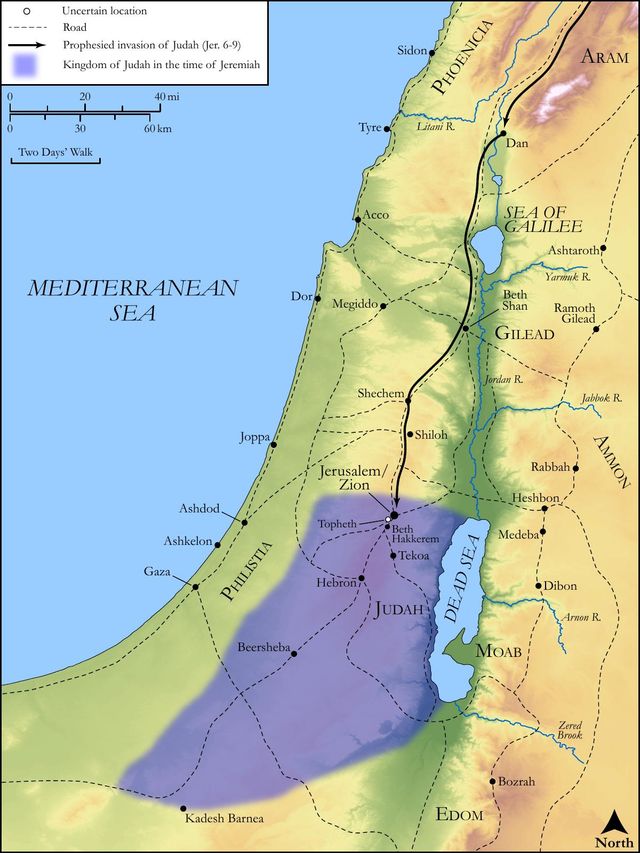
This prophecy is situated in the late 7th or early 6th century BC, a period of significant geopolitical upheaval. The Neo-Babylonian Empire, under Nebuchadnezzar, was rapidly rising to prominence, having already defeated Assyria and Egypt. For Judah, the "north" was the traditional invasion route for powerful empires (Assyria, Babylon), as the desert to the east and south made direct approaches difficult. The command to the "children of Benjamin" is significant because Jerusalem, the capital, lay within Benjamin's tribal territory, making them the immediate inhabitants of the threatened region. Tekoa and Bethhaccerem were elevated towns south of Jerusalem, strategically chosen for their visibility. Tekoa, about 10 miles south of Jerusalem, was the hometown of the prophet Amos (Amos from Tekoa). Bethhaccerem, often identified with Ramat Rachel, was a high point just south of Jerusalem. Blowing a shofar (trumpet) and setting up a fire signal were ancient, well-understood methods of rapid communication and alarm in a pre-technological society, used to alert scattered populations to an approaching enemy, similar to the watchman's role described in The Watchman's Warning. This highlights the cultural reliance on visual and auditory signals for communal defense and survival.
Key Themes
ShowHideJeremiah 6:1 powerfully articulates several key themes central to the book of Jeremiah and biblical prophecy. Firstly, it emphasizes Imminent Judgment, portraying the "evil" and "great destruction" as an appearing, present reality rather than a distant threat. Secondly, it underscores Divine Warning and Mercy, demonstrating God's faithfulness in providing a clear, urgent warning and an opportunity for His people to flee the coming calamity, even in the face of their persistent disobedience. This reflects God's character as one who desires to warn before judgment falls, offering a chance for repentance and escape, as seen in the warnings given to Noah before the flood (God's Warning to Noah) or to Lot before Sodom's destruction (Lot's Escape from Sodom). Lastly, the verse implicitly points to the Consequences of Disobedience, as the "evil" and "destruction" are the direct result of Judah's sustained rebellion against God's covenant and their embrace of idolatry, a theme pervasive throughout Jeremiah's prophecies (e.g., Judah's Sins Cause Calamity).
Exposition and Analysis
ShowHideKey Word Analysis
ShowHideFrom bên (son) and yâmîn (right hand), meaning "son of (the) right hand." This refers to the youngest son of Jacob and the tribe descended from him. In this context, it specifically addresses the inhabitants of the tribal territory that included Jerusalem and its immediate surroundings, making them the primary recipients of this urgent warning. The command is localized and direct, targeting those most immediately in the path of the northern invasion.
A primitive root meaning "to be strong," but causatively, "to strengthen, i.e., to save (by flight)." The imperative "gather yourselves to flee" conveys not just a suggestion but a desperate, urgent command for self-preservation. It implies a need for immediate, decisive action to escape impending doom, highlighting the severity of the threat.
From shâbar (to break), meaning "a fracture," "ruin," or "breaking." This word vividly describes the comprehensive and devastating nature of the coming judgment. It implies a shattering, a complete ruin, emphasizing the severity and totality of the impending calamity that will be brought by the northern enemy.
Verse Breakdown
ShowHide"O ye children of Benjamin, gather yourselves to flee out of the midst of Jerusalem"
This is a direct, urgent address and command. The "children of Benjamin" are the specific audience, as Jerusalem and its environs fell within their tribal inheritance. The command to "gather yourselves to flee" emphasizes the need for collective, immediate evacuation from the capital, signaling that Jerusalem itself is no longer a safe haven but a target of the impending "evil."
"and blow the trumpet in Tekoa, and set up a sign of fire in Bethhaccerem"
These are specific, practical instructions for warning and alarm. Tekoa and Bethhaccerem, being elevated positions south of Jerusalem, were ideal for broadcasting signals across the Judean landscape. The "trumpet" (shofar) served as an auditory alarm, heard across valleys, while the "sign of fire" (beacon) served as a visual alarm, seen from afar. This dual warning system underscores the extreme urgency and the need for widespread alert.
"for evil appeareth out of the north, and great destruction."
This clause provides the rationale for the urgent commands. The "evil" is not abstract but a concrete, visible threat that "appeareth" or "looks out" from the north. This refers to the Babylonian army, which would invade from the north. The phrase "great destruction" further clarifies the nature of this "evil," emphasizing its overwhelming and devastating impact, leaving no doubt about the severity of the impending judgment.
Literary Devices
ShowHideJeremiah 6:1 is rich in Imperative Mood, with direct commands like "gather yourselves to flee," "blow," and "set up." This grammatical choice immediately conveys the urgency and non-negotiable nature of God's warning. The verse also employs powerful Imagery, painting a vivid picture of a society in peril: the sound of the trumpet piercing the air, the rising smoke of a fire signal against the sky, and the ominous "evil" appearing from the north. These sensory details heighten the dramatic tension. The geographical specificity of Tekoa and Bethhaccerem serves as a form of Symbolism, representing strategic watchpoints and traditional warning posts, grounding the abstract threat in concrete, recognizable locations for the original audience. Furthermore, the phrase "evil appeareth out of the north" functions as Anticipation or Foreshadowing, clearly indicating the source and nature of the impending calamity, which the audience would have understood as the Babylonian threat, even if not explicitly named. The "great destruction" is a form of Hyperbole or Emphasis, stressing the complete and devastating nature of the judgment.
Theological and Thematic Connections
ShowHideThis verse powerfully illustrates God's character as both righteous judge and merciful Father. While Judah's persistent sin necessitates divine judgment, God, in His compassion, provides clear and urgent warnings, offering an opportunity for escape. This act of warning underscores the principle that God takes no pleasure in the death of the wicked but desires their repentance and life. The call to flee is not an invitation to defy God's judgment but an act of grace to those who would heed His voice. It highlights the biblical pattern of God providing a way out before calamity, emphasizing the importance of spiritual discernment and immediate response to divine revelation. The "evil from the north" serves as a tangible manifestation of God's righteous wrath against sin, a theme echoed throughout prophetic literature where foreign nations are often instruments of divine judgment against disobedient Israel.
Reflection and Application
ShowHideJeremiah 6:1 serves as a timeless reminder of the urgency of heeding God's warnings, both individually and corporately. Just as the ancient Israelites faced a tangible threat requiring immediate action, believers today are called to spiritual alertness in a world often hostile to God's truth. This verse compels us to consider whether we are listening for God's "trumpet" and "fire signal" in our own lives, discerning the "evil" that may be approaching—whether it be the subtle erosion of spiritual vitality, the deceptive allure of worldly values, or the consequences of unconfessed sin. The command to "flee" is a call to decisive repentance, to turn away from anything that separates us from God and to seek refuge in His unfailing grace. It underscores that God's warnings are not meant to condemn but to save, providing an opportunity for reconciliation and escape from spiritual or temporal disaster.
Questions for Reflection
ShowHideFAQ
ShowHideWhy is the warning specifically directed to the "children of Benjamin" and to flee "out of the midst of Jerusalem"?
ShowHideThe warning is directed to the "children of Benjamin" because Jerusalem, the capital city and primary target of the impending invasion, lay within the tribal territory of Benjamin. Therefore, the inhabitants of this region were in the most immediate danger. The command to flee "out of the midst of Jerusalem" signifies that the city itself, typically a place of refuge and strength, would become a place of extreme peril. It highlights the severity of the coming judgment, implying that even the fortified capital would not offer safety, necessitating evacuation to the surrounding countryside or further south. This specific instruction underscores the comprehensiveness of the impending "great destruction."
What is the significance of blowing the trumpet in Tekoa and setting up a sign of fire in Bethhaccerem?
ShowHideTekoa and Bethhaccerem were elevated geographical points south of Jerusalem, making them ideal locations for signaling across a wide area. Blowing the trumpet (a shofar) was a traditional method for sounding an alarm, assembling people for battle, or signaling impending danger, as seen in Trumpets for Alarm. Setting up a "sign of fire" (a beacon or smoke signal) was another ancient, effective way to communicate urgent messages visually over long distances, often used to warn of approaching enemies. These specific instructions illustrate the prophet's concrete and desperate call for immediate, widespread alert and evacuation. They were well-understood cultural practices for warning the populace in times of war, emphasizing the dire nature of the "evil" appearing from the north.
Christ-Centered Fulfillment
ShowHideJeremiah 6:1, with its urgent call to flee impending judgment, finds its ultimate fulfillment and transformation in the person and work of Jesus Christ. While Jeremiah warned of a physical destruction by an earthly army, the New Testament reveals a far greater "evil" and "destruction"—the spiritual judgment against sin and the eternal consequences of rejecting God. Jesus, the true prophet, issues an even more profound call to "flee" not from a physical city, but from the wrath to come, as John the Baptist warned in Matthew 3:7. He is the ultimate "sign" and "trumpet call" to humanity, announcing the kingdom of God and offering refuge from spiritual death. Just as the people of Benjamin were called to escape the northern invasion, all humanity is called to escape the dominion of sin and death by turning to Christ, who is the only way, the truth, and the life (John 14:6). His sacrifice on the cross became the ultimate "sign of fire" and "trumpet blast," signaling victory over sin and providing the path to eternal salvation for all who believe, fulfilling the deepest longing for escape from spiritual destruction (Romans 5:9). In Christ, the "great destruction" of sin's power is overcome, and a new life of peace and reconciliation with God is offered to all who heed His gracious invitation to flee to Him (2 Corinthians 5:17).