


2 Samuel 11:5
- וַתַּהַרva·Ta·harand she conceivedH2029Conj-w ¦ V-Qal-ConsecImperf-3fsVerb Qal Consecutive Imperfect 3rd Singular Feminineוַandתַּהַרshe conceived
- הָאִשָּׁהha·'i·Shahthe womanH802Art ¦ N-fsNoun Singular Feminine Absoluteהָtheאִשָּׁהwoman
- וַתִּשְׁלַחva·tish·Lachand she sentH7971Conj-w ¦ V-Qal-ConsecImperf-3fsVerb Qal Consecutive Imperfect 3rd Singular Feminineוַandתִּשְׁלַחshe sent
- וַתַּגֵּדva·ta·Gedand she toldH5046Conj-w ¦ V-Hiphil-ConsecImperf-3fsVerb Hiphil Consecutive Imperfect 3rd Singular Feminineוַandתַּגֵּדshe told
- לְדָוִדle·da·Vidto DavidH1732Prep-l ¦ N-proper-mNoun Proper MasculineלְtoדָוִדDavid
- וַתֹּאמֶרva·To·merand she saidH559Conj-w ¦ V-Qal-ConsecImperf-3fsVerb Qal Consecutive Imperfect 3rd Singular Feminineוַandתֹּאמֶרshe said
- הָרָהha·Rah[am] pregnantH2030Adj-fsAdjective Singular Feminine Absolute
- אָנֹכִי'a·No·khiIH595Pro-1csPronoun Personal 1st Singular common gender
English is a literal word-by-word gloss of the Hebrew, not the KJV's wording. Why?
This is the original text the KJV's translators worked from — each Hebrew word with its own literal English meaning in this verse, prepared by scholars at Tyndale House, Cambridge. The KJV translates whole sentences, not word by word, so its wording differs: one Hebrew word can become several English words, and the KJV may choose “the LORD” where the gloss reads “Yahweh”. Both are faithful — they answer different questions. For the KJV's own rendering, switch to the KJV text.
Details
See on the biblical-era map

Study this verse
Public-domain commentary
Matthew Henry
From his Commentary on the Whole Bible. Henry comments on passages, not single verses — this entry covers 2 Samuel 11:1–5. His three-level outline is real structure in the source text, so it is rendered as structure.
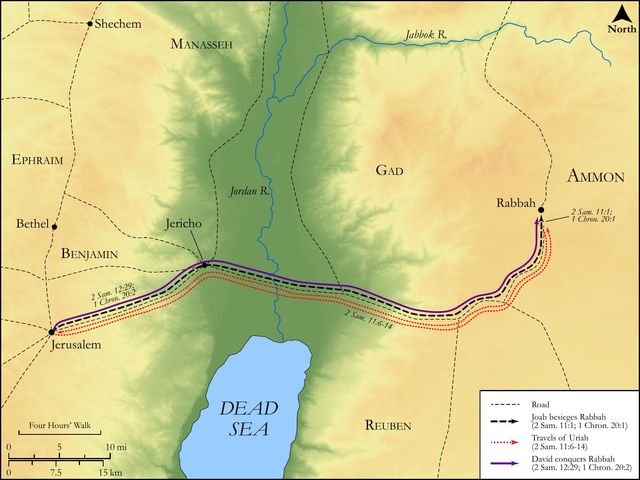
Here is, I. David's glory, in pursuing the war against the Ammonites, Sa2 11:1. We cannot take that pleasure in viewing this great action which hitherto we have taken in observing David's achievements, because the beauty of it was stained and sullied by sin; otherwise we might take notice of David's wisdom and bravery in following his blow. Having routed the army of the Ammonites in the field, as soon as ever the season of the year permitted he sent more forces to waste the country and further to avenge the quarrel of his ambassadors. Rabbah, their metropolis, made a stand, and held out a great while. To this city Joab laid close siege, and it was at the time of this siege that David fell into this sin.
II.David's shame, in being himself conquered, and led captive by his own lust.
The sin he was guilty of was adultery, against the letter of the seventh commandment, and (in the judgment of the patriarchal age) a heinous crime, and an iniquity to be punished by the judges (Job 31:11), a sin which takes away the heart, and gets a man a wound and dishonour, more than any other, and the reproach of which is not wiped away.
1.Observe the occasions which led to this sin.
(1.)Neglect of his business. When he should have been abroad with his army in the field, fighting the battles of the Lord, he devolved the care upon others, and he himself tarried still at Jerusalem, Sa2 11:1. To the war with the Syrians David went in person, Sa2 10:17. Had he been now at his post at the head of his forces, he would have been out of the way of this temptation. When we are out of the way of our duty we are in the way of temptation.
(2.)Love of ease, and the indulgence of a slothful temper: He came off his bed at evening-tide, Sa2 11:2. There he had dozed away the afternoon in idleness, which he should have spent in some exercise for his own improvement or the good of others. He used to pray, not only morning and evening, but at noon, in the day of his trouble: it is to be feared he had, this noon, omitted to do so. Idleness gives great advantage to the tempter. Standing waters gather filth. The bed of sloth often proves the bed of lust.
(3.)A wandering eye: He saw a woman washing herself, probably from some ceremonial pollution, according to the law. The sin came in at the eye, as Eve's did. Perhaps he sought to see her, at least he did not practise according to his own prayer, Turn away my eyes from beholding vanity, and his son's caution in a like case, Look not thou on the wine it is red. Either he had not, like Job, made a covenant with his eyes, or, at this time, he had forgotten it.
2.The steps of the sin. When he saw her, lust immediately conceived, and,
(1.)He enquired who she was (Sa2 11:3), perhaps intending only, if she were unmarried, to take her to wife, as he had taken several; but, if she were a wife, having no design upon her.
(2.)The corrupt desire growing more violent, though he was told she was a wife, and whose wife she was, yet he sent messengers for her, and then, it may be, intended only to please himself with her company and conversation. But,
(3.)When she came he lay with her, she too easily consenting, because he was a great man, and famed for his goodness too. Surely (thinks she) that can be no sin which such a man as David is the mover of. See how the way of sin is down-hill; when men begin to do evil they cannot soon stop themselves. The beginning of lust, as of strife, is like the letting forth of water; it is therefore wisdom to leave it off before it be meddled with. The foolish fly fires her wings, and fools away her life at last, by playing about the candle.
3.The aggravations of the sin.
(1.)He was now in years, fifty at least, some think more, when those lusts which are more properly youthful, one would think, should not have been violent in him,
(2.)He had many wives and concubines of his own; this is insisted on, Sa2 12:8.
(3.)Uriah, whom he wronged, was one of his own worthies, a person of honour and virtue, one that was now abroad in his service, hazarding his life in the high places of the field for the honour and safety of him and his kingdom, where he himself should have been.
(4.)Bath-sheba, whom he debauched, was a lady of good reputation, and, till she was drawn by him and his influence into this wickedness, had no doubt preserved her purity. Little did she think that ever she could have done so bad a thing as to forsake the guide of her youth, and forget the covenant of her God; nor perhaps could any one in the world but David have prevailed against her. The adulterer not only wrongs and ruins his own soul, but, as much as he can, another's soul too.
(5.)David was a king, whom God had entrusted with the sword of justice and the execution of the law upon other criminals, particularly upon adulterers, who were, by the law, to be put to death; for him therefore to be guilty of those crimes himself was to make himself a pattern, when he should have been a terror, to evil doers. With what face could he rebuke or punish that in others which he was conscious to himself of being guilty of? See Rom 2:22. Much more might be said to aggravate the sin; and I can think but of one excuse for it, which is that it was done but once; it was far from being his practice; it was by the surprise of a temptation that he was drawn into it. He was not one of those of whom the prophet complains that they were as fed horses, neighing every one after his neighbour's wife (Jer 5:8); but this once God left him to himself, as he did Hezekiah, that he might know what was in his heart, Ch2 32:31. Had he been told of it before, he would have said, as Hazael, What! is thy servant a dog? But by this instance we are taught what need we have to pray every day, Father, in heaven, lead us not into temptation, and to watch, that we enter not into it.
Historical interpretation
Historical reception
1 surviving comment on this verse from the historical church.
We have taken up the task of writing an apology for the present style of the prophet David, not because he needs this gift, who has excelled in such great merits and flourished in virtues, but because many people, reading the sequence of his deeds without considering the power of the Scriptures or the hidden mysteries, wonder how such a great prophet did not avoid the contagion of adultery first and then of murder.
Therefore, it was our desire to review the history itself, which seems to have been exposed to sin. For in the second book of Kings (2 Samuel 11:2-27), we read that while David was walking in his royal palace, he saw a woman bathing (her name was Bathsheba), of remarkable beauty and grace, with a very attractive face, and he was overcome by the desire to possess her. However, the woman was married to a man named Uriah, and the scene of his death was arranged by royal command. For although it had no effect on his desire, yet it was considered to greatly impede his sense of shame for adultery.
Therefore, let us begin with the most obvious, whom God justified, so that you may not judge. 'For it is of little concern to me,' says Paul, 'that I should be judged by you or by any human court; indeed, I do not even judge myself' (1 Corinthians 4:3). Even though he was still in the body and subject to temptation, he did not judge himself because a spiritual person is not judged by anyone but God alone. Finally, he added, 'The one who judges me is the Lord' (1 Corinthians 4:4). Therefore, do not judge anything before the appointed time (ibid., 4 and 5). But David has already fulfilled his time and has earned grace, and he is justified by Christ; since David himself rejoiced in being called the son of the Lord, and those who confessed him in this way were enlightened. Why do you call a man of God from a reward to judgment? The Lord has already judged him, of whom he said to Solomon: If you walk before me as your father David walked in the holiness of heart and righteousness, in order to do everything I commanded him (3 Kings 9:4). Is he worthy of judgment or reward, who has done everything according to heavenly commands, walking in holiness and righteousness of heart? Where the vices and sins of others are hidden, there David receives divine testimony of his virtue and glory. And we discuss his sin in vain, for it is through his merit and grace that the sins of others have been revealed. For when Solomon sinned by not keeping the Lord's commands and God intended to divide his kingdom into many parts, He said to him: However, I will not do this in your days because of your father David. I will take it from the hand of your son. However, I will not take the whole kingdom; I will give him one scepter because of my servant David (3 Kings 11:12-13). Therefore, since the Lord justifies, who is there to condemn? What God has cleansed, you must not call common (Acts 10:15).
Nevertheless, with due regard to heavenly judgment, in which you honor the prophet even more, enter into his actions and behaviors. Do not marvel at the man, and do not judge him to be equal to the angels, because he has spent most of his life, even from childhood, dwelling in riches, honors, and positions of power, and has been subjected to many temptations. He has only once given in to error, and it is through this error that even the angels of heaven, as Scripture recounts (Genesis 6:2), were cast down from their virtue and grace. Indeed, another error of his is mentioned, that he caused the people to be counted.
Continue studying 2 Samuel 11:5 across the web’s major study libraries — every link below opens this exact verse, chapter, or book on the destination site.
Read & Compare
 BibleGatewayThis verse in more than 200 translations and 70 languages.
 Bible.comThe YouVersion reader — hundreds of translations, reading plans, and highlights.
 ESV.orgCrossway's official English Standard Version reader.
 NET BibleThe NET translation with 60,000+ translators' notes on every rendering decision.
 STEP BibleTyndale House's free study tool — original text, vocabulary, and scholarly resources.
 BibliaLogos Bible Software's free web reader.
 USCCBThe New American Bible (Revised Edition) with the U.S. bishops' study notes.
Commentaries
 BibleHub CommentariesDozens of classic commentaries on this verse, gathered on one page.
 StudyLightMore than 100 commentary sets — the largest collection on the web.
 BibleRefPlain-English commentary on what this verse means, verse by verse.
 Enduring WordDavid Guzik's free commentary on this chapter, widely used by Bible teachers.
 Bible Study ToolsVerse commentary alongside Greek and Hebrew study aids.
Original Language & Research
- BibleHub InterlinearThe verse word by word — original language, transliteration, and English.
- BibleHub LexiconEvery word's original-language definition and Strong's entry.
 Blue Letter BibleDeep-study tools — Strong's numbers, concordance, and word studies.
 SefariaThe Hebrew text with Rashi and centuries of Jewish commentary.
Sermons, Hymns & Audio


TrulyRandomVerse is not affiliated with these sites and doesn’t control their content. They’re linked because they’re genuinely useful.
Summary
Second Samuel 11:5 records the stark and pivotal moment when Bathsheba, having conceived a child from her illicit encounter with King David, sends word to him, declaring, "I [am] with child." This concise yet devastating message serves as the undeniable, physical manifestation of David's sin, transforming a private transgression into an unavoidable public crisis and setting in motion a tragic chain of events that would profoundly impact David's family, his kingdom, and his relationship with God, illustrating the inescapable consequences of moral compromise.
Context
ShowHideLiterary Context
This verse immediately follows David's egregious actions detailed in 2 Samuel 11:1-4. While his army, led by Joab, was engaged in the siege of Rabbah, David remained in Jerusalem, neglecting his kingly duty to lead in battle. From his rooftop, he saw Bathsheba, the wife of Uriah the Hittite, one of his most loyal and esteemed soldiers, bathing. Succumbing to lust, David sent for her and committed adultery. The news of Bathsheba's pregnancy in 2 Samuel 11:5 is the direct and undeniable outcome of this illicit encounter, demanding David's immediate attention and forcing his hand to attempt a desperate cover-up. This verse marks the point of no return, escalating David's initial sin into a compounding series of deceptions and ultimately, murder, as narrated in the subsequent verses of 2 Samuel 11.
Historical & Cultural Context
In ancient Israel, kings held immense power, yet they were still subject to God's covenant law, unlike many surrounding pagan monarchs. Adultery was a capital offense under the Mosaic Law, punishable by death for both parties (Leviticus 20:10 and Deuteronomy 22:22). For a king to commit such an act, especially with the wife of a loyal soldier who was actively serving in his army, was a profound abuse of power, a betrayal of trust, and a direct affront to divine and human justice. The public nature of pregnancy in a society without modern medical privacy meant that Bathsheba's condition would soon become undeniably visible, exposing the illicit affair and bringing shame upon her, Uriah, and potentially David himself. Furthermore, the concept of a child's legitimacy was crucial for inheritance, social standing, and tribal identity. David's actions threatened not only Bathsheba's life but also Uriah's honor and the child's future, placing immense pressure on David to conceal his transgression and manage the ensuing scandal.
Key Themes
ShowHideThe message of Bathsheba's pregnancy in 2 Samuel 11:5 powerfully underscores several major themes within the book of Samuel and the broader biblical narrative. It starkly illustrates the inescapable consequences of sin, demonstrating that even hidden transgressions inevitably bear tangible and often painful fruit. This verse initiates a chain of repercussions for David, which the prophet Nathan later articulates in 2 Samuel 12:10-14. It also highlights the uncoverable nature of sin, showing how David's desperate attempts to hide his adultery only lead him to deeper moral depravity and further desperate measures, ultimately failing to conceal his wrongdoing from God's sight or the eventual public revelation. Finally, this narrative serves as a sobering reminder of human frailty and moral failure, even for a figure like King David, who is elsewhere described as "a man after God's own heart" in Acts 13:22. It underscores that no one, regardless of their piety or position, is immune to temptation's allure or sin's destructive power.
Exposition and Analysis
ShowHideKey Word Analysis
ShowHideA primitive root meaning "to be (or become) pregnant, conceive (literally or figuratively)." This verb is a straightforward and unambiguous declaration of Bathsheba's condition. Its simplicity belies the immense moral and political crisis it immediately precipitates for David. The word carries no hidden nuance here; it is a direct statement of biological fact that shatters any illusion of the affair remaining a secret, demanding an immediate and drastic response from the king.
A primitive root meaning "to send away, for, or out (in a great variety of applications)." This verb indicates a deliberate and purposeful action. Bathsheba's act of sending a messenger to David is not a casual communication but a formal and urgent notification. It signifies her understanding of the gravity of the situation and her expectation that David, as the king and father of the child, must address it. The act of "sending" underscores the shift from a private, illicit act to a public problem that demands royal intervention and resolution.
A primitive root meaning "properly, to front, i.e. stand boldly out opposite; by implication (causatively), to manifest; figuratively, to announce (always by word of mouth to one present)." This verb emphasizes the direct and unequivocal nature of the message delivered to David. Bathsheba's communication was not a hint or a suggestion, but a clear, forthright declaration of her pregnancy. The word implies a direct confrontation with the truth, leaving no room for misinterpretation or denial on David's part.
Verse Breakdown
ShowHide"And the woman conceived"
This opening clause directly states the biological outcome of the illicit encounter between David and Bathsheba. It is the undeniable physical evidence that the secret sin can no longer remain hidden. The conception transforms the private act of adultery into a public dilemma, as pregnancy in ancient societies was quickly discernible and carried significant social implications regarding paternity, legitimacy, and the potential for scandal and punishment under the law.
"and sent and told David"
This describes Bathsheba's immediate and decisive action upon realizing her pregnancy. Her sending a message to David indicates her recognition that he is the father and, as the king, is responsible for the situation and its resolution. This act places the burden squarely on David, forcing him to confront the consequences of his actions rather than allowing the matter to remain unaddressed. It also highlights the power dynamic, as she, a woman in a vulnerable position, relies on the king to resolve the crisis he created.
"and said, I [am] with child"
This is the direct, concise, and devastating message delivered to David. The Hebrew phrase (הָרָה אָנֹכִי, hâreh anokhi) is a simple, emphatic declaration: "I am pregnant." There is no equivocation, no elaborate explanation, and no emotional plea; the starkness of the message underscores its undeniable truth and the immediate, profound crisis it creates for David, who must now devise a plan to cover up his sin and avoid public scandal and the severe legal repercussions of adultery.
Literary Devices
ShowHideThe verse employs several potent literary devices that amplify its dramatic impact and thematic significance. Understatement is profoundly evident in the stark simplicity of Bathsheba's message, "I [am] with child." This concise declaration, devoid of emotional elaboration or explicit detail, belies the immense weight of its implications—the shame, the danger, the impending scandal, and the profound moral and political crisis it creates for the king. This simplicity enhances the dramatic impact, allowing the reader to grasp the gravity through the implied, catastrophic consequences rather than explicit description. Furthermore, there is a strong element of cause and effect, as this verse directly presents the unavoidable, natural consequence of David's previous actions (his adultery), setting in motion the tragic narrative that unfolds throughout the remainder of 2 Samuel 11 and beyond. The verse also serves as a point of dramatic irony, as the reader is fully aware of David's sin and its immediate outcome, while the wider kingdom remains ignorant, intensifying the tension as David attempts to conceal what is now physically undeniable.
Theological and Thematic Connections
ShowHideThe message of Bathsheba's pregnancy in 2 Samuel 11:5 serves as a powerful theological statement about the nature of sin and its inevitable consequences. It demonstrates unequivocally that sin, no matter how secretly committed or how powerful the perpetrator, cannot ultimately be hidden from God or from the natural outworking of its effects in the world. This verse initiates a narrative arc that profoundly illustrates the biblical principle that "your sin will find you out," as stated in Numbers 32:23, forcing David into increasingly desperate and destructive measures to conceal his transgression. It underscores divine justice, which, though sometimes delayed, always comes to bear, revealing the truth and demanding accountability, often through the very consequences that sin itself produces. The narrative serves as a stark reminder that actions have repercussions, and attempts to suppress truth only lead to deeper entanglement in deceit and further moral degradation.
Reflection and Application
ShowHideThe revelation of Bathsheba's pregnancy in 2 Samuel 11:5 offers a profound and sobering lesson for believers today, serving as a stark reminder that sin, even when committed in secret, carries inherent consequences that often manifest in undeniable ways, disrupting our lives and the lives of those around us. David's subsequent desperate attempts to cover up his sin only compounded his guilt, leading him from adultery to deception, and ultimately to murder. This narrative urges us to confront our own temptations and failures with honesty and humility, recognizing that true freedom and healing come not from concealment but from confession and repentance. Rather than trying to hide our transgressions, which only deepens their hold and complicates our lives, we are called to bring them into the light, trusting in God's mercy and forgiveness, which are abundantly available to those who genuinely seek them. This story encourages a posture of vigilance against temptation and a commitment to integrity, knowing that God sees all and His grace is sufficient for our brokenness, offering a path to restoration that concealment can never provide.
Questions for Reflection
ShowHideFAQ
ShowHideWhy did Bathsheba send a message to David instead of Uriah, her husband?
ShowHideBathsheba sent the message to David, not Uriah, because David was the father of the child. Sending the message to Uriah would have immediately exposed her adultery and placed both her and David in mortal danger under the Mosaic Law, which prescribed death for adultery (Leviticus 20:10). By informing David, she was placing the responsibility squarely on him, as the king and the child's father, to resolve the crisis. This act highlights her vulnerable position as a woman in a patriarchal society and David's culpability, forcing him to confront the direct consequence of his abuse of power and illicit affair, rather than allowing the devastating truth to be discovered by Uriah or the public.
Christ-Centered Fulfillment
ShowHideWhile 2 Samuel 11:5 describes a moment of profound human failure and the immediate consequence of sin, it also implicitly points to the ultimate need for a deliverer from sin's pervasive power and devastating consequences, a role perfectly fulfilled by Jesus Christ. David, despite being "a man after God's own heart" as described in Acts 13:22, demonstrates the universal human propensity to sin and the inability of even the greatest earthly kings to escape its corrupting influence. The pregnancy of Bathsheba is a stark reminder that sin is not merely an internal thought but has tangible, often devastating, external effects that ripple through lives and communities. In contrast, Jesus, the true King and Son of David, was conceived by the Holy Spirit without sin (Luke 1:35) and lived a perfectly righteous life, never succumbing to temptation (Hebrews 4:15). He did not seek to cover up sin but came to expose it and then to atone for it, taking the full weight of humanity's transgressions upon Himself on the cross (2 Corinthians 5:21). The tragic consequences that unfold from David's sin in 2 Samuel 11 underscore the desperate need for a divine solution to the problem of sin—a solution found only in the redemptive work of the Lamb of God, who takes away the sin of the world!. Through Christ, the cycle of sin and its inevitable consequences is broken, offering forgiveness, reconciliation, and new life to all who believe (Romans 6:23).