


2 Kings 7:11
- וַיִּקְרָאvai·yik·Ra'and he called outH7121Conj-w ¦ V-Qal-ConsecImperf-3msVerb Qal Consecutive Imperfect 3rd Singular Masculineוַandיִּקְרָאhe called out
- הַשֹּׁעֲרִיםha·sho·'a·Rimthe gatekeepersH7778Art ¦ N-mpNoun Plural Masculine Absoluteהַtheשֹּׁעֲרִיםgatekeepers
- וַיַּגִּידוּvai·ya·Gi·duand they toldH5046Conj-w ¦ V-Hiphil-ConsecImperf-3mpVerb Hiphil Consecutive Imperfect 3rd Plural Masculineוַandיַּגִּידוּthey told
- בֵּיתbeit[the] household ofH1004N-mscNoun Singular Masculine Construct
- הַמֶּלֶךְha·Me·lekhthe kingH4428Art ¦ N-msNoun Singular Masculine Absoluteהַtheמֶּלֶךְking
- פְּנִימָהpe·Ni·mahwithinH6441AdvAdverb
English is a literal word-by-word gloss of the Hebrew, not the KJV's wording. Why?
This is the original text the KJV's translators worked from — each Hebrew word with its own literal English meaning in this verse, prepared by scholars at Tyndale House, Cambridge. The KJV translates whole sentences, not word by word, so its wording differs: one Hebrew word can become several English words, and the KJV may choose “the LORD” where the gloss reads “Yahweh”. Both are faithful — they answer different questions. For the KJV's own rendering, switch to the KJV text.
Details
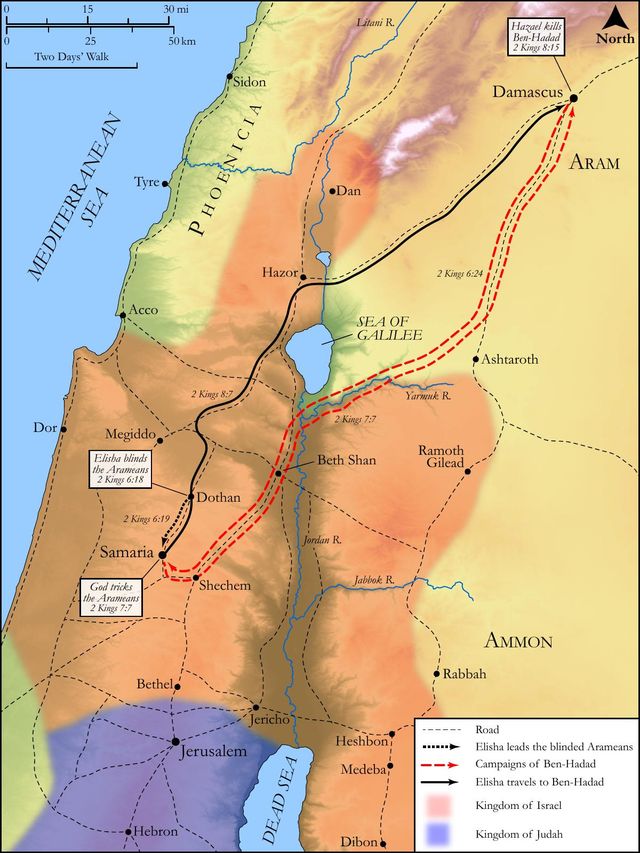
See on the biblical-era map
Study this verse
Public-domain commentary
Matthew Henry
From his Commentary on the Whole Bible. Henry comments on passages, not single verses — this entry covers 2 Kings 7:3–11. His two-level outline is real structure in the source text, so it is rendered as structure.
We are here told,
I.How the siege of Samaria was raised in the evening, at the edge of night (Kg2 7:6, Kg2 7:7), not by might or power, but by the Spirit of the Lord of hosts, striking terror upon the spirits of the besiegers. Here was not a sword drawn against them, not a drop of blood shed, it was not by thunder or hailstones that they were discomfited, nor were they slain, as Sennacherib's army before Jerusalem, by a destroying angel; but,
1.The Lord made them to hear a noise of chariots and horses. The Syrians that besieged Dothan had their sight imposed upon, Kg2 6:18. These had their hearing imposed upon. For God knows how to work upon every sense, pursuant to his own counsels as he makes the hearing ear and the seeing eye, so he makes the deaf and the blind, Exo 4:11. Whether the noise was really made in the air by the ministry of angels, or whether it was only a sound in their ears, is not certain; which soever it was, it was from God, who both brings the wind out of his treasures, and forms the spirit of man within him. The sight of horses and chariots had encouraged the prophet's servant, Kg2 6:17. The noise of horses and chariots terrified the hosts of Syria. For notices from the invisible world are either very comfortable or very dreadful, according as men are at peace with God or at war with him.
2.Hearing this noise, they concluded the king of Israel had certainly procured assistance from some foreign power: He has hired against us the kings of the Hittites and the kings of the Egyptians. There was, for aught we know but one king of Egypt, and what kings there were of the Hittites nobody can imagine; but, as they were imposed upon by that dreadful sound in their ears, so they imposed upon themselves by the interpretation they made of it. Had they supposed the king of Judah to have come with his forces, there would have been more of probability in their apprehensions than to dream of the kings of the Hittites and the Egyptians. If the fancies of any of them raised this spectre, yet their reasons might soon have laid it: how could the king of Israel, who was closely besieged, hold intelligence with those distant princes? What had he to hire them with? It was impossible but some notice would come, before, of the motions of so great a host; but there were they in great fear where no fear was.
3.Hereupon they all fled with incredible precipitation, as for their lives, left their camp as it was: even their horses, that might have hastened their flight, they could not stay to take with them, Kg2 7:7. None of them had so much sense as to send out scouts to discover the supposed enemy, much less courage enough to face the enemy, though fatigued with a long march. The wicked flee when none pursues. God can, when he pleases, dispirit the boldest and most brave, and make the stoutest heart to tremble. Those that will not fear God he can make to fear at the shaking of a leaf.
II.How the Syrians' flight was discovered by four leprous men.
Samaria was delivered, and did not know it. The watchmen on the walls were not aware of the retreat of the enemy, so silently did they steal away. But Providence employed four lepers to be the intelligencers, who had their lodging without the gate, being excluded from the city, as ceremonially unclean: the Jews say they were Gehazi and his three sons; perhaps Gehazi might be one of them, which might cause him to be taken notice of afterwards by the king, Kg2 8:4. See here,
1.How these lepers reasoned themselves into a resolution to make a visit in the night to the camp of the Syrians, Kg2 7:3, Kg2 7:4. They were ready to perish for hunger; none passed through the gate to relieve them. Should they go into the city, there was nothing to be had there, they mist die in the streets; should they sit still, they must pine to death in their cottage. They therefore determine to go over to the enemy, and throw themselves upon their mercy: if they killed them, better die by the sword than by famine, one death than a thousand; but perhaps they would save them alive, as objects of compassion. Common prudence will put us upon that method which may better our condition, but cannot make it worse. The prodigal son resolves to return to his father, whose displeasure he had reason to fear, rather than perish with hunger in the far country. These lepers conclude, "If they kill us, we shall but die;" and happy they who, in another sense, can thus speak of dying. "We shall but die, that is the worst of it, not die and be damned, not be hurt of the second death." According to this resolution, they went, in the beginning of the night, to the camp of the Syrians, and, to their great surprise, found it wholly deserted, not a man to be seen or heard in it, Kg2 7:5. Providence ordered it, that these lepers came as soon as ever the Syrians had fled, for they fled in the twilight, the evening twilight (Kg2 7:7), and in the twilight the lepers came (Kg2 7:5), and so no time was lost.
2.How they reasoned themselves into a resolution to bring tidings of this to the city. They feasted in the first tent they came to (Kg2 7:8) and then began to think of enriching themselves with the plunder; but they corrected themselves (Kg2 7:9): "We do not well to conceal these good tidings from the community we are members of, under colour of being avenged upon them for excluding us from their society; it was the law that did it, not they, and therefore let us bring them the news. Though it awake them from sleep, it will be life from the dead to them." Their own consciences told them that some mischief would befal them if they acted separately, and sought themselves only. Selfish narrow-spirited people cannot expect to prosper; the most comfortable advantage is that which our brethren share with us in. According to this resolution, they returned to the gate, and acquainted the sentinel with what they had discovered (Kg2 7:10), who straightway brought the intelligence to court (Kg2 7:11), and it was not the less acceptable for being first brought by lepers.
Historical interpretation
Historical reception
1 surviving comment on this verse from the historical church.
Even though the four lepers are loathsome, if we symbolically recognize in them the fact that they announced goods for the inhabitants of their city, they do no wrong to the symbol but correctly represent the four holy Evangelists. Indeed, we must bear in mind that through their books the grace of our Savior and source of life Jesus Christ was known, and freedom was given to all people according to his divine plan. And so those whose flesh was leprous shone in their interior look with the splendor of their righteousness. In addition, they symbolically represent the first attitude of the apostles in the fact that leprosy had corrupted their skin. But they also represent them in the fact that their interior was adorned with righteous behavior because the old man has been transformed by the coming of the Holy Spirit and renewed. Therefore they have clothed themselves with the garment shining with the colors of heaven and have been sent to show the work of the hands of God.
Continue studying 2 Kings 7:11 across the web’s major study libraries — every link below opens this exact verse, chapter, or book on the destination site.
Read & Compare
 BibleGatewayThis verse in more than 200 translations and 70 languages.
 Bible.comThe YouVersion reader — hundreds of translations, reading plans, and highlights.
 ESV.orgCrossway's official English Standard Version reader.
 NET BibleThe NET translation with 60,000+ translators' notes on every rendering decision.
 STEP BibleTyndale House's free study tool — original text, vocabulary, and scholarly resources.
 BibliaLogos Bible Software's free web reader.
 USCCBThe New American Bible (Revised Edition) with the U.S. bishops' study notes.
Commentaries
 BibleHub CommentariesDozens of classic commentaries on this verse, gathered on one page.
 StudyLightMore than 100 commentary sets — the largest collection on the web.
 BibleRefPlain-English commentary on what this verse means, verse by verse.
 Enduring WordDavid Guzik's free commentary on this chapter, widely used by Bible teachers.
 Bible Study ToolsVerse commentary alongside Greek and Hebrew study aids.
Original Language & Research
- BibleHub InterlinearThe verse word by word — original language, transliteration, and English.
- BibleHub LexiconEvery word's original-language definition and Strong's entry.
 Blue Letter BibleDeep-study tools — Strong's numbers, concordance, and word studies.
 SefariaThe Hebrew text with Rashi and centuries of Jewish commentary.
Sermons, Hymns & Audio


TrulyRandomVerse is not affiliated with these sites and doesn’t control their content. They’re linked because they’re genuinely useful.
Summary
Second Kings 7:11 serves as a crucial narrative pivot in the miraculous account of Samaria's deliverance from a devastating Aramean siege. This verse meticulously records the critical relay of life-altering information, following the astonishing discovery by four outcast lepers that the enemy camp was supernaturally deserted and laden with provisions. It details the immediate action taken by the lepers in summoning the city's gatekeepers, who, in turn, promptly conveyed the extraordinary news to the king's inner household, setting in motion Samaria's transition from utter despair and famine to unexpected hope and abundance.
Context
ShowHideLiterary Context
This verse is deeply embedded within the climactic narrative of 2 Kings 6:24-33 and 2 Kings 7:1-20, which portrays Samaria's desperate plight under a prolonged Aramean siege. The preceding verses vividly describe the horrific famine within the city, reaching such an extreme that instances of cannibalism were reported, highlighting the populace's utter desperation, as seen in 2 Kings 6:24-29. The prophet Elisha had previously declared that God would bring an end to the famine within twenty-four hours, a prophecy met with skepticism by a royal officer (2 Kings 7:1-2). The immediate context of 2 Kings 7:3-8 describes the four lepers, resigned to their fate, venturing out to the Aramean camp only to find it miraculously deserted. This divine intervention was a result of the Lord causing the Arameans to hear a terrifying sound of chariots and horses, leading them to flee in panic (2 Kings 7:6-7). After initially indulging themselves, the lepers recognized their moral obligation to share this "good tidings" with the starving city (2 Kings 7:9-10). Thus, 2 Kings 7:11 marks the crucial moment when this vital information begins its journey from the city's periphery to its central authority, initiating the city's deliverance.
Historical & Cultural Context
Ancient cities, including Samaria, were typically fortified with massive walls and gates, which served as the primary points of entry and exit. The "porters" (Hebrew: sho'arim) were essential gatekeepers, responsible for security, controlling access, and receiving intelligence. Their position at the city's threshold made them the first point of contact for anyone approaching from outside, making them the natural recipients of urgent news. The "king's house within" refers to the royal palace or the inner chambers of the government, the seat of power where critical decisions were made. In a besieged city, communication was paramount, and the chain of command from the outer defenses to the royal court was well-established. The swift relay of information from the porters to the king's household underscores the urgency and significance of the message, as the king and his advisors would be the ones to verify the news and orchestrate the city's response to this unexpected turn of events. This cultural understanding highlights the structured nature of ancient urban administration and the critical role of its personnel during times of crisis.
Key Themes
ShowHideThe verse significantly contributes to several overarching themes within 2 Kings and the broader Old Testament narrative. Firstly, it underscores the theme of Divine Providence and Deliverance, as the good news being relayed is a direct consequence of God's unseen, miraculous intervention that caused the Aramean army to flee (2 Kings 7:6-7). Secondly, it highlights the Urgency and Importance of Communication, particularly of life-saving information. The swift, unhindered relay of the news from the lepers to the porters and then to the king's house demonstrates the critical role of effective communication in bringing about salvation and relief. Thirdly, the narrative showcases God Using Unexpected Messengers. The fact that outcasts—lepers, who were ritually unclean and overlooked in society—were the initial bearers of such vital news, emphasizes God's sovereign choice to use anyone, regardless of their social standing or perceived unworthiness, to accomplish His divine purposes (1 Corinthians 1:27-29). Finally, the verse marks a turning point from Despair to Hope, as the message carried by the porters transforms the city's outlook from one of utter hopelessness and famine to one of impending abundance and relief, reflecting God's faithfulness to His people even in their darkest hour.
Exposition and Analysis
ShowHideKey Word Analysis
ShowHideThis primitive root signifies "to call out to," "to address by name," or "to summon urgently." In 2 Kings 7:11, it conveys the lepers' immediate and purposeful action of attracting the attention of the gatekeepers. It implies more than a casual greeting; it suggests a deliberate and perhaps loud appeal, reflecting the urgency of the message they carried.
This term refers to a janitor, doorkeeper, or gatekeeper. In ancient fortified cities, porters were strategically positioned at the city gates, serving as the first line of defense and communication. Their role was critical for controlling access, maintaining security, and receiving intelligence from outside. Here, they are the designated recipients of external news, making them the crucial link in the chain of communication to the city's leadership.
A primitive root meaning "to front," "to stand boldly out opposite," or, by implication, "to manifest" or "to announce." In this context, it specifically means to declare, report, or show forth. The porters did not merely whisper the news but announced it, conveying the critical information with clarity and urgency to the king's household. This verb emphasizes the active and authoritative nature of their communication.
Verse Breakdown
ShowHide"And he called the porters;"
This initial clause describes the decisive action taken by the lepers, or one acting on their behalf, as they approached the city gate. The verb "called" (וַיִּקְרָא, vayyiqra') implies a direct and urgent summons. Having realized the immense significance of their discovery—the deserted Aramean camp filled with provisions—the lepers understood their moral obligation to share this life-saving news with the starving city. Their act of calling out to the porters signifies the initiation of the communication chain, moving the vital information from the city's periphery to its official channels.
"and they told [it] to the king's house within."
This second clause details the porters' immediate and faithful response upon receiving the astonishing news from the lepers. Without hesitation or delay, they promptly relayed the message. The phrase "king's house within" emphasizes that the news reached the very heart of the city's leadership—the royal palace or inner court—ensuring that the king himself was informed directly and without delay. The "it" refers to the "good tidings" of the miraculously deserted Aramean camp and the abundance of food, the news that would irrevocably transform the city's fate from famine to abundance.
Literary Devices
ShowHideThe verse, though concise, employs several effective literary devices. Conciseness itself is a powerful device, highlighting the swiftness and efficiency of the communication. The narrative moves directly from the lepers' decision to the king's awareness, emphasizing the urgency of the situation and the immediate impact of the news. There is a clear Chain of Communication established, where the sequential relay of information (lepers to porters to king's house) is crucial to the plot's resolution. This chain underscores the theme of collective action and responsibility in bringing about deliverance. Furthermore, the verse contributes to the overall sense of Anticipation within the broader narrative. The reader knows the good news, and this verse builds suspense as the news travels to those who can act upon it, setting the stage for the city's dramatic deliverance. Finally, there's a subtle Irony in the fact that the most overlooked members of society, the lepers, are the ones who initiate the salvation of the entire city, a testament to God's often unexpected means of working.
Theological and Thematic Connections
ShowHideThis brief verse, detailing the relay of life-saving information, resonates with profound theological truths about God's providence, the nature of good news, and the responsibility of those who receive it. It illustrates how God, in His sovereign plan, orchestrates events and uses various agents—even the most unlikely—to bring about His purposes of deliverance and blessing. The news of abundance following severe famine is a tangible manifestation of God's faithfulness to His people, even when they are at their lowest point. The prompt and faithful communication of this news by the porters underscores the ethical imperative to share vital information, especially that which brings hope and salvation. This narrative serves as a powerful Old Testament parallel to the urgency and joy of proclaiming the ultimate good news of redemption.
Reflection and Application
ShowHideThe swift and faithful relay of the good news in 2 Kings 7:11 holds enduring lessons for believers today. Just as the news of the abandoned Aramean camp brought physical salvation and relief to the starving city of Samaria, the Gospel message brings spiritual salvation and abundant life to a world starving for hope and truth. We are called to be like the lepers, who, having received an extraordinary blessing, recognized their moral obligation not to withhold such life-altering news. Our personal encounter with God's grace and deliverance compels us to share the "good tidings" of Christ's victory over sin and death. Furthermore, the diligence of the porters reminds us of the importance of faithful and accurate communication in all spheres of life, especially when dealing with matters of eternal consequence. God often uses unexpected messengers and ordinary people to accomplish His extraordinary purposes, challenging us to be ready and willing vessels for His truth, regardless of our perceived status or limitations.
Questions for Reflection
ShowHideFAQ
ShowHideWhat was the significance of the "porters" in this narrative?
ShowHideThe porters, or gatekeepers, were crucial figures in ancient cities. Their significance in 2 Kings 7:11 lies in their role as the first official point of contact for external communication and security. They were strategically positioned to receive urgent news from outside the city walls. In this instance, they acted as the vital intermediary between the outcast lepers, who had discovered the miraculous deliverance, and the king's household. Their prompt and faithful relay of the message was essential for the news to reach the highest authority, allowing for verification and the subsequent mobilization of the city for its deliverance. Without their diligent action, the life-saving information might have been delayed or dismissed, prolonging the city's suffering.
Christ-Centered Fulfillment
ShowHideThe narrative of Samaria's deliverance in 2 Kings 7, culminating in the relay of good news in 2 Kings 7:11, finds its ultimate and most profound fulfillment in the person and work of Jesus Christ. The "good tidings" of the deserted Aramean camp, bringing physical salvation from famine and siege, foreshadows the infinitely greater "good news" (Gospel) of spiritual salvation brought by Christ. He is the ultimate messenger, the very Word of God made flesh (John 1:14), who came to proclaim freedom to the captives and good news to the poor (Luke 4:18). Just as the lepers, outcasts of society, became the bearers of life-saving news for Samaria, so too did God choose to send His Son, who "made himself nothing, taking the very nature of a servant" (Philippians 2:7), to deliver humanity from the siege of sin and death. The abundance found in the deserted camp points to the spiritual abundance found in Christ—forgiveness, eternal life, and reconciliation with God (John 10:10). The prompt relay of the news to the king's house anticipates the universal proclamation of the Gospel, the ultimate message for all nations, leading to the establishment of Christ's eternal kingdom (Matthew 28:19-20). Thus, 2 Kings 7:11 is a powerful Old Testament echo of the joyous, urgent, and life-transforming message of redemption found in Jesus, the Lamb of God who takes away the sin of the world (John 1:29).