


2 Kings 7:10
Bible text: King James Version (1769 Blayney text) · Public domain
Bible text: King James Version with Strong's numbers · Public domain
Bible text: Berean Standard Bible · Public domain
Bible text: American Standard Version (1901) · Public domain
Bible text: World English Bible, Messianic edition · Public domain
Bible text: Geneva Bible (1599) · Public domain
Bible text: Young's Literal Translation · Public domain
- וַיָּבֹאוּvai·ya·Vo·'uand they wentH935Conj-w ¦ V-Qal-ConsecImperf-3mpVerb Qal Consecutive Imperfect 3rd Plural Masculineוַandיָּבֹאוּthey went
- וַיִּקְרְאוּvai·yik·re·'Uand they called outH7121Conj-w ¦ V-Qal-ConsecImperf-3mpVerb Qal Consecutive Imperfect 3rd Plural Masculineוַandיִּקְרְאוּthey called out
- אֶל'eltoH413PrepPreposition
- שֹׁעֵרsho·'Er[the] gatekeeper ofH7778N-mscNoun Singular Masculine Construct
- הָעִירha·'Irthe cityH5892Art ¦ N-fsNoun Singular Feminine Absoluteהָtheעִירcity
- וַיַּגִּידוּvai·ya·Gi·duand they toldH5046Conj-w ¦ V-Hiphil-ConsecImperf-3mpVerb Hiphil Consecutive Imperfect 3rd Plural Masculineוַandיַּגִּידוּthey told
- לָהֶםla·Hemto themPrep-l ¦ 3mpSuffix Personal 3rd Plural Masculineלָtoהֶםthem
- לֵאמֹרle·Mor<to> sayingH559Prep-l ¦ V-Qal-InfVerb Qal Infinitive Constructלֵ<to>אמֹרsaying
- בָּאנוּBa·nuwe wentH935V-Qal-Perf-1cpVerb Qal Perfect 1st Plural common gender
- אֶל'elintoH413PrepPreposition
- מַחֲנֵהma·cha·Neh[the] camp ofH4264N-fscNoun Singular Feminine Construct
- אֲרָם'a·RamAramH758N-properNoun Proper Location
- וְהִנֵּהve·hi·Nehand there!H2009Conj-w ¦ PrtParticle Interjectionוְandהִנֵּהthere!
- אֵין'einthere notH369N-mscNoun Singular Masculine Construct
- שָׁםshamthereH8033AdvAdverb
- אִישׁ'ish[was] anyoneH376N-msNoun Singular Masculine Absolute
- וְקוֹלve·Koland [the] sound ofH6963Conj-w ¦ N-mscNoun Singular Masculine Constructוְandקוֹל[the] sound of
- אָדָם'a·DamanyoneH120N-msNoun Singular Masculine Absolute
- כִּיkithatH3588PrtParticle Conditional
- אִם'imexceptH518PrtParticle Conditional
- הַסּוּסha·Susthe horse[s]H5483Art ¦ N-msNoun Singular Masculine Absoluteהַtheסּוּסhorse[s]
- אָסוּר'a·Surtied upH631V-Qal-PassPrtcpl-msVerb Qal Participle Passive Singular Masculine Absolute
- וְהַחֲמוֹרve·ha·cha·Morand the donkey[s]H2543Conj-w ¦ Art ¦ N-csNoun Singular common gender Absoluteוְandהַtheחֲמוֹרdonkey[s]
- אָסוּר'a·Surtied upH631V-Qal-PassPrtcpl-msVerb Qal Participle Passive Singular Masculine Absolute
- וְאֹהָלִיםve·'o·ha·Limand tentsH168Conj-w ¦ N-mpNoun Plural Masculine Absoluteוְandאֹהָלִיםtents
- כַּאֲשֶׁרka·'a·Sher[are] just asH834Prep-k ¦ RelParticle Relativeכַּ[are] justאֲשֶׁרas
- הֵמָּהHe·mahthey [were]H1992Pro-3mpPronoun Personal 3rd Plural Masculine
English is a literal word-by-word gloss of the Hebrew, not the KJV's wording. Why?
This is the original text the KJV's translators worked from — each Hebrew word with its own literal English meaning in this verse, prepared by scholars at Tyndale House, Cambridge. The KJV translates whole sentences, not word by word, so its wording differs: one Hebrew word can become several English words, and the KJV may choose “the LORD” where the gloss reads “Yahweh”. Both are faithful — they answer different questions. For the KJV's own rendering, switch to the KJV text.
Details
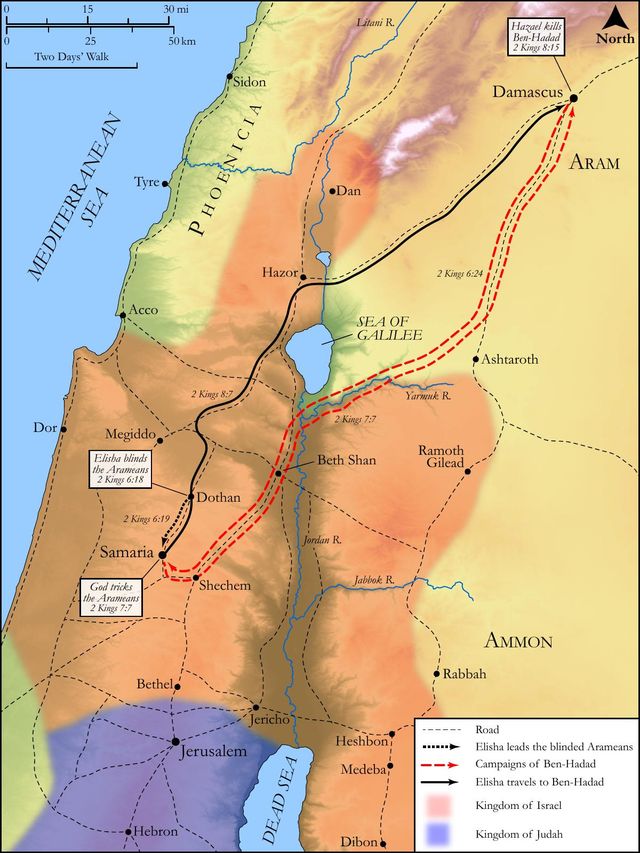
See on the biblical-era map
Study this verse
Public-domain commentary
Matthew Henry
From his Commentary on the Whole Bible. Henry comments on passages, not single verses — this entry covers 2 Kings 7:3–11. His two-level outline is real structure in the source text, so it is rendered as structure.
We are here told,
I.How the siege of Samaria was raised in the evening, at the edge of night (Kg2 7:6, Kg2 7:7), not by might or power, but by the Spirit of the Lord of hosts, striking terror upon the spirits of the besiegers. Here was not a sword drawn against them, not a drop of blood shed, it was not by thunder or hailstones that they were discomfited, nor were they slain, as Sennacherib's army before Jerusalem, by a destroying angel; but,
1.The Lord made them to hear a noise of chariots and horses. The Syrians that besieged Dothan had their sight imposed upon, Kg2 6:18. These had their hearing imposed upon. For God knows how to work upon every sense, pursuant to his own counsels as he makes the hearing ear and the seeing eye, so he makes the deaf and the blind, Exo 4:11. Whether the noise was really made in the air by the ministry of angels, or whether it was only a sound in their ears, is not certain; which soever it was, it was from God, who both brings the wind out of his treasures, and forms the spirit of man within him. The sight of horses and chariots had encouraged the prophet's servant, Kg2 6:17. The noise of horses and chariots terrified the hosts of Syria. For notices from the invisible world are either very comfortable or very dreadful, according as men are at peace with God or at war with him.
2.Hearing this noise, they concluded the king of Israel had certainly procured assistance from some foreign power: He has hired against us the kings of the Hittites and the kings of the Egyptians. There was, for aught we know but one king of Egypt, and what kings there were of the Hittites nobody can imagine; but, as they were imposed upon by that dreadful sound in their ears, so they imposed upon themselves by the interpretation they made of it. Had they supposed the king of Judah to have come with his forces, there would have been more of probability in their apprehensions than to dream of the kings of the Hittites and the Egyptians. If the fancies of any of them raised this spectre, yet their reasons might soon have laid it: how could the king of Israel, who was closely besieged, hold intelligence with those distant princes? What had he to hire them with? It was impossible but some notice would come, before, of the motions of so great a host; but there were they in great fear where no fear was.
3.Hereupon they all fled with incredible precipitation, as for their lives, left their camp as it was: even their horses, that might have hastened their flight, they could not stay to take with them, Kg2 7:7. None of them had so much sense as to send out scouts to discover the supposed enemy, much less courage enough to face the enemy, though fatigued with a long march. The wicked flee when none pursues. God can, when he pleases, dispirit the boldest and most brave, and make the stoutest heart to tremble. Those that will not fear God he can make to fear at the shaking of a leaf.
II.How the Syrians' flight was discovered by four leprous men.
Samaria was delivered, and did not know it. The watchmen on the walls were not aware of the retreat of the enemy, so silently did they steal away. But Providence employed four lepers to be the intelligencers, who had their lodging without the gate, being excluded from the city, as ceremonially unclean: the Jews say they were Gehazi and his three sons; perhaps Gehazi might be one of them, which might cause him to be taken notice of afterwards by the king, Kg2 8:4. See here,
1.How these lepers reasoned themselves into a resolution to make a visit in the night to the camp of the Syrians, Kg2 7:3, Kg2 7:4. They were ready to perish for hunger; none passed through the gate to relieve them. Should they go into the city, there was nothing to be had there, they mist die in the streets; should they sit still, they must pine to death in their cottage. They therefore determine to go over to the enemy, and throw themselves upon their mercy: if they killed them, better die by the sword than by famine, one death than a thousand; but perhaps they would save them alive, as objects of compassion. Common prudence will put us upon that method which may better our condition, but cannot make it worse. The prodigal son resolves to return to his father, whose displeasure he had reason to fear, rather than perish with hunger in the far country. These lepers conclude, "If they kill us, we shall but die;" and happy they who, in another sense, can thus speak of dying. "We shall but die, that is the worst of it, not die and be damned, not be hurt of the second death." According to this resolution, they went, in the beginning of the night, to the camp of the Syrians, and, to their great surprise, found it wholly deserted, not a man to be seen or heard in it, Kg2 7:5. Providence ordered it, that these lepers came as soon as ever the Syrians had fled, for they fled in the twilight, the evening twilight (Kg2 7:7), and in the twilight the lepers came (Kg2 7:5), and so no time was lost.
2.How they reasoned themselves into a resolution to bring tidings of this to the city. They feasted in the first tent they came to (Kg2 7:8) and then began to think of enriching themselves with the plunder; but they corrected themselves (Kg2 7:9): "We do not well to conceal these good tidings from the community we are members of, under colour of being avenged upon them for excluding us from their society; it was the law that did it, not they, and therefore let us bring them the news. Though it awake them from sleep, it will be life from the dead to them." Their own consciences told them that some mischief would befal them if they acted separately, and sought themselves only. Selfish narrow-spirited people cannot expect to prosper; the most comfortable advantage is that which our brethren share with us in. According to this resolution, they returned to the gate, and acquainted the sentinel with what they had discovered (Kg2 7:10), who straightway brought the intelligence to court (Kg2 7:11), and it was not the less acceptable for being first brought by lepers.
Historical interpretation
Historical reception
1 surviving comment on this verse from the historical church.
Even though the four lepers are loathsome, if we symbolically recognize in them the fact that they announced goods for the inhabitants of their city, they do no wrong to the symbol but correctly represent the four holy Evangelists. Indeed, we must bear in mind that through their books the grace of our Savior and source of life Jesus Christ was known, and freedom was given to all people according to his divine plan. And so those whose flesh was leprous shone in their interior look with the splendor of their righteousness. In addition, they symbolically represent the first attitude of the apostles in the fact that leprosy had corrupted their skin. But they also represent them in the fact that their interior was adorned with righteous behavior because the old man has been transformed by the coming of the Holy Spirit and renewed. Therefore they have clothed themselves with the garment shining with the colors of heaven and have been sent to show the work of the hands of God.
Continue studying 2 Kings 7:10 across the web’s major study libraries — every link below opens this exact verse, chapter, or book on the destination site.
Read & Compare
 BibleGatewayThis verse in more than 200 translations and 70 languages.
 Bible.comThe YouVersion reader — hundreds of translations, reading plans, and highlights.
 ESV.orgCrossway's official English Standard Version reader.
 NET BibleThe NET translation with 60,000+ translators' notes on every rendering decision.
 STEP BibleTyndale House's free study tool — original text, vocabulary, and scholarly resources.
 BibliaLogos Bible Software's free web reader.
 USCCBThe New American Bible (Revised Edition) with the U.S. bishops' study notes.
Commentaries
 BibleHub CommentariesDozens of classic commentaries on this verse, gathered on one page.
 StudyLightMore than 100 commentary sets — the largest collection on the web.
 BibleRefPlain-English commentary on what this verse means, verse by verse.
 Enduring WordDavid Guzik's free commentary on this chapter, widely used by Bible teachers.
 Bible Study ToolsVerse commentary alongside Greek and Hebrew study aids.
Original Language & Research
- BibleHub InterlinearThe verse word by word — original language, transliteration, and English.
- BibleHub LexiconEvery word's original-language definition and Strong's entry.
 Blue Letter BibleDeep-study tools — Strong's numbers, concordance, and word studies.
 SefariaThe Hebrew text with Rashi and centuries of Jewish commentary.
Sermons, Hymns & Audio


TrulyRandomVerse is not affiliated with these sites and doesn’t control their content. They’re linked because they’re genuinely useful.
Summary
Second Kings 7:10 narrates the pivotal moment when four desperate lepers, having ventured beyond Samaria's besieged walls, report their astonishing discovery to the city's gatekeeper: the entire Syrian siege camp has been miraculously abandoned. They found no human presence, only tethered animals and undisturbed tents, clear evidence of a sudden and panicked flight. This verse serves as the immediate and dramatic fulfillment of Elisha's prophecy, signaling God's unexpected and complete deliverance for a starving and desperate Israel.
Context
ShowHideLiterary Context
This verse marks the crucial turning point in the narrative of 2 Kings 7, following a period of extreme famine and despair in Samaria. It directly follows the prophet Elisha's seemingly impossible prophecy of abundant food within twenty-four hours, delivered amidst the king's profound hopelessness (2 Kings 7:1). The preceding verses detail the desperate decision of four lepers, facing certain death by starvation, to surrender to the Syrian army (2 Kings 7:3-5). Their subsequent discovery of the deserted camp (2 Kings 7:8) and their realization of the moral imperative to share this life-saving news with the city (2 Kings 7:9) directly sets the stage for their report in 2 Kings 7:10. This announcement initiates the city's deliverance and validates the divine authority of Elisha's prophetic word, shifting the narrative from utter despair to miraculous provision.
Historical & Cultural Context
Samaria, the capital of the Northern Kingdom of Israel, was enduring a severe and prolonged siege by the Aramean (Syrian) army under King Ben-hadad. Sieges were a common and brutal form of ancient warfare, designed to cut off supplies and starve a city into submission. The famine within Samaria had reached horrific levels, leading to acts of cannibalism, as graphically depicted in 2 Kings 6:25-29. According to Mosaic Law, lepers were considered ritually unclean and were compelled to live outside the city gates, ostracized from society and unable to participate in communal life (Leviticus 13:46). Their decision to approach the Syrian camp was not an act of courage but one of utter desperation; they faced certain death by starvation if they remained outside Samaria and a slim chance of survival if they surrendered to the enemy. This dire context profoundly underscores the irony and magnitude of God's intervention, as He chose the most lowly and hopeless individuals to be the unexpected bearers of salvation for the entire city.
Key Themes
ShowHide2 Kings 7:10 powerfully encapsulates several core themes. Foremost is Divine Deliverance, showcasing God's unparalleled power to rescue His people from seemingly impossible situations through extraordinary and often counter-intuitive means. It vividly illustrates God's Sovereignty over nations, armies, and even the laws of nature, demonstrating His ability to cause a massive, formidable army to flee in terror without a single battle, simply by creating a sound (2 Kings 7:6-7). The narrative also highlights the theme of Unexpected Instruments, as God deliberately chooses four outcast lepers, rather than the king's military or political advisors, to convey the news of salvation. Finally, it underscores the unfailing Fulfillment of Prophecy, as Elisha's bold declaration of abundant provision is immediately and spectacularly validated, reinforcing the absolute reliability and trustworthiness of God's spoken word.
Exposition and Analysis
ShowHideKey Word Analysis
ShowHideThis term (H7778) refers to the gatekeeper or janitor, the official responsible for guarding the city entrance, controlling access, and receiving reports. The lepers' immediate action to report to the porter highlights the urgency and official nature of their discovery. The porter serves as the crucial intermediary, the first point of contact between the desperate, starving city and the miraculous news waiting outside its walls, symbolizing the opening of a closed and hopeless situation.
The repetition of "no man there, neither voice of man" (H376 for 'man', H6963 for 'voice') is a powerful rhetorical device emphasizing the absolute desolation and supernatural emptiness of the camp. The term ʼîysh denotes an individual human being. Its absence, coupled with the lack of any human sound, signifies a complete and total abandonment, not merely a strategic withdrawal. This detail highlights the panic and haste of the Syrian flight, orchestrated entirely by God's unseen hand.
The description of "horses tied, and asses tied" (H631) is a crucial detail. This word means to yoke, hitch, or fasten. The fact that the animals were left tethered, rather than unhitched or released, implies an incredibly sudden and terror-stricken flight. The Syrians fled so quickly that they did not even take the time to untie their most valuable assets for transport and supplies, further emphasizing the supernatural terror that gripped them and the completeness of their rout.
Verse Breakdown
ShowHide"So they came and called unto the porter of the city:"
Having realized the immense significance of their discovery and their moral obligation to share the good news, the lepers return to the city gate. Their act of "calling unto the porter" signifies their attempt to communicate with the official channels of the city, despite their outcast status and the physical barrier of the gate. This is the crucial first step in bringing the news of deliverance to the beleaguered city of Samaria.
"and they told them, saying,"
This phrase indicates the direct and immediate communication of their astonishing findings. The lepers, once overlooked and unheard, now stand as the unexpected, eyewitness messengers of hope and salvation to a city on the brink of collapse. Their testimony is direct, urgent, and carries the weight of their desperate journey.
"We came to the camp of the Syrians, and, behold, [there was] no man there, neither voice of man,"
This is the core of their report, a statement of profound surprise and supernatural reality. The interjection "behold" (Hebrew, hinneh) emphasizes the shocking and unexpected nature of their discovery. The absolute absence of human life or even a sound in what was previously a bustling and threatening enemy camp underscores the miraculous nature of the Syrian flight, orchestrated entirely by God's unseen hand, demonstrating His power to dismantle a formidable foe without human intervention.
"but horses tied, and asses tied, and the tents as they [were]."
This final clause provides the concrete, irrefutable evidence of the Syrians' panicked flight. The undisturbed tents and the tethered animals confirm that the departure was not a planned retreat but a sudden, terror-induced abandonment of all their possessions, including their vital transport animals and supplies. This vivid detail powerfully portrays the completeness of God's intervention and the abundance of provision now available to the starving city, transforming scarcity into immediate surplus.
Literary Devices
ShowHideThe passage masterfully employs several literary devices to heighten its impact and convey its theological message. Irony is profoundly prominent, as the four lepers, the most lowly, ritually unclean, and hopeless individuals in Israelite society, become the unexpected bearers of the most vital and life-saving news for the entire city. This stands in stark contrast to the king's despair and the city's utter hopelessness. There is also significant Dramatic Irony, as the reader is privy to the divine cause of the Syrian flight from 2 Kings 7:6-7, yet the lepers and the city initially only grasp the inexplicable reality of the deserted camp. The vivid Imagery of "horses tied, and asses tied, and the tents as they [were]" paints a powerful and immediate picture of sudden, panicked abandonment, emphasizing the supernatural terror that gripped the Syrian army. This stark Contrast between the previously bustling, threatening enemy camp and its current silent, deserted state underscores the magnitude and completeness of God's miraculous intervention.
Theological and Thematic Connections
ShowHideThis verse powerfully illustrates God's sovereign power to deliver His people from overwhelming odds, often through the most unexpected means and instruments. It stands as a profound testament to divine intervention, where God's unseen hand accomplishes what human strength, military strategy, or political maneuvering never could. The lepers, outcast and desperate, become the unlikely heralds of good news, demonstrating God's consistent pattern of using the humble, the overlooked, and the weak to achieve His grand purposes and confound the wise. Their report not only confirms the physical reality of the abandoned camp but also the absolute reliability of God's prophetic word spoken through Elisha, reinforcing faith in His promises even when circumstances seem utterly dire. The abandoned camp, overflowing with provisions, symbolizes God's abundant and immediate provision, turning scarcity into surplus overnight for His faithful, though despairing, people.
Reflection and Application
ShowHideThe account in 2 Kings 7:10 serves as a profound and enduring reminder that even in our deepest despair, most seemingly insurmountable challenges, or most desperate circumstances, God is capable of orchestrating sudden, complete, and miraculous deliverance. Just as the lepers, facing certain death, stumbled upon the unexpected and abundant provision of God, we are called to look beyond our immediate, limited circumstances and trust in His unfathomable ways and sovereign power. This narrative encourages us to cultivate an openness to God using unconventional means, unexpected people, and surprising turns of events to bring about His perfect will. Furthermore, it challenges us to consider our own response when we encounter "good news"—whether it's a spiritual truth, a personal breakthrough, or a profound blessing from God. Like the lepers, who realized they could not keep such life-changing information to themselves, believers are compelled by both gratitude and divine commission to share the hope, provision, and salvation found in God with a world that often feels besieged by its own forms of famine, despair, and spiritual emptiness.
Questions for Reflection
ShowHideFAQ
ShowHideWhy did the Syrians flee so suddenly, leaving everything behind?
ShowHideThe biblical text in 2 Kings 7:6-7 explicitly states that "the Lord had caused the army of the Syrians to hear a noise of chariots, and a noise of horses, even the noise of a great host." This was not a natural sound but a supernatural, divinely orchestrated deception. God caused the Syrians to perceive the sound of a massive, approaching army, leading them to believe that the King of Israel had hired the powerful armies of the Hittites and the Egyptians to attack them. Overwhelmed by terror and convinced they were about to be ambushed by an overwhelming coalition, they fled for their lives in a panicked, headlong retreat, abandoning all their possessions, including their tethered animals, their gold, silver, and clothing, and the entire contents of their tents. Their flight was not a strategic withdrawal but a divinely induced rout, demonstrating God's power to dismantle a formidable enemy without a single sword being drawn by Israel.
What is the significance of the lepers being the ones to discover the deserted camp?
ShowHideThe fact that four lepers, the most lowly, ritually unclean, and despised members of Israelite society who were forced to live outside the city gates (Leviticus 13:46), were the first to discover the deserted camp is profoundly significant. It powerfully highlights God's sovereign choice to use the humble, the outcast, and the unexpected to accomplish His purposes and bring salvation. It demonstrates that God's power is not limited by human status, societal perception, or perceived weakness. Their desperate act of seeking food led them to be the unwitting instruments of God's miraculous deliverance for the entire city. This underscores a recurring biblical theme that God often works through the weak, the foolish, and the lowly to confound the wise and mighty (1 Corinthians 1:27-29), ensuring that the glory belongs to Him alone.
Christ-Centered Fulfillment
ShowHideThe narrative of 2 Kings 7:10, with its profound themes of divine deliverance, unexpected messengers, and abundant provision, finds its ultimate and most glorious Christ-centered fulfillment. Just as God supernaturally delivered Samaria from a physical siege and a devastating famine, Christ offers humanity ultimate deliverance from the spiritual siege of sin and death, providing not just sustenance but abundant and eternal spiritual life (John 10:10). The lepers, outcasts of society, became the unlikely bearers of life-saving good news to a desperate city; similarly, Jesus Christ came not for the healthy or the self-righteous but for the sick, the lost, and the lowly, proclaiming good news to the poor, liberty to the captives, and recovery of sight to the blind (Luke 4:18). He deliberately chose humble fishermen, tax collectors, and even former persecutors to spread the life-giving message of the Gospel, demonstrating that God's power is perfected in weakness and that His grace is sufficient (2 Corinthians 12:9). The deserted Syrian camp, overflowing with provisions, vividly foreshadows the lavish spiritual feast and eternal inheritance available through Christ, who is the true bread of life that came down from heaven (John 6:35) and the ultimate fulfillment of all God's promises, bringing an end to spiritual famine and ushering in an era of grace and truth. The lepers' imperative to share the good news they discovered (2 Kings 7:9) also powerfully prefigures the Great Commission, where believers are called to share the good news of Christ's salvation with all nations, making disciples and proclaiming His victory over sin and death (Matthew 28:19-20).