


2 Kings 19:27
Bible text: King James Version (1769 Blayney text) · Public domain
Bible text: Berean Standard Bible · Public domain
Bible text: American Standard Version (1901) · Public domain
Bible text: World English Bible, Messianic edition · Public domain
Bible text: Geneva Bible (1599) · Public domain
Bible text: Young's Literal Translation · Public domain
- וְשִׁבְתְּךָve·shiv·te·Khaand sitting down youH3427Conj-w ¦ V-Qal-Inf ¦ 2msVerb Qal Infinitive Constructוְandשִׁבְתְּsitting downךָyou
- וְצֵאתְךָve·tze·te·Khaand going out youH3318Conj-w ¦ V-Qal-Inf ¦ 2msVerb Qal Infinitive Constructוְandצֵאתְgoing outךָyou
- וּבֹאֲךָu·vo·'a·Khaand coming youH935Conj-w ¦ V-Qal-Inf ¦ 2msVerb Qal Infinitive Constructוּandבֹאֲcomingךָyou
- יָדָעְתִּיya·Da·'e·tiI knowH3045V-Qal-Perf-1csVerb Qal Perfect 1st Singular common gender
- וְאֵתve·'Etand <obj.>H853Conj-w ¦ DirObjMParticle Object Indicatorוְandאֵת<obj.>
- הִתְרַגֶּזְךָhit·ra·gez·Kharaging youH7264V-Hithpael-Inf ¦ 2msVerb Hithpael Infinitive Constructהִתְרַגֶּזְragingךָyou
- אֵלָי'e·Laiagainst meH413Prep ¦ 1csPrepositionאֵלָagainstיme
English is a literal word-by-word gloss of the Hebrew, not the KJV's wording. Why?
This is the original text the KJV's translators worked from — each Hebrew word with its own literal English meaning in this verse, prepared by scholars at Tyndale House, Cambridge. The KJV translates whole sentences, not word by word, so its wording differs: one Hebrew word can become several English words, and the KJV may choose “the LORD” where the gloss reads “Yahweh”. Both are faithful — they answer different questions. For the KJV's own rendering, switch to the KJV text.
Details
See on the biblical-era map
Study this verse
Public-domain commentary
Matthew Henry
From his Commentary on the Whole Bible. Henry comments on passages, not single verses — this entry covers 2 Kings 19:20–34. His three-level outline is real structure in the source text, so it is rendered as structure.
We have here the gracious copious answer which God gave to Hezekiah's prayer. The message which he sent him by the same hand (Kg2 19:6, Kg2 19:7), one would think, was an answer sufficient to his prayer; but, that he might have strong consolation, he was encouraged by two immutable things, in which it was impossible for God to lie, Heb 6:18. In general, God assured him that his prayer was heard, his prayer against Sennacherib, Kg2 19:20. Note, The case of those that have the prayers of God's people against them is miserable. For, if the oppressed cry to God against the oppressor, he will hear, Exo 22:23. God hears and answers, hears with the saving strength of his right hand, Psa 20:6.
This message bespeaks two things: -
I.Confusion and shame to Sennacherib and his forces.
It is here foretold that he should be humbled and broken. The prophet elegantly directs his speech to him, as he does, Isa 10:5. O Assyrian! the rod of my anger. Not that this message was sent to him, but what is here said to him he was made to know by the event. Providence spoke it to him with a witness; and perhaps his own heart was made to whisper this to him: for God has more ways than one of speaking to sinners in his wrath, so as to vex them in his sore displeasure, Psa 2:5. Sennacherib is here represented,
1.As the scorn of Jerusalem, Kg2 19:21. He thought himself the terror of the daughter of Zion, that chaste and beautiful virgin, and that by his threats he could force her to submit to him: "But, being a virgin in her Father's house and under his protection, she defies thee, despises thee, laughs thee to scorn. Thy impotent malice is ridiculous; he that sits in heaven laughs at thee, and therefore so do those that abide under his shadow." By this word God intended to silence the fears of Hezekiah and his people. Though to an eye of sense the enemy looked formidable, to an eye of faith he looked despicable.
2.As an enemy to God; and that was enough to make him miserable. Hezekiah pleaded this: "Lord, he has reproached thee," Kg2 19:16. "He has," saith God, "and I take it as against myself (Kg2 19:22): Whom hast thou reproached? Is it not the Holy One of Israel, whose honour is dear to him, and who has power to vindicate it, which the gods of the heathen have not?" Meno me impune lacesset - No one shall provoke me with impunity.
3.As a proud vainglorious fool, that spoke great swelling words of vanity, and boasted of a false gift, by his boasts, as well as by his threats, reproaching the Lord. For,
(1.)He magnified his own achievements out of measure and quite above what really they were (Kg2 19:23, Kg2 19:24): Thou hast said so and so. This was not in the letter he wrote, but God let Hezekiah know that he not only saw what was written there, but heard what he said elsewhere, probably in the speeches he made to his councils or armies. Note, God takes notice of the boasts of proud men, and will call them to an account, that he may look upon them and abuse them, Job 40:11. What a mighty figure does Sennacherib think he makes! Driving his chariots to the tops of the highest mountains, forcing his way through woods and rivers, breaking through all difficulties, making himself master of all he had a mind to. Nothing could stand before him or be withheld from him; no hills too high for him to climb, no trees too strong for him to fell, no waters too deep for him to dry up; as if he had the power of a God, to speak and it is done.
(2.)He took to himself the glory of doing these great things, whereas they were all the Lord's doing, Kg2 19:25, Kg2 19:26. Sennacherib, in his letter, had appealed to what Hezekiah had heard (Kg2 19:11): Thou hast heard what the kings of Assyria have done; but, in answer to that, he is reminded of what God has done for Israel of old, drying up the Red Sea, leading them through the wilderness, planting them in Canaan. "What are all thy doings to these? And as for the desolations thou hast made in the earth, and particularly in Judah, thou art but the instrument in God's hand, a mere tool: it is I that have brought it to pass. I gave thee thy power, gave thee thy success, and made thee what thou art, raised thee up to lay waste fenced cities and so to punish them for their wickedness, and therefore their inhabitants were of small power." What a foolish insolent thing was it for him to exalt himself above God, and against God, upon that which he had done by him and under him. Sennacherib's boasts here are expounded in Isa 10:13, Isa 10:14, By the strength of my hand I have done it, and by my wisdom, etc.; and they are answered (Kg2 19:15), Shall the axe boast itself against him that heweth therewith? It is surely absurd for the fly upon the wheel to say, What a dust do I make! or for the sword in the hand to say, What execution I do! If God be the principal agent in all that is done, boasting is for ever excluded.
4.As under the check and rebuke of that God whom he blasphemed. All his motions were,
(1.)Under the divine cognizance (Kg2 19:27): "I have thy abode, and what thou dost secretly devise and design, thy going out and coming in, marches and counter-marches, and thy rage against me and my people, the tumult of thy passions, the tumult of thy preparations, the noise and bluster thou makest: I know it all." That was more than Hezekiah did, who wished for intelligence of the enemy's motions; but what need was there for this when the eye of God was a constant spy upon him? Ch2 16:9.
(2.)Under the divine control (Kg2 19:28): "I will put my hook in thy nose, thou great Leviathan (Job 41:1, Job 41:2), my bridle in thy jaws, thou great Behemoth. I will restrain thee, manage thee, turn thee where I please, send thee home like a fool as thou camest, re infecta - disappointed of thy aim." Note, It is a great comfort to all the church's friends that God has a hook in the nose and a bridle in the jaws of all her enemies, can make even their wrath to serve and praise him and then restrain the remainder of it. Here shall its proud waves be stayed.
II.Salvation and joy to Hezekiah and his people.
This shall be a sign to them of God's favour, and that he is reconciled to them, and his anger is turned away (Isa 12:1), a wonder in their eyes (for so a sign sometimes signifies), a token for good, and an earnest of the further mercy God has in store for them, that a good issue shall be put to their present distress in every respect.
1.Provisions were scarce and dear; and what should they do for food? The fruits of the earth were devoured by the Assyrian army, Isa 32:9, Isa 32:10, etc. Why, they shall not only dwell in the land, but verily they shall be fed. If God save them, he will not starve them, nor let them die by famine, when they have escaped the sword: "Eat you this year that which groweth of itself, and you shall find enough of that. Did the Assyrians reap what you sowed? You shall reap what you did not sow." But the next year was the sabbatical year, when the land was to rest, and they must neither sow nor reap. What must they do that year? Why, Jehovah-jireh - The Lord will provide. God's blessing shall save them seed and labour, and, that year too, the voluntary productions of the earth shall serve to maintain them, to remind them that the earth brought forth before there was a man to till it, Gen 1:11. And then, the third year, their husbandry should return into its former channel, and they should sow and reap as they used to do.
2.The country was laid waste, families were broken up and scattered, and all was in confusion; how should it be otherwise when it was over-run by such an army? As to this, it is promised that the remnant that has escaped of the house of Judah (that is, of the country people) shall yet again be planted in their own habitations, upon their own estates, shall take root there, shall increase and grow rich, Kg2 19:30. See how their prosperity is described: it is taking root downwards, and bearing fruit upwards, being well fixed and well provided for themselves, and then doing good to others. Such is the prosperity of the soul: it is taking root downwards by faith in Christ, and then being fruitful in fruits of righteousness.
3.The city was shut up, none went out or came in; but now the remnant in Jerusalem and Zion shall go forth freely, and there shall be none to hinder them, or make them afraid, Kg2 19:31. Great destruction had been made both in city and country, bit in both there was a remnant that escaped, which typified the saved remnant of Israelites indeed (as appears by comparing Isa 10:22, Isa 10:23, which speaks of this very event, with Rom 9:27, Rom 9:28), and they shall go forth into the glorious liberty of the children of God.
4.The Assyrians were advancing towards Jerusalem, and would in a little time besiege it in form, and it was in great danger of falling into their hands. But it is here promised that the siege they feared should be prevented, - that, though the enemy had now (as it should seem) encamped before the city, yet they should never come into the city, no, nor so much as shoot an arrow into it (Kg2 19:32, Kg2 19:33), - that he should be forced to retire with shame, and a thousand times to repent his undertaking. God himself undertakes to defend the city (Kg2 19:34), and that person, that place, cannot but be safe, the protection of which he undertakes.
5.The honour and truth of God are engaged for the doing of all this. These are great things, but how will they be effected? Why, the zeal of the Lord of hosts shall do this, Kg2 19:31. He is Lord of hosts, has all creatures at his beck, therefore he is able to do it; he is jealous for Jerusalem with great jealousy (Zac 1:14); having espoused her a chaste virgin to himself, he will not suffer he to be abused, Kg2 19:21. "You have reason to think yourselves unworthy that such great things should be done for you; but God's own zeal will do it." His zeal,
(1.)For his own honour (Kg2 19:34): "I will do it for my own sake, to make myself an everlasting name." God's reasons of mercy are fetched from within himself.
(2.)For his own truth: "I will do it for my servant David's sake; not for the sake of his merit, but the promise made to him and the covenant made with him, those sure mercies of David." Thus all the deliverances of the church are wrought for the sake of Christ, the Son of David.
Historical interpretation
Historical reception
1 surviving comment on this verse from the historical church.
When eyes are ascribed to God, it is implied that he sees all things; an ear, to show that he hears all things; a finger, to reveal a certain signification of the will; nostrils, to show that he is aware of our prayers as one is of odors; hands, to prove that he is the author of every created thing; an arm, to make it known that no nature can resist his power; and finally feet, to make it clear that he fills all things and that there is no thing in which God is not.
Continue studying 2 Kings 19:27 across the web’s major study libraries — every link below opens this exact verse, chapter, or book on the destination site.
Read & Compare
 BibleGatewayThis verse in more than 200 translations and 70 languages.
 Bible.comThe YouVersion reader — hundreds of translations, reading plans, and highlights.
 ESV.orgCrossway's official English Standard Version reader.
 NET BibleThe NET translation with 60,000+ translators' notes on every rendering decision.
 STEP BibleTyndale House's free study tool — original text, vocabulary, and scholarly resources.
 BibliaLogos Bible Software's free web reader.
 USCCBThe New American Bible (Revised Edition) with the U.S. bishops' study notes.
Commentaries
 BibleHub CommentariesDozens of classic commentaries on this verse, gathered on one page.
 StudyLightMore than 100 commentary sets — the largest collection on the web.
 BibleRefPlain-English commentary on what this verse means, verse by verse.
 Enduring WordDavid Guzik's free commentary on this chapter, widely used by Bible teachers.
 Bible Study ToolsVerse commentary alongside Greek and Hebrew study aids.
Original Language & Research
- BibleHub InterlinearThe verse word by word — original language, transliteration, and English.
- BibleHub LexiconEvery word's original-language definition and Strong's entry.
 Blue Letter BibleDeep-study tools — Strong's numbers, concordance, and word studies.
 SefariaThe Hebrew text with Rashi and centuries of Jewish commentary.
Sermons, Hymns & Audio


TrulyRandomVerse is not affiliated with these sites and doesn’t control their content. They’re linked because they’re genuinely useful.
Summary
Second Kings 19:27 delivers a profound divine declaration from Yahweh, spoken through the prophet Isaiah to King Hezekiah, directly confronting the blasphemous threats of the Assyrian king Sennacherib. This verse powerfully asserts God's absolute omniscience and unwavering sovereignty over all human endeavors, revealing His intimate knowledge of Sennacherib's every movement, intention, and, most critically, his defiant "rage" directed against the Almighty Himself. It functions as a divine assurance to Judah and a stark warning to their formidable oppressor, underscoring that no earthly power can escape the all-seeing eye and ultimate control of the Living God.
Context
ShowHideLiterary Context
This verse is a pivotal component of God's direct response to King Hezekiah's desperate prayer in the temple, recorded in 2 Kings 19:15-19. Faced with the overwhelming military might of Sennacherib and his blasphemous challenge to Yahweh's sovereignty (delivered through the Rabshakeh in 2 Kings 18:17-35), Hezekiah had spread Sennacherib's threatening letter before the Lord. God's reply, conveyed by the prophet Isaiah, is a multi-faceted oracle of judgment against Sennacherib and deliverance for Jerusalem. Verse 27, along with the preceding and following verses, forms the core of this divine oracle, explicitly demonstrating God's intimate awareness of Sennacherib's every action and his arrogant defiance, setting the stage for the miraculous deliverance that immediately follows in 2 Kings 19:35-36.
Historical & Cultural Context
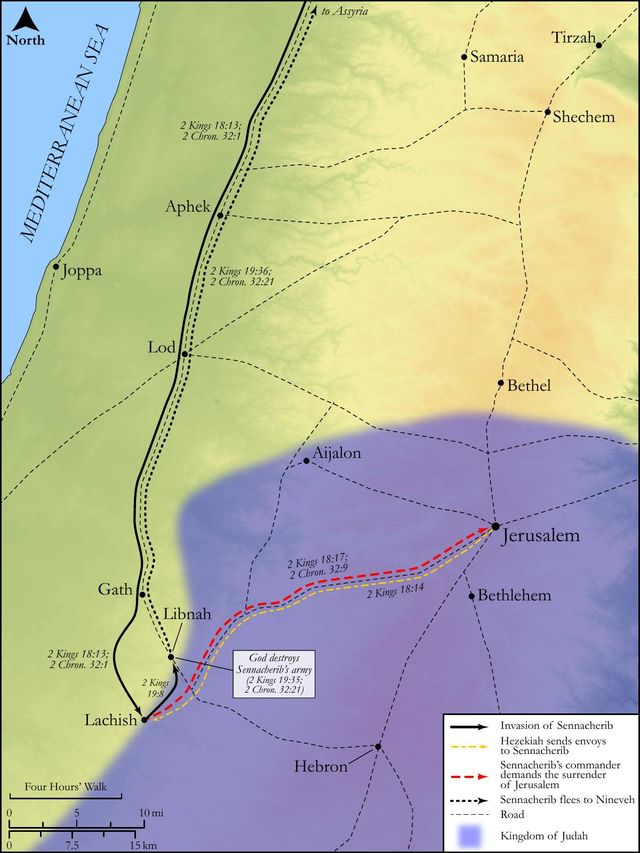
The late 8th century BCE was a period dominated by the Neo-Assyrian Empire, known for its brutal military campaigns and policy of forced deportation. Sennacherib's campaign against Judah in 701 BCE, following the fall of the Northern Kingdom of Israel in 722 BCE, was a significant event. He had already conquered many fortified cities in Judah, including the strategically important Lachish (depicted vividly on the Lachish reliefs in the British Museum). The Assyrian taunts, delivered by the Rabshakeh, were not merely military intimidation but a calculated psychological and theological assault, aiming to undermine Judah's faith in their God by comparing Yahweh to the defeated gods of other nations. In this context, God's declaration in 2 Kings 19:27 directly counters this cultural and religious challenge, reaffirming His unique power and authority over all other deities and earthly rulers.
Key Themes
ShowHideThis verse powerfully contributes to several overarching themes within 2 Kings and the broader biblical narrative. Foremost is Divine Omniscience, as God's declaration "I know thy abode, and thy going out, and thy coming in" asserts His comprehensive and intimate knowledge of every detail of Sennacherib's life, movements, and intentions, echoing the psalmist's awe at God's all-knowing nature in Psalm 139:2-4. This omniscience is inextricably linked to Divine Sovereignty, demonstrating that even the most powerful human kings and empires are ultimately under God's control and serve His purposes, whether wittingly or not, as seen throughout the narratives of the kings of Israel and Judah. Furthermore, the phrase "thy rage against me" highlights the theme of God's Vindication of His Name and Honor. Sennacherib's blasphemy was a direct affront to Yahweh, and God's response underscores His commitment to defending His own glory and His covenant people. Finally, for King Hezekiah and the people of Judah, this message served as a profound source of Comfort and Assurance in the face of overwhelming odds, reminding them that their God was fully aware of their plight and actively engaged in their deliverance, providing a basis for trust even in dire circumstances, as encouraged in Proverbs 3:5-6.
Exposition and Analysis
ShowHideKey Word Analysis
ShowHideThis primitive root (H3045) signifies more than mere intellectual awareness; it implies a deep, intimate, and experiential knowledge. It encompasses observation, care, recognition, and even a causative sense of instruction or designation. When God declares "I know," it means He has ascertained by seeing, is fully aware, comprehends, and has complete understanding of Sennacherib's entire being and activity. This knowledge is not passive but active, forming the basis for His subsequent judgment and action.
This triad of terms (H3427, H3318, H935) forms a classic Hebrew merism, an idiom signifying the totality or entirety of a person's activities, existence, or sphere of influence. "Abode" (yâshab) refers to one's sitting, resting, or dwelling place, encompassing one's private life, strategic planning, and moments of quiet. "Going out" (yâtsâʼ) refers to one's departure, military campaigns, or public actions. "Coming in" (bôwʼ) refers to one's return, entry into cities, or successful conclusion of ventures. Together, these terms convey God's absolute, comprehensive knowledge of Sennacherib's entire life—from his most secret thoughts and plans to his most public and aggressive military movements. Nothing is hidden from God's sight.
The Hebrew word (H7264) denotes a strong, agitated emotion, often translated as "rage," "fury," "indignation," "quivering," or "trembling." In this context, it captures Sennacherib's intense, arrogant defiance, his blasphemous anger, and his hostile intent directed specifically "against me" (God). It highlights the personal nature of Sennacherib's affront, not just against Judah, but against the very being of Yahweh. This "rage" is not merely human anger but a rebellious, prideful fury that challenges divine authority, making it a particularly offensive and punishable act in God's eyes.
Verse Breakdown
ShowHide"But I know thy abode"
This opening clause immediately establishes God's intimate and personal knowledge of Sennacherib. "Abode" refers to Sennacherib's resting place, his private chambers, his strategic headquarters, or even his mental state of dwelling on his plans. God asserts that He is fully aware of Sennacherib's innermost thoughts, his secret strategies, and his place of rest, implying that even in his moments of supposed security or private plotting, he is under divine scrutiny.
"and thy going out, and thy coming in"
This phrase expands upon God's knowledge to encompass all of Sennacherib's public actions and movements. "Going out" refers to his military expeditions, his campaigns, his marches against cities and nations. "Coming in" refers to his return from these campaigns, his triumphant entries, or his arrival at his intended destinations. Together, these signify God's complete awareness of Sennacherib's entire sphere of activity, his every move on the battlefield and in his empire. It underscores that no military maneuver, no strategic deployment, no act of conquest goes unnoticed by the Almighty.
"and thy rage against me"
This culminating clause reveals the true nature of Sennacherib's opposition and the reason for divine intervention. His "rage" is not merely political ambition or military aggression; it is a direct, blasphemous fury aimed at God Himself. Sennacherib's taunts against Yahweh (as recorded in 2 Kings 18:33-35) are understood by God as a personal affront. This phrase transforms the conflict from a mere geopolitical struggle into a collision of kingdoms, where God's honor and sovereignty are directly challenged, necessitating a divine response.
Literary Devices
ShowHideThe verse employs several powerful literary devices to convey its message. Merism is prominently featured in "thy abode, and thy going out, and thy coming in," which, as discussed, comprehensively describes all of Sennacherib's activities, emphasizing God's total knowledge. This comprehensive knowledge is a form of Anthropomorphism, where God is described as "knowing" in a human-like way, yet it simultaneously points to His divine Omniscience, an attribute far beyond human comprehension. The declaration is a direct Divine Speech or Oracle, carrying the weight of God's absolute authority and truth, serving both as a prophecy and a judgment. There is also an element of Dramatic Irony at play: Sennacherib believes himself to be in control, powerful, and unchallengeable, yet the audience knows, through this divine declaration, that his every move is intimately known and ultimately controlled by the very God he rages against.
Theological and Thematic Connections
ShowHideThis verse profoundly articulates the biblical doctrine of divine omniscience and sovereignty. God's declaration that He knows Sennacherib's every move and his "rage" is not merely a statement of fact but a powerful assertion of His active oversight and control over all of creation, including the seemingly independent actions of defiant human rulers. It challenges the notion of human autonomy apart from God, demonstrating that even the most formidable adversaries operate within the bounds of God's overarching plan. This divine knowledge is not passive observation but the basis for righteous judgment and the execution of His redemptive purposes. It assures believers that no enemy, however powerful or malicious, can escape the notice of the Almighty, and that God will ultimately vindicate His name and defend His people against all who rage against Him.
Reflection and Application
ShowHideIn a world often characterized by overwhelming challenges and seemingly insurmountable opposition, 2 Kings 19:27 offers immense comfort and a sobering warning. For the believer, this verse is a profound reminder that when facing personal trials, spiritual attacks, or societal injustices, God is not distant or unaware. He intimately knows every detail of our circumstances, every move of those who oppose us, and every word spoken in defiance of His truth. This divine omniscience should cultivate a deep sense of peace and trust, knowing that our sovereign God is fully engaged and will ultimately act on behalf of His children. It empowers us to pray with confidence, knowing that He hears and sees all. Conversely, this verse serves as a stark and timeless warning to those who, in their pride and arrogance, rage against God or His people. No scheme, no act of rebellion, no blasphemous word goes unnoticed. God's intimate knowledge implies ultimate accountability and certain judgment for those who defy His authority. It calls all to humility and repentance, recognizing that true power and ultimate destiny rest solely in the hands of the all-knowing and sovereign Creator.
Questions for Reflection
ShowHideFAQ
ShowHideWhat does "abode, going out, and coming in" truly mean in the context of God's knowledge?
ShowHideThis phrase is a Hebrew idiom known as a merism, meaning it uses two contrasting or complementary parts to refer to a whole. "Abode" (sitting/dwelling), "going out," and "coming in" together comprehensively describe every aspect of a person's life, activities, and movements. It signifies God's complete and intimate knowledge of Sennacherib's entire existence – his private thoughts and plans, his public actions and military campaigns, his departures and his arrivals, his resting and his working. It emphasizes that absolutely nothing about Sennacherib, from his most hidden intentions to his most visible displays of power, was unknown to God. This highlights God's perfect omniscience, where all things are laid bare before Him, as seen in Hebrews 4:13.
What was the ultimate outcome for Sennacherib after this declaration?
ShowHideFollowing God's declaration in 2 Kings 19:27-28, the Lord acted decisively. That very night, the angel of the Lord struck down 185,000 Assyrian soldiers in their camp (2 Kings 19:35). Sennacherib, humiliated and defeated, was forced to withdraw from Judah and return to Nineveh. Years later, while worshipping in the temple of his god Nisroch, he was assassinated by his own sons, Adrammelech and Sharezer (2 Kings 19:36-37). This outcome perfectly fulfilled God's prophetic word, demonstrating His absolute sovereignty over even the most powerful earthly rulers.
Does God's knowledge of Sennacherib's "rage" imply that God causes evil or rebellion?
ShowHideNo, God's knowledge of Sennacherib's "rage" does not imply that God causes or instigates evil. Instead, it affirms God's perfect omniscience and sovereignty, meaning He is fully aware of all human actions, including sinful ones, and retains ultimate control over their outcomes without being the author of sin. Sennacherib's rage was a product of his own pride, ambition, and defiance, freely chosen. However, God, in His sovereignty, can permit, limit, and even use the evil actions of humanity to accomplish His own righteous purposes, as illustrated in the story of Joseph in Genesis 50:20. God's knowledge is exhaustive, and His control is absolute, but human beings remain morally responsible for their choices.
Christ-Centered Fulfillment
ShowHideThe profound truth of God's omniscience and sovereignty over Sennacherib finds its ultimate and most glorious fulfillment in the person and work of Jesus Christ. Just as the Father knew Sennacherib's every move and his "rage," so too does the Son, who is God incarnate, possess infinite knowledge of all things. Jesus demonstrated this divine omniscience repeatedly during His earthly ministry, knowing the thoughts and intentions of people (Matthew 9:4), the past of the Samaritan woman (John 4:17-19), and even the location of a specific fish with a coin in its mouth (Matthew 17:27). More significantly, Christ's victory over the "rage" of spiritual adversaries and the powers of darkness far surpasses God's judgment on Sennacherib. The forces that raged against God and His Anointed One ultimately led to the crucifixion, yet this act of human and demonic rage was precisely God's sovereign plan for redemption (Acts 2:23). Through His death and resurrection, Christ disarmed principalities and powers (Colossians 2:15), demonstrating His ultimate authority over all earthly and spiritual dominion. Therefore, 2 Kings 19:27 foreshadows the comprehensive knowledge and absolute triumph of the Lamb of God, who reigns supreme over every foe, and whose kingdom will have no end (Revelation 19:11-16).