


2 Chronicles 9:20
Bible text: King James Version (1769 Blayney text) · Public domain
Bible text: King James Version with Strong's numbers · Public domain
Bible text: Berean Standard Bible · Public domain
Bible text: American Standard Version (1901) · Public domain
Bible text: World English Bible, Messianic edition · Public domain
Bible text: Geneva Bible (1599) · Public domain
Bible text: Young's Literal Translation · Public domain
- וְכֹלVe·kholand allH3605Conj-w ¦ N-mscNoun Singular Masculine Constructוְandכֹלall
- כְּלֵיke·Lei[the] vessels ofH3627N-mpcNoun Plural Masculine Construct
- מַשְׁקֵהmash·Keh[the] drink ofH4945N-mscNoun Singular Masculine Construct
- הַמֶּלֶךְha·Me·lekhthe kingH4428Art ¦ N-msNoun Singular Masculine Absoluteהַtheמֶּלֶךְking
- שְׁלֹמֹהshe·lo·MohSolomonH8010N-proper-mNoun Proper Masculine
- זָהָבza·Hav[were] goldH2091N-msNoun Singular Masculine Absolute
- וְכֹלve·Kholand allH3605Conj-w ¦ N-mscNoun Singular Masculine Constructוְandכֹלall
- כְּלֵיke·Lei[the] utensils ofH3627N-mpcNoun Plural Masculine Construct
- בֵּיתbeit[the] House ofH1004N-mscNoun Singular Masculine Construct
- יַעַרYa·'ar[the] Forest ofH3293N-mscNoun Singular Masculine Construct
- הַלְּבָנוֹןha·le·va·Non<the> LebanonH3844Art ¦ N-properNoun Proper Locationהַ<the>לְּבָנוֹןLebanon
- זָהָבza·Hav[were] goldH2091N-msNoun Singular Masculine Absolute
- סָגוּרsa·Gurpure goldH5462N-msNoun Singular Masculine Absolute
- אֵין'einnotH369N-mscNoun Singular Masculine Construct
- כֶּסֶףKe·sefsilverH3701N-msNoun Singular Masculine Absolute
- נֶחְשָׁבnech·Shav[was] esteemedH2803V-Niphal-Prtcpl-msVerb Niphal Participle Singular Masculine Absolute
- בִּימֵיbi·Meiin [the] days ofH3117Prep-b ¦ N-mpcNoun Plural Masculine Constructבִּinימֵי[the] days of
- שְׁלֹמֹהshe·lo·MohSolomonH8010N-proper-mNoun Proper Masculine
- לִמְאוּמָהlim·'U·mahto anythingH3972Prep-l ¦ N-fsNoun Singular Feminine Absoluteלִtoמְאוּמָהanything
English is a literal word-by-word gloss of the Hebrew, not the KJV's wording. Why?
This is the original text the KJV's translators worked from — each Hebrew word with its own literal English meaning in this verse, prepared by scholars at Tyndale House, Cambridge. The KJV translates whole sentences, not word by word, so its wording differs: one Hebrew word can become several English words, and the KJV may choose “the LORD” where the gloss reads “Yahweh”. Both are faithful — they answer different questions. For the KJV's own rendering, switch to the KJV text.
Details
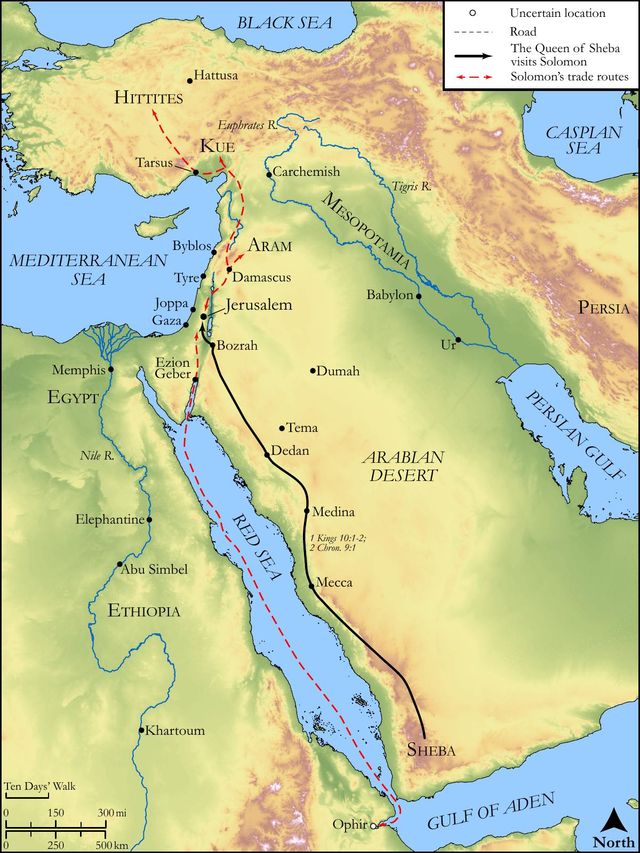
See on the biblical-era map
Study this verse
Public-domain commentary
Matthew Henry
From his Commentary on the Whole Bible. Henry comments on passages, not single verses — this entry covers 2 Chronicles 9:13–31. His two-level outline is real structure in the source text, so it is rendered as structure.
We have here Solomon in his throne, and Solomon in his grave; for the throne would not secure him from the grave. Mors sceptra ligonibus aequat - Death wrenches from the hand the sceptre as well as the spade.
I.Here is Solomon reigning in wealth and power, in ease and fulness, such as, for aught I know, could never since be paralleled by any king whatsoever. In cannot pretend to be critical in comparing the grandeur of Solomon with that of some of the great princes of the earth. But I may observe that the most illustrious of them were famed for their wars, whereas Solomon reigned forty years in profound peace. Some of those that might be thought to vie with Solomon affected retirement, kept people in awe by keeping them at a great distance; nobody must see them, or come near him, upon pain of death: but Solomon went much abroad, and appeared in public business. So that, all things considered, the promise was fulfilled, that God would give him riches, and wealth, and honour, such as no kings have had, or shall have, Ch2 1:12.
1.Never any prince appeared in public with great splendour than Solomon did, which to those that judge by the sight of the eye, as most people do, would very much recommend him. He had 200 targets and 300 shields, all of beaten gold, carried before him (Ch2 9:15, Ch2 9:16), and sat upon a most stately throne, Ch2 9:17-19. There was not the like in any kingdom. The lustre wherein he appeared was typical of the spiritual glory of the kingdom of the Messiah and but a faint representation of his throne, which is above every throne. Solomon's pomp was all artificial; and therefore our Saviour prefers the natural beauty of the lilies of the field before it. Mat 6:29, Solomon, in all his glory, was not arrayed like one of these.
2.Never any prince had greater plenty of gold and silver, though there were no gold or silver mines in his own kingdom. Either he made himself master of the mines in other countries, and, having a populous country, sent hands to dig out those rich metals, or, having a fruitful country, he exported the commodities of it and with them fetched home all this gold that is here spoken of, Ch2 9:13, Ch2 9:14-21.
3.Never any prince had such presents brought him by all his neighbours as Solomon had: All the kings of Arabia, and governors of the country, brought him gold and silver (Ch2 9:14), not as tribute which he extorted from them, but as freewill offerings to procure his favour, or in a way of exchange for some of the productions of his husbandry, corn or cattle. All the kings of the earth brought him presents, that is, all in those parts of the world (Ch2 9:24, Ch2 9:28), because they coveted his acquaintance and friendship. Herein he was a type of Christ, to whom, as soon as he was born, the wise men of the east brought presents, gold, frankincense, and myrrh (Mat 2:11), and to whom all that are about him must bring presents, Psa 76:11; Rom 12:1.
4.Never any prince was so renowned for wisdom, so courted, so consulted, so admired (Ch2 9:23): The kings of the earth (for it was too great a favour for common persons to pretend to) sought to hear his wisdom - his natural philosophy, or his skill in physic, or his state policy, or his rules of prudence for the conduct of human life, or perhaps the principles of his religion, and the reasons of it. The application which they then made to Solomon to hear his wisdom will aggravate, shame, and condemn, men's general contempt of Christ and his gospel. Though in them are hidden all the treasures of wisdom and knowledge, yet none of the princes of this world desire to know them, for they are foolishness to them, Co1 2:8, Co1 2:14.
II.Here is Solomon dying, stripped of his pomp, and leaving all his wealth and power, not to one concerning whom he knew not whether he would be a wise man or a fool (Ecc 2:19), but who he knew would be a fool. This was not only vanity but vexation of spirit, Ch2 9:29-31. It is very observable that no mention is here made of Solomon's departure from God in his latter days, not the least hint given of it,
1.Because the Holy Ghost would teach us not to take delight in repeating the faults and follies of others. If those that have been in reputation for wisdom and honour misbehave, though it may be of use to take notice of their misconduct for warning to ourselves and others, yet we must not be forward to mention it, once the speaking of it is enough; why should that unpleasing string be again struck upon? Why can we not do as the sacred historian here does, speak largely of that in others which is praise-worthy, without saying any thing of their blemishes, yea, though they have been gross and obvious? This is but doing as we would be done by.
2.Because, though he fell, yet he was not utterly cast down. His sin is not again recorded, because it was repented of, and pardoned, and became as if it had never been. Scripture-silence sometimes speaks. I am willing to believe that its silence here concerning the sin of Solomon is an intimation that none of the sins he committed were mentioned against him, Eze 33:16. When God pardons sin he casts it behind his back and remembers it no more.
Continue studying 2 Chronicles 9:20 across the web’s major study libraries — every link below opens this exact verse, chapter, or book on the destination site.
Read & Compare
 BibleGatewayThis verse in more than 200 translations and 70 languages.
 Bible.comThe YouVersion reader — hundreds of translations, reading plans, and highlights.
 ESV.orgCrossway's official English Standard Version reader.
 NET BibleThe NET translation with 60,000+ translators' notes on every rendering decision.
 STEP BibleTyndale House's free study tool — original text, vocabulary, and scholarly resources.
 BibliaLogos Bible Software's free web reader.
 USCCBThe New American Bible (Revised Edition) with the U.S. bishops' study notes.
Commentaries
 BibleHub CommentariesDozens of classic commentaries on this verse, gathered on one page.
 StudyLightMore than 100 commentary sets — the largest collection on the web.
 BibleRefPlain-English commentary on what this verse means, verse by verse.
 Enduring WordDavid Guzik's free commentary on this chapter, widely used by Bible teachers.
 Bible Study ToolsVerse commentary alongside Greek and Hebrew study aids.
Original Language & Research
- BibleHub InterlinearThe verse word by word — original language, transliteration, and English.
- BibleHub LexiconEvery word's original-language definition and Strong's entry.
 Blue Letter BibleDeep-study tools — Strong's numbers, concordance, and word studies.
 SefariaThe Hebrew text with Rashi and centuries of Jewish commentary.
Sermons, Hymns & Audio


TrulyRandomVerse is not affiliated with these sites and doesn’t control their content. They’re linked because they’re genuinely useful.
Summary
2 Chronicles 9:20 vividly portrays the unparalleled opulence of King Solomon's reign, revealing that even common drinking vessels and the magnificent furnishings of his "house of the forest of Lebanon" were crafted from pure gold. This verse underscores the extraordinary abundance of gold in his kingdom, so vast that silver, a precious metal highly valued in other societies, was considered worthless—"not accounted of"—during his prosperous era. It stands as a powerful testament to the zenith of Solomon's material wealth, a direct manifestation of divine favor and blessing bestowed upon him.
Context
ShowHideLiterary Context
This verse is strategically placed within a larger narrative block in 2 Chronicles (and its parallel in 1 Kings 10) that meticulously details the immense wealth and unparalleled wisdom of King Solomon. Immediately following the awe-struck visit of the Queen of Sheba, who marveled at his prosperity and administrative genius (2 Chronicles 9:1-12), the text transitions to an itemized account of the sources and manifestations of Solomon's riches. Verses 13-28 enumerate the vast quantities of gold he received annually, the construction of his golden shields, and the grandeur of his throne, culminating in this verse's striking depiction of gold's pervasive presence in his daily life and royal structures. The "house of the forest of Lebanon" refers to one of Solomon's magnificent palaces, a grand structure built primarily of cedar wood, whose numerous pillars resembled a forest, serving as an armory, a royal residence, and a hall of judgment. The narrative here emphasizes the fulfillment of God's promise to Solomon to grant him riches and honor beyond any king before or after him, in addition to his renowned wisdom (see 2 Chronicles 1:12).
Historical & Cultural Context
Among the kings of that day, a king's wealth was a direct reflection of his power, prestige, and divine favor. Gold, being a rare and highly valued metal, symbolized ultimate luxury and status. Solomon's reign (c. 970-931 BC) marked a period of unprecedented peace and prosperity for Israel, largely due to his strategic alliances, control over vital trade routes, and divinely bestowed wisdom. The gold mentioned in this verse likely came from various sources, including tribute from the kings of Arabia, taxes, and extensive trade, particularly with Ophir (mentioned in 2 Chronicles 9:10). The cultural norm was to use precious metals for royal and sacred vessels, but the sheer volume and exclusivity of gold, to the point of completely displacing silver, was extraordinary. Silver, typically a standard medium of exchange and a valuable commodity, being "not accounted of" highlights a level of affluence virtually unparalleled in that day, demonstrating Israel's unique standing under Solomon's rule, a testament to the fulfillment of God's promises.
Key Themes
ShowHideThis verse powerfully contributes to several overarching themes in 2 Chronicles. Firstly, it underscores the theme of Unprecedented Wealth as a tangible manifestation of divine blessing. Solomon's riches were not merely accumulated through human effort but were a direct fulfillment of God's promise, signifying His favor upon a king who sought wisdom. Secondly, the explicit statement that "none [were of] silver; it was [not] any thing accounted of" highlights the theme of Gold's Supremacy and Silver's Demotion. This dramatic contrast emphasizes the extraordinary abundance of gold, effectively devaluing silver to the status of common stones in Jerusalem, as explicitly stated in 2 Chronicles 9:27. This hyperbolic description serves to magnify the extent of God's provision. Lastly, the verse reinforces the theme of Divine Blessing and Covenant Fulfillment. Solomon's prosperity is directly linked to his initial faithfulness and God's covenant promises, serving as a visible sign of God's faithfulness to His people when they walk in obedience, and pointing to the ideal state of a blessed kingdom.
Exposition and Analysis
ShowHideKey Word Analysis
ShowHideThis term (H2091) refers to the precious metal, gold. In this context, its repeated mention emphasizes not only the quantity but also the inherent value and splendor associated with Solomon's reign. Figuratively, gold represents purity, royalty, and divine blessing, making its pervasive presence in Solomon's household and palaces a powerful symbol of his divinely granted prosperity and glory. The description of "pure gold" (from H5462 çâgar, meaning "to shut up," idiomatically "pure") further signifies the highest quality and refinement of the metal, underscoring the king's ultimate luxury.
The verb châshab (H2803) means "to think, regard, value, compute, esteem." In the negative construction "it was not any thing accounted of," it conveys that silver had lost its perceived worth or desirability in the days of Solomon. This is not merely about abundance, but about a shift in valuation; silver was so common that it ceased to be esteemed as a precious commodity, effectively becoming negligible in comparison to the overwhelming presence of gold. This demonstrates the profound impact of Solomon's unprecedented wealth on the economic and cultural perceptions of value within his kingdom.
Verse Breakdown
ShowHide"And all the drinking vessels of king Solomon [were of] gold"
This clause immediately establishes the extraordinary extent of Solomon's wealth, permeating even the most common and functional items of daily life within his royal court. That every drinking vessel was made of gold, rather than more typical materials like pottery, bronze, or even silver, speaks to an unprecedented level of luxury and abundance. It signifies a standard of living that surpassed that of any contemporary monarch, showcasing a kingdom saturated with divine blessing.
"and all the vessels of the house of the forest of Lebanon [were of] pure gold"
This part specifies the material of the vessels within one of Solomon's most magnificent and well-known structures, the "house of the forest of Lebanon." This grand palace, used for various state functions and as a royal residence, was adorned with vessels of "pure gold." The emphasis on "pure" gold underscores not only the sheer quantity but also the exceptional quality and refinement of the materials used in his most prestigious architectural projects, reflecting his immense resources and sophisticated taste, a direct consequence of God's provision.
"none [were of] silver; it was [not] any thing accounted of in the days of Solomon"
This is the most striking and hyperbolic statement in the verse. It declares the complete absence of silver in these categories of vessels, not due to scarcity, but because silver had become so abundant that it had lost its value and desirability. This dramatic declaration emphasizes the sheer volume of gold that must have been present in Jerusalem. For silver, a metal highly prized and used as currency among the nations, to be considered "nothing accounted of" or "worthless" is a powerful testament to the unparalleled economic prosperity and gold saturation during Solomon's reign, making it a unique era in Israel's history and a vivid illustration of God's superabundant blessing.
Literary Devices
ShowHideThe verse employs several potent Literary Devices to convey the extraordinary nature of Solomon's wealth. The most prominent is Hyperbole, an intentional exaggeration used for emphatic effect. The statement that silver was "not any thing accounted of" is a hyperbolic expression designed to impress upon the reader the sheer, unimaginable abundance of gold, rather than a literal declaration that silver had zero monetary value. This exaggeration effectively communicates the unparalleled scale of Solomon's riches, making his kingdom unique in its affluence. Additionally, there is a strong use of Contrast, pitting the supreme value and omnipresence of gold against the devalued, almost negligible status of silver. This sharp distinction highlights the unique economic reality of Solomon's kingdom, where the typical hierarchy of precious metals was inverted. Finally, Symbolism is deeply at play, with gold serving as a potent symbol of divine blessing, wisdom, and the unparalleled glory of God's chosen king. The material wealth reflects a spiritual reality of God's favor and the flourishing of His kingdom on earth during this period of peace and prosperity.
Theological and Thematic Connections
ShowHideThe extraordinary wealth of Solomon, as depicted in 2 Chronicles 9:20, serves as a powerful theological statement about God's abundant provision and faithfulness to His covenant promises. This opulence was not merely a display of human ambition but a direct fulfillment of God's pledge to grant Solomon "riches, and wealth, and honour, such as none of the kings have had that have been before thee, neither shall there any after thee have the like" (2 Chronicles 1:12). It illustrates God's capacity to bless beyond measure, demonstrating His sovereignty over all resources and His willingness to pour out blessings upon those who seek His wisdom and walk in His ways. However, the narrative of Solomon's life also subtly introduces a tension: while divine blessing is evident, the accumulation of vast wealth, particularly in excess of what God commanded for kings (Deuteronomy 17:17), could also become a snare, leading to spiritual complacency and idolatry. This verse, therefore, stands as a high point of material blessing, inviting reflection on the true source of prosperity and the potential pitfalls of earthly riches, reminding us that even great blessings can become a test of faithfulness.
Reflection and Application
ShowHide2 Chronicles 9:20, with its stunning portrayal of Solomon's gold-saturated kingdom, invites us to reflect deeply on our own values and sources of security. While we may not experience material abundance on Solomon's scale, the verse challenges us to consider what we truly account of value in our lives. If silver, a precious metal, could become worthless in Solomon's day due to the overwhelming presence of gold, what "silver" are we clinging to today—possessions, status, fleeting pleasures—that pales in comparison to the "gold" of God's eternal truth, spiritual riches, and His abiding presence? This passage reminds us that all blessings, material or otherwise, ultimately flow from God's generous hand. It encourages us to cultivate a heart of gratitude for His provision, recognizing that true and lasting wealth is not found in perishable earthly treasures but in a vibrant relationship with Him and in storing up treasures in heaven (see Matthew 6:19-21). Our ultimate security and satisfaction are found not in what we possess, but in the One who possesses all things and offers a kingdom that will never end.
Questions for Reflection
ShowHideFAQ
ShowHideWhat was the "house of the forest of Lebanon"?
ShowHideThe "house of the forest of Lebanon" was one of King Solomon's magnificent royal buildings in Jerusalem, described in 1 Kings 7:2-5. It was called this because it was constructed primarily of cedar wood imported from Lebanon, with numerous cedar pillars that made it resemble a dense forest. This grand structure served multiple purposes, including an armory for storing shields, a hall for state functions, and possibly a royal residence or a place for judgment. Its sheer size and the lavish materials used in its construction, as highlighted by the "pure gold" vessels mentioned in 2 Chronicles 9:20, underscored the immense wealth and architectural prowess of Solomon's reign.
Why was silver "not accounted of" in Solomon's day?
ShowHideThe phrase "it was [not] any thing accounted of in the days of Solomon" (also stated in 2 Chronicles 9:27 that "the king made silver in Jerusalem as stones") indicates that silver was so incredibly abundant during Solomon's reign that it lost its relative value compared to gold. This unprecedented influx of gold came from various sources, including tribute from the kings of Arabia, extensive international trade (especially with Ophir), and Solomon's own shrewd economic policies. The sheer volume of gold in Jerusalem meant that silver, though a precious metal in other societies and typically a standard medium of exchange, became so common that it was no longer highly esteemed or desired as a valuable commodity. This hyperbolic description emphasizes the unparalleled economic prosperity and unique status of Solomon's kingdom as a direct result of God's blessing.
Was Solomon's immense wealth a good thing for him?
ShowHideInitially, Solomon's wealth was a direct and tangible sign of God's blessing and faithfulness, a fulfillment of the promise made to him for seeking wisdom above all else (2 Chronicles 1:11-12). It allowed him to build the magnificent Temple and consolidate Israel's power and influence, bringing an era of peace and prosperity. However, the Bible also presents a nuanced view. While a blessing, this vast wealth, combined with his numerous foreign wives, eventually became a source of temptation and contributed to his spiritual decline. Deuteronomy 17:17 had warned kings against accumulating excessive silver and gold, lest their hearts be led astray. Solomon ultimately failed to heed this warning, as his heart was "not loyal to the Lord his God, as was the heart of his father David" (1 Kings 11:4). Thus, while divinely granted, his wealth ultimately proved to be a mixed blessing, highlighting the dangers of material prosperity when not held in proper perspective and when it leads one away from devotion to God.
Christ-Centered Fulfillment
ShowHideThe unparalleled earthly glory and material splendor of Solomon's kingdom, so vividly depicted in 2 Chronicles 9:20, serve as a profound shadow and type pointing to the infinitely greater, eternal, and spiritual glory of Christ's kingdom. Solomon's reign, a golden age of peace and prosperity, was temporary and ultimately flawed by his own sin and decline (1 Kings 11:4). In contrast, Jesus Christ is the true and greater King, whose kingdom is not of this world (John 18:36) and whose riches are not perishable gold but eternal life, divine wisdom, and perfect righteousness. While Solomon's vessels were of pure gold, Christ embodies the unsearchable riches of God's grace (Ephesians 3:8), in whom "are hidden all the treasures of wisdom and knowledge" (Colossians 2:3). The abundance of gold in Solomon's Jerusalem foreshadows the New Jerusalem, whose streets are of pure gold (Revelation 21:21), symbolizing the absolute purity and eternal value of God's dwelling with humanity. Christ's reign brings not just earthly prosperity but spiritual transformation, offering a wealth of grace that makes "silver" (worldly values and pursuits) truly "not accounted of" in light of the surpassing worth of knowing Him (Philippians 3:8). He is the true Temple, the true King, and the source of all true and lasting treasure, offering a kingdom that will never fade.