


2 Chronicles 30:6
- וַיֵּלְכוּvai·ye·le·Khuand they wentH1980Conj-w ¦ V-Qal-ConsecImperf-3mpVerb Qal Consecutive Imperfect 3rd Plural Masculineוַandיֵּלְכוּthey went
- הָרָצִיםha·ra·Tzimthe runnersH7323Art ¦ V-Qal-Prtcpl-mpVerb Qal Participle Plural Masculine Absoluteהָtheרָצִיםrunners
- בָּאִגְּרוֹתba·'i·ge·Rotwith <the> lettersH107Prep-b ¦ N-fpNoun Plural Feminine Absoluteבָּwith <the>אִגְּרוֹתletters
- מִיַּדmi·Yadfrom [the] hand ofH3027Prep-m ¦ N-cscNoun Singular common gender Constructמִfromיַּד[the] hand of
- הַמֶּלֶךְha·Me·lekhthe kingH4428Art ¦ N-msNoun Singular Masculine Absoluteהַtheמֶּלֶךְking
- וְשָׂרָיוve·sa·Ravand his officialsH8269Conj-w ¦ N-mpc ¦ 3msNoun Plural Masculine Constructוְandשָׂרָיofficialsוhis
- בְּכָלbe·kholin allH3605Prep-b ¦ N-mscNoun Singular Masculine Constructבְּinכָלall
- יִשְׂרָאֵלYis·ra·'ElIsraelH3478N-properNoun Proper Location
- וִיהוּדָהvi·hu·Dahand JudahH3063Conj-w ¦ N-properNoun Proper LocationוִandיהוּדָהJudah
- וּכְמִצְוַתu·khe·mitz·Vatand according to [the] command ofH4687Conj-w ¦ Prep-k ¦ N-fscNoun Singular Feminine Constructוּandכְaccording toמִצְוַת[the] command of
- הַמֶּלֶךְha·Me·lekhthe kingH4428Art ¦ N-msNoun Singular Masculine Absoluteהַtheמֶּלֶךְking
- לֵאמֹרle·Mor<to> sayingH559Prep-l ¦ V-Qal-InfVerb Qal Infinitive Constructלֵ<to>אמֹרsaying
- בְּנֵיbe·NeiO people ofH1121N-mpcNoun Plural Masculine Construct
- יִשְׂרָאֵלYis·ra·'ElIsraelH3478N-properNoun Proper Location
- שׁוּבוּShu·vureturnH7725V-Qal-Imp-2mpVerb Qal Imperative 2nd Plural Masculine
- אֶל'eltoH413PrepPreposition
- יְהוָהYah·wehYahwehH3068N-properNoun Proper Title
- אֱלֹהֵי'e·lo·Hei[the] God ofH430N-mpcNoun Plural Masculine Construct
- אַבְרָהָם'av·ra·HamAbrahamH85N-proper-mNoun Proper Masculine
- יִצְחָקyitz·ChakIsaacH3327N-proper-mNoun Proper Masculine
- וְיִשְׂרָאֵלve·Yis·ra·'Eland IsraelH3478Conj-w ¦ N-properNoun Proper LocationוְandיִשְׂרָאֵלIsrael
- וְיָשֹׁבve·ya·Shoso he may returnH7725Conj-w ¦ V-Qal-Imperf-3msVerb Qal Imperfect 3rd Singular Masculineוְsoיָשֹׁבhe may return
- אֶל'eltoH413PrepPreposition
- הַפְּלֵיטָהha·pe·lei·Tahthe escaped remnantH6413Art ¦ N-fsNoun Singular Feminine Absoluteהַtheפְּלֵיטָהescaped remnant
- הַנִּשְׁאֶרֶתha·nish·'E·retwhich remainsH7604Art ¦ V-Niphal-Prtcpl-fsVerb Niphal Participle Singular Feminine Absoluteהַwhichנִּשְׁאֶרֶתremains
- לָכֶםla·Khemto youPrep-l ¦ 2mpSuffix Personal 2nd Plural Masculineלָtoכֶםyou
- מִכַּףmi·Kaffrom [the] hand ofH3709Prep-m ¦ N-fscNoun Singular Feminine Constructמִfromכַּף[the] hand of
- מַלְכֵיmal·Khei[the] kings ofH4428N-mpcNoun Plural Masculine Construct
- אַשּׁוּר'a·ShurAssyriaH804N-properNoun Proper Location
English is a literal word-by-word gloss of the Hebrew, not the KJV's wording. Why?
This is the original text the KJV's translators worked from — each Hebrew word with its own literal English meaning in this verse, prepared by scholars at Tyndale House, Cambridge. The KJV translates whole sentences, not word by word, so its wording differs: one Hebrew word can become several English words, and the KJV may choose “the LORD” where the gloss reads “Yahweh”. Both are faithful — they answer different questions. For the KJV's own rendering, switch to the KJV text.
Details
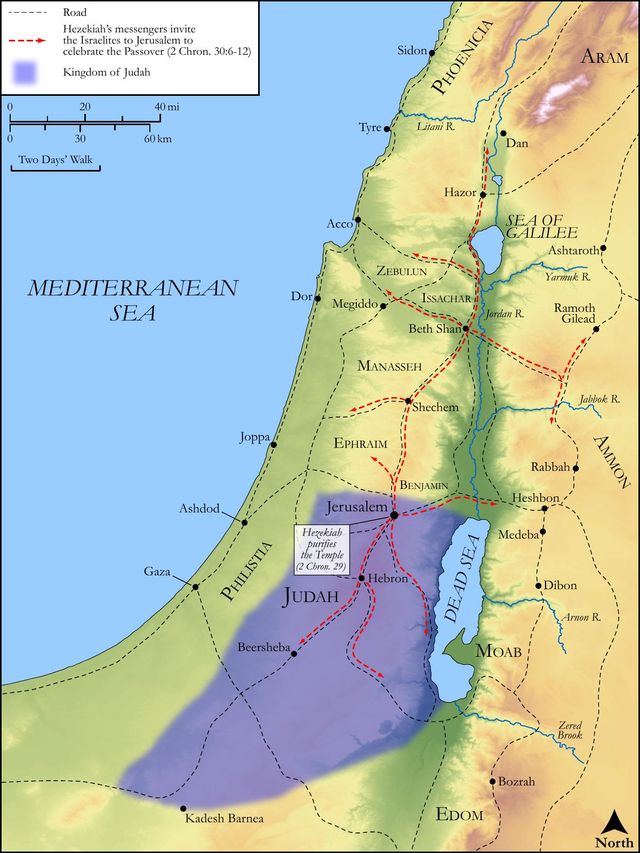
See on the biblical-era map
Study this verse
Public-domain commentary
Matthew Henry
From his Commentary on the Whole Bible. Henry comments on passages, not single verses — this entry covers 2 Chronicles 30:1–12. His four-level outline is real structure in the source text, so it is rendered as structure.
Here is, I. A passover resolved upon. That annual feast was instituted as a memorial of the bringing of the children of Israel out of Egypt. It happened that the reviving of the temple service fell within the appointed days of that feast, the seventeenth day of the first month: this brought that forgotten solemnity to mind. "What shall we do," says Hezekiah, "about the passover? It is a very comfortable ordinance, and has been long neglected. How shall we revive it? The time has elapsed for this year; we cannot go about it immediately; the congregation is thin, the people have not notice, the priests are not prepared, Ch2 30:3. Must we defer it till another year?" Many, it is likely, were for deferring it; but Hezekiah considered that by that time twelve-month the good affections of the people would cool, and it would be too long to want the benefit of the ordinance; and therefore, finding a proviso in the law of Moses that particular persons who were unclean in the first month might keep the passover the fourteenth day of the second month and be accepted (Num 9:11), he doubted not but that it might be extended to the congregation. Whereupon they resolved to keep the passover in the second month. Let the circumstance give way to the substance, and let not the thing itself be lost upon a nicety about the time. It is good striking while the iron is hot, and taking people when they are in a good mind. Delays are dangerous.
II.A proclamation issued out to give notice of this passover and to summon the people to it.
1.An invitation was sent to the ten revolted tribes to stir them up to come and attend this solemnity. Letters were written to Ephraim and Manasseh to invite them to Jerusalem to keep this passover (Ch2 30:1), not with any political design, to bring them back to the house of David, but with a pious design to bring them back to the Lord God of Israel. "Let them take whom they will for their king," says Hezekiah, "so they will but take him for their God." The matters in difference between Judah and Israel, either upon a civil or sacred account, shall not hinder but that if the people of Israel will sincerely return to the Lord their God Hezekiah will bid them as welcome to the passover as any of his own subjects. Expresses are sent post throughout all the tribes of Israel with memorials earnestly pressing the people to take this opportunity of returning to the God from whom they had revolted. Now here we have,
(1.)The contents of the circular letters that were despatched upon the occasion, in which Hezekiah discovers a great concern both for the honour of God and for the welfare of the neighbouring kingdom, the prosperity of which he seems passionately desirous of, though he not only received no toll, tribute, or custom, from it, but it had often, and not long since, been vexatious to his kingdom. This is rendering good for evil. Observe,
[1.]What it is which he presses them to (Ch2 30:8): "Yield yourselves unto the Lord. Before you can come into communion with him you must come into covenant with him." Give the hand to the Lord (so the word is), that is, "Consent to take him for your God." A bargain is confirmed by giving the hand. "Strike this bargain. Join yourselves to him in an everlasting covenant. Subscribe with the hand to be his, Isa 44:5. Give him your hand, in token of giving him your heart. Lay your hand to his plough. Devote yourselves to his service, to work for him. Yield to him," that is, "Come up to his terms, come under his government, stand it not out any longer against him." "Yield to him, to be absolutely and universally at his command, at his disposal, to be, and do, and have, and suffer, whatever he pleases. In order to this, be not stiff-necked as your fathers were; let not your corrupt and wicked wills rise up in resistance of and rebellion against the will of God. Say not that you will do what you please, but resolve to do what he pleases." There is in the carnal mind a stiffness, an obstinacy, an unaptness to comply with God. We have it from our fathers; it is bred in the bone with us. This must be conquered; and the will that had in it a spirit of contradiction must be melted into the will of God; and to his yoke the neck that was an iron sinew must be bowed and fitted. In pursuance of this resignation to God, he presses them to enter into his sanctuary, that is, to attend upon him in that place which he had chosen, to put his name there, and serve him in the ordinances which he had appointed. "The doors of the sanctuary are now opened, and you have liberty to enter; the temple service is now revived, and you are welcome to join in it." The king says, Come; the princes and priests say, Come; whosoever will, let him come. This he calls (Ch2 30:6) turning to the Lord God; for they had forsaken him, and worshipped other gods. Repent now, and be converted. Thus those who through grace have turned to God themselves should do all they can to bring others back to him.
[2.]What arguments he uses to persuade them to do this. First, "You are children of Israel, and therefore stand related, stand obliged, to the God of Israel, from whom you have revolted." Secondly, "The God you are called to return to is the God of Abraham, Isaac, and Jacob, a God in covenant with your first fathers, who served him and yielded themselves to him; and it was their honour and happiness that they did so." Thirdly, "Your late fathers that forsook him and trespassed against him have been given up to desolation; their apostasy and idolatry have been their ruin, as you see (Ch2 30:7); let their harms be your warnings." Fourthly, "You yourselves are but a remnant narrowly escaped out of the hands of the kings of Assyria (Ch2 30:6), and therefore are concerned to put yourselves under the protection of the God of your fathers, that you be not quite swallowed up." Fifthly, "This is the only way of turning away the fierceness of God's anger from you (Ch2 30:8), which will certainly consume you if you continue stiff-necked." Lastly, "If you return to God in a way of duty, he will return to you in a way of mercy." This he begins with (Ch2 30:6) and concludes with, Ch2 30:9. In general, "You will find him gracious and merciful, and one that will not turn away his face from you, if you seek him, notwithstanding the provocations you have given him." Particularly, "You may hope that he will turn again the captivity of your brethren that are carried away, and bring them back to their own land." Could any thing be expressed more pathetically, more movingly? Could there be a better cause, or could it be better pleaded?
(2.)The entertainment which Hezekiah's messengers and message met with. It does not appear that Hoshea, who was now king of Israel, took any umbrage from, or gave any opposition to, the dispersing of these proclamations through his kingdom, nor that he forbade his subjects to accept the invitation. He seems to have left them entirely to their liberty. They might go to Jerusalem to worship if they pleased; for, though he did evil, yet not like the kings of Israel that were before him, Kg2 17:2. He saw ruin coming upon his kingdom, and, if any of his subjects would try this expedient to prevent it, they had his full permission. But, for the people,
[1.]The generality of them slighted the call and turned a deaf ear to it. The messengers went from city to city, some to one and some to another, and used pressing entreaties with the people to come up to Jerusalem to keep the passover; but they were so far from complying with the message that they abused those that brought it, laughed them to scorn, and mocked them (Ch2 30:10), not only refused, but refused with disdain. Tell them of the God of Abraham! they knew him not, they had other gods to serve, Baal and Ashtaroth. Tell them of the sanctuary! their high places were as good. Tell them of God's mercy and wrath! they neither dreaded the one nor desired the other. No marvel that the king's messengers were thus despitefully used by this apostate race when God's messengers were so, his servants the prophets, who produced credentials from him. The destruction of the kingdom of the ten tribes was now at hand. It was but two or three years after this that the king of Assyria laid siege to Samaria, which ended in the captivity of those tribes. Just before this they had not only a king of their own that permitted them to return to God's sanctuary, but a king of Judah that earnestly invited them to do it. Had they generally accepted this invitation, it might have prevented their ruin; but their contempt of it hastened and aggravated it, and left them inexcusable.
[2.]Yet there were some few that accepted the invitation. The message, though to some it was a savour of death unto death, was to others a savour of life unto life, Ch2 30:11. In the worst of times God has had a remnant; so he had here, many of Asher, Manasseh, and Zebulun (here is no mention of any out of Ephraim, though some of that tribe are mentioned, Ch2 30:18), humbled themselves, and came to Jerusalem, that is, were sorry for their sins and submitted to God. Pride keeps men from yielding themselves to the Lord; when that is brought down, the work is done.
2.A command was given to the men of Judah to attend this solemnity; and they universally obeyed it, v. 12. They did it with one heart, were all of a mind in it, and the hand of God gave them that one heart; for it is in the day of power that Christ's subjects are made willing. It is God that works both to will and to do. When people, at any time, manifest an unexpected forwardness to do that which is good, we must acknowledge that hand of God in it.
Continue studying 2 Chronicles 30:6 across the web’s major study libraries — every link below opens this exact verse, chapter, or book on the destination site.
Read & Compare
 BibleGatewayThis verse in more than 200 translations and 70 languages.
 Bible.comThe YouVersion reader — hundreds of translations, reading plans, and highlights.
 ESV.orgCrossway's official English Standard Version reader.
 NET BibleThe NET translation with 60,000+ translators' notes on every rendering decision.
 STEP BibleTyndale House's free study tool — original text, vocabulary, and scholarly resources.
 BibliaLogos Bible Software's free web reader.
 USCCBThe New American Bible (Revised Edition) with the U.S. bishops' study notes.
Commentaries
 BibleHub CommentariesDozens of classic commentaries on this verse, gathered on one page.
 StudyLightMore than 100 commentary sets — the largest collection on the web.
 BibleRefPlain-English commentary on what this verse means, verse by verse.
 Enduring WordDavid Guzik's free commentary on this chapter, widely used by Bible teachers.
 Bible Study ToolsVerse commentary alongside Greek and Hebrew study aids.
Original Language & Research
- BibleHub InterlinearThe verse word by word — original language, transliteration, and English.
- BibleHub LexiconEvery word's original-language definition and Strong's entry.
 Blue Letter BibleDeep-study tools — Strong's numbers, concordance, and word studies.
 SefariaThe Hebrew text with Rashi and centuries of Jewish commentary.
Sermons, Hymns & Audio


TrulyRandomVerse is not affiliated with these sites and doesn’t control their content. They’re linked because they’re genuinely useful.
Summary
King Hezekiah, in an unprecedented and divinely inspired initiative, dispatched swift royal messengers bearing letters throughout both the southern kingdom of Judah and the scattered remnants of the northern kingdom of Israel. His decree was a fervent and authoritative call for national repentance and spiritual renewal, urging all descendants of Jacob to abandon their idolatrous practices and return wholeheartedly to the covenant God of their patriarchs—Abraham, Isaac, and Israel. The message carried a profound promise: if the people, particularly those who had survived the devastating Assyrian invasions, would turn back to the Lord, He, in turn, would draw near to them, extending mercy, restoration, and renewed covenant fellowship.
Context
ShowHideLiterary Context
This pivotal verse is situated within the narrative of King Hezekiah's ambitious and comprehensive religious reforms, which commenced immediately upon his ascension to the throne (compare 2 Chronicles 29:3). Having diligently cleansed and reconsecrated the temple in Jerusalem, Hezekiah then resolved to celebrate the Passover, an observance that had been neglected for centuries. The surrounding narrative in 2 Chronicles 30 meticulously details the logistical and spiritual challenges of this undertaking, including the pragmatic decision to celebrate the Passover in the second month due to the priests' insufficient consecration and the people's unpreparedness in the first month (see 2 Chronicles 30:2-3). Verse 6 marks the profound moment where Hezekiah extends this sacred invitation beyond the political borders of Judah, demonstrating a deep, divinely-inspired desire for the spiritual reunification of all twelve tribes of Israel, despite their long-standing political and historical divisions.
Historical & Cultural Context
At the time of Hezekiah's reign (late 8th century BCE), the geopolitical landscape was dominated by the formidable Assyrian Empire. The northern kingdom of Israel had already suffered catastrophic defeats, with its capital, Samaria, falling in 722 BCE. Many of its inhabitants had been brutally deported, leaving behind a scattered, diminished, and religiously compromised population (as recounted in 2 Kings 17:6). Judah, while still maintaining its independence, lived under the constant shadow of Assyrian aggression, and its people had largely succumbed to the idolatrous practices prevalent in the northern kingdom and among surrounding pagan nations. Hezekiah's call was therefore far more than a mere religious invitation; it was a bold theological and political statement, asserting the supreme sovereignty of Yahweh over all Israel, even those under foreign domination. The "posts" or royal runners (Hebrew: rûwts) were official, swift messengers, indicative of the urgency, importance, and wide-reaching nature of the king's decree, utilizing the established communication infrastructure of ancient Near Eastern empires.
Key Themes
ShowHideThis verse encapsulates several crucial themes central to the Chronicler's theology and the broader biblical metanarrative. Foremost is the theme of repentance and return, powerfully expressed in the direct command to "turn again unto the LORD." This call underscores the divine expectation for humanity to forsake their wayward paths and actively re-engage in covenant relationship with their God. This is intrinsically linked to God's covenant faithfulness, as Hezekiah's message invokes "the LORD God of Abraham, Isaac, and Israel," reminding the people of God's enduring and immutable promises to their forefathers, despite their own pervasive unfaithfulness (compare Exodus 3:6). The profound promise that "he will return to the remnant of you" highlights the theme of divine reciprocity and restoration, demonstrating God's readiness to respond with mercy, forgiveness, and renewed presence when His people genuinely seek Him. Finally, the expansive outreach to "all Israel and Judah" and the specific mention of the "remnant" emphasize the themes of unity and hope, reflecting a yearning for the spiritual reunification of God's people and the recognition that even a small surviving group can be the recipient of God's redemptive and preserving work (see Isaiah 10:21).
Exposition and Analysis
ShowHideKey Word Analysis
ShowHideThis term (H7323) refers to swift runners or couriers, often part of an organized royal messenger system. In ancient Near Eastern kingdoms, such systems were indispensable for rapid communication, particularly for decrees of national or strategic importance. The deployment of "posts" here underscores the urgency, widespread nature, and official authority of Hezekiah's invitation, indicating a deliberate and efficient effort to reach all corners of the land, including the distant and scattered northern tribes. It signifies the king's earnestness and the divine imperative behind the message.
This is the foundational Hebrew word (H7725) for "repentance" or "return." It signifies a complete change of direction, a decisive turning away from sin, idolatry, or a path of disobedience, and a turning back towards God. It implies not merely a mental acknowledgment of wrongdoing but a transformative action of reorientation in one's life and allegiance. The call to "turn again unto the LORD" is an invitation to a renewed and restored covenant relationship, emphasizing the active, volitional role of humanity in responding to God's gracious initiative. This verb is central to the prophetic call for Israel to return to their covenant obligations (e.g., Joel 2:13).
This term (H7604) refers to those who remain, survive, or are left over after a catastrophe, judgment, or dispersion. In the immediate context of 2 Chronicles 30:6, it specifically denotes the survivors of the northern kingdom who had escaped deportation or death during the Assyrian invasions. The concept of the "remnant" is deeply theological in the Old Testament, representing God's faithfulness to preserve a portion of His people, even through severe judgment, for the continuation of His covenant purposes. Hezekiah's outreach to this "remnant" signals hope, inclusion, and divine mercy, recognizing their continued place within the covenant community despite their suffering and dispersion.
Verse Breakdown
ShowHide"So the posts went with the letters from the king and his princes throughout all Israel and Judah,"
This opening clause describes the immediate and decisive action taken by King Hezekiah. The dispatch of "posts" (swift messengers) carrying official "letters" (royal decrees) signifies the formal, urgent, and authoritative nature of the invitation. The expansive scope of their mission, "throughout all Israel and Judah," highlights Hezekiah's audacious vision for a unified national repentance and Passover celebration, extending his invitation beyond his immediate kingdom of Judah to include the scattered and largely apostate northern tribes.
"and according to the commandment of the king, saying,"
This phrase unequivocally emphasizes the authoritative source and nature of the message. It was not merely a suggestion or an appeal but a direct "commandment" issued by the king with the full backing of his princes, underscoring its royal legitimacy and the expectation of compliance. The following words are presented as the direct speech of the king's decree, imbuing them with immense weight and solemnity.
"Ye children of Israel, turn again unto the LORD God of Abraham, Isaac, and Israel,"
This is the theological core of Hezekiah's fervent appeal. The direct address, "Ye children of Israel," is inclusive, encompassing all descendants of Jacob, regardless of their current political or geographical divisions, reminding them of their shared heritage and identity as God's chosen people. The imperative "turn again" (Hebrew: shûwb) is a profound and urgent call to repentance, urging a fundamental reorientation of their lives away from idolatry, syncretism, and disobedience, and back to the exclusive worship and allegiance of the true God. The invocation of "the LORD God of Abraham, Isaac, and Israel" serves as a powerful reminder of God's unchanging covenant faithfulness, His unique identity as the God who chose, sustained, and promised to their forefathers, thereby emphasizing His historical and relational claim on them.
"and he will return to the remnant of you, that are escaped out of the hand of the kings of Assyria."
This concluding clause presents the divine promise, contingent upon human repentance. The reciprocal action—"he will return"—assures God's compassionate and gracious response to a repentant heart, signifying His willingness to restore His presence, favor, and blessing. The specific mention of the "remnant... escaped out of the hand of the kings of Assyria" directly addresses the dire plight of the northern tribes, acknowledging their immense suffering, dispersion, and vulnerability. This specific targeting offers hope of restoration and inclusion to those who had survived the devastating Assyrian conquests, thereby extending God's mercy and redemptive invitation even to those who seemed most lost or forgotten.
Literary Devices
ShowHideThe verse employs several impactful literary devices to convey its urgent and profound message. Direct Address is prominently featured, as the king's message directly speaks to "Ye children of Israel," creating an immediate, personal, and inclusive appeal to the entire nation, transcending political fragmentation. The use of Parallelism is evident in the reciprocal action: "turn again unto the LORD... and he will return to the remnant of you," which powerfully highlights the conditional nature of God's favor and the direct correlation between human repentance and divine restoration. The phrase "the LORD God of Abraham, Isaac, and Israel" functions as a potent Allusion to the foundational covenant promises and God's unchanging identity as revealed to their patriarchs, grounding the call to repentance in the rich history of God's unwavering faithfulness. Furthermore, the concept of the "remnant" carries significant Symbolism, representing not merely physical survivors but a profound theological concept of God's preservation of a faithful few through judgment, upon whom His future redemptive plans and the continuation of His covenant purposes rest.
Theological and Thematic Connections
ShowHide2 Chronicles 30:6 stands as a powerful testament to God's persistent call for repentance and His unwavering commitment to His covenant people, even in their deepest apostasy. It underscores the profound biblical principle that genuine turning to God—a sincere shûwb—elicits His gracious return to His people, marked by forgiveness, restoration, and renewed communion. Hezekiah's expansive outreach, clearly driven by divine inspiration and a deep desire for unity, serves as a compelling model of spiritual leadership that transcends political boundaries and historical grievances, seeking the holistic well-being and spiritual reunification of God's scattered flock. The verse reminds us that divine mercy is extended even to those who have suffered the dire consequences of their sin, offering hope and a clear path to reconciliation for the "remnant" who respond to the call. This theme of repentance and restoration is a recurring motif throughout Scripture, beautifully demonstrating God's character as one who is "gracious and compassionate, slow to anger and abounding in love" (compare Psalm 145:8).
Reflection and Application
ShowHideThe timeless message embedded in 2 Chronicles 30:6 resonates deeply with believers today, serving as a perpetual and urgent invitation from God to "turn again" to Him. In a contemporary world often characterized by pervasive distraction, moral compromise, and spiritual apathy, this verse calls us to a radical and intentional reorientation of our lives towards the Lord. It profoundly reminds us that true spiritual renewal—whether for an individual, a family, or a community—begins with a sincere and decisive turning away from anything that separates us from God: be it idols of the heart, unconfessed sin, misplaced allegiances, or worldly pursuits. Just as God promised to return to the remnant of ancient Israel, He promises His abiding presence, complete forgiveness, and transformative power to all who genuinely seek Him with a contrite and repentant heart. This passage also challenges us, as individual believers and as the collective body of Christ, to actively extend invitations of grace, reconciliation, and hope to those who are spiritually distant, scattered, hurting, or overlooked, thereby reflecting Hezekiah's compassionate and unifying vision. It reassures us that no one is too far gone, no past too broken, for God's restorative hand to reach out and bring them back into His loving and redemptive embrace.
Questions for Reflection
ShowHideFAQ
ShowHideWhy did Hezekiah send messengers to "all Israel and Judah," especially the northern kingdom?
ShowHideHezekiah's decision to send messengers to "all Israel and Judah" was a profound act of faith and a demonstration of his expansive vision for the spiritual reunification of God's people. Historically, the northern kingdom of Israel had separated from Judah after Solomon's reign, forming its own kingdom and largely embracing idolatry. By Hezekiah's time, the northern kingdom had already fallen to the Assyrian Empire, and many of its people were deported or scattered. Despite these deep political and religious divisions, Hezekiah recognized that all twelve tribes were still "children of Israel" and part of God's covenant people. His invitation to the Passover was a bold attempt to transcend these divisions and call all the descendants of Jacob back to the worship of the one true God, Yahweh, demonstrating a fervent desire for national spiritual unity under the Lord, reminiscent of the unified kingdom under David and Solomon (compare 1 Kings 12:16-19).
What is the significance of invoking "the LORD God of Abraham, Isaac, and Israel" in the message?
ShowHideInvoking "the LORD God of Abraham, Isaac, and Israel" (or Jacob) is a profoundly significant theological statement that grounds the call to repentance in God's unchanging covenant faithfulness and His unique identity. This specific divine title, first revealed to Moses at the burning bush (Exodus 3:6), powerfully reminds the people of God's foundational promises to their patriarchs—promises of land, numerous descendants, and a unique, intimate relationship. By using this sacred title, Hezekiah's message assures the people that despite their pervasive unfaithfulness, their idolatry, and the calamities they had endured, God remained absolutely true to His covenant. It was a powerful appeal to their heritage and a solemn reminder that the God who had chosen, sustained, and blessed their ancestors was still their God, ever ready to receive them back into His covenant embrace.
Who is the "remnant... escaped out of the hand of the kings of Assyria" and why are they specifically mentioned?
ShowHideThe "remnant... escaped out of the hand of the kings of Assyria" refers specifically to the survivors of the northern kingdom of Israel who had not been killed, deported, or enslaved during the devastating Assyrian invasions and the fall of Samaria (see 2 Kings 17:6). Their specific mention highlights their dire circumstances, immense suffering, and vulnerability. Theologically, the concept of a "remnant" is profoundly significant throughout the Old Testament, signifying God's faithfulness to preserve a portion of His people through judgment for the continuation of His redemptive plan and the fulfillment of His covenant promises (e.g., Isaiah 10:21). By reaching out to them, Hezekiah's message extends profound hope and inclusion to those who might have felt forgotten, abandoned, or beyond redemption, underscoring God's boundless mercy and His unwavering desire to restore even the most broken and scattered among His people.
Christ-Centered Fulfillment
ShowHide2 Chronicles 30:6, with its fervent call to "turn again unto the LORD" and the reciprocal promise of God's return, finds its ultimate fulfillment and deepest meaning in the person and work of Jesus Christ. Hezekiah's invitation to a physical Passover celebration, which was a shadow of the ultimate deliverance, profoundly foreshadows Christ's universal call to repentance and faith. Just as the ancient Israelites were urged to turn from their idols and wayward paths to the God of Abraham, so too does the New Testament unequivocally proclaim that all humanity must "repent and believe in the gospel" (Mark 1:15). Jesus Himself is the ultimate "Lamb of God" whose perfect sacrifice fulfills the Passover, taking away the sin of the world once and for all (John 1:29). The "remnant" who miraculously escaped Assyrian hands prefigures the spiritual remnant, the Church, which is gathered from every tribe, tongue, people, and nation, redeemed by Christ's atoning blood and delivered from the power of sin and eternal death. Through Christ, God has not merely "returned" to a scattered few, but has fully and eternally reconciled the world to Himself (2 Corinthians 5:19), establishing a new covenant where His Holy Spirit dwells within His people, ensuring an abiding and intimate presence far greater than any physical return. In Him, the ancient call for unity finds its glorious consummation, as Jew and Gentile are made one new humanity, "no longer strangers and aliens, but fellow citizens with the saints and members of the household of God" (Ephesians 2:19).