


2 Chronicles 30:7
Bible text: King James Version (1769 Blayney text) · Public domain
Bible text: King James Version with Strong's numbers · Public domain
Bible text: Berean Standard Bible · Public domain
Bible text: American Standard Version (1901) · Public domain
Bible text: World English Bible, Messianic edition · Public domain
Bible text: Geneva Bible (1599) · Public domain
Bible text: Young's Literal Translation · Public domain
- וְאַלve·'aland may notH408Conj-w ¦ NegParticle Negativeוְandאַלmay not
- תִּהְיוּtih·Yuyou beH1961V-Qal-Imperf-2mpVerb Qal Imperfect 2nd Plural Masculine
- כַּאֲבוֹתֵיכֶםka·'a·vo·tei·Khemlike your fathersH1Prep-k ¦ N-fpc ¦ 2mpNoun Plural Feminine Constructכַּlikeאֲבוֹתֵיfathersכֶםyour
- וְכַאֲחֵיכֶםve·Kha·'a·chei·Khemand like your brothersH251Conj-w ¦ Prep-k ¦ N-mpc ¦ 2mpNoun Plural Masculine Constructוְandכַlikeאֲחֵיbrothersכֶםyour
- אֲשֶׁר'a·SherwhoH834RelParticle Relative
- מָעֲלוּma·'a·Luthey acted unfaithfullyH4603V-Qal-Perf-3cpVerb Qal Perfect 3rd Plural common gender
- בַּיהוָהba·Yah·wehagainst YahwehH3068Prep-b ¦ N-properNoun Proper TitleבַּagainstיהוָהYahweh
- אֱלֹהֵי'e·lo·Hei[the] God ofH430N-mpcNoun Plural Masculine Construct
- אֲבוֹתֵיהֶם'a·vo·tei·Hemtheir ancestorsH1N-fpc ¦ 3mpNoun Plural Feminine Constructאֲבוֹתֵיancestorsהֶםtheir
- וַיִּתְּנֵםvai·yi·te·Nemand he made themH5414Conj-w ¦ V-Qal-ConsecImperf-3ms ¦ 3mpVerb Qal Consecutive Imperfect 3rd Singular Masculineוַandיִּתְּנֵhe madeםthem
- לְשַׁמָּהle·sha·Mahinto a horrorH8047Prep-l ¦ N-fsNoun Singular Feminine Absoluteלְintoשַׁמָּהa horror
- כַּאֲשֶׁרka·'a·Sherjust asH834Prep-k ¦ RelParticle Relativeכַּjustאֲשֶׁרas
- אַתֶּם'a·TemyouH859Pro-2mpPronoun Personal 2nd Plural Masculine
- רֹאִיםro·'Im[are] seeingH7200V-Qal-Prtcpl-mpVerb Qal Participle Plural Masculine Absolute
English is a literal word-by-word gloss of the Hebrew, not the KJV's wording. Why?
This is the original text the KJV's translators worked from — each Hebrew word with its own literal English meaning in this verse, prepared by scholars at Tyndale House, Cambridge. The KJV translates whole sentences, not word by word, so its wording differs: one Hebrew word can become several English words, and the KJV may choose “the LORD” where the gloss reads “Yahweh”. Both are faithful — they answer different questions. For the KJV's own rendering, switch to the KJV text.
Details
See on the biblical-era map
Study this verse
Public-domain commentary
Matthew Henry
From his Commentary on the Whole Bible. Henry comments on passages, not single verses — this entry covers 2 Chronicles 30:1–12. His four-level outline is real structure in the source text, so it is rendered as structure.
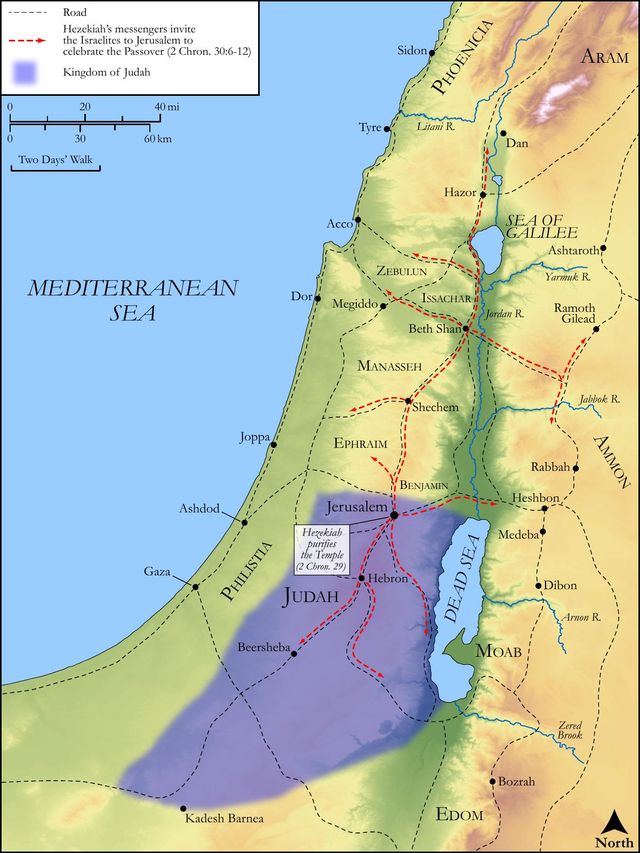
Here is, I. A passover resolved upon. That annual feast was instituted as a memorial of the bringing of the children of Israel out of Egypt. It happened that the reviving of the temple service fell within the appointed days of that feast, the seventeenth day of the first month: this brought that forgotten solemnity to mind. "What shall we do," says Hezekiah, "about the passover? It is a very comfortable ordinance, and has been long neglected. How shall we revive it? The time has elapsed for this year; we cannot go about it immediately; the congregation is thin, the people have not notice, the priests are not prepared, Ch2 30:3. Must we defer it till another year?" Many, it is likely, were for deferring it; but Hezekiah considered that by that time twelve-month the good affections of the people would cool, and it would be too long to want the benefit of the ordinance; and therefore, finding a proviso in the law of Moses that particular persons who were unclean in the first month might keep the passover the fourteenth day of the second month and be accepted (Num 9:11), he doubted not but that it might be extended to the congregation. Whereupon they resolved to keep the passover in the second month. Let the circumstance give way to the substance, and let not the thing itself be lost upon a nicety about the time. It is good striking while the iron is hot, and taking people when they are in a good mind. Delays are dangerous.
II.A proclamation issued out to give notice of this passover and to summon the people to it.
1.An invitation was sent to the ten revolted tribes to stir them up to come and attend this solemnity. Letters were written to Ephraim and Manasseh to invite them to Jerusalem to keep this passover (Ch2 30:1), not with any political design, to bring them back to the house of David, but with a pious design to bring them back to the Lord God of Israel. "Let them take whom they will for their king," says Hezekiah, "so they will but take him for their God." The matters in difference between Judah and Israel, either upon a civil or sacred account, shall not hinder but that if the people of Israel will sincerely return to the Lord their God Hezekiah will bid them as welcome to the passover as any of his own subjects. Expresses are sent post throughout all the tribes of Israel with memorials earnestly pressing the people to take this opportunity of returning to the God from whom they had revolted. Now here we have,
(1.)The contents of the circular letters that were despatched upon the occasion, in which Hezekiah discovers a great concern both for the honour of God and for the welfare of the neighbouring kingdom, the prosperity of which he seems passionately desirous of, though he not only received no toll, tribute, or custom, from it, but it had often, and not long since, been vexatious to his kingdom. This is rendering good for evil. Observe,
[1.]What it is which he presses them to (Ch2 30:8): "Yield yourselves unto the Lord. Before you can come into communion with him you must come into covenant with him." Give the hand to the Lord (so the word is), that is, "Consent to take him for your God." A bargain is confirmed by giving the hand. "Strike this bargain. Join yourselves to him in an everlasting covenant. Subscribe with the hand to be his, Isa 44:5. Give him your hand, in token of giving him your heart. Lay your hand to his plough. Devote yourselves to his service, to work for him. Yield to him," that is, "Come up to his terms, come under his government, stand it not out any longer against him." "Yield to him, to be absolutely and universally at his command, at his disposal, to be, and do, and have, and suffer, whatever he pleases. In order to this, be not stiff-necked as your fathers were; let not your corrupt and wicked wills rise up in resistance of and rebellion against the will of God. Say not that you will do what you please, but resolve to do what he pleases." There is in the carnal mind a stiffness, an obstinacy, an unaptness to comply with God. We have it from our fathers; it is bred in the bone with us. This must be conquered; and the will that had in it a spirit of contradiction must be melted into the will of God; and to his yoke the neck that was an iron sinew must be bowed and fitted. In pursuance of this resignation to God, he presses them to enter into his sanctuary, that is, to attend upon him in that place which he had chosen, to put his name there, and serve him in the ordinances which he had appointed. "The doors of the sanctuary are now opened, and you have liberty to enter; the temple service is now revived, and you are welcome to join in it." The king says, Come; the princes and priests say, Come; whosoever will, let him come. This he calls (Ch2 30:6) turning to the Lord God; for they had forsaken him, and worshipped other gods. Repent now, and be converted. Thus those who through grace have turned to God themselves should do all they can to bring others back to him.
[2.]What arguments he uses to persuade them to do this. First, "You are children of Israel, and therefore stand related, stand obliged, to the God of Israel, from whom you have revolted." Secondly, "The God you are called to return to is the God of Abraham, Isaac, and Jacob, a God in covenant with your first fathers, who served him and yielded themselves to him; and it was their honour and happiness that they did so." Thirdly, "Your late fathers that forsook him and trespassed against him have been given up to desolation; their apostasy and idolatry have been their ruin, as you see (Ch2 30:7); let their harms be your warnings." Fourthly, "You yourselves are but a remnant narrowly escaped out of the hands of the kings of Assyria (Ch2 30:6), and therefore are concerned to put yourselves under the protection of the God of your fathers, that you be not quite swallowed up." Fifthly, "This is the only way of turning away the fierceness of God's anger from you (Ch2 30:8), which will certainly consume you if you continue stiff-necked." Lastly, "If you return to God in a way of duty, he will return to you in a way of mercy." This he begins with (Ch2 30:6) and concludes with, Ch2 30:9. In general, "You will find him gracious and merciful, and one that will not turn away his face from you, if you seek him, notwithstanding the provocations you have given him." Particularly, "You may hope that he will turn again the captivity of your brethren that are carried away, and bring them back to their own land." Could any thing be expressed more pathetically, more movingly? Could there be a better cause, or could it be better pleaded?
(2.)The entertainment which Hezekiah's messengers and message met with. It does not appear that Hoshea, who was now king of Israel, took any umbrage from, or gave any opposition to, the dispersing of these proclamations through his kingdom, nor that he forbade his subjects to accept the invitation. He seems to have left them entirely to their liberty. They might go to Jerusalem to worship if they pleased; for, though he did evil, yet not like the kings of Israel that were before him, Kg2 17:2. He saw ruin coming upon his kingdom, and, if any of his subjects would try this expedient to prevent it, they had his full permission. But, for the people,
[1.]The generality of them slighted the call and turned a deaf ear to it. The messengers went from city to city, some to one and some to another, and used pressing entreaties with the people to come up to Jerusalem to keep the passover; but they were so far from complying with the message that they abused those that brought it, laughed them to scorn, and mocked them (Ch2 30:10), not only refused, but refused with disdain. Tell them of the God of Abraham! they knew him not, they had other gods to serve, Baal and Ashtaroth. Tell them of the sanctuary! their high places were as good. Tell them of God's mercy and wrath! they neither dreaded the one nor desired the other. No marvel that the king's messengers were thus despitefully used by this apostate race when God's messengers were so, his servants the prophets, who produced credentials from him. The destruction of the kingdom of the ten tribes was now at hand. It was but two or three years after this that the king of Assyria laid siege to Samaria, which ended in the captivity of those tribes. Just before this they had not only a king of their own that permitted them to return to God's sanctuary, but a king of Judah that earnestly invited them to do it. Had they generally accepted this invitation, it might have prevented their ruin; but their contempt of it hastened and aggravated it, and left them inexcusable.
[2.]Yet there were some few that accepted the invitation. The message, though to some it was a savour of death unto death, was to others a savour of life unto life, Ch2 30:11. In the worst of times God has had a remnant; so he had here, many of Asher, Manasseh, and Zebulun (here is no mention of any out of Ephraim, though some of that tribe are mentioned, Ch2 30:18), humbled themselves, and came to Jerusalem, that is, were sorry for their sins and submitted to God. Pride keeps men from yielding themselves to the Lord; when that is brought down, the work is done.
2.A command was given to the men of Judah to attend this solemnity; and they universally obeyed it, v. 12. They did it with one heart, were all of a mind in it, and the hand of God gave them that one heart; for it is in the day of power that Christ's subjects are made willing. It is God that works both to will and to do. When people, at any time, manifest an unexpected forwardness to do that which is good, we must acknowledge that hand of God in it.
Continue studying 2 Chronicles 30:7 across the web’s major study libraries — every link below opens this exact verse, chapter, or book on the destination site.
Read & Compare
 BibleGatewayThis verse in more than 200 translations and 70 languages.
 Bible.comThe YouVersion reader — hundreds of translations, reading plans, and highlights.
 ESV.orgCrossway's official English Standard Version reader.
 NET BibleThe NET translation with 60,000+ translators' notes on every rendering decision.
 STEP BibleTyndale House's free study tool — original text, vocabulary, and scholarly resources.
 BibliaLogos Bible Software's free web reader.
 USCCBThe New American Bible (Revised Edition) with the U.S. bishops' study notes.
Commentaries
 BibleHub CommentariesDozens of classic commentaries on this verse, gathered on one page.
 StudyLightMore than 100 commentary sets — the largest collection on the web.
 BibleRefPlain-English commentary on what this verse means, verse by verse.
 Enduring WordDavid Guzik's free commentary on this chapter, widely used by Bible teachers.
 Bible Study ToolsVerse commentary alongside Greek and Hebrew study aids.
Original Language & Research
- BibleHub InterlinearThe verse word by word — original language, transliteration, and English.
- BibleHub LexiconEvery word's original-language definition and Strong's entry.
 Blue Letter BibleDeep-study tools — Strong's numbers, concordance, and word studies.
 SefariaThe Hebrew text with Rashi and centuries of Jewish commentary.
Sermons, Hymns & Audio


TrulyRandomVerse is not affiliated with these sites and doesn’t control their content. They’re linked because they’re genuinely useful.
Summary
King Hezekiah's impassioned plea in 2 Chronicles 30:7 serves as a solemn warning to the people of Judah and the scattered remnants of Israel, urging them to avoid the profound unfaithfulness that characterized their ancestors. He powerfully asserts that the "trespasses" of previous generations against the LORD God directly resulted in their observable "desolation," a stark and visible consequence. This verse thus underscores the immutable principle of covenant disobedience leading to divine judgment, functioning as a potent deterrent and an implicit call to repentance and renewed fidelity to God.
Context
ShowHideLiterary Context
This verse is an integral part of King Hezekiah's sweeping invitation to all Israel to participate in a long-neglected Passover celebration in Jerusalem. Coming on the heels of the extensive cleansing and rededication of the Temple in 2 Chronicles 29, Hezekiah's message here is a direct rhetorical appeal within his broader effort to restore proper worship and foster national unity under the LORD. It functions as a stark warning, providing the historical and theological rationale for the urgency of his call to repentance and participation in the sacred feast. The verse immediately precedes the people's varied responses, which range from mockery to humble acceptance, setting the stage for the subsequent celebration and widespread religious reforms.
Historical & Cultural Context
King Hezekiah reigned in Judah during a highly volatile period, approximately 715-686 BC, shortly after the catastrophic fall of the northern kingdom of Israel to the Assyrian Empire in 722 BC. The "desolation" explicitly mentioned in the verse refers directly to the Assyrian deportations and the widespread destruction and abandonment of cities in the northern territories, a visible and recent historical trauma that served as a chilling object lesson. Culturally, the Passover was a foundational, divinely ordained feast commemorating Israel's deliverance from Egyptian bondage, a cornerstone of their covenant identity that had been largely ignored for generations, particularly during the reigns of idolatrous kings. Hezekiah's unprecedented invitation to the scattered northern tribes was a radical act of faith and a bold attempt to transcend the political and spiritual divisions that had plagued Israel for centuries, appealing to a shared heritage and their common "LORD God of their fathers."
Key Themes
ShowHideThe verse powerfully articulates several crucial themes prevalent throughout Chronicles and the broader Old Testament. It emphasizes the concept of learning from history, urging the present generation to heed the lessons of their ancestors' spiritual failures, a recurring Deuteronomic principle evident in passages like Deuteronomy 4:9-10. Central to the warning is the theme of the consequences of covenant disobedience, specifically highlighting how idolatry and unfaithfulness directly led to divine judgment and national ruin, as vividly depicted in the account of the fall of Israel in 2 Kings 17:7-23. The phrase "gave them up to desolation" underscores the theme of divine justice and sovereignty, affirming that God actively orchestrates or permits the consequences of sin. Implicitly, the warning also serves as a profound call to repentance and return to the LORD, setting the stage for the subsequent national revival and restoration of proper worship that Hezekiah champions.
Exposition and Analysis
ShowHideKey Word Analysis
ShowHideThis term (H4603) signifies more than a general sin; it denotes an act of unfaithfulness, treachery, or a breach of trust, particularly in the context of a covenant relationship. Derived from a root meaning "to cover up" or "act covertly," it implies a deliberate violation against God's established order, a betrayal of the sacred trust placed upon His people. In the Old Testament, mâʻal often refers to sacrilege or a violation of holy things, indicating the profound gravity of Israel's turning away from the LORD, their covenant partner.
This word (H8047) vividly describes a state of ruin, waste, astonishment, or horror. It refers to the tangible, visible destruction and abandonment that resulted from God's judgment. It's not merely a spiritual condition but a physical reality—ruined cities, barren lands, and scattered populations—that served as a stark, undeniable testimony to the consequences of their unfaithfulness, a condition they could "see" with their own eyes.
Verse Breakdown
ShowHide"And be not ye like your fathers, and like your brethren"
This is a direct, imperative warning, a negative command urging the current generation to avoid imitating the destructive behavior of their predecessors. "Your fathers" refers primarily to the ancestors of Judah, while "your brethren" specifically denotes the northern kingdom of Israel, who had recently suffered devastating judgment. The call is to intentionally break a generational cycle of spiritual decline and covenant infidelity.
"which trespassed against the LORD God of their fathers"
This clause specifies the precise nature of the ancestors' offense: a profound act of covenant unfaithfulness. The phrase "LORD God of their fathers" emphasizes the deeply personal and historical relationship God had maintained with Israel, making their betrayal all the more grievous. Their trespasses included widespread idolatry, persistent neglect of God's laws, and the abandonment of true worship.
"[who] therefore gave them up to desolation"
This critical phrase highlights divine agency in the judgment. God, in His righteous justice, actively allowed or brought about the ruin and destruction that befell the unfaithful generations. The word "therefore" establishes a clear and undeniable cause-and-effect relationship: their trespasses were the direct cause, and God's giving them up to desolation was the just and inevitable consequence.
"as ye see"
This concluding phrase grounds the warning in observable, undeniable reality. The people could physically witness the ruined cities, the scattered populations, and the diminished state of their land, particularly the northern territories. This visual evidence served as a powerful and undeniable testimony to the truth of Hezekiah's warning and the severity of God's righteous judgment.
Literary Devices
ShowHideThe verse employs several impactful literary devices to convey its urgent message. A primary device is Warning, a direct admonition from King Hezekiah to the people to avoid repeating the grievous mistakes of the past. This warning is powerfully amplified through Analogy or Comparison, as the current generation is explicitly cautioned against being "like your fathers, and like your brethren," drawing a clear parallel between their potential future and the historical, devastating fate of their ancestors. The verse also powerfully uses Cause and Effect, explicitly linking the "trespasses" of the past generations to the resulting "desolation" ("who therefore gave them up to desolation"). Finally, the phrase "as ye see" serves as an potent Appeal to Observation, grounding the abstract theological warning in the tangible, undeniable reality of the destruction around them, making the message more immediate, compelling, and undeniable.
Theological and Thematic Connections
ShowHideThis verse powerfully articulates the consistent biblical principle that sin, particularly covenant unfaithfulness, inevitably leads to divine judgment. It underscores God's unwavering commitment to His covenant, which includes both blessings for obedience and curses for disobedience. The "desolation" is not arbitrary but a just consequence of Israel's repeated betrayal of the "LORD God of their fathers." Yet, within this warning of judgment, there is an implicit invitation to repentance and restoration, echoing God's character as both just and merciful. Hezekiah's call is a testament to the fact that even in the face of severe consequences, God offers a path back to fellowship through humility and obedience.
Reflection and Application
ShowHideHezekiah's warning in 2 Chronicles 30:7 carries timeless relevance for believers today. We are called to be diligent students of history, both biblical and personal, learning from the spiritual failures of those who came before us. This verse challenges us to honestly assess whether we, individually or communally, are repeating patterns of spiritual apathy, idolatry, or disobedience that have led to "desolation" in previous generations or even in our own lives. It reminds us that God's warnings are not mere threats but gracious invitations to turn from destructive paths. The "desolation" we "see" today—whether societal breakdown, personal brokenness, or spiritual emptiness—can serve as a powerful reminder of the consequences of straying from God's ways. Conversely, it implicitly encourages us to seek God's will, live in active obedience, and embrace the path of repentance, knowing that God's mercy and grace are always available for those who genuinely turn to Him.
Questions for Reflection
ShowHideFAQ
ShowHideWhat does "trespassed against the LORD God of their fathers" mean in this context?
ShowHideIn this context, "trespassed against the LORD God of their fathers" refers to a profound and deliberate act of covenant unfaithfulness. The Hebrew word for "trespassed" (mâʻal) implies a deep breach of trust, a betrayal of the sacred relationship God had established with Israel through His covenant. This wasn't merely a minor sin but a fundamental turning away from God, often manifested through idolatry, neglecting His commands, failing to worship Him properly, and embracing the practices of surrounding pagan nations. It was an affront to the very God who had faithfully delivered and sustained their ancestors, making their unfaithfulness particularly egregious.
How did God "give them up to desolation" as a consequence of their sin?
ShowHideThe phrase "gave them up to desolation" signifies divine judgment, not as an act of arbitrary cruelty, but as a just and inevitable consequence of their persistent unfaithfulness. God, in His sovereignty, either allowed or actively brought about the ruin and destruction that befell the unfaithful generations. This included allowing foreign powers, most notably the Assyrian Empire, to conquer, deport, and destroy their land and cities, particularly the northern kingdom of Israel (2 Kings 17). The "desolation" was a visible, tangible state of ruin, waste, and abandonment, serving as a stark and undeniable testament to their covenant breach and God's righteous response to their rebellion.
Christ-Centered Fulfillment
ShowHideHezekiah's warning in 2 Chronicles 30:7, while rooted in the Old Covenant's cycle of sin and judgment, finds its ultimate fulfillment and resolution in Jesus Christ. The "trespasses" of Israel's fathers, which led to "desolation," point to the universal human condition of sin and rebellion against God, a condition that brings spiritual death and separation (Romans 6:23). Hezekiah's call for the people to return to the Passover and the Temple foreshadows Christ's ultimate invitation to spiritual reconciliation and a new covenant. Jesus, as the perfect Lamb of God, bore the full weight of humanity's "trespasses" on the cross, taking upon Himself the "desolation" and curse that was due to us (Galatians 3:13). Through His sacrifice, we are freed from the old cycle of sin and judgment, no longer needing to fear being "given up to desolation" for our unfaithfulness. Instead, by faith in Him, we are granted forgiveness, new life, and the promise of eternal communion with God, enabling us to live in true fidelity, not by the law alone, but by the power of His Spirit (Romans 8:1-4).