


1 Samuel 9:23
Bible text: King James Version (1769 Blayney text) · Public domain
Bible text: Berean Standard Bible · Public domain
Bible text: American Standard Version (1901) · Public domain
Bible text: World English Bible, Messianic edition · Public domain
Bible text: Geneva Bible (1599) · Public domain
Bible text: Young's Literal Translation · Public domain
- וַיֹּאמֶרvai·Yo·merand he saidH559Conj-w ¦ V-Qal-ConsecImperf-3msVerb Qal Consecutive Imperfect 3rd Singular Masculineוַandיֹּאמֶרhe said
- שְׁמוּאֵלshe·mu·'ElSamuelH8050N-proper-mNoun Proper Masculine
- לַטַּבָּחla·ta·Bachto the cookH2876Prep-l ¦ N-msNoun Singular Masculine Absoluteלַto theטַּבָּחcook
- תְּנָהte·Nahgive !H5414V-Qal-Imp-2ms ¦ SfxVerb Qal Imperative 2nd Singular Masculineתְּנָgiveה!
- אֶת'et<obj.>H853DirObjMParticle Object Indicator
- הַמָּנָהha·ma·Nahthe portionH4490Art ¦ N-fsNoun Singular Feminine Absoluteהַtheמָּנָהportion
- אֲשֶׁר'a·SherwhichH834RelParticle Relative
- נָתַתִּיna·Ta·tiI gaveH5414V-Qal-Perf-1csVerb Qal Perfect 1st Singular common gender
- לָךְLakhto <the> youPrep-l ¦ 2msSuffix Personal 2nd Singular Masculineלָto <the>ךְyou
- אֲשֶׁר'a·SherwhichH834RelParticle Relative
- אָמַרְתִּי'a·Mar·tiI saidH559V-Qal-Perf-1csVerb Qal Perfect 1st Singular common gender
- אֵלֶיךָ'e·Lei·khato youH413Prep ¦ 2msPreposition Definiteאֵלֶיtoךָyou
- שִׂיםsimputH7760V-Qal-Imp-2msVerb Qal Imperative 2nd Singular Masculine
- אֹתָהּ'o·Tah<obj.> itH853DirObjM ¦ 3fsParticle Object Indicatorאֹתָ<obj.>הּit
- עִמָּךְ'i·Makhwith youH5973Prep ¦ 2msPreposition Definiteעִמָּwithךְyou
English is a literal word-by-word gloss of the Hebrew, not the KJV's wording. Why?
This is the original text the KJV's translators worked from — each Hebrew word with its own literal English meaning in this verse, prepared by scholars at Tyndale House, Cambridge. The KJV translates whole sentences, not word by word, so its wording differs: one Hebrew word can become several English words, and the KJV may choose “the LORD” where the gloss reads “Yahweh”. Both are faithful — they answer different questions. For the KJV's own rendering, switch to the KJV text.
Details
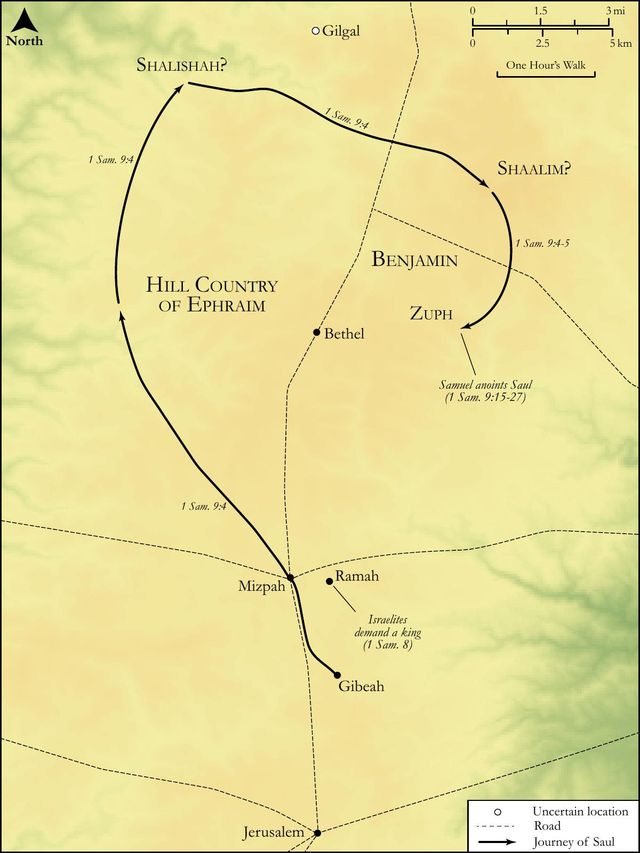
See on the biblical-era map
Study this verse
Public-domain commentary
Matthew Henry
From his Commentary on the Whole Bible. Henry comments on passages, not single verses — this entry covers 1 Samuel 9:18–27. His two-level outline is real structure in the source text, so it is rendered as structure.
Providence having at length brought Samuel and Saul together, we have here an account of what passed between them in the gate, at the feast, and in private.
I.In the gate of the city; passing through that, Saul found him (Sa1 9:18), and, little thinking that he was Samuel himself, asked him the way to Samuel's house: Tell me where the seer's house is; for there he expected to find him. See how mean a figure Samuel made, though so great a man: he took not any state, had no attendants, no ensigns of honour carried before him, nor any distinguishing habit, no, not when he went to church, but appeared, in all respects, so much a common person that Saul, though he was told he should meet him, never suspected that it was he, but, as if he looked more like a porter than a prophet, asked him the way to the seer's house. Thus is great worth oftentimes hidden under a very despicable appearance. Samuel knew that it was not the house, but the man, that he wanted, and therefore answered him, "I am the seer, the person you enquire for," Sa1 9:19. Samuel knew him before he knew Samuel; thus, though all that are called to the kingdom of glory are brought to know God, yet first they were known of him, Gal 4:9. Now,
1.Samuel obliges him to stay with him till the next day. The greatest part of this day had been spent in sacrificing, and the rest of it was to be spent in holy feasting, and therefore, "Tomorrow I will let thee go, and not sooner; now go up before me to the high place; let us pray together, and then we will talk together." Saul had nothing in his mind but to find his asses, but Samuel would take him off from that care, and dispose him to the exercises of piety; and therefore bids him go to the high place, and go before him, because, it may be, some business obliged Samuel to call by the way.
2.He satisfies him about his asses (Sa1 9:20): Set not thy mind on them, be not in further care about them; they are found. By this Saul might perceive that he was a prophet, that he could give him an answer to the enquiry which he had not yet made, and tell him what he thought; and thence he might infer, if a man of God can do this, much more doth God himself understand our thoughts afar off.
3.He surprises him with an intimation of preferment before him: "On whom is all the desire of Israel? Is it not a king that they are set upon, and there is never a man in Israel that will suit them as thou wilt." It does not appear that the country had as yet any eye upon him for the government, because they had left it wholly to God to choose for them; but such a one as he they wished for, and his advancement would be the advancement of his family and relations, as Abner, and others.
4.To this strange intimation Saul returns a very modest answer, Sa1 9:21. Samuel, he thought, did but banter him, because he was a tall man, but a very unlikely man to be a king; for, though the historian says (Sa1 9:1) his father was a mighty man of power, yet he himself speaks diminishingly of his tribe and family. "Benjamin, the youngest of Jacob's sons, when grown up to be a man, was called a little one (Gen 44:20); that tribe was diminished by the war of Gibeah; and I am a Benjamite, my family the least," probably a younger house, not in any place of honour or trust, no, not in their own tribe. Gideon had expressed himself thus, Jdg 6:15. A humble disposition is a good presage of preferment.
II.At the public feast; thither Samuel took him and his servant.
Though the advancement of Saul would be the deposing of Samuel, yet that good prophet was so far from envying him, or bearing him any ill-will for it, that he was the first and forwardest man to do him honour, in compliance with the will of God. If this be the man whom God has chosen, though he be none of Samuel's particular friends or confidants, yet he is heartily welcome to his table, nay, to his bosom. We may suppose it was no unseasonable kindness to Saul to give him a meal's meat, for it seems, by what he said (Sa1 9:7), that all their meat and money were spent. But this was not all. Samuel treats him not as a common person, but a person of quality and distinction, to prepare both him and the people for what was to follow. Two marks of honour he put upon him: - 1. He set him in the best place, as more honourable than any other of the guests, to whom he said, Give this man place, Luk 14:9. Though we may suppose the magistrates were there, who in their own city would claim precedency, yet the master of the feast made Saul and his servant too (who, if Saul was a king, must be respected as his prime minister of state) sit in the chief place, Sa1 9:22. Note, Civil respects must be paid to those who in civil things have the precedency given them by the divine providence. 2. He presented him with the best dish, which, having had notice from heaven the day before of his coming (Sa1 9:16), he had designed for him, and ordered the cook to secure for him, when he gave orders for inviting the guests and making preparation for them. And what should this precious dish be, which was so very carefully reserved for the king-elect? One would expect it should be something very nice and delicate. No, it was a plain shoulder of mutton (Sa1 9:23, Sa1 9:24). The right shoulder of the peace-offerings was to be given to the priests, who were God's receivers (Lev 7:32); the next in honour to that was the left shoulder, which probably was always allotted to those that sat at the upper end of the table, and was wont to be Samuel's mess at other times; so that his giving it to Saul now was an implicit resignation of his place to him. Some observe a significancy in this dish. The shoulder denotes strength, and the breast, which some think went with it, denotes affection: he that was king had the government upon his shoulder, for he must bear the weight of it; and the people in his bosom, for they must be dear to him.
III.What passed between them in private.
Both that evening and early the next morning Samuel communed with Saul upon the flat roof of the house, Sa1 9:25, Sa1 9:26. We may suppose Samuel now told him the whole story of the people's desire of a king, the grounds of their desire, and God's grant of it, to all which Saul, living very privately, was perhaps a stranger; he satisfied him that he was the person God had pitched upon for the government; and whereas Saul would object that Samuel was in possession, and he would not for all the world take it out of his hands, Samuel, we may suppose, gave him all the assurance he could desire of his willingness to resign. Early in the morning he sent him towards home, brought him part of the way, bade him send his servant before, that they might be private (Sa1 9:27), and there, as we find in the beginning of the next chapter, he anointed him, and therein showed him the word of the Lord, that is, gave him full satisfaction that he was the person chosen to be king, for he would not jest with that sacred rite. It is by the unction of the Holy Ghost that Christ, the great prophet, shows us the word of the Lord. Jo1 2:27, the same anointing teacheth you of all things.
Historical interpretation
Historical reception
1 surviving comment on this verse from the historical church.
And Samuel said to the cook, "Bring the portion which I gave you," etc. John spoke in his own language, which was accustomed to provide the audience with the food of life, saying: "Preach the power of the singular virtue, which I commanded you to say was given to no pure man." And she, immediately obeying with a prophetic heart, brought forth words suitable solely to divine power and majesty. And she testified that these belonged to the Mediator of men, to the name of Jesus Christ, saying: "He who has the bride is the bridegroom; and he who comes from above is above all" (John 3). And again: "For God does not give the Spirit by measure. The Father loves the Son and has given all things into His hand" (ibid.).
Continue studying 1 Samuel 9:23 across the web’s major study libraries — every link below opens this exact verse, chapter, or book on the destination site.
Read & Compare
 BibleGatewayThis verse in more than 200 translations and 70 languages.
 Bible.comThe YouVersion reader — hundreds of translations, reading plans, and highlights.
 ESV.orgCrossway's official English Standard Version reader.
 NET BibleThe NET translation with 60,000+ translators' notes on every rendering decision.
 STEP BibleTyndale House's free study tool — original text, vocabulary, and scholarly resources.
 BibliaLogos Bible Software's free web reader.
 USCCBThe New American Bible (Revised Edition) with the U.S. bishops' study notes.
Commentaries
 BibleHub CommentariesDozens of classic commentaries on this verse, gathered on one page.
 StudyLightMore than 100 commentary sets — the largest collection on the web.
 BibleRefPlain-English commentary on what this verse means, verse by verse.
 Enduring WordDavid Guzik's free commentary on this chapter, widely used by Bible teachers.
 Bible Study ToolsVerse commentary alongside Greek and Hebrew study aids.
Original Language & Research
- BibleHub InterlinearThe verse word by word — original language, transliteration, and English.
- BibleHub LexiconEvery word's original-language definition and Strong's entry.
 Blue Letter BibleDeep-study tools — Strong's numbers, concordance, and word studies.
 SefariaThe Hebrew text with Rashi and centuries of Jewish commentary.
Sermons, Hymns & Audio


TrulyRandomVerse is not affiliated with these sites and doesn’t control their content. They’re linked because they’re genuinely useful.
Summary
1 Samuel 9:23 vividly portrays a moment of divine orchestration and prophetic insight, as Samuel, acting upon God's prior revelation, instructs his cook to present a specially reserved portion to Saul. This seemingly simple command is laden with significance, underscoring Samuel's meticulous preparation for Saul's arrival and signaling the imminent anointing of Israel's first king. It highlights the sovereign hand of God at work, meticulously arranging even the smallest details to bring about His monumental purposes.
Context
ShowHideLiterary Context
This verse is strategically placed within the narrative of Saul's unexpected encounter with Samuel in Ramah, following Saul's seemingly mundane search for lost donkeys. Prior to this, the narrative reveals God's explicit instruction to Samuel regarding Saul's arrival and future kingship (1 Samuel 9:15-17). Samuel has already greeted Saul, invited him to dine, and subtly hinted at his destiny by stating that "all the desire of Israel is on you and on all your father's house" (1 Samuel 9:20). The command in verse 23 directly precedes the serving of the meal, where Saul is given the place of honor among "about thirty people" (1 Samuel 9:22), and sets the stage for Saul's anointing as prince over Israel, which immediately follows in 1 Samuel 10:1. Thus, this verse serves as a crucial bridge, transitioning from God's private revelation to Samuel to the public manifestation of Saul's divine appointment.
Historical & Cultural Context
In Israel, as in the households of the patriarchs, hospitality was a deeply ingrained cultural value and a sacred duty. Meals were not merely for sustenance but were profound social and even religious events, often signifying covenant, honor, and fellowship. The practice of reserving and presenting the choicest portion of meat to the most honored guest was a customary and highly visible way to confer status, respect, and favor. Given Samuel's stature as a prophet and judge, his household would have adhered to these customs meticulously. The mention of a "sacrificial feast" in 1 Samuel 9:12-13 further elevates the significance of this meal, as specific portions of sacrifices were often designated for priests or honored individuals, aligning Saul's reception with a sacred, divinely sanctioned act. This cultural practice provides the backdrop against which Samuel's specific instruction to the cook takes on immense symbolic weight for all present.
Key Themes
ShowHide1 Samuel 9:23 powerfully illustrates several overarching themes central to the book of 1 Samuel and the broader biblical narrative. Firstly, it highlights Divine Sovereignty and Providence, demonstrating that Saul's unexpected elevation to kingship was not a random occurrence but a meticulously planned event orchestrated by God, down to the details of a communal meal. God's active hand is evident as He guides Saul's steps and prepares Samuel for his arrival (1 Samuel 9:15-16). Secondly, the verse underscores Prophetic Insight and Obedience, showcasing Samuel's deep communion with God and his faithful execution of divine instructions. Samuel's actions are a direct result of his prophetic discernment, emphasizing the vital role of prophets in mediating God's will to His people. Lastly, the act of reserving the choicest portion for Saul speaks to Hospitality and Honor, signifying Saul's pre-ordained status and the respect due to one chosen by God. This act of honor foreshadows his public anointing and acceptance as Israel's first king, setting a precedent for how God elevates those He chooses, as seen in other instances of divine favor throughout Scripture, such as Joseph's elevation in Egypt (Genesis 41:40-43).
Exposition and Analysis
ShowHideKey Word Analysis
ShowHideThe Hebrew word H2876, ṭabbâch, refers to a "butcher" or "cook." While it can also denote a "lifeguardsman" (due to their role as executioners), in this context, it clearly refers to the one responsible for preparing and serving the food. The choice of this specific individual for such an important task highlights the domestic yet significant setting of Samuel's actions, demonstrating that even the household staff were involved in the divine orchestration.
The Hebrew word H4490, mânâh, signifies "something weighed out," a "division," or specifically, a "ration" of food. This term emphasizes that the meat given to Saul was not a random piece but a particular, pre-selected, and likely choicest cut. Its use here reinforces the idea of intentionality and a divinely appointed share, indicating a deliberate act of setting aside a specific part for a specific, honored recipient.
The Hebrew word H7760, sûwm (or śîm), is a primitive root meaning "to put." It is used with broad application, including to "appoint," "lay," or "preserve." In this context, "Set it by thee" conveys the instruction to reserve or keep something separate and ready for a specific purpose or person. This command to the cook indicates Samuel's prior arrangement and foreknowledge, demonstrating that he had already given instructions to set aside this particular portion for an anticipated guest, long before Saul's arrival, highlighting the precision and foresight of Samuel's actions, guided by divine revelation.
Verse Breakdown
ShowHide"And Samuel said unto the cook,"
This opening clause immediately establishes the direct line of command from Samuel, underscoring his authority within his household and his role as the orchestrator of the meal. It places the instruction within a domestic setting, yet one imbued with prophetic significance, as Samuel acts on divine foreknowledge.
"Bring the portion which I gave thee,"
This part of the command reveals a pre-existing arrangement between Samuel and his cook. Samuel had previously entrusted a specific "portion" to the cook, implying a distinct instruction to set aside a particular piece of meat. This detail emphasizes Samuel's meticulous preparation and forethought, confirming that Saul's arrival was anticipated and prepared for, not a spontaneous event.
"of which I said unto thee, Set it by thee."
This final clause reiterates and clarifies the original instruction given to the cook, reinforcing the intentionality behind the special treatment Saul was about to receive. The phrase "Set it by thee" (or "keep it for yourself" in the sense of reserving it) confirms that this portion was specifically designated to be "set aside" or "reserved" for a special guest. This detail highlights the pre-ordained honor awaiting Saul, signifying his unique status even before his public anointing.
Literary Devices
ShowHideThe verse employs several key literary devices to convey its profound message. Foreshadowing is prominently featured, as Samuel's precise instructions to the cook subtly hint at Saul's elevated status before his formal anointing. The reserved portion itself acts as a powerful Symbol of divine favor and pre-ordained kingship, visually communicating Saul's unique and chosen position. The concise Dialogue between Samuel and the cook, though brief, is highly significant, serving to reveal Samuel's prophetic insight and his unwavering obedience to God's prior revelation. A subtle layer of Dramatic Irony is present, as Saul remains unaware of his true purpose for being there, while Samuel, the cook, and the discerning reader are privy to the divine orchestration behind the seemingly ordinary act of serving a meal. This irony heightens the sense of God's sovereign control over human events and His meticulous attention to detail.
Theological and Thematic Connections
ShowHide1 Samuel 9:23 serves as a powerful testament to God's meticulous providence and His active involvement in the minute details of human history, particularly in the establishment of leadership. The seemingly small act of reserving a portion of food becomes a tangible sign of divine election, demonstrating that God's plans are not haphazard but carefully orchestrated. This verse underscores the theme that God often prepares the way for His chosen vessels, not only by calling them but also by arranging the circumstances, people, and even the smallest details necessary for their appointed task. It highlights the interplay between divine sovereignty and human agency, as Samuel faithfully executes God's will, ensuring that the chosen one receives due honor and recognition, even before his public revelation. This divine preparation and honor for the chosen leader resonate throughout Scripture, affirming God's active hand in raising up those who will fulfill His purposes.
Reflection and Application
ShowHideThis verse, though brief, offers profound insights into the nature of God's providence and our role in His unfolding plan. It reminds us that God is actively at work in the seemingly insignificant details of our lives, orchestrating circumstances and preparing the way for His purposes. Just as Samuel meticulously prepared for Saul's arrival, God often prepares us and our paths for His divine appointments, even when we are unaware of the bigger picture. This calls us to cultivate a posture of attentiveness and trust, recognizing that God's hand is present even in the mundane. Furthermore, Samuel's obedience to God's prior instruction, even in a domestic setting, teaches us the importance of faithfulness in all areas of life, no matter how small they may seem. Our actions, guided by faith, can be part of God's grand design, contributing to His sovereign will. We are called to honor those whom God places in positions of leadership or significance, reflecting God's own regard for them, and to trust in His perfect timing and provision, knowing that His plans are always for our good and His glory.
Questions for Reflection
ShowHideFAQ
ShowHideWhat was the significance of the "portion" Samuel had reserved for Saul?
ShowHideThe "portion" (Hebrew: mânâh) was not just any piece of food; it was a specially designated, and likely the choicest, cut of meat from the sacrificial feast Samuel had prepared. Its significance was multifaceted: it symbolized divine honor and favor, marked Saul as the pre-ordained guest of honor, and visually communicated his special status before his public anointing as Israel's first king. In Israel, offering the best portion to a guest was a profound gesture of respect and recognition, as when Joseph gave Benjamin a mess five times as large as any of his brothers', underscoring that Saul's visit was not coincidental but part of God's sovereign plan, as revealed to Samuel beforehand (1 Samuel 9:15-16).
How did Samuel know to prepare this special portion for Saul?
ShowHideSamuel knew because God had divinely revealed Saul's imminent arrival to him the day before. 1 Samuel 9:15-16 explicitly states that the Lord had "told Samuel in his ear a day before Saul came, saying, Tomorrow about this time I will send thee a man out of the land of Benjamin, and thou shalt anoint him to be captain over my people Israel." Samuel, acting on this prophetic insight and divine instruction, meticulously prepared the feast and reserved the special portion, demonstrating his obedience and deep connection with God's unfolding plan.
Christ-Centered Fulfillment
ShowHideWhile 1 Samuel 9:23 directly concerns the anointing of Israel's first king, Saul, it profoundly foreshadows the ultimate divine appointment and the prepared "portion" for humanity in Jesus Christ. Just as Samuel, guided by God's precise instruction, prepared a special place of honor and a unique portion for Saul, God the Father meticulously prepared the way for His Son, Jesus, who would be the true King of Israel and of all creation. Jesus is the ultimate "chosen portion" for humanity, the Lamb of God who was "foreknown before the foundation of the world" (1 Peter 1:20) and "prepared" for His redemptive work. His coming was not coincidental but the culmination of God's eternal plan, meticulously orchestrated down to every detail, from His miraculous birth (Luke 1:31-33) to His sacrificial death and glorious resurrection. The temporal honor bestowed upon Saul through a physical portion pales in comparison to the spiritual honor and eternal life offered to those who partake in Christ, the Bread of Life (John 6:35) and the true Passover Lamb (1 Corinthians 5:7). He is the ultimate "portion" given by God for our salvation and eternal sustenance, inviting all to His divinely prepared feast, the "marriage supper of the Lamb" (Revelation 19:9).