


1 Samuel 9:22
Bible text: King James Version (1769 Blayney text) · Public domain
Bible text: King James Version with Strong's numbers · Public domain
Bible text: Berean Standard Bible · Public domain
Bible text: American Standard Version (1901) · Public domain
Bible text: World English Bible, Messianic edition · Public domain
Bible text: Geneva Bible (1599) · Public domain
Bible text: Young's Literal Translation · Public domain
- וַיִּקַּחvai·yi·Kachand he tookH3947Conj-w ¦ V-Qal-ConsecImperf-3msVerb Qal Consecutive Imperfect 3rd Singular Masculineוַandיִּקַּחhe took
- שְׁמוּאֵלshe·mu·'ElSamuelH8050N-proper-mNoun Proper Masculine
- אֶת'et<obj.>H853DirObjMParticle Object Indicator
- שָׁאוּלsha·'UlSaulH7586N-proper-mNoun Proper Masculine
- וְאֶתve·'Etand <obj.>H853Conj-w ¦ DirObjMParticle Object Indicatorוְandאֶת<obj.>
- נַעֲרוֹna·'a·Rohis servantH5288N-msc ¦ 3msNoun Singular Masculine Constructנַעֲרservantוֹhis
- וַיְבִיאֵםvay·vi·'Emand he brought themH935Conj-w ¦ V-Hiphil-ConsecImperf-3ms ¦ 3mpVerb Hiphil Consecutive Imperfect 3rd Singular Masculineוַandיְבִיאֵhe broughtםthem
- לִשְׁכָּתָהlish·Ka·tah[the] room towardsH3957N-fs ¦ SfxNoun Singular Feminine Absoluteלִשְׁכָּתָ[the] roomהtowards
- וַיִּתֵּןvai·yi·Tenand he gaveH5414Conj-w ¦ V-Qal-ConsecImperf-3msVerb Qal Consecutive Imperfect 3rd Singular Masculineוַandיִּתֵּןhe gave
- לָהֶםla·Hemto <the> themPrep-l ¦ 3mpSuffix Personal 3rd Plural Masculineלָto <the>הֶםthem
- מָקוֹםma·kOma placeH4725N-msNoun Singular Masculine Absolute
- בְּרֹאשׁbe·Roshat [the] head ofH7218Prep-b ¦ N-mscNoun Singular Masculine Constructבְּatרֹאשׁ[the] head of
- הַקְּרוּאִיםha·ke·ru·'Imthose [who] were invitedH7121Art ¦ V-Qal-PassPrtcpl-mpVerb Qal Participle Passive Plural Masculine Absoluteהַthoseקְּרוּאִים[who] were invited
- וְהֵמָּהve·He·mahand theyH1992Conj-w ¦ Pro-3mpPronoun Personal 3rd Plural Masculineוְandהֵמָּהthey
- כִּשְׁלֹשִׁיםkish·lo·Shim[were] about thirtyH7970Prep-k ¦ N-mpNoun Plural Masculine Absoluteכִּ[were] aboutשְׁלֹשִׁיםthirty
- אִישׁ'IshmanH376N-msNoun Singular Masculine Absolute
English is a literal word-by-word gloss of the Hebrew, not the KJV's wording. Why?
This is the original text the KJV's translators worked from — each Hebrew word with its own literal English meaning in this verse, prepared by scholars at Tyndale House, Cambridge. The KJV translates whole sentences, not word by word, so its wording differs: one Hebrew word can become several English words, and the KJV may choose “the LORD” where the gloss reads “Yahweh”. Both are faithful — they answer different questions. For the KJV's own rendering, switch to the KJV text.
Details
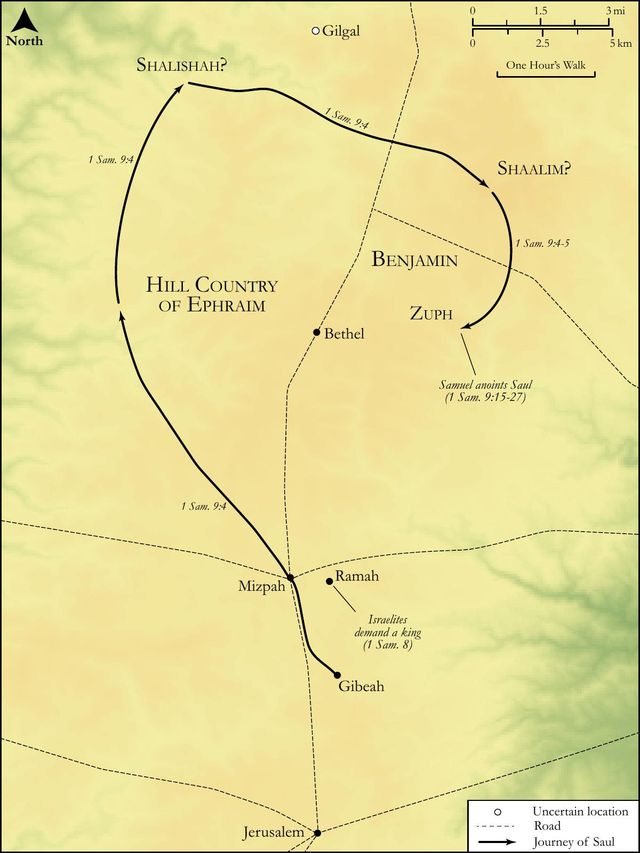
See on the biblical-era map
Study this verse
Public-domain commentary
Matthew Henry
From his Commentary on the Whole Bible. Henry comments on passages, not single verses — this entry covers 1 Samuel 9:18–27. His two-level outline is real structure in the source text, so it is rendered as structure.
Providence having at length brought Samuel and Saul together, we have here an account of what passed between them in the gate, at the feast, and in private.
I.In the gate of the city; passing through that, Saul found him (Sa1 9:18), and, little thinking that he was Samuel himself, asked him the way to Samuel's house: Tell me where the seer's house is; for there he expected to find him. See how mean a figure Samuel made, though so great a man: he took not any state, had no attendants, no ensigns of honour carried before him, nor any distinguishing habit, no, not when he went to church, but appeared, in all respects, so much a common person that Saul, though he was told he should meet him, never suspected that it was he, but, as if he looked more like a porter than a prophet, asked him the way to the seer's house. Thus is great worth oftentimes hidden under a very despicable appearance. Samuel knew that it was not the house, but the man, that he wanted, and therefore answered him, "I am the seer, the person you enquire for," Sa1 9:19. Samuel knew him before he knew Samuel; thus, though all that are called to the kingdom of glory are brought to know God, yet first they were known of him, Gal 4:9. Now,
1.Samuel obliges him to stay with him till the next day. The greatest part of this day had been spent in sacrificing, and the rest of it was to be spent in holy feasting, and therefore, "Tomorrow I will let thee go, and not sooner; now go up before me to the high place; let us pray together, and then we will talk together." Saul had nothing in his mind but to find his asses, but Samuel would take him off from that care, and dispose him to the exercises of piety; and therefore bids him go to the high place, and go before him, because, it may be, some business obliged Samuel to call by the way.
2.He satisfies him about his asses (Sa1 9:20): Set not thy mind on them, be not in further care about them; they are found. By this Saul might perceive that he was a prophet, that he could give him an answer to the enquiry which he had not yet made, and tell him what he thought; and thence he might infer, if a man of God can do this, much more doth God himself understand our thoughts afar off.
3.He surprises him with an intimation of preferment before him: "On whom is all the desire of Israel? Is it not a king that they are set upon, and there is never a man in Israel that will suit them as thou wilt." It does not appear that the country had as yet any eye upon him for the government, because they had left it wholly to God to choose for them; but such a one as he they wished for, and his advancement would be the advancement of his family and relations, as Abner, and others.
4.To this strange intimation Saul returns a very modest answer, Sa1 9:21. Samuel, he thought, did but banter him, because he was a tall man, but a very unlikely man to be a king; for, though the historian says (Sa1 9:1) his father was a mighty man of power, yet he himself speaks diminishingly of his tribe and family. "Benjamin, the youngest of Jacob's sons, when grown up to be a man, was called a little one (Gen 44:20); that tribe was diminished by the war of Gibeah; and I am a Benjamite, my family the least," probably a younger house, not in any place of honour or trust, no, not in their own tribe. Gideon had expressed himself thus, Jdg 6:15. A humble disposition is a good presage of preferment.
II.At the public feast; thither Samuel took him and his servant.
Though the advancement of Saul would be the deposing of Samuel, yet that good prophet was so far from envying him, or bearing him any ill-will for it, that he was the first and forwardest man to do him honour, in compliance with the will of God. If this be the man whom God has chosen, though he be none of Samuel's particular friends or confidants, yet he is heartily welcome to his table, nay, to his bosom. We may suppose it was no unseasonable kindness to Saul to give him a meal's meat, for it seems, by what he said (Sa1 9:7), that all their meat and money were spent. But this was not all. Samuel treats him not as a common person, but a person of quality and distinction, to prepare both him and the people for what was to follow. Two marks of honour he put upon him: - 1. He set him in the best place, as more honourable than any other of the guests, to whom he said, Give this man place, Luk 14:9. Though we may suppose the magistrates were there, who in their own city would claim precedency, yet the master of the feast made Saul and his servant too (who, if Saul was a king, must be respected as his prime minister of state) sit in the chief place, Sa1 9:22. Note, Civil respects must be paid to those who in civil things have the precedency given them by the divine providence. 2. He presented him with the best dish, which, having had notice from heaven the day before of his coming (Sa1 9:16), he had designed for him, and ordered the cook to secure for him, when he gave orders for inviting the guests and making preparation for them. And what should this precious dish be, which was so very carefully reserved for the king-elect? One would expect it should be something very nice and delicate. No, it was a plain shoulder of mutton (Sa1 9:23, Sa1 9:24). The right shoulder of the peace-offerings was to be given to the priests, who were God's receivers (Lev 7:32); the next in honour to that was the left shoulder, which probably was always allotted to those that sat at the upper end of the table, and was wont to be Samuel's mess at other times; so that his giving it to Saul now was an implicit resignation of his place to him. Some observe a significancy in this dish. The shoulder denotes strength, and the breast, which some think went with it, denotes affection: he that was king had the government upon his shoulder, for he must bear the weight of it; and the people in his bosom, for they must be dear to him.
III.What passed between them in private.
Both that evening and early the next morning Samuel communed with Saul upon the flat roof of the house, Sa1 9:25, Sa1 9:26. We may suppose Samuel now told him the whole story of the people's desire of a king, the grounds of their desire, and God's grant of it, to all which Saul, living very privately, was perhaps a stranger; he satisfied him that he was the person God had pitched upon for the government; and whereas Saul would object that Samuel was in possession, and he would not for all the world take it out of his hands, Samuel, we may suppose, gave him all the assurance he could desire of his willingness to resign. Early in the morning he sent him towards home, brought him part of the way, bade him send his servant before, that they might be private (Sa1 9:27), and there, as we find in the beginning of the next chapter, he anointed him, and therein showed him the word of the Lord, that is, gave him full satisfaction that he was the person chosen to be king, for he would not jest with that sacred rite. It is by the unction of the Holy Ghost that Christ, the great prophet, shows us the word of the Lord. Jo1 2:27, the same anointing teacheth you of all things.
Historical interpretation
Historical reception
1 surviving comment on this verse from the historical church.
Therefore, taking Samuel, Saul, and his servant, he brought them into the dining hall, etc. The dining hall in Greek is called the coenaculum. It is called the dining hall from the three couches of those reclining thus named. For in Greek, they call a couch or bed klini. Indeed, among the ancients, in the place where the banquet was prepared, three couches were spread, on which those reclining feasted. Therefore, John, by preaching, called many to the feasts of virtues, preferring to all these Christ and His apostles, even those coming later; and rightly, because only through His baptism, which began to be given by their ministry, could the hall of the heavenly kingdom be opened. For those whom he taught would fulfill the Decalogue of the law through the recognition of the Holy Trinity with a strong and tireless mind.
Continue studying 1 Samuel 9:22 across the web’s major study libraries — every link below opens this exact verse, chapter, or book on the destination site.
Read & Compare
 BibleGatewayThis verse in more than 200 translations and 70 languages.
 Bible.comThe YouVersion reader — hundreds of translations, reading plans, and highlights.
 ESV.orgCrossway's official English Standard Version reader.
 NET BibleThe NET translation with 60,000+ translators' notes on every rendering decision.
 STEP BibleTyndale House's free study tool — original text, vocabulary, and scholarly resources.
 BibliaLogos Bible Software's free web reader.
 USCCBThe New American Bible (Revised Edition) with the U.S. bishops' study notes.
Commentaries
 BibleHub CommentariesDozens of classic commentaries on this verse, gathered on one page.
 StudyLightMore than 100 commentary sets — the largest collection on the web.
 BibleRefPlain-English commentary on what this verse means, verse by verse.
 Enduring WordDavid Guzik's free commentary on this chapter, widely used by Bible teachers.
 Bible Study ToolsVerse commentary alongside Greek and Hebrew study aids.
Original Language & Research
- BibleHub InterlinearThe verse word by word — original language, transliteration, and English.
- BibleHub LexiconEvery word's original-language definition and Strong's entry.
 Blue Letter BibleDeep-study tools — Strong's numbers, concordance, and word studies.
 SefariaThe Hebrew text with Rashi and centuries of Jewish commentary.
Sermons, Hymns & Audio


TrulyRandomVerse is not affiliated with these sites and doesn’t control their content. They’re linked because they’re genuinely useful.
Summary
1 Samuel 9:22 meticulously details the prophet Samuel's deliberate and public act of honoring Saul, the future king of Israel, by seating him and his servant in the most prominent position at a communal sacrificial feast. This seemingly simple gesture, occurring among approximately thirty invited guests, was a divinely orchestrated prelude to Saul's anointing, subtly elevating him in the eyes of the community and signifying his imminent transition from an ordinary Benjamite to the nation's chosen leader.
Context
ShowHideLiterary Context
This verse is a crucial moment in the unfolding narrative of Israel's transition from a tribal confederacy led by judges to a monarchy. Immediately preceding this, God had revealed to Samuel His divine plan to send a man from Benjamin to be king, instructing Samuel to anoint him. Saul, a young man from the tribe of Benjamin, had arrived in Ramah, Samuel's residence, on a seemingly mundane quest to find his father's lost donkeys. Unbeknownst to Saul, his journey was divinely orchestrated, leading him directly to the prophet. Samuel, guided by the Lord, recognized Saul upon his arrival and, rather than immediately anointing him, invited him to a sacrificial feast, a significant communal and religious event. This verse describes the specific arrangement at that feast, where Samuel publicly distinguishes Saul, setting the stage for the private anointing and subsequent public revelation of his kingship. The narrative meticulously builds anticipation, showing God's hand in every detail, from Saul's lost donkeys to his honored seat.
Historical & Cultural Context
Sacrificial feasts were integral to ancient Israelite religious and social life, serving as communal meals that fostered fellowship, expressed devotion, and often accompanied significant religious events or decisions. The "parlour" (Hebrew: lishkah) would have been a designated chamber or dining hall, likely part of a larger complex associated with Samuel's prophetic activities or a local high place where sacrifices were offered. In Israel, seating arrangements at feasts were highly significant, reflecting social hierarchy, honor, and status, as when Joseph's brothers sat before him "the firstborn according to his birthright, and the youngest according to his youth." To be placed in the "chiefest place" (literally, "head of those invited") was a profound public gesture of respect and elevation, signaling to all present that the individual held a position of unique importance. This act by Samuel was not merely a courtesy but a public, symbolic endorsement, preparing the community for the extraordinary role Saul was about to assume, even before his anointing was widely known. It underscored Samuel's authority as a prophet to designate leaders on God's behalf.
Key Themes
ShowHideThis verse powerfully illustrates several overarching themes within 1 Samuel and the broader biblical narrative. Firstly, it highlights Divine Providence, demonstrating God's sovereign hand at work in seemingly ordinary circumstances; Saul's search for donkeys was a divinely orchestrated path to his destiny as king, echoing how God often uses mundane events to fulfill His grand purposes, as seen in the life of Joseph or David's anointing. Secondly, the theme of Elevation and Honor is prominent, as Samuel's public act of placing Saul in the chiefest seat signifies a transition from an unknown individual to one destined for extraordinary leadership. This pre-anointing honor foreshadows Saul's future kingship and the weight of responsibility that comes with it. Lastly, the verse underscores Samuel's Obedience and Wisdom. Samuel faithfully executes God's instructions, not impulsively, but with strategic wisdom, preparing both Saul and the community for the momentous shift in national leadership, reflecting the importance of prophetic discernment in God's plan for Israel, as also seen in Moses' leadership.
Exposition and Analysis
ShowHideKey Word Analysis
ShowHideThis primitive root (H3947) signifies "to take" in a wide variety of applications, including to accept, bring, fetch, or seize. In this context, Samuel's action of "taking" Saul and his servant emphasizes his active and deliberate role in leading them. It implies a purposeful escort and an intentional act of inclusion and elevation, rather than a mere casual invitation. This verb highlights Samuel's authoritative and divinely guided initiative in setting the stage for Saul's public recognition.
Derived from an unused root (H3957), this term refers to a room or chamber within a building, specifically one used for storage, eating, or lodging. Here, it denotes a designated dining hall or chamber where the sacrificial feast was held. The use of lishkâh suggests a formal, perhaps semi-private, and intentional setting for this significant communal meal, underscoring the formality and importance of the event orchestrated by Samuel as a prelude to Saul's anointing.
This word (H7218) literally means "head" or "top," but is used figuratively here to denote the highest rank, principal position, or most prominent spot. When combined with "them that were bidden" (from H7121, qârâʼ, meaning "called out to" or "invited"), it signifies the seat of supreme honor and preeminence among the guests. Samuel's action of placing Saul in this position was a profound public declaration of Saul's elevated status, a visible sign of his special favor and future leadership, even before his anointing was widely known. It was a strategic move to establish Saul's authority and dignity in the eyes of the community.
Verse Breakdown
ShowHide"And Samuel took Saul and his servant"
This clause highlights Samuel's direct, personal involvement and authoritative action. The verb "took" (Hebrew: lâqach) implies a deliberate act of leading and receiving, not merely a casual invitation. The inclusion of Saul's servant underscores the comprehensive nature of Samuel's hospitality and the complete integration of Saul's party into this significant event, lending credibility to Saul's presence and foreshadowing his future elevation.
"and brought them into the parlour"
This action signifies a purposeful transition from a general gathering area to a more intimate and significant setting for the feast. The "parlour" (Hebrew: lishkâh) was a designated chamber or dining hall, emphasizing the formal, sacred, and social importance of the occasion. It was within this specific, intentional space that the key interactions and revelations concerning Saul's destiny would unfold.
"and made them sit in the chiefest place among them that were bidden"
This is the pivotal action of the verse, a profound public gesture of honor and distinction. Samuel, acting under divine instruction, deliberately assigns Saul the seat of highest prominence. In Israel, seating arrangements were highly symbolic, communicating status, authority, and respect. This calculated move was designed to set Saul apart from the other guests and subtly prepare them for his future role, serving as a visible sign of his preeminence and divine favor.
"which [were] about thirty persons"
The specific mention of the approximate number of guests provides crucial context for the intimacy and strategic significance of the gathering. It was not a vast public assembly but a select group, likely composed of local elders, prominent individuals, or Samuel's trusted associates. Placing Saul in the chiefest place among this relatively small, influential group ensured that his elevation was noticed and understood by those who held sway in the community, lending weight and legitimacy to his impending kingship.
Literary Devices
ShowHideThe passage in 1 Samuel 9:22 employs several significant literary devices that enrich its meaning and impact. Foreshadowing is prominently featured, as Samuel's deliberate act of seating Saul in the "chiefest place" subtly but powerfully hints at Saul's impending anointing as king. This public elevation precedes the private revelation, building anticipation for both Saul and the reader regarding his future role. The "chiefest place" itself serves as potent Symbolism, representing not merely a seat of honor at a meal but the very throne and position of authority that Saul is destined to occupy as Israel's first king. It is a visual metaphor for his future kingship. Furthermore, there is an element of Divine Irony at play: Saul, an ordinary man from the smallest tribe, is on a seemingly mundane search for lost donkeys, yet this journey leads him directly to a prophetic encounter that culminates in his being seated in the place of highest honor, entirely unaware of the divine appointment unfolding around him. This highlights God's sovereign control over seemingly random events, demonstrating His ability to use the ordinary for extraordinary purposes.
Theological and Thematic Connections
ShowHideThis verse powerfully illustrates the theme of divine election and the often-surprising ways God initiates His plans. Samuel's actions are not arbitrary but a direct fulfillment of God's prior revelation, showcasing a God who actively intervenes in human affairs to raise up leaders for His people. The public honor bestowed upon Saul, even before his anointing, underscores the principle that God often prepares a person for a role by first establishing their credibility and authority in the eyes of others. This pre-anointing elevation also serves as a testament to Samuel's prophetic obedience and wisdom, as he carefully navigates the delicate process of introducing Israel's first king. The narrative emphasizes that true authority and honor originate from God, not from human ambition or achievement, setting a crucial theological precedent for leadership within God's covenant community.
Reflection and Application
ShowHideThe scene in 1 Samuel 9:22 offers profound insights into God's sovereign orchestrations and our posture within His plans. Just as Saul was unknowingly led to his destiny, we too can trust that God is at work in our lives, even in the mundane or perplexing moments. Our seemingly ordinary tasks or unexpected detours might be precisely where God is positioning us for His extraordinary purposes. This verse encourages us to cultivate a spirit of humility and availability, recognizing that true honor and elevation come from God's hand, not from our own striving. Samuel's wisdom in publicly honoring Saul before his full revelation also reminds us of the importance of recognizing and affirming God-given leadership within our communities. It challenges us to consider how we might, like Samuel, discern and support those whom God is raising up, always remembering that God's ways are often surprising and transcend human expectations. Our role is to remain faithful and observant, trusting that His divine providence is always at work, even when the full picture is not yet clear.
Questions for Reflection
ShowHideFAQ
ShowHideWhy did Samuel seat Saul in the "chiefest place" before anointing him king?
ShowHideSamuel's action was a divinely orchestrated public gesture, a subtle but powerful foreshadowing of Saul's imminent kingship. By placing Saul in the most honored seat among the invited guests, Samuel was publicly distinguishing him and subtly preparing the community for his future elevation. This act served to establish Saul's prominence and dignity in the eyes of key individuals present at the feast, lending weight to the authority he would soon receive. It was a strategic move by Samuel, guided by God, to ensure a smooth transition of leadership and to underscore that Saul's appointment was not arbitrary but divinely sanctioned. This pre-anointing honor was part of God's careful plan to introduce Israel's first king.
What was the significance of the "parlour" and the "thirty persons" at the feast?
ShowHideThe "parlour" (Hebrew: lishkâh) was likely a designated chamber or dining hall, indicating a more formal and intimate setting for the feast rather than a casual gathering. This specific location underscored the importance of the event. The mention of "about thirty persons" suggests a select group of guests, likely prominent individuals, elders, or Samuel's close associates. This relatively small, influential gathering meant that Saul's public elevation would be witnessed and understood by those who held sway in the community. It was a carefully curated audience, ensuring that the symbolic act of seating Saul in the "chiefest place" would have maximum impact among those who mattered, further solidifying his future position. This intimate setting allowed Samuel to subtly introduce Saul's significance before his public anointing, as described later in 1 Samuel 10:17-24.
Christ-Centered Fulfillment
ShowHideThe elevation of Saul in 1 Samuel 9:22, though a pivotal moment in Israel's history, ultimately points beyond itself to the ultimate King, Jesus Christ. Saul was chosen from among his brethren, elevated to a place of honor, and anointed to lead God's people, yet his reign would ultimately falter due to disobedience and pride, as detailed in 1 Samuel 15. In stark contrast, Jesus, the true Son of David, was not merely given the "chiefest place" at a feast, but was divinely appointed before the foundation of the world, eternally seated at the right hand of God in the ultimate place of honor and authority (Hebrews 1:3). While Saul's anointing was a temporary, earthly kingship, Christ's anointing by the Holy Spirit was for an eternal, spiritual kingdom (Luke 1:32-33). Saul was chosen to deliver Israel from physical enemies, but Christ, the true Lamb of God, was chosen to deliver humanity from the ultimate enemy, sin and death (John 1:29). Thus, Saul's initial, divinely orchestrated elevation foreshadows the perfect, unwavering, and eternal reign of Jesus, who truly holds the "chiefest place" over all creation (Colossians 1:18).