


1 Samuel 17:31
Bible text: King James Version (1769 Blayney text) · Public domain
Bible text: Berean Standard Bible · Public domain
Bible text: American Standard Version (1901) · Public domain
Bible text: World English Bible, Messianic edition · Public domain
Bible text: Geneva Bible (1599) · Public domain
Bible text: Young's Literal Translation · Public domain
- וַיְּשָּׁמְעוּvai·ye·sha·me·'Uand they were heardH8085Conj-w ¦ V-Niphal-ConsecImperf-3mpVerb Niphal Consecutive Imperfect 3rd Plural Masculineוַandיְּשָּׁמְעוּthey were heard
- הַדְּבָרִיםha·de·va·Rimthe wordsH1697Art ¦ N-mpNoun Plural Masculine Absoluteהַtheדְּבָרִיםwords
- אֲשֶׁר'a·SherwhichH834RelParticle Relative
- דִּבֶּרdi·Berhe spokeH1696V-Piel-Perf-3msVerb Piel Perfect 3rd Singular Masculine
- דָּוִדda·VidDavidH1732N-proper-mNoun Proper Masculine
- וַיַּגִּדוּvai·ya·Gi·duand people toldH5046Conj-w ¦ V-Hiphil-ConsecImperf-3mpVerb Hiphil Consecutive Imperfect 3rd Plural Masculineוַandיַּגִּדוּpeople told
- לִפְנֵיlif·nei<to> beforeH6440Prep-l ¦ N-mpcNoun Plural Masculine Constructלִ<to>פְנֵיbefore
- שָׁאוּלsha·'UlSaulH7586N-proper-mNoun Proper Masculine
- וַיִּקָּחֵהוּvai·yi·ka·Che·huand he sent for himH3947Conj-w ¦ V-Qal-ConsecImperf-3ms ¦ 3msVerb Qal Consecutive Imperfect 3rd Singular Masculineוַandיִּקָּחֵhe sent forהוּhim
English is a literal word-by-word gloss of the Hebrew, not the KJV's wording. Why?
This is the original text the KJV's translators worked from — each Hebrew word with its own literal English meaning in this verse, prepared by scholars at Tyndale House, Cambridge. The KJV translates whole sentences, not word by word, so its wording differs: one Hebrew word can become several English words, and the KJV may choose “the LORD” where the gloss reads “Yahweh”. Both are faithful — they answer different questions. For the KJV's own rendering, switch to the KJV text.
Details
See on the biblical-era map
Study this verse
Public-domain commentary
Matthew Henry
From his Commentary on the Whole Bible. Henry comments on passages, not single verses — this entry covers 1 Samuel 17:31–39. His three-level outline is real structure in the source text, so it is rendered as structure.
David is at length presented to Saul for his champion (Sa1 17:31) and he bravely undertakes to fight the Philistine (Sa1 17:32): Let no man's heart fail because of him. It would have reflected too much upon the valour of his prince if he had said, Let not thy heart fail; therefore he speaks generally: Let no man's heart fail. A little shepherd, come but this morning from keeping sheep, has more courage than all the mighty men of Israel, and encourages them. Thus does God often send good words to his Israel, and do great things for them, by the weak and foolish things of the world. David only desires a commission from Saul to go and fight with the Philistine, but says nothing to him of the reward he had proposed, because that was not the thing he was ambitious of, but only the honour of serving God and his country: nor would he seem to question Saul's generosity. Two things David had to do with Saul: -
I.To get clear of the objection Saul made against his undertaking.
"Alas!" says Saul, "thou hast a good heart to it, but art by no means an equal match for this Philistine. To engage with him is to throw away a life which may better be reserved for more agreeable services. Thou art but a youth, rash and inconsiderate, weak and unversed in arms: he is a man that has the head and hands of a man, a man of war, trained up and inured to it from his youth (Sa1 17:33), and how canst thou expect but that he will be too hard for thee?" David, as he had answered his brother's passion with meekness, so he answered Saul's fear with faith, and gives a reason of the hope which was in him that he should conquer the Philistine, to the satisfaction of Saul. We have reason to fear that Saul had no great acquaintance with nor regard to the word of God, and therefore David, in reasoning with him, fetched not his arguments and encouragements thence, how much soever he had an eye to it in his own mind. But he argues from experience; though he was but a youth, and never in the wars, yet perhaps he had done as much as the killing of Goliath came to, for he had had, by divine assistance, spirit enough to encounter and strength enough to subdue a lion once and another time a bear that robbed him of his lambs, Sa1 17:34-36. To these he compares this uncircumcised Philistine, looks upon him to be as much a ravenous beast as either of them, and therefore doubts not but to deal as easily with him; and hereby he gives Saul to understand that he was not so inexperienced in hazardous combats as he took him to be.
1.He tells his story like a man of spirit. He is not ashamed to own that he kept his father's sheep, which his brother had just now upbraided him with. So far is he from concealing it that from his employment as a shepherd he fetches the experience that now animated him. But he lets those about him know that he was no ordinary shepherd. Whatever our profession or calling is, be it ever so mean, we should labour to excel in it, and do the business of it in the best manner. When David kept sheep,
(1.)He approved himself very careful and tender of his flock, though it was not his own, but his father's. He could not see a lamb in distress but he would venture his life to rescue it. This temper made him fit to be a king, to whom the lives of subjects should be dear and their blood precious (Psa 72:14), and fit to be a type of Christ, the good Shepherd, who gathers the lambs in his arms and carries them in his bosom (Isa 40:11), and who not only ventured, but laid down his life for his sheep. Thus too was David fit to be an example to ministers with the utmost care and diligence to watch for souls, that they be not a prey to the roaring lion.
(2.)He approved himself very bold and brave in the defence of his flock. This was that which he was now concerned to give proof of, and better evidence could not be demanded than this: "Thy servant not only rescued the lambs, but, to revenge the injury, slew both the lion and the bear."
2.He applies his story like a man of faith. He owns (Sa1 17:37) it was the Lord that delivered him from the lion and the bear; to him he gives the praise of that great achievement, and thence he infers, He will deliver me out of the hand of this Philistine. "The lion and the bear were enemies only to me and my sheep, and it was in defence of my own interest that I attacked them; but this Philistine is an enemy to God and Israel, defies the armies of the living God, and it is for their honour that I attack him." Note,
(1.)Our experiences ought to be improved by us as our encouragements to trust in God and venture in the way of duty. He that has delivered does and will.
(2.)By the care which common Providence takes of the inferior creatures, and the protection they are under, we may be encouraged to depend upon that special Providence which surrounds the Israel of God. He that sets bounds to the waves of the sea and the rage of wild beasts can and will restrain the wrath of wicked men. Paul seems to allude to this of David (Ti2 4:17, Ti2 4:18), I was delivered out of the mouth of the lion, and therefore, I trust, the Lord shall deliver me. And perhaps David here thought of the story of Samson, and encouraged himself with it; for his slaying a lion was a happy presage of his many illustrious victories over the Philistines in single combat. Thus David took off Saul's objection against his undertaking, and gained a commission to fight the Philistine, with which Saul gave him a hearty good wish; since he would not venture himself, he prayed for him that would: Go, and the Lord be with thee, a good word, if it was not spoken customarily, and in a formal manner, as too often it is. But David has somewhat to do likewise,
II.To get clear of the armour wherewith Saul would, by all means, have him dressed up when he went upon this great action (Sa1 17:38):
He armed David with his armour, not that which he wore himself, the disproportion of his stature would not admit that, but some that he kept in his armoury, little thinking that he on whom he now put his helmet and coat of mail must shortly inherit his crown and robe. David, being not yet resolved which way to attack his enemy, girded on his sword, not knowing, as yet, but he should have occasion to make use of it; but he found the armour would but encumber him, and would be rather his burden than his defence, and therefore he desires leave of Saul to put them off again: I cannot go with these, for I have not proved them, that is, "I have never been accustomed to such accoutrements as these." We may suppose Saul's armour was both very fine and very firm, but what good would it do David if it were not fit, or if he knew not how to manage himself in it? Those that aim at things above their education and usage, and covet the attire and armour of princes, forget that that is the best for us which we are fit for and accustomed to; if we had our desire, we should wish to be in our own coat again, and should say, "We cannot go with these;" we had therefore better go without them.
Historical interpretation
Historical reception
1 surviving comment on this verse from the historical church.
The words that David spoke have been heard, etc. The words spoken by Christ about the glory of the coming kingdom were trusted and spread by fame even to the leaders of the Judean empire. And when many of these also came in part to hear the word, He spoke to them; lest they be troubled by the soon-to-be-weakened power of the old deceiver, lest they be disturbed by his soon-to-be-nullified fraud, lest they lose hope in the redemption of the human race, which was already about to come. I, He says, who for this very reason assumed the form of a servant, progressing to greater works of virtue, will conquer the ancient enemy of the world, the devil.
Continue studying 1 Samuel 17:31 across the web’s major study libraries — every link below opens this exact verse, chapter, or book on the destination site.
Read & Compare
 BibleGatewayThis verse in more than 200 translations and 70 languages.
 Bible.comThe YouVersion reader — hundreds of translations, reading plans, and highlights.
 ESV.orgCrossway's official English Standard Version reader.
 NET BibleThe NET translation with 60,000+ translators' notes on every rendering decision.
 STEP BibleTyndale House's free study tool — original text, vocabulary, and scholarly resources.
 BibliaLogos Bible Software's free web reader.
 USCCBThe New American Bible (Revised Edition) with the U.S. bishops' study notes.
Commentaries
 BibleHub CommentariesDozens of classic commentaries on this verse, gathered on one page.
 StudyLightMore than 100 commentary sets — the largest collection on the web.
 BibleRefPlain-English commentary on what this verse means, verse by verse.
 Enduring WordDavid Guzik's free commentary on this chapter, widely used by Bible teachers.
 Bible Study ToolsVerse commentary alongside Greek and Hebrew study aids.
Original Language & Research
- BibleHub InterlinearThe verse word by word — original language, transliteration, and English.
- BibleHub LexiconEvery word's original-language definition and Strong's entry.
 Blue Letter BibleDeep-study tools — Strong's numbers, concordance, and word studies.
 SefariaThe Hebrew text with Rashi and centuries of Jewish commentary.
Sermons, Hymns & Audio


TrulyRandomVerse is not affiliated with these sites and doesn’t control their content. They’re linked because they’re genuinely useful.
Summary
1 Samuel 17:31 marks the pivotal moment when David's audacious and faith-filled words, spoken in response to Goliath's defiance and Israel's widespread fear, were reported to King Saul. This verse serves as the immediate catalyst, bringing the young shepherd boy, previously unknown to the king and the army, directly into the royal presence, thereby setting the stage for his legendary confrontation with the Philistine giant and initiating his public role in Israel's history as God's chosen deliverer.
Context
ShowHideLiterary Context
This verse is strategically positioned within the dramatic narrative of David and Goliath, serving as the critical pivot point that elevates David from obscurity to the king's attention. Prior to this, the Philistine champion Goliath had issued a daily challenge to the armies of Israel for forty days, paralyzing King Saul and his men with fear, as detailed in 1 Samuel 17:1-11. David, a young shepherd, arrives at the battlefield to deliver provisions to his brothers. Upon hearing Goliath's blasphemous taunts and witnessing the terror of the Israelite army, David is deeply indignant, asserting, "Who is this uncircumcised Philistine, that he should defy the armies of the living God?" (1 Samuel 17:26). He expresses unwavering faith in God's ability to deliver Israel, recounting his past victories over a lion and a bear as evidence of divine protection. His bold declarations, which starkly contrast with the prevailing despair and silence, are overheard and subsequently reported, leading directly to the royal summons described in this verse.
Historical & Cultural Context
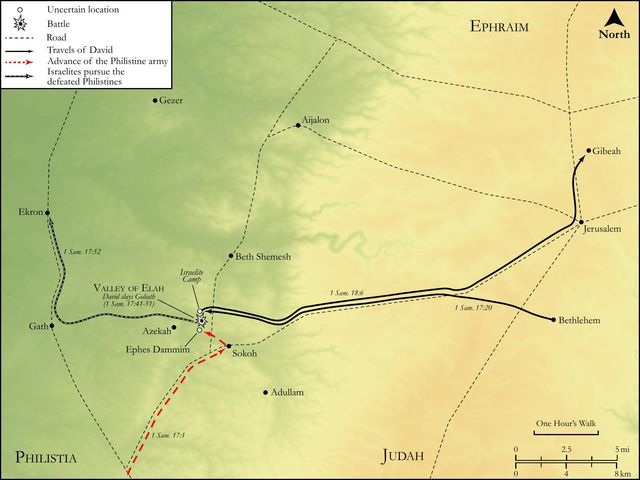
The confrontation unfolds in the Valley of Elah, a strategically vital border region frequently contested between Philistine and Israelite territories. During this period, Israel, under King Saul, was locked in ongoing conflict with the Philistines, a formidable military power known for their superior weaponry and organized forces. The practice of single combat, where champions from opposing armies would fight to determine the outcome of a larger battle, was a recognized, though not universally adopted, custom intended to minimize casualties. Saul, as the anointed king, was expected to lead his people in battle and embody courage, yet he and his army were paralyzed by Goliath's intimidating presence. Culturally, a shepherd boy like David would have occupied a low social status, making his audacious offer to fight Goliath all the more astonishing and counter-cultural. His private anointing by Samuel in 1 Samuel 16:13 had not yet translated into public recognition as a warrior or leader.
Key Themes
ShowHideThe immediate context of 1 Samuel 17 highlights several profound themes. Courage Born of Faith is paramount, as David's audacity is not mere youthful bravado but stems from a deep, unshakeable trust in God's power and covenant faithfulness, standing in stark contrast to the fear that grips the entire Israelite army and its king. This verse also underscores Divine Providence, illustrating how God orchestrates seemingly coincidental events—David's visit to the camp, his indignant words, and their reporting to Saul—to bring about His sovereign purposes, specifically the defeat of Goliath and the elevation of David. Furthermore, it emphasizes The Power of Words, demonstrating how David's confident, faith-filled declarations, unlike the fearful whispers of others, carried sufficient weight and conviction to reach the king's ears and prompt a royal summons. This moment also marks David's transition From Obscurity to Prominence, as a humble shepherd boy is brought into the king's presence, not by ambition, but by the Spirit-inspired impact of his words, setting the stage for his destiny as Israel's future king, a destiny already foretold in 1 Samuel 16.
Exposition and Analysis
ShowHideKey Word Analysis
ShowHideThis term (H1697) is more expansive than merely spoken utterances; it can refer to a "matter," "thing," "affair," or "decree." In this context, David's "words" were not just casual remarks but carried the weight of a significant declaration, an expressed intention, and a challenge to the status quo. They were weighty enough to be considered a "matter" worthy of royal attention, signifying their profound impact and substance.
The verb (H8085) implies not just the physical act of hearing, but also intelligent listening, understanding, and often, the implication of attention or even obedience. Here, it suggests that David's words were not simply overheard but were listened to and comprehended for their profound significance, their challenge to Goliath's defiance, and their potential implications for the stalled battle. The fact that they were "heard" implies they resonated with those who heard them, prompting them to act.
This primitive root (H5046) properly means "to front," i.e., to stand boldly out opposite, and by implication, to "manifest" or "announce." In this context, it means "reported" or "recounted" to someone present. It signifies a deliberate and formal act of conveying what was heard, emphasizing that David's statements were not casual or fleeting but were significant enough to be formally communicated to the highest authority in Israel, highlighting their profound impact and the unusual nature of David's bold speech.
Verse Breakdown
ShowHide"And when the words were heard which David spake"
This opening clause immediately establishes the public and impactful nature of David's declarations. His words, filled with faith and indignation against Goliath's defiance of God's armies, were not whispered in private but were spoken openly enough to be heard by others, likely members of the Israelite army and perhaps even Saul's own court. The emphasis is on the content and conviction of David's speech, which stood out amidst the prevailing fear, silence, and despair of the Israelite camp.
"they rehearsed [them] before Saul"
This is the crucial turning point in the narrative. The significant "words" David spoke, brimming with faith and a righteous anger against Goliath's blasphemy, were deemed so extraordinary by those who heard them that they were formally reported or recounted directly to King Saul. This act of reporting indicates that David's statements were perceived as offering a glimmer of hope, a potential solution, or at least a stark challenge to the king's inaction, thus bridging the gap between David's private conviction and his public introduction.
"and he sent for him"
This final phrase describes Saul's immediate and decisive response to the report. The king's summons (using the verb H3947, lâqach, meaning "to take" or "send for") signifies David's official entry onto the national stage. Up until this point, David was largely unknown to the army and the king, serving humbly as a shepherd. His words, however, were so striking—so filled with unusual courage and conviction—that they could not be ignored, prompting the king to personally investigate this unexpected source of defiance against Goliath.
Literary Devices
ShowHideThis verse masterfully employs Foreshadowing and Contrast. The summons of David by King Saul clearly foreshadows David's future role as Israel's deliverer and, ultimately, as its divinely appointed king. It is the initial, crucial step in his public ascent, hinting at the divine plan for his life that was set in motion by his anointing in 1 Samuel 16. The verse also highlights a profound Contrast between David's faith-filled words and the fear-paralyzed silence of Saul and the entire Israelite army. While the king and his seasoned warriors cower in fear, it is the audacious words of an unassuming shepherd boy that stir action. Furthermore, there is an element of Irony in that the king, who should be the courageous leader confronting the enemy, is instead brought to action by the report of a young man's faith, rather than by his own initiative or courage.
Theological and Thematic Connections
ShowHide1 Samuel 17:31 powerfully illustrates God's sovereign hand in raising up unexpected individuals to accomplish His purposes. It underscores that true courage is not found in physical might, military prowess, or social standing alone, but in an unwavering faith in God's power and willingness to act. David's words, born of deep conviction and indignation for God's honor, serve as a potent testament to the transformative power of speech when it aligns with divine truth and is fueled by the Spirit. This moment also emphasizes that God often uses the humble, the overlooked, and the seemingly unqualified to confront seemingly insurmountable obstacles, demonstrating that His strength is made perfect in weakness. It teaches that our words, when rooted in faith and spoken in alignment with God's will, can have far-reaching consequences, influencing those in authority and initiating divine intervention in seemingly impossible situations.
Reflection and Application
ShowHideDavid's summons in 1 Samuel 17:31 serves as a profound encouragement and challenge for believers today. In a world often dominated by fear, doubt, or overwhelming challenges, this verse reminds us that our words, when spoken in faith and rooted in God's truth, possess immense power to shift atmospheres and catalyze divine action. Like David, we may find ourselves in situations where the "giants" of our lives—whether they be personal struggles, societal injustices, spiritual battles, or professional obstacles—seem insurmountable, and those around us are paralyzed by fear or cynicism. This verse challenges us to consider whether our speech reflects a deep, active trust in God's ability to overcome any obstacle. It encourages us to speak out boldly for righteousness, hope, and truth, even when we feel insignificant, unqualified, or when others are paralyzed by fear. Our faithful declarations, however humble their origin, can be the catalyst that stirs action, brings hope to the despondent, and ultimately opens doors for God to work in mighty ways, just as David's words led him to confront Goliath and deliver Israel.
Questions for Reflection
ShowHideFAQ
ShowHideWhy were David's words so significant that they were reported to Saul?
ShowHideDavid's words were profoundly significant because they stood in stark contrast to the prevailing fear, despair, and silence that gripped the entire Israelite army, including King Saul himself. While everyone else was terrified and silent in the face of Goliath's daily taunts, David spoke with unwavering faith, expressing righteous indignation that an "uncircumcised Philistine" would defy "the armies of the living God" (1 Samuel 17:26). His confidence, rooted in his past experiences of God's deliverance (over a lion and a bear), was so unusual, bold, and compelling that it could not be ignored. His words offered the first glimmer of hope and a potential solution in a desperate situation, making them worthy of being formally conveyed to the highest authority, the king.
What was Saul's initial reaction to David's words?
ShowHideSaul's immediate reaction, as indicated by the phrase "and he sent for him," was to summon David into his royal presence. This indicates a mixture of curiosity, perhaps a desperate hope, and a desire to personally assess this unexpected source of courage and defiance. Despite his own fear and the apparent unsuitability of a young shepherd boy as a champion, the sheer boldness and conviction of David's words were enough to prompt the king to investigate further. This summons was the critical step that brought David from obscurity into the royal court and directly into the path of his destiny to confront Goliath and ultimately deliver Israel.
Christ-Centered Fulfillment
ShowHideThe narrative of David and Goliath, initiated by David's bold words and subsequent summons in 1 Samuel 17:31, powerfully foreshadows the ultimate confrontation and victory achieved by Jesus Christ. David, the unexpected champion, steps forward when all others are paralyzed by fear, offering himself to face a seemingly invincible enemy on behalf of his people. This mirrors Christ, the true and greater David, who, though appearing in humble form, willingly confronted the ultimate enemy—sin, death, and the power of Satan—when humanity was utterly helpless and enslaved (Hebrews 2:14-15). David's words of faith, which led to his summons, find their ultimate fulfillment in the authoritative words of Jesus, who declared, "Be of good cheer; I have overcome the world" (John 16:33). Just as David's victory brought deliverance to Israel, Christ's definitive triumph on the cross and resurrection secured eternal salvation and freedom for all who believe, disarming the powers and authorities and making a public spectacle of them (Colossians 2:15). David, the shepherd-king, is a profound type of the Good Shepherd who lays down His life for His sheep (John 10:11), the Lamb of God who takes away the sin of the world (John 1:29), and the King who reigns eternally.