


1 Kings 11:20
Bible text: King James Version (1769 Blayney text) · Public domain
Bible text: King James Version with Strong's numbers · Public domain
Bible text: Berean Standard Bible · Public domain
Bible text: American Standard Version (1901) · Public domain
Bible text: World English Bible, Messianic edition · Public domain
Bible text: Geneva Bible (1599) · Public domain
Bible text: Young's Literal Translation · Public domain
- וַתֵּלֶדva·Te·ledand she boreH3205Conj-w ¦ V-Qal-ConsecImperf-3fsVerb Qal Consecutive Imperfect 3rd Singular Feminineוַandתֵּלֶדshe bore
- לוֹloto himPrep-l ¦ 3msSuffix Personal 3rd Singular Masculineלtoוֹhim
- אֲחוֹת'a·Chot[the] sister ofH269N-fscNoun Singular Feminine Construct
- תַּחְפְּנֵיסtach·pe·NeisTahpenesH8472N-proper-fNoun Proper Feminine
- אֵת'et<obj.>H853DirObjMParticle Object Indicator
- גְּנֻבַתge·nu·VatGenubathH1592N-proper-mNoun Proper Masculine
- בְּנוֹbe·Nohis sonH1121N-msc ¦ 3msNoun Singular Masculine Constructבְּנsonוֹhis
- וַתִּגְמְלֵהוּva·tig·me·Le·huand she weaned himH1580Conj-w ¦ V-Qal-ConsecImperf-3fs ¦ 3msVerb Qal Consecutive Imperfect 3rd Singular Feminineוַandתִּגְמְלֵshe weanedהוּhim
- תַחְפְּנֵסtach·pe·NesTahpenesH8472N-proper-fNoun Proper Feminine
- בְּתוֹךְbe·Tokhin [the] midst ofH8432Prep-b ¦ N-mscNoun Singular Masculine Constructבְּinתוֹךְ[the] midst of
- בֵּיתbeit[the] household ofH1004N-mscNoun Singular Masculine Construct
- פַּרְעֹהpar·'OhPharaohH6547N-msNoun Title Singular Masculine Absolute
- וַיְהִיvay·Hiand he wasH1961Conj-w ¦ V-Qal-ConsecImperf-3msVerb Qal Consecutive Imperfect 3rd Singular Masculineוַandיְהִיhe was
- גְנֻבַתge·nu·VatGenubathH1592N-proper-mNoun Proper Masculine
- בֵּיתbeit[the] house ofH1004N-mscNoun Singular Masculine Construct
- פַּרְעֹהpar·'OhPharaohH6547N-msNoun Title Singular Masculine Absolute
- בְּתוֹךְbe·Tokhin amongH8432Prep-b ¦ N-mscNoun Singular Masculine Constructבְּinתוֹךְamong
- בְּנֵיbe·Nei[the] sons ofH1121N-mpcNoun Plural Masculine Construct
- פַרְעֹהfar·'OhPharaohH6547N-msNoun Title Singular Masculine Absolute
English is a literal word-by-word gloss of the Hebrew, not the KJV's wording. Why?
This is the original text the KJV's translators worked from — each Hebrew word with its own literal English meaning in this verse, prepared by scholars at Tyndale House, Cambridge. The KJV translates whole sentences, not word by word, so its wording differs: one Hebrew word can become several English words, and the KJV may choose “the LORD” where the gloss reads “Yahweh”. Both are faithful — they answer different questions. For the KJV's own rendering, switch to the KJV text.
Details
See on the biblical-era maps
Study this verse
Public-domain commentary
Matthew Henry
From his Commentary on the Whole Bible. Henry comments on passages, not single verses — this entry covers 1 Kings 11:14–25. His three-level outline is real structure in the source text, so it is rendered as structure.
While Solomon kept closely to God and to his duty there was no adversary nor evil occurrent (Kg1 5:4), nothing to create him any disturbance or uneasiness in the least; but here we have an account of two adversaries that appeared against him, inconsiderable, and that could not have done any thing worth taking notice of if Solomon had not first made God his enemy. What hurt could Hadad or Rezon have done to so great and powerful a king as Solomon was if he had not, by sin, made himself mean and weak? And then those little people menace and insult him. If God be on our side, we need not fear the greatest adversary; but, if he be against us, he can made us fear the least, and the very grasshopper shall be a burden. Observe,
I.Both these adversaries God stirred up, Kg1 11:14, Kg1 11:23.
Though they themselves were moved by principles of ambition or revenge, God made use of them to serve his design of correcting Solomon. The principal judgment threatened was deferred, namely, the rending of the kingdom from him, but he himself was made to fee the smart of the rod, for his greater humiliation. Note, Whoever are, in any way, adversaries to us, we must take notice of the hand of God stirring them up to be so, as he bade Shimei curse David; we must look through the instruments of our trouble to the author of it and hear the Lord's controversy in it.
II.Both these adversaries had the origin of their enmity to Solomon and Israel laid in David's time, and in his conquests of their respective countries, Kg1 11:15, Kg1 11:24. Solomon had the benefit and advantage of his father's successes both in the enlargement of his dominion and the increase of his treasure, and would never have known any thing but the benefit of them if he had kept closely to God; but now he finds evils to balance the advantages, and that David had made himself enemies, who were thorns in his sides. Those that are too free in giving provocation ought to consider that perhaps it may be remembered in time to come and returned with interest to theirs after them; having so few friends in this world, it is our wisdom not to make ourselves more enemies than we needs must.
1.Hadad, an Edomite, was an adversary to Solomon. We are not told what he did against him, nor which way he gave him disturbance, only, in general, that he was an adversary to him: but we are told,
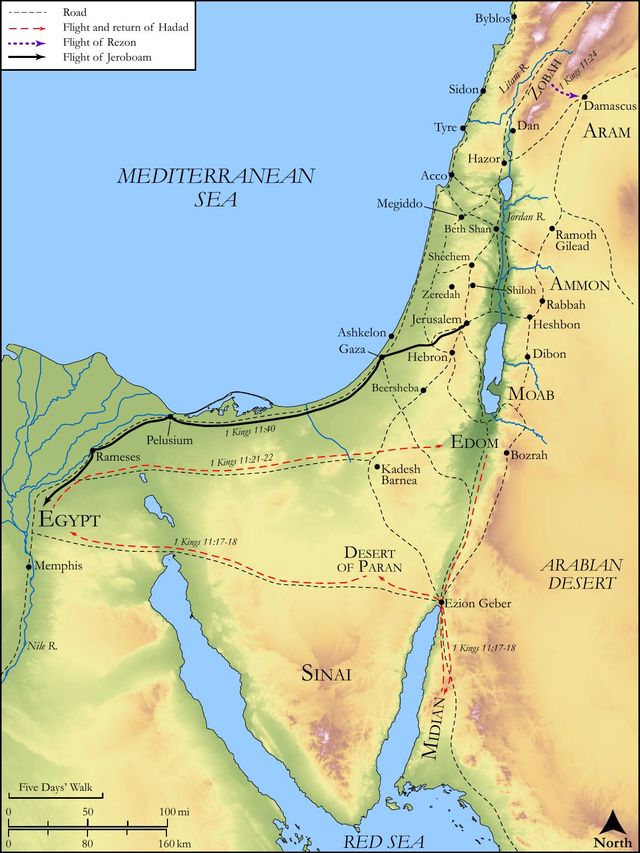
(1.)What induced him to bear Solomon a grudge. David had conquered Edom, Sa2 8:14. Joab put all the males to the sword, Kg1 11:15, Kg1 11:16. A terrible execution he made, avenging on Edom their old enmity to Israel, yet perhaps with too great a severity. From this general slaughter, while Joab was burying the slain (for he left not any alive of their own people to bury them, and buried they must be, or they would be an annoyance to the country, Eze 39:12), Hadad, a branch of the royal family, then a little child, was taken and preserved by some of the king's servants, and conveyed to Egypt, Kg1 11:17. They halted by the way, in Midian first, and then in Paran, where they furnished themselves with men, not to fight for them or force their passage, but to attend them, that their young master might go into Egypt with an equipage agreeable to his quality. There he was kindly sheltered and entertained by Pharaoh, as a distressed prince, as well provided for, and so recommended himself that, in process of time, he married the queen's sister (Kg1 11:19), and by her had a child, which the queen herself conceived such a kindness for that she brought him up in Pharaoh's house, among the king's children.
(2.)What enabled him to do Solomon a mischief. Upon the death of David and Joab, he returned to his own country, in which, it should seem, he settled and remained quiet while Solomon continued wise and watchful for the public good, but from which he had opportunity of making inroads upon Israel when Solomon, having sinned away his wisdom as Samson did his strength (and in the same way), grew careless of public affairs, was off his guard himself, and had forfeited the divine protection. What vexation Hadad gave to Solomon we are not here told, but only how loth Pharaoh was to part with him and how earnestly he solicited his stay (Kg1 11:22): What hast thou lacked with me? "Nothing," says Hadad; "but let me go to my own country, my native air, my native soil." Peter Martyr has a pious reflection upon this: "Heaven is our home, and we ought to keep up a holy affection to that, and desire towards it, even when the world, the place of our banishment, smiles most upon us." Does it ask, What have you lacked, that you are so willing to be gone? We may answer, "Nothing that the world can do for us; but still let us go thither, where our hope, and honour, and treasure are."
2.Rezon, a Syrian, was another adversary to Solomon. When David conquered the Syrians, he headed the remains, lived at large by spoil and rapine, till Solomon grew careless, and then he got possession of Damascus, reigned there (Kg1 11:24) and over the country about (Kg1 11:25), and he created troubles to Israel, probably in conjunction with Hadad, all the days of Solomon (namely, after his apostasy), or he was an enemy to Israel during all Solomon's reign, and upon all occasions vented his then impotent malice against them, but till Solomon's revolt, when his defence had departed from him, he could not do them any mischief. It is said of him that he abhorred Israel. Other princes loved and admired Israel and Solomon, and courted their friendship, but here was one that abhorred them. The greatest and best of princes and people, however much they may in general be respected, will yet perhaps be hated and abhorred by some.
Continue studying 1 Kings 11:20 across the web’s major study libraries — every link below opens this exact verse, chapter, or book on the destination site.
Read & Compare
 BibleGatewayThis verse in more than 200 translations and 70 languages.
 Bible.comThe YouVersion reader — hundreds of translations, reading plans, and highlights.
 ESV.orgCrossway's official English Standard Version reader.
 NET BibleThe NET translation with 60,000+ translators' notes on every rendering decision.
 STEP BibleTyndale House's free study tool — original text, vocabulary, and scholarly resources.
 BibliaLogos Bible Software's free web reader.
 USCCBThe New American Bible (Revised Edition) with the U.S. bishops' study notes.
Commentaries
 BibleHub CommentariesDozens of classic commentaries on this verse, gathered on one page.
 StudyLightMore than 100 commentary sets — the largest collection on the web.
 BibleRefPlain-English commentary on what this verse means, verse by verse.
 Enduring WordDavid Guzik's free commentary on this chapter, widely used by Bible teachers.
 Bible Study ToolsVerse commentary alongside Greek and Hebrew study aids.
Original Language & Research
- BibleHub InterlinearThe verse word by word — original language, transliteration, and English.
- BibleHub LexiconEvery word's original-language definition and Strong's entry.
 Blue Letter BibleDeep-study tools — Strong's numbers, concordance, and word studies.
 SefariaThe Hebrew text with Rashi and centuries of Jewish commentary.
Sermons, Hymns & Audio


TrulyRandomVerse is not affiliated with these sites and doesn’t control their content. They’re linked because they’re genuinely useful.
Summary
This verse provides a crucial detail about Hadad the Edomite, an adversary raised by God against King Solomon, specifically focusing on the birth and upbringing of his son, Genubath. It highlights Genubath's deep integration into the Egyptian royal family, being born to the sister of Pharaoh's queen, Tahpenes, and weaned and raised within Pharaoh's own household among his sons. This seemingly minor genealogical note underscores Hadad's high status, political legitimacy, and the profound connections he forged in Egypt, which would later empower his challenge to Solomon's kingdom, illustrating God's meticulous orchestration of events to fulfill His divine judgment.
Context
ShowHideLiterary Context
This verse is situated within a pivotal section of 1 Kings 11, which details King Solomon's spiritual decline and God's subsequent judgment upon him. Following Solomon's widespread idolatry and disobedience, particularly his turning away from the Lord after his many foreign wives led him astray (as recounted in 1 Kings 11:1-13), God declares He will tear the kingdom from Solomon's hand. Verses 1 Kings 11:14-25 then introduce the adversaries God raises up to fulfill this judgment. Hadad the Edomite is the first such figure, a royal survivor from David's conquest of Edom (see 1 Kings 11:14-17). After finding refuge in Egypt and gaining favor with Pharaoh, Hadad marries the sister of Pharaoh's queen, Tahpenes, as mentioned in 1 Kings 11:19. Verse 20, therefore, serves to solidify Hadad's established position and lineage within the powerful Egyptian court, demonstrating the deep roots of his influence and legitimacy before his eventual return to Edom to cause trouble for Solomon.
Historical & Cultural Context
Among the kings of that day, royal marriages were often strategic alliances, and the integration of foreign royalty into a reigning monarch's court was a common practice to secure political influence or refuge. Hadad's marriage to the sister of Pharaoh's queen signifies the highest level of acceptance and favor within the Egyptian ruling elite. The mention of Tahpenes, the queen, personally weaning Genubath is particularly significant. Weaning (which could occur anywhere from 2-5 years of age) was often a ceremonial event, as when Abraham "made a great feast the same day that Isaac was weaned," marking a child's transition from infancy to a more formal stage of upbringing within the household. For a queen to personally oversee this process for a foreign prince's son underscores Genubath's full and formal adoption into the royal family, granting him the status and privileges akin to Pharaoh's own sons. This deep integration provided Hadad with unparalleled political and social standing, making him a formidable potential adversary.
Key Themes
ShowHideThis verse contributes to several overarching themes in 1 Kings and the broader biblical narrative. Firstly, it powerfully illustrates Divine Sovereignty and Judgment. Even in the seemingly intricate details of a foreign royal court, God is actively orchestrating events to bring about His purposes, specifically His judgment against Solomon for his unfaithfulness (a theme echoed in Deuteronomy 28). Secondly, the verse emphasizes Legitimacy and Influence. Genubath's upbringing "in Pharaoh's household among the sons of Pharaoh" highlights the profound political and social capital Hadad accumulated. This high status would have bolstered his claim and influence upon his eventual return to Edom, setting the stage for his effective challenge to Solomon's rule. Lastly, it speaks to Long-Term Consequences of Disobedience. The establishment of Hadad's lineage and his son's privileged upbringing signifies that the repercussions of Solomon's sin were not immediate but developed over time, affecting future generations and the stability of his kingdom. God's judgment often unfolds gradually, with deep and far-reaching effects.
Exposition and Analysis
ShowHideKey Word Analysis
ShowHideVerse Breakdown
ShowHide"And the sister of Tahpenes bare him Genubath his son"
This clause establishes the lineage of Genubath, identifying him as the son of Hadad and the unnamed sister of Pharaoh's queen, Tahpenes. This marital alliance, mentioned in 1 Kings 11:19, is crucial for understanding Hadad's elevated status and the deep political connections he forged in Egypt. The birth of a son further cemented his place within the royal family, providing a legitimate heir to his Edomite claim, bolstered by Egyptian royal connections.
"whom Tahpenes weaned in Pharaoh's house"
This is a highly significant detail. The queen herself, Tahpenes, took personal responsibility for Genubath's weaning. This act was more than just a biological process; it was a formal and public acknowledgement of Genubath's integration into the royal family. Weaning marked a transition into a more formal stage of childhood, and the queen's direct involvement underscores the child's privileged status and the deep level of acceptance Hadad and his family received. It indicates that Genubath was truly considered one of their own, not just a temporary resident or a minor noble.
"and Genubath was in Pharaoh's household among the sons of Pharaoh"
This final clause reiterates and reinforces Genubath's exceptional status. He was not merely in the palace, but specifically "among the sons of Pharaoh," meaning he was raised alongside the royal princes, receiving the same upbringing, education, and social standing. This full integration into the highest echelons of Egyptian society provided Genubath, and by extension Hadad, with immense legitimacy, influence, and a powerful network that would prove instrumental when Hadad eventually returned to challenge Solomon's kingdom. It speaks to the comprehensive nature of his adoption into the royal inner circle.
Literary Devices
ShowHideThe narrative in 1 Kings 11:20 employs several literary devices to enhance its impact. Foreshadowing is prominent, as the meticulous detail of Genubath's upbringing in Pharaoh's house subtly but powerfully hints at the formidable adversary Hadad will become. The deep roots of his influence, established through his son's royal integration, suggest a long-term, legitimate threat to Solomon's kingdom. There is also an element of Irony present; Solomon, renowned for his wisdom and international alliances, is ultimately undermined by an adversary who gained his power through an alliance with the very nation (Egypt) that Solomon himself sought to align with through marriage (1 Kings 3:1). The detail about Genubath's weaning and placement "among the sons of Pharaoh" also serves as Symbolism, representing the complete and deep integration of Hadad's lineage into a powerful foreign court, thereby legitimizing his future actions as an instrument of divine judgment against Solomon.
Theological and Thematic Connections
ShowHide1 Kings 11:20, though seemingly a minor genealogical note, profoundly illustrates God's active and meticulous sovereignty over all nations and circumstances, even those far removed from His covenant people. It demonstrates that God orchestrates events, even within foreign royal courts, to fulfill His divine purposes and judgments. The raising of Hadad, and the detailed account of his son's privileged upbringing, reveals God's precision in preparing adversaries as a direct consequence of Solomon's unfaithfulness. This verse underscores that God's judgment is not arbitrary but unfolds through specific, often long-term, historical processes, using human agents and their circumstances to achieve His will. It reminds us that no detail is too small for God's overarching plan, and that disobedience carries significant, often generational, repercussions.
Reflection and Application
ShowHideThe detailed account of Genubath's upbringing in 1 Kings 11:20 serves as a powerful reminder of God's profound sovereignty, working through seemingly incidental details and even within the courts of foreign powers to accomplish His will. For us today, it underscores that God is intimately involved in the unfolding of history, and no event, however small or distant, falls outside of His providential plan. It challenges us to recognize that our choices, especially those concerning faithfulness to God, have far-reaching and often long-term consequences, not only for ourselves but potentially for future generations and the stability of our communities. Just as Solomon's disobedience led to the meticulous preparation of an adversary like Hadad, our own spiritual complacency or rebellion can invite unforeseen difficulties. Conversely, it offers comfort that even in chaotic or seemingly random circumstances, God is at work, orchestrating all things for His ultimate purposes, often using unexpected means to bring about justice or correction, reminding us that His hand is always at work for good for those who love Him.
Questions for Reflection
ShowHideFAQ
ShowHideWhy is the weaning of Genubath specifically mentioned in this verse?
ShowHideThe mention of Tahpenes, Pharaoh's queen, personally weaning Genubath is a significant detail that highlights the child's elevated status and deep integration into the Egyptian royal family. Weaning was often a formal and ceremonial event, as at Isaac's, marking a child's transition into a more structured upbringing. For the queen herself to oversee this process for a foreign prince's son signifies a deliberate act of acceptance and a formal acknowledgment of Genubath as part of the royal household, granting him privileges and status akin to Pharaoh's own sons. This detail underscores the profound political and social legitimacy Hadad garnered through his alliance with Egypt, making him a more formidable adversary against Solomon.
How does this verse contribute to the narrative of God's judgment on Solomon?
ShowHideThis verse is crucial because it illustrates the meticulous and long-term nature of God's judgment against King Solomon for his idolatry and disobedience (as detailed in 1 Kings 11:1-13). By detailing Genubath's upbringing "in Pharaoh's household among the sons of Pharaoh," the text emphasizes the deep roots and powerful connections of Hadad, the Edomite, whom God raised as an adversary (mentioned in 1 Kings 11:14). This seemingly minor genealogical note demonstrates that God's judgment was not a sudden, impulsive act, but a carefully orchestrated process, using a well-placed and highly legitimate figure to bring about the promised tearing away of Solomon's kingdom. It shows God's sovereignty over all aspects of history, even in foreign courts, to fulfill His divine will.
Christ-Centered Fulfillment
ShowHideWhile 1 Kings 11:20 details God's sovereign hand in raising an adversary against Solomon due to his unfaithfulness, it ultimately points to the greater King, Jesus Christ, who perfectly fulfills God's will and whose kingdom will never be divided or fall. Solomon's failure, leading to the meticulous preparation of a threat like Hadad, underscores humanity's inability to maintain perfect obedience and highlights the need for a truly righteous King. Jesus, unlike Solomon, was not merely raised in a royal household, but is the eternal Son of God, the rightful heir to the throne of David, whose reign is characterized by perfect obedience and unwavering faithfulness. The meticulous detail of God's orchestration in 1 Kings 11:20, even in seemingly minor events, foreshadows the even greater precision and purpose with which God orchestrated the entire plan of salvation through Christ, from His miraculous birth to His atoning death and glorious resurrection. All things, even the rise of adversaries and the fall of kingdoms, ultimately serve the unfolding of God's redemptive plan, culminating in Christ's eternal kingdom, where He reigns supreme over all creation, and to whom all authority in heaven and on earth has been given (Matthew 28:18). Unlike Solomon's kingdom, which was torn due to sin, Christ's kingdom is an everlasting kingdom, built on His perfect righteousness and secured by His ultimate sacrifice, ensuring that no adversary can ever prevail against it (Hebrews 1:8; Revelation 11:15).