


Genesis 21:8
Bible text: King James Version (1769 Blayney text) · Public domain
Bible text: Berean Standard Bible · Public domain
Bible text: American Standard Version (1901) · Public domain
Bible text: World English Bible, Messianic edition · Public domain
Bible text: Geneva Bible (1599) · Public domain
Bible text: Young's Literal Translation · Public domain
- וַיִּגְדַּלvai·yig·Daland he grew upH1431Conj-w ¦ V-Qal-ConsecImperf-3msVerb Qal Consecutive Imperfect 3rd Singular Masculineוַandיִּגְדַּלhe grew up
- הַיֶּלֶדhai·Ye·ledthe childH3206Art ¦ N-msNoun Singular Masculine Absoluteהַtheיֶּלֶדchild
- וַיִּגָּמַלvai·yi·ga·Maland he was weanedH1580Conj-w ¦ V-Niphal-ConsecImperf-3msVerb Niphal Consecutive Imperfect 3rd Singular Masculineוַandיִּגָּמַלhe was weaned
- וַיַּעַשׂvai·Ya·'asand he preparedH6213Conj-w ¦ V-Qal-ConsecImperf-3msVerb Qal Consecutive Imperfect 3rd Singular Masculineוַandיַּעַשׂhe prepared
- אַבְרָהָם'av·ra·HamAbrahamH85N-proper-mNoun Proper Masculine
- מִשְׁתֶּהmish·Teha feastH4960N-msNoun Singular Masculine Absolute
- גָדוֹלga·DolgreatH1419Adj-msAdjective Singular Masculine Absolute
- בְּיוֹםbe·Yomon [the] dayH3117Prep-b ¦ N-mscNoun Singular Masculine Constructבְּonיוֹם[the] day
- הִגָּמֵלhi·ga·Melwas weanedH1580V-Niphal-InfVerb Niphal Infinitive Construct
- אֶת'et<obj.>H853DirObjMParticle Object Indicator
- יִצְחָקyitz·ChakIsaacH3327N-proper-mNoun Proper Masculine
English is a literal word-by-word gloss of the Hebrew, not the KJV's wording. Why?
This is the original text the KJV's translators worked from — each Hebrew word with its own literal English meaning in this verse, prepared by scholars at Tyndale House, Cambridge. The KJV translates whole sentences, not word by word, so its wording differs: one Hebrew word can become several English words, and the KJV may choose “the LORD” where the gloss reads “Yahweh”. Both are faithful — they answer different questions. For the KJV's own rendering, switch to the KJV text.
Details
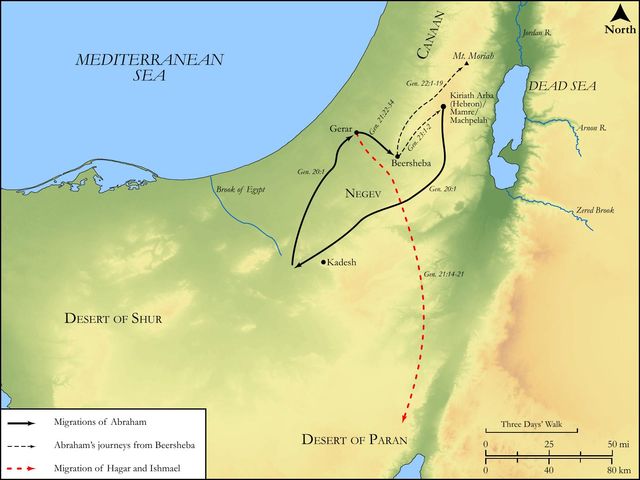
See on the biblical-era maps


Study this verse
Public-domain commentary
Matthew Henry
From his Commentary on the Whole Bible. Henry comments on passages, not single verses — this entry covers Genesis 21:1–8. His three-level outline is real structure in the source text, so it is rendered as structure.
Long-looked-for comes at last. The vision concerning the promised seed is for an appointed time, and now, at the end, it speaks, and does not lie; few under the Old Testament were brought into the world with such expectation as Isaac was, not for the sake of any great person eminence at which he was to arrive, but because he was to be, in this very thin, a type of Christ, that seed which the holy God had so long promised and holy men so long expected. In this account of the first days of Isaac we may observe,
I.The fulfilling of God's promise in the conception and birth of Isaac, Gen 21:1, Gen 21:2.
Note, God's providences look best and brightest when they are compared with his word, and when we observe how God, in them all, acts as he has said, as he has spoken.
1.Isaac was born according to the promise. The Lord visited Sarah in mercy, as he had said. Note, No word of God shall fall to the ground; for he is faithful that has promised, and God's faithfulness is the stay and support of his people's faith. He was born at the set time of which God had spoken, Gen 21:2. Note, God is always punctual to his time; though his promised mercies come not at the time we set, they will certainly come at the time he sets, and that is the best time.,
2.He was born by virtue of the promise: Sarah by faith received strength to conceive Heb 11:11. God therefore by promise gave that strength. It was not by the power of common providence, but by the power of a special promise, that Isaac was born. A sentence of death was, as it were, passed upon the second causes: Abraham was old, and Sarah old, and both as good as dead; and then the word of God took place. Note, True believers, by virtue of God's promises, are enabled to do that which is above the power of human nature, for by them they partake of a divine nature, Pe2 1:4.
II.Abraham's obedience to God's precept concerning Isaac.
1.He named him, as God commanded him, Gen 21:3. God directed him to a name for a memorial, Isaac, laughter; and Abraham, whose office it was, gave him that name, though he might have designed him some other name of a more pompous signification. Note, It is fit that the luxuriancy of human invention should always yield to the sovereignty and plainness of divine institution; yet there was good reason for the name, for,
(1.)When Abraham received the promise of him he laughed for joy, Gen 17:17. Note, When the sun of comfort has risen upon the soul it is good to remember how welcome the dawning of the day was, and with what exultation we embraced the promise.
(2.)When Sarah received the promise she laughed with distrust and diffidence. Note, When God gives us the mercies we began to despair of we ought to remember with sorrow and shame our sinful distrusts of God's power and promise, when we were in pursuit of them.
(3.)Isaac was himself, afterwards, laughed at by Ishmael (Gen 21:9), and perhaps his name bade him expect it. Note, God's favourites are often the world's laughing-stocks.
(4.)The promise which he was not only the son, but the heir of, was to be the joy of all the saints in all ages, and that which would fill their mouths with laughter.
2.He circumcised him, Gen 21:4. The covenant being established with him, the seal of the covenant was administered to him; and though a bloody ordinance, and he a darling, yet it must not be omitted, no, nor deferred beyond the eighth day. God had kept time in performing the promise, and therefore Abraham must keep time in obeying the precept.
III.The impressions which this mercy made upon Sarah.
1.It filled her with joy (Gen 21:6): "God has made me to laugh; he has given me both cause to rejoice and a heart to rejoice." Thus the mother of our Lord, Luk 1:46, Luk 1:47. Note,
(1.)God bestows mercies upon his people to encourage their joy in his work and service; and, whatever is the matter of our joy, God must be acknowledged as the author of it, unless it be the laughter of the fool.
(2.)When mercies have been long deferred they are the more welcome when they come.
(3.)It adds to the comfort of any mercy to have our friends rejoice with us in it: All that hear will laugh with me; for laughing is catching. See Luk 1:58. Others would rejoice in this instance of God's power and goodness, and be encouraged to trust in him. See Psa 119:74.
2.It filled her with wonder, Gen 21:7. Observe here,
(1.)What it was she thought so wonderful: That Sarah should give children suck, that she should, not only bear a child, but be so strong and hearty at the age as to give it suck. Note, Mothers, if they be able, ought to be nurses to their own children. Sarah was a person of quality, was aged; nursing might be thought prejudicial of herself, or to the child, or to both; she had choice of nurses, no doubt, in her own family: and yet she would do her duty in this matter; and her daughters the good wives are while they thus do well, Pe1 3:5, Pe1 3:6. See Lam 4:3.
(2.)How she expressed her wonder: "Who would have said it? The thing was so highly improbable, so near to impossible, that if any one but God had said it we could not have believed it." Note, God's favours to his covenant-people are such as surpass both their own and others' thoughts and expectations. Who could imagine that God should do so much for those that deserve so little, nay, for those that deserve so ill? See Eph 3:20; Sa2 7:18, Sa2 7:19. Who would have said that God should send his Son to die for us, his Spirit to sanctify us, his angels to attend us? Who would have said that such great sins should be pardoned, such mean services accepted, and such worthless worms taken into covenant and communion with the great and holy God?
IV.A short account of Isaac's infancy:
The child grew, Gen 21:8. Special notice is taken of this, though a thing of course, to intimate that the children of the promise are growing children. See Luk 1:80; Luk 2:40. Those that are born of God shall increase of God, Col 2:19. He grew so as not always to need milk, but was able to bear strong meat, and then he was weaned. See Heb 5:13, Heb 5:14. And then it was that Abraham made a great feast for his friends and neighbours, in thankfulness to God for his mercy to him. He made this feast, not on the day that Isaac was born, that would have been too great a disturbance to Sarah; nor on the day that he was circumcised, that would have been too great a diversion from the ordinance; but on the day that he was weaned, because God's blessing upon the nursing of children, and the preservation of them throughout the perils of the infant age, are signal instances of the care and tenderness of the divine providence, which ought to be acknowledged, to its praise. See Psa 22:9, Psa 22:10; Hos 11:1.
Historical interpretation
Five Centuries of Reception
3 surviving comments on this verse. Each one is dated, so this reads as a timeline rather than a list.
Select a marker to jump to its quote. Markers stagger vertically where authors wrote within a few decades of each other.
Isaac, Scripture says, “grew” and became strong; that is, Abraham’s joy grew as he looked not at those things “which are seen but at the things which are not seen.” For Abraham did not rejoice about present things or about the riches of the world and the activities of the age. But do you wish to hear why Abraham rejoiced? Hear the Lord saying to the Jews: “Abraham your father desired to see my day, and he saw it and was glad.” In this way, therefore, “Isaac grew.” That vision of Abraham, in which he saw the day of Christ and the hope which is in Christ, were increasing his joys. And would that you too might be made Isaac and be a joy to your mother the church!
And Abraham held a great feast on the day of Isaac's weaning, because it is indeed a great solemnity for the highest teachers of the mind when they see those whom they have nurtured ascend to the summit of wisdom and virtue.
The boy grew and was weaned, and Abraham held a great feast on the day of his weaning. Isaac is nourished with milk when each chosen one, that is, the son of the promise, newly begotten in Christ, receives the first rudiments of faith, and although he cannot yet sufficiently search the most profound secrets of divinity, nevertheless, delighted by the sweetness of celestial rewards, he strives to engage in good works through which, with God's help and generosity, he may deserve to receive greater things, according to what the apostle Peter said: "Therefore, laying aside all malice, all deceit, hypocrisy, envy, and all evil speaking, like newborn infants, long for the pure spiritual milk so that by it you may grow up into salvation, if indeed you have tasted that the Lord is good." But Isaac, being weaned and coming to the nourishment of bread, occurs when the chosen ones, with the progress of faith, learn not only to confess Jesus Christ and him crucified but also to add that in the beginning was the Word, and the Word was with God, and the Word was God.
Continue studying Genesis 21:8 across the web’s major study libraries — every link below opens this exact verse, chapter, or book on the destination site.
Read & Compare
 BibleGatewayThis verse in more than 200 translations and 70 languages.
 Bible.comThe YouVersion reader — hundreds of translations, reading plans, and highlights.
 ESV.orgCrossway's official English Standard Version reader.
 NET BibleThe NET translation with 60,000+ translators' notes on every rendering decision.
 STEP BibleTyndale House's free study tool — original text, vocabulary, and scholarly resources.
 BibliaLogos Bible Software's free web reader.
 USCCBThe New American Bible (Revised Edition) with the U.S. bishops' study notes.
Commentaries
 BibleHub CommentariesDozens of classic commentaries on this verse, gathered on one page.
 StudyLightMore than 100 commentary sets — the largest collection on the web.
 BibleRefPlain-English commentary on what this verse means, verse by verse.
 Enduring WordDavid Guzik's free commentary on this chapter, widely used by Bible teachers.
 Bible Study ToolsVerse commentary alongside Greek and Hebrew study aids.
Original Language & Research
- BibleHub InterlinearThe verse word by word — original language, transliteration, and English.
- BibleHub LexiconEvery word's original-language definition and Strong's entry.
 Blue Letter BibleDeep-study tools — Strong's numbers, concordance, and word studies.
 SefariaThe Hebrew text with Rashi and centuries of Jewish commentary.
Sermons, Hymns & Audio


TrulyRandomVerse is not affiliated with these sites and doesn’t control their content. They’re linked because they’re genuinely useful.
Summary
Genesis 21:8 records a significant developmental milestone for Isaac, the long-awaited son of promise: his weaning. This event, far more than a simple dietary change, marked a crucial transition from infancy to early childhood in the households of the patriarchs. Abraham's subsequent "great feast" on the same day underscores the profound joy, gratitude, and public affirmation of God's faithfulness in bringing His covenant promises to fruition through the vitality and growth of the heir.
Context
ShowHideLiterary Context
Genesis 21:8 follows directly from the miraculous birth of Isaac to Abraham and Sarah in their old age, a fulfillment of God's long-standing covenant promise (e.g., Genesis 17:19). The preceding verses describe Isaac's circumcision on the eighth day and Sarah's joyful, yet somewhat incredulous, laughter at God's impossible deed. The weaning event, therefore, is not an isolated incident but a natural progression in the narrative, confirming Isaac's health, growth, and continued existence as the promised heir. It sets the stage for the subsequent conflict with Ishmael (Genesis 21:9-21), as Isaac's maturation brings the issue of the true heir to a head, leading to Hagar and Ishmael's expulsion.
Historical & Cultural Context
In the days of the patriarchs, weaning was a protracted process, often lasting two to three years, and sometimes even longer, up to five years of age. It was a significant rite of passage, marking a child's transition from complete dependence on the mother to a more independent stage of early childhood, where they would begin to integrate more fully into the family and community structure. The "great feast" (Hebrew: mishteh gadol) associated with this event was a public declaration of the child's successful development and the family's prosperity and joy. Such feasts were costly and elaborate, signifying the immense value placed on the child and the momentousness of the occasion, particularly for a child as significant as Isaac, the son of promise.
Key Themes
ShowHideThis verse contributes significantly to several overarching themes within Genesis and the broader biblical narrative. Firstly, it powerfully reinforces the theme of God's faithfulness in fulfilling His promises, even against all human odds and delays, as seen in Isaac's continued growth and vitality. Secondly, it highlights the theme of joy and laughter, directly connected to Isaac's name (Yitschâq, meaning "he laughs" or "laughter"), celebrating the divine delight brought into Abraham and Sarah's lives. Thirdly, it underscores the continuity of the covenant lineage, demonstrating that the promised seed, through whom God's redemptive plan would unfold, was indeed thriving and progressing towards maturity, setting the stage for the future nation of Israel as outlined in God's covenant with Abraham in Genesis 12:1-3.
Exposition and Analysis
ShowHideGenesis 21:8 succinctly captures a moment of profound significance for Abraham's family and the unfolding of God's redemptive plan. The verse states, "And the child grew, and was weaned: and Abraham made a great feast the [same] day that Isaac was weaned." This seemingly straightforward account is rich with cultural, linguistic, and theological depth.
Key Word Analysis
ShowHideA primitive root meaning "to be (causatively make) large (in various senses, as in body, mind, estate or honor, also in pride)." This word emphasizes Isaac's physical development and maturation, indicating that he was not merely surviving but thriving. His growth was a tangible sign of God's blessing and the vitality of the promised lineage, moving from infancy towards the fullness of childhood.
A primitive root meaning "to treat a person (well or ill), i.e. benefit or requite; by implication (of toil), to ripen, i.e. (specifically) to wean." This term signifies completion and maturity in a specific developmental stage. Isaac's weaning was a "ripening" or "completion" of his infancy, marking his readiness for a new phase of life and a step towards greater independence. It implies a successful transition, affirming his health and robust development.
(feast) and H1419 (great). Mishteh refers to "drink, by implication, drinking (the act); also (by implication) a banquet or (generally) feast." Gâdôwl means "great (in any sense); hence, older; also insolent." Combined, "great feast" denotes a lavish, significant, and public celebration. It was not a private family meal but a communal event, reflecting the immense joy and importance attached to Isaac's milestone and the fulfillment of God's promise.
Verse Breakdown
ShowHide"And the child grew, and was weaned"
This clause highlights Isaac's physical and developmental progression. The verb "grew" (gâdal) indicates a natural and healthy maturation process, affirming the vitality of the son of promise. The verb "was weaned" (gâmal) signifies the successful completion of his infancy, marking a crucial rite of passage in the households of the patriarchs. This transition from complete dependence on his mother to a new stage of independence was a public affirmation of his health and progression, vital for the future of the covenant people.
"and Abraham made a great feast the [same] day that Isaac was weaned"
This part of the verse describes Abraham's response to Isaac's milestone. The "great feast" (mishteh gadol) was a lavish, public, and joyous celebration, underscoring the profound importance of this event for Abraham's household and beyond. It was a direct expression of the immense joy and gratitude Abraham and Sarah felt for Isaac, whose very name, "Isaac" (Yitschâq), means "he laughs." This celebration was a public declaration of God's faithfulness and the realization of His promises through the continued development of their miraculous son.
Literary Devices
ShowHideThe verse employs several literary devices to convey its profound meaning. Repetition is evident in the phrase "was weaned," which appears twice, emphasizing the significance and finality of this developmental milestone. This repetition reinforces the idea that the event was a definitive transition. Symbolism is also at play; Isaac's weaning symbolizes not just physical maturation but also the progressive fulfillment of God's covenant promises. The "great feast" functions as a symbol of joy, celebration, and public affirmation of God's faithfulness and the vitality of the promised lineage. Furthermore, the entire scene subtly uses foreshadowing, as Isaac, the miraculously born son of promise, thriving and celebrated, prefigures the greater Son of Promise, Jesus Christ, whose coming would bring ultimate joy and the fulfillment of all God's redemptive purposes.
Theological and Thematic Connections
ShowHideGenesis 21:8 encapsulates the profound truth of God's unwavering faithfulness and His active involvement in the lives of His chosen people. Isaac's successful growth and weaning, culminating in a public celebration, serve as tangible evidence that God is meticulously bringing His covenant promises to fruition. This event underscores that God's plan unfolds not always through dramatic miracles, but often through the ordinary, yet divinely sustained, processes of life and development. The feast itself highlights the biblical precedent for celebrating significant milestones with joy and gratitude, recognizing God's hand in every stage of life and the blessings He bestows. It solidifies the continuity of the covenant lineage, ensuring that the promised seed, through whom all nations would be blessed, was indeed thriving.
Reflection and Application
ShowHideGenesis 21:8 offers a rich tapestry for reflection and application in our contemporary lives. It serves as a powerful reminder of the importance of acknowledging and celebrating life's significant milestones and transitions, whether they are personal achievements, family developments, or communal blessings. Just as Abraham celebrated Isaac's weaning with a "great feast," we are encouraged to cultivate a spirit of gratitude and joy, recognizing God's providential care in every stage of our journey and in the growth of those around us. This verse also stands as a profound testament to God's unwavering faithfulness in fulfilling His promises, even when they seem long delayed or humanly impossible. It encourages us to trust in God's perfect timing and His sovereign plans, knowing that what He begins, He will bring to completion. We are called to observe and celebrate God's hand at work, even in the seemingly mundane aspects of life, for they are often the very means through which His grand purposes unfold.
Questions for Reflection
ShowHideFAQ
ShowHideWhy was weaning such a significant event in ancient times?
ShowHideWeaning was a major developmental milestone in the households of the patriarchs, typically occurring between two and five years of age, and sometimes even older. It signified a child's transition from complete dependence on the mother to early childhood, marking a period of greater independence and a step closer to integration into the adult community. It was often celebrated publicly to acknowledge the child's growth and the family's joy, as well as the child's successful progression towards maturity and full participation in the household.
What is the significance of the "great feast" Abraham made?
ShowHideThe "great feast" (Hebrew: mishteh gadol) underscores the profound joy and gratitude Abraham and Sarah felt for Isaac, who was the miraculous son of promise. It was a lavish, public celebration that served as a declaration of the fulfillment of God's covenant, a public acknowledgment of Isaac's vitality, and an expression of the laughter and delight Isaac's birth and continued development had brought into their lives. Such a feast would have been a significant social event, affirming Isaac's status as the legitimate and thriving heir.
Christ-Centered Fulfillment
ShowHideGenesis 21:8, with its focus on Isaac's growth and the celebratory feast, profoundly points forward to Christ, the ultimate "seed" of Abraham. Isaac, as the miraculously born "son of promise" through whom the covenant lineage would continue, serves as a powerful type of Christ, in whom all of God's promises find their definitive "Yes" and "Amen" (2 Corinthians 1:20). The celebration of Isaac's growth and transition from infancy foreshadows the greater joy and fulfillment found in the coming of Jesus, who brings humanity from spiritual infancy to maturity in Him. Just as Isaac's weaning marked a new, more independent stage in the covenant's progression, Christ's life, sacrificial death, and glorious resurrection inaugurated the new covenant (Hebrews 8:6), bringing humanity into a deeper, more complete relationship with God and fulfilling the ultimate promise of redemption and eternal life. The joy of Abraham's feast for Isaac, a temporary earthly celebration, pales in comparison to the eternal joy and spiritual feast that accompanies salvation through Christ, where believers are invited to the marriage supper of the Lamb (Revelation 19:9).