


1 Kings 1:37
Bible text: King James Version (1769 Blayney text) · Public domain
Bible text: Berean Standard Bible · Public domain
Bible text: American Standard Version (1901) · Public domain
Bible text: World English Bible, Messianic edition · Public domain
Bible text: Geneva Bible (1599) · Public domain
Bible text: Young's Literal Translation · Public domain
- כַּאֲשֶׁרka·'a·Sherjust asH834Prep-k ¦ RelParticle Relativeכַּjustאֲשֶׁרas
- הָיָהha·Yahhe has beenH1961V-Qal-Perf-3msVerb Qal Perfect 3rd Singular Masculine
- יְהוָהYah·wehYahwehH3068N-properNoun Proper Title
- עִם'imwithH5973PrepPreposition
- אֲדֹנִי'a·do·Nimy lordH113N-msc ¦ 1csNoun Singular Masculine Constructאֲדֹנִlordיmy
- הַמֶּלֶךְha·Me·lekhthe kingH4428Art ¦ N-msNoun Singular Masculine Absoluteהַtheמֶּלֶךְking
- כֵּןkensoH3651AdvAdverb
- יִהְיֶהye·hihe will beH1961V-Qal-Imperf-3msVerb Qal Imperfect 3rd Singular Masculine
- עִם'imwithH5973PrepPreposition
- שְׁלֹמֹהshe·lo·MohSolomonH8010N-proper-mNoun Proper Masculine
- וִיגַדֵּלvi·ga·Deland may he make greatH1431Conj-w ¦ V-Piel-ConjImperf-3msVerb Piel Conjunction+Imperfect 3rd Singular Masculineוִandיגַדֵּלmay he make great
- אֶת'et<obj.>H853DirObjMParticle Object Indicator
- כִּסְאוֹkis·'Ohis throneH3678N-msc ¦ 3msNoun Singular Masculine Constructכִּסְאthroneוֹhis
- מִכִּסֵּאmi·ki·Se'more than [the] throne ofH3678Prep-m ¦ N-mscNoun Singular Masculine Constructמִmore thanכִּסֵּא[the] throne of
- אֲדֹנִי'a·do·Nimy lordH113N-msc ¦ 1csNoun Singular Masculine Constructאֲדֹנִlordיmy
- הַמֶּלֶךְha·Me·lekhthe kingH4428Art ¦ N-msNoun Singular Masculine Absoluteהַtheמֶּלֶךְking
- דָּוִדda·VidDavidH1732N-proper-mNoun Proper Masculine
English is a literal word-by-word gloss of the Hebrew, not the KJV's wording. Why?
This is the original text the KJV's translators worked from — each Hebrew word with its own literal English meaning in this verse, prepared by scholars at Tyndale House, Cambridge. The KJV translates whole sentences, not word by word, so its wording differs: one Hebrew word can become several English words, and the KJV may choose “the LORD” where the gloss reads “Yahweh”. Both are faithful — they answer different questions. For the KJV's own rendering, switch to the KJV text.
Details
See on the biblical-era maps

Study this verse
Public-domain commentary
Matthew Henry
From his Commentary on the Whole Bible. Henry comments on passages, not single verses — this entry covers 1 Kings 1:32–40. His two-level outline is real structure in the source text, so it is rendered as structure.
We have here the effectual care David took both to secure Solomon's right and to preserve the public peace, by crushing Adonijah's project in the bud. Observe,
I.The express orders he gave for the proclaiming of Solomon.
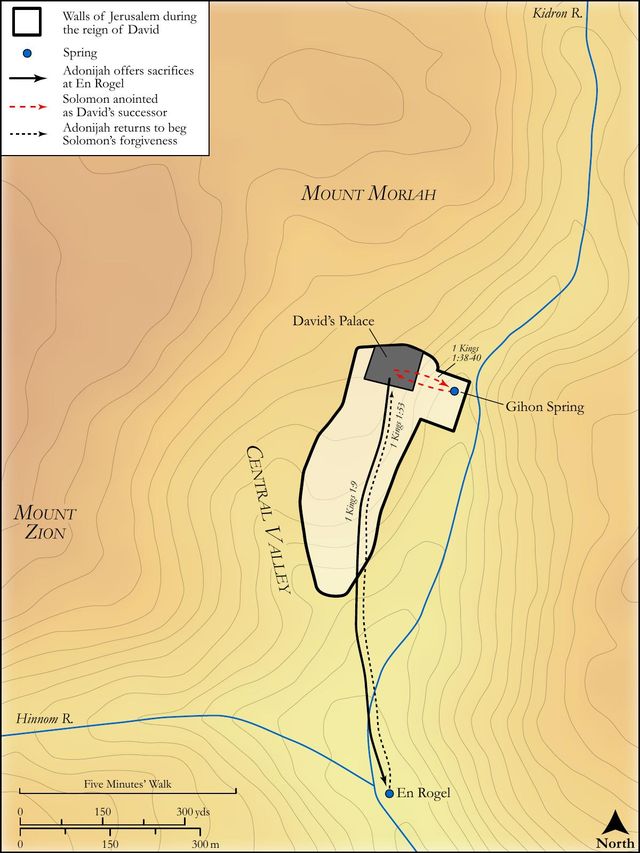
The persons he entrusted with this great affair were Zadok, Nathan, and Benaiah, men of power and interest whom David had always reposed a confidence in and found faithful to him, and whom Adonijah had passed by in his invitation, Kg1 1:10. David orders them forthwith, with all possible solemnity, to proclaim Solomon. They must take with them the servants of their lord, the lifeguards, and all the servants of the household. They must set Solomon on the mule the king used to ride, for he kept not such stables of horses as his son afterwards did. He appoints them whither to go (Kg1 1:33 and Kg1 1:34, Kg1 1:35), and what to do.
1.Zadok and Nathan, the two ecclesiastical persons, must, in God's name, anoint him king; for though he was not the first of his family, as Saul and David were, yet he was a younger son, was made king by divine appointment, and his title was contested, which made it necessary that hereby it should be settled. This unction was typical of the designation and qualification of the Messiah, or Christ, the anointed one, on whom the Spirit, that oil of gladness, was poured without measure, Heb 1:9, Psa 89:20. And all Christians, being heirs of the kingdom (Jam 2:5), do from him receive the anointing, Jo1 2:27.
2.The great officers, civil and military, are ordered to give public notice of this, and to express the public joy upon this occasion by sound of trumpet, by which the law of Moses directed the gracing of great solemnities; to this must be added the acclamations of the people: "Let king Solomon live, let him prosper, let his kingdom be established and perpetuated, and let him long continue in the enjoyment of it;" so it had been promised concerning him. Psa 72:15, He shall live.
3.They must then bring him in state to the city of David, and he must sit upon the throne of his father, as his substitute now, or viceroy, to despatch public business during his weakness and be his successor after his death: He shall be king in my stead. It would be a great satisfaction to David himself, and to all parties concerned, to have this done immediately, that upon the demise of the king there might be no dispute, or agitation, in the public affairs. David was far from grudging his successor the honour of appearing such in his life-time, and yet perhaps was so taken up with his devotions on his sick-bed that, if he had not been put in mind of it by others, this great good work, which was so necessary to the public repose, would have been left undone.
II.The great satisfaction which Benaiah, in the name of the rest, professed in these orders.
The king said, "Solomon shall reign for me, and reign after me." "Amen" (says Benaiah heartily); "as the king says, so say we; we are entirely satisfied in the nomination, and concur in the choice, we give our vote for Solomon, nemine contradicente - unanimously, and since we can bring nothing to pass, much less establish it, without the concurrence of a propitious providence, The Lord God of my lord the king say so too!" Kg1 1:36. This is the language of his faith in that promise of God on which Solomon's government was founded. If we say as God says in his word, we may hope that he will say as we say by his providence. To this he adds a prayer for Solomon (Kg1 1:37), that God would be with him as he had been with David, and make his throne greater. He knew David was not one of those that envy their children's greatness, and that therefore he would not be disquieted at this prayer, nor take it as an affront, but would heartily say Amen to it. The wisest and best man in the world desires his children may be wiser and better than he, for he himself desires to be wiser and better than he is; and wisdom and goodness are true greatness.
III.The immediate execution of these orders, Kg1 1:38-40.
No time was lost, but Solomon was brought in state to the place appointed, and there Zadok (who, though he was not as yet high priest, was, we may suppose, the suffragan, the Jews called him the sagan, or second priest) anointed him by the direction of Nathan the prophet and David the king, Kg1 1:39. In the tabernacle, where the ark was now lodged, was kept among other sacred things, the holy oil for many religious services thence Zadok took a horn of oil, which denotes both power and plenty, and therewith anointed Solomon. We do not find that Abiathar pretended to anoint Adonijah: he was made king by a feast, not by an unction. Whom God calls, he will qualify, which was signified by the anointing; usurpers had it not. Christ signifies anointed, and he is the king whom God hath set upon his holy hill of Sion, according to decree, Psa 2:6, Psa 2:7. Christians also are made to our God (and by him) kings, and they have an unction from the Holy One, Jo1 2:20. The people, hereupon, express their great joy and satisfaction in the elevation of Solomon, surround him with their Hosannas - God save king Solomon, and attend him with their music and shouts of joy, Kg1 1:40. Hereby they declared their concurrence in the choice, and that he was not forced upon them, but cheerfully accepted by them. The power of a prince can be little satisfaction to himself, unless he knows it to be a satisfaction to his people. Every Israelite indeed rejoices in the exaltation of the Son of David.
Continue studying 1 Kings 1:37 across the web’s major study libraries — every link below opens this exact verse, chapter, or book on the destination site.
Read & Compare
 BibleGatewayThis verse in more than 200 translations and 70 languages.
 Bible.comThe YouVersion reader — hundreds of translations, reading plans, and highlights.
 ESV.orgCrossway's official English Standard Version reader.
 NET BibleThe NET translation with 60,000+ translators' notes on every rendering decision.
 STEP BibleTyndale House's free study tool — original text, vocabulary, and scholarly resources.
 BibliaLogos Bible Software's free web reader.
 USCCBThe New American Bible (Revised Edition) with the U.S. bishops' study notes.
Commentaries
 BibleHub CommentariesDozens of classic commentaries on this verse, gathered on one page.
 StudyLightMore than 100 commentary sets — the largest collection on the web.
 BibleRefPlain-English commentary on what this verse means, verse by verse.
 Enduring WordDavid Guzik's free commentary on this chapter, widely used by Bible teachers.
 Bible Study ToolsVerse commentary alongside Greek and Hebrew study aids.
Original Language & Research
- BibleHub InterlinearThe verse word by word — original language, transliteration, and English.
- BibleHub LexiconEvery word's original-language definition and Strong's entry.
 Blue Letter BibleDeep-study tools — Strong's numbers, concordance, and word studies.
 SefariaThe Hebrew text with Rashi and centuries of Jewish commentary.
Sermons, Hymns & Audio


TrulyRandomVerse is not affiliated with these sites and doesn’t control their content. They’re linked because they’re genuinely useful.
Summary
1 Kings 1:37 encapsulates the fervent prayer and loyal declaration of Benaiah, a trusted figure in David's court, during the critical period of Solomon's anointing as king. It articulates a profound desire for the LORD's continued and empowering presence to rest upon Solomon's reign, mirroring the divine blessing that characterized King David's rule. Furthermore, it expresses a bold aspiration for Solomon's kingdom to surpass even the esteemed glory and influence of his father's, underscoring the deep theological conviction that the success and legitimacy of Israel's monarchy were intrinsically tied to the active presence and empowering hand of the LORD.
Context
ShowHideLiterary Context
This verse is strategically placed at a pivotal moment in the narrative of David's succession. It immediately follows King David's decisive command, prompted by Nathan the prophet and Bathsheba, for Solomon to be anointed king, effectively countering Adonijah's attempted usurpation of the throne (1 Kings 1:5-27). The anointing ceremony itself, performed by Zadok the priest and Nathan the prophet at the Gihon spring, accompanied by the jubilant shouts of the people, has just taken place (1 Kings 1:32-35). Benaiah's declaration in 1 Kings 1:37 serves as a powerful public affirmation of loyalty and a profound prayer for divine blessing upon the newly established king, setting a foundational tone for Solomon's reign and emphasizing the crucial continuity of God's favor.
Historical & Cultural Context
The setting is the waning period of King David's lengthy and impactful reign, a time frequently fraught with internal power struggles and questions of succession among the kings of that day. David's advanced age and physical frailty had created a perceived power vacuum, which Adonijah, one of David's elder sons, sought to exploit by prematurely declaring himself king. In Israel, the anointing of a king, typically performed by a prophet or priest, was not merely a political act but a sacred ritual signifying divine selection and legitimacy, distinguishing the Israelite monarchy from purely human political systems. The choice of Gihon, a vital natural spring outside Jerusalem, for the anointing was symbolic, representing life, purity, and a fresh, divinely sanctioned beginning for the new king. Benaiah, identified as one of David's most trusted and capable military commanders (2 Samuel 23:20-23), represents the loyal faction of David's court, whose public endorsement of Solomon was indispensable for consolidating the new king's authority and quelling any lingering dissent from Adonijah's supporters.
Key Themes
ShowHideThis verse powerfully articulates several core themes central to the book of 1 Kings and the broader Deuteronomistic History. Firstly, it underscores the theme of Divine Presence and Favor as the ultimate source of a king's success and legitimacy. David's reign was consistently characterized by God "being with" him (e.g., 2 Samuel 7:9), and the prayer for Solomon is that this essential divine partnership would continue, recognizing it as the foundation of true royal authority. Secondly, it highlights Legitimacy and Continuity of the Davidic line. Despite the political maneuvering and Adonijah's attempted coup, Solomon's anointing is presented as divinely sanctioned, fulfilling the enduring promises of the Davidic Covenant that David's house and kingdom would be established forever. Finally, the aspiration for a "greater" throne introduces the theme of Aspiration for Greater Glory, not merely in terms of political power or territorial expansion, but in wisdom, justice, and divine blessing, foreshadowing the unparalleled prosperity and renown of Solomon's early reign (1 Kings 4:29-34) and ultimately pointing to the ideal, messianic king whose reign would truly be without end.
Exposition and Analysis
ShowHideKey Word Analysis
ShowHideThis is the covenant name of God (H3068), emphasizing His personal, relational, and faithful character. The use of "Yᵉhôvâh" here underscores that the success of David's reign, and the hope for Solomon's, was not due to human might or wisdom alone, but to the active, covenantal presence and intervention of the sovereign God of Israel. It signifies a reliance on divine power rather than human strength, highlighting God as the ultimate source of royal authority and blessing.
This primitive root (H1431) means properly "to twist," but in a causative sense, "to make large" or "to be great." In this context, when Benaiah prays for God to "make his throne greater," it signifies an increase not merely in physical size or political territory, but a profound expansion in honor, influence, wisdom, justice, and divine favor. The aspiration is for a reign that not only matches but surpasses David's in its manifestation of God's blessing and the king's righteous rule, setting a new, higher standard for the monarchy.
This word (H3678) refers to a seat of authority, specifically a royal throne. Among the kings of that day, the throne symbolized the king's power, dominion, and legitimacy. In this verse, the "throne" represents the entire reign and kingdom of Solomon. The prayer for his "throne" to be "greater" than David's is a comprehensive request for the entirety of Solomon's rule—its stability, prosperity, wisdom, and divine sanction—to exceed that of his revered father. It encapsulates the hope for an unparalleled era of peace and flourishing under God's favor.
Verse Breakdown
ShowHide"As the LORD hath been with my lord the king"
This opening clause establishes a crucial premise and precedent for the prayer. It acknowledges that King David's successful, divinely empowered, and blessed reign was a direct consequence of the LORD's active presence, unwavering support, and abundant favor. This implicitly recognizes that David's authority, accomplishments, and widespread respect were not self-derived but divinely bestowed, setting a foundational expectation that similar divine engagement is absolutely necessary for the incoming king.
"even so be he with Solomon"
This is the core petition of Benaiah's prayer, a fervent plea for the continuity of divine favor. It expresses the deep desire that the same empowering, guiding, and blessing presence of the LORD that characterized David's rule would likewise be granted to Solomon. This highlights the profound understanding that without God's active presence, Solomon's reign, regardless of human efforts or political maneuvering, would lack true legitimacy, stability, and ultimate success in the eyes of God and the people.
"and make his throne greater than the throne of my lord king David"
This final clause expresses a bold, hopeful, and perhaps even prophetic aspiration. It is a prayer not merely for continuity but for an escalation of divine blessing. The desire for a "greater" throne implies a hope for a reign marked by even more profound wisdom, justice, peace, and prosperity than David's, which was already considered a golden age. This aspiration looks forward to an ideal king whose dominion and influence, under God's hand, would surpass all predecessors, setting an unprecedented standard for God's kingdom on earth.
Literary Devices
ShowHideThe verse employs several significant literary devices to convey its profound message. Parallelism is prominently featured in the direct comparison between God's past presence with David and the prayer for His future presence with Solomon ("As the LORD hath been... even so be he with Solomon"). This structural repetition powerfully emphasizes continuity, divine precedent, and the essential nature of God's active involvement in the monarchy. The phrase "make his throne greater than the throne of my lord king David" can be interpreted as Aspirational Language, or even a form of Hyperbole, expressing a profound hope for an unprecedented level of divine blessing and glory that pushes the boundaries of human expectation for the new king. The entire verse functions as a powerful Prayer/Supplication, a direct and earnest address to God, mediated through the speaker Benaiah, expressing deep faith and reliance on divine intervention for the success and flourishing of the monarchy.
Theological and Thematic Connections
ShowHideThis pivotal verse articulates a profound theological truth central to Israel's understanding of kingship: true royal authority and enduring success do not stem from human power, military might, or even lineage alone, but fundamentally from the active, empowering presence and favor of the LORD. It reinforces the concept of a divinely chosen and sustained monarchy, where the king serves as God's anointed representative on earth. The aspiration for Solomon's throne to be "greater" than David's not only speaks to immediate hopes for prosperity, peace, and wisdom but also carries a significant prophetic undertone, pointing beyond the limitations of any earthly monarchy to a future, ideal king whose reign would indeed be infinitely "greater" in every conceivable way. This inherent longing for an ultimate, perfect king finds its ultimate and glorious fulfillment in the person and eternal kingdom of Jesus Christ, who embodies the supreme divine presence and whose reign transcends all earthly limitations and failures.
Reflection and Application
ShowHideBenaiah's declaration in 1 Kings 1:37 offers timeless principles for believers today, transcending its ancient monarchical context. It serves as a powerful reminder that true success, whether in leadership, personal endeavors, or spiritual growth, is ultimately dependent on the active presence and favor of God. Just as Solomon desperately needed the LORD's "being with" him, we too must cultivate a deep, abiding reliance on God's guidance, strength, and blessing in every aspect of our lives, recognizing that apart from Him, our efforts are ultimately in vain. This verse profoundly encourages us to pray fervently and consistently for our leaders—whether in government, the church, or our local communities—asking for divine wisdom, integrity, and the empowering presence of God to enable them to lead justly, compassionately, and effectively. Furthermore, the aspiration for a "greater" throne challenges us to not merely maintain the status quo in our own lives or ministries but to seek God's greater glory in our spheres of influence, always striving for excellence and impact that extends far beyond our own capabilities, trusting that God can do "immeasurably more than all we ask or imagine" (Ephesians 3:20).
Questions for Reflection
ShowHideFAQ
ShowHideWho was Benaiah, and why were his words so significant in this context?
ShowHideBenaiah, the son of Jehoiada, was one of King David's most loyal and formidable military commanders, renowned for his personal bravery, unwavering fidelity, and decisive action (2 Samuel 23:20-23). His words in 1 Kings 1:37 were profoundly significant because they represented the public affirmation of a key, powerful figure from David's inner circle and military leadership. In a time of acute political instability and a contested succession, Benaiah's declaration of loyalty to Solomon and his fervent prayer for divine blessing upon the new king served to legitimize Solomon's reign and consolidate his authority. This public endorsement signaled to the entire court and kingdom that the transition was not only divinely sanctioned but also strongly supported by crucial military and administrative leadership, helping to quell any remaining dissent from Adonijah's faction.
What is the deeper significance of praying for Solomon's throne to be "greater than" David's?
ShowHideThis prayer is far more than a mere wish for increased political power, territorial expansion, or material wealth. David's reign was already considered a golden age in Israel's history, marked by significant military victories, the establishment of Jerusalem as the capital, and the bringing of the ark of the covenant into the city. Therefore, to pray for Solomon's reign to be "greater" implies a profound spiritual and theological aspiration for an even deeper manifestation of divine favor, unparalleled wisdom, profound justice, and widespread peace. It suggests a desire for a reign that would surpass David's in its spiritual and societal impact, fulfilling the highest ideals of God's kingdom on earth. This aspiration also carries a significant prophetic undertone, subtly pointing to the ultimate, perfect reign of the Messiah, whose kingdom would indeed be infinitely greater and eternal compared to any earthly monarchy (Psalm 72).
Christ-Centered Fulfillment
ShowHideThe bold aspiration for Solomon's throne to be "greater than the throne of my lord king David" finds its ultimate, perfect, and eternal fulfillment in Jesus Christ. While Solomon's reign was indeed marked by unparalleled wisdom, peace, and prosperity (1 Kings 4:29-34), it ultimately fell tragically short of the ideal due to his later disobedience and idolatry (1 Kings 11:1-8). Jesus, however, is the true and perfect Son of David, the one to whom the enduring promises of the Davidic Covenant ultimately point. He is the King whose wisdom infinitely surpasses Solomon's (Matthew 12:42), whose kingdom is eternal, righteous, and unshakable (Luke 1:32-33), and whose reign brings true peace, salvation, and reconciliation to all who believe. The fervent prayer for the LORD to "be with Solomon" is fully and perfectly realized in Christ, who is God incarnate, Emmanuel, "God with us" (Matthew 1:23). His throne is not merely greater than David's or Solomon's; it is the very throne of God Himself, from which He reigns forever as the supreme King of kings and Lord of lords (Revelation 19:16).