


1 Chronicles 12:4
Bible text: King James Version (1769 Blayney text) · Public domain
Bible text: Berean Standard Bible · Public domain
Bible text: American Standard Version (1901) · Public domain
Bible text: World English Bible, Messianic edition · Public domain
Bible text: Geneva Bible (1599) · Public domain
Bible text: Young's Literal Translation · Public domain
- וְיִשְׁמַעְיָהve·yish·ma'·Yahand IshmaiahH3460Conj-w ¦ N-proper-mNoun Proper MasculineוְandיִשְׁמַעְיָהIshmaiah
- וְיִרְמְיָהve·yir·me·Yahand JeremiahH3414Conj-w ¦ N-proper-mNoun Proper MasculineוְandיִרְמְיָהJeremiah
- הַגִּבְעוֹנִיha·giv·'o·Nithe GibeoniteH1393Art ¦ N-msNoun Gentilic Singular Masculine AbsoluteהַtheגִּבְעוֹנִיGibeonite
- וְיַחֲזִיאֵלve·ya·cha·zi·'Eland JahazielH3166Conj-w ¦ N-proper-mNoun Proper MasculineוְandיַחֲזִיאֵלJahaziel
- גִּבּוֹרgi·Bora mighty [man]H1368N-msNoun Singular Masculine Absolute
- וְיוֹחָנָןve·Yo·cha·Nanand JohananH3076Conj-w ¦ N-proper-mNoun Proper MasculineוְandיוֹחָנָןJohanan
- בַּשְּׁלֹשִׁיםba·she·lo·Shimamong the thirtyH7970Prep-b ¦ N-mpNoun Plural Masculine Absoluteבַּamong theשְּׁלֹשִׁיםthirty
- וְיוֹזָבָדve·yo·za·Vadand JozabadH3107Conj-w ¦ N-proper-mNoun Proper MasculineוְandיוֹזָבָדJozabad
- וְעַלve·'aland overH5921Conj-w ¦ PrepPrepositionוְandעַלover
- הַגְּדֵרָתִיha·ge·de·ra·Tithe GederathiteH1452Art ¦ N-msNoun Gentilic Singular Masculine AbsoluteהַtheגְּדֵרָתִיGederathite
- הַשְּׁלֹשִׁיםha·she·lo·Shimthe thirtyH7970Art ¦ N-mpNoun Plural Masculine Absoluteהַtheשְּׁלֹשִׁיםthirty
English is a literal word-by-word gloss of the Hebrew, not the KJV's wording. Why?
This is the original text the KJV's translators worked from — each Hebrew word with its own literal English meaning in this verse, prepared by scholars at Tyndale House, Cambridge. The KJV translates whole sentences, not word by word, so its wording differs: one Hebrew word can become several English words, and the KJV may choose “the LORD” where the gloss reads “Yahweh”. Both are faithful — they answer different questions. For the KJV's own rendering, switch to the KJV text.
Details
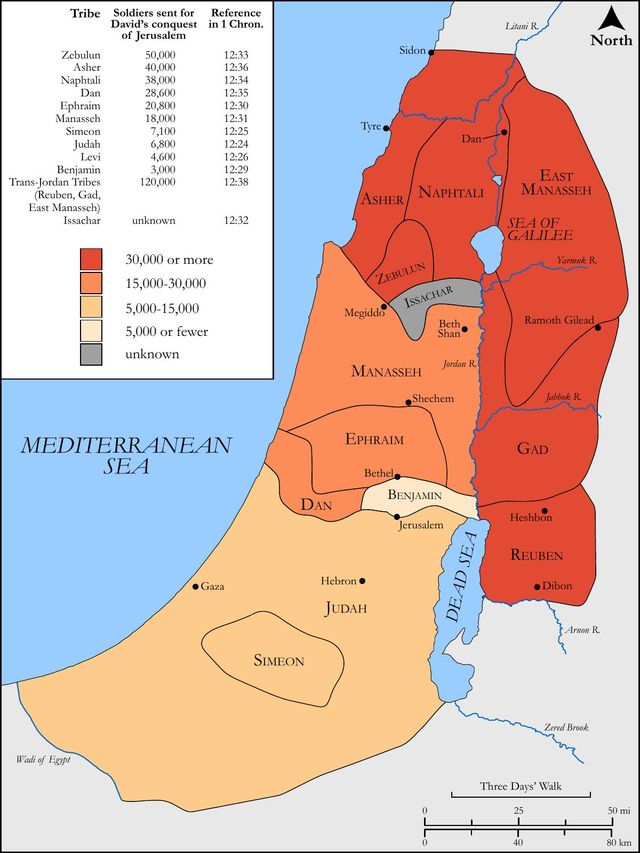
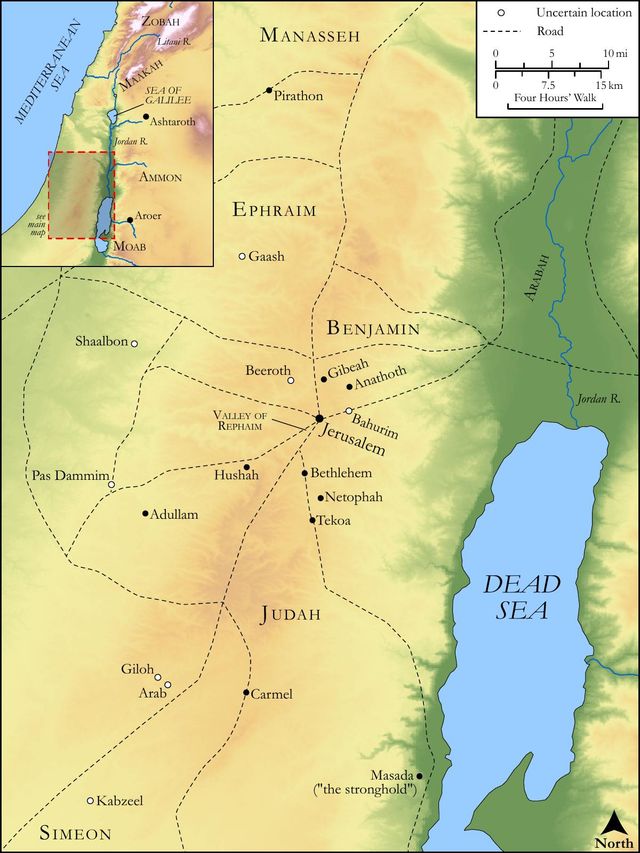
See on the biblical-era maps
Study this verse
Public-domain commentary
Matthew Henry
From his Commentary on the Whole Bible. Henry comments on passages, not single verses — this entry covers 1 Chronicles 12:1–22. His four-level outline is real structure in the source text, so it is rendered as structure.
We have here an account of those that appeared and acted as David's friends, upon the death of Saul, to bring about the revolution. All the forces he had, while he was persecuted, was but 600 men, who served for his guards; but, when the time had come that he must begin to act offensively, Providence brought in more to his assistance. Even while he kept himself close, because of Saul (Ch1 12:1), while he did not appear, to invite or encourage his friends and well-wishers to come in to him (not foreseeing that the death of Saul was so near), God was inclining and preparing them to come over to him with seasonable succours. Those that trust God to do his work for them in his own way and time shall find his providence outdoing all their forecast and contrivance. The war was God's, and he found out helpers of the war, whose forwardness to act for the man God designed for the government is here recorded to their honour.
I.Some, even of Saul's brethren, of the tribe of Benjamin, and a-kin to him, came over to David, Ch1 12:2.
What moved them to it we are not told. Probably a generous indignation at the base treatment which Saul, one of their tribe, gave him, animated them to appear the more vigorously for him, that the guilt and reproach of it might not lie upon them. These Benjamites are described to be men of great dexterity, that were trained up in shooting and slinging, and used both hands alike - ingenious active men; a few of these might do David a great deal of service. Several of the leading men of them are here named. See Jdg 20:16.
II.Some of the tribe of Gad, though seated on the other side Jordan, had such a conviction of David's title to the government, and fitness for it, that they separated themselves from their brethren (a laudable separation it was) to go to David, though he was in the hold in the wilderness (Ch1 12:8), probably some of his strong holds in the wilderness of Engedi. They were but few, eleven in all, here named, but they added much to David's strength. Those that had hitherto come in to his assistance were most of them men of broken fortunes, distressed, discontented, and soldiers of fortune, that came to him rather for protection than to do him any service, Sa1 22:2. But these Gadites were brave men, men of war, and fit for the battle, Ch1 12:8. For,
1.They were able-bodied men, men of incredible swiftness, not to fly from, but to fly upon, the enemy, and to pursue the scattered forces. In this they were as swift as the roes upon the mountains, so that no man could escape from them; and yet they had faces like the faces of lions, so that no man could out-fight them.
2.They were disciplined men, trained up to military exercises; they could handle shield and buckler, use both offensive and defensive weapons.
3.They were officers of the militia in their own tribe (Ch1 12:14), so that though they did not bring soldiers with them they had them at command, hundreds, thousands.
4.They were daring men, that could break through the greatest difficulties. Upon some expedition or other, perhaps this to David, they swam over the Jordan, when it overflowed all its banks, Ch1 12:15. Those are fit to be employed in the cause of God that can venture thus in a dependence upon the divine protection.
5.They were men that would go through with the business they engaged in. What enemies those were that they met with in the valleys, when they had passed Jordan, does not appear; but they put them to flight with their lion-like faces, and pursued them with matchless fury, both towards the east and towards the west; which way soever they turned, they followed their blow, and did not do their work by halves.
III.Some of Judah and Benjamin came to him, Ch1 12:16.
Their leader was Amasai, whether the same with that Amasa that afterwards sided with Absalom (Sa2 17:25) or no does not appear. Now here we have,
1.David's prudent treaty with them, Ch1 12:17. He was surprised to see them, and could not but conceive some jealousy of the intentions of their coming, having been so often in danger by the treachery of the men of Ziph and the men of Keilah, who yet were all men of Judah. He might well be timorous whose life was so much struck at; he might well be suspicious who had been deceived in so many that he said, in his haste, All men are liars. No marvel that he meets these men of Judah with caution. Observe,
(1.)How he puts the matter to themselves, how fairly he deals with them. As they are, they shall find him; so shall all that deal with the Son of David.
[1.]If they be faithful and honourable, he will be their rewarder: "If you have come peaceably unto me, to help me, though you have come late and have left me exposed a great while, though you bring no great strength with you to turn the scale for me, yet I will thankfully accept your good-will, and my heart shall be knit unto you; I will love you and honour you, and do you all the kindness I can." Affection, respect, and service, that are cordial and sincere, will find favour with a good man, as they do with a good God, though clogged with infirmities, and turning to no great account. But,
[2.]If they be false, and come to betray him into the hands of Saul, under colour of friendship, he leaves them to God to be their avenger, as he is, and will be, of every thing that is treacherous and perfidious. Never was man more violently run upon, and run down, than David was (except the Son of David himself), and yet he had the testimony of his conscience that there was no wrong in his hands. He meant no harm to any man, which was his rejoicing in the day of evil, and enabled him, when he feared treachery, to commit his cause to him that judges righteously. He will not be judge in his own cause, though a wise man, nor avenge himself, though a man of valour; but let the righteous God, who hath said, Vengeance is mine, do both. The God of our fathers look thereon and rebuke it.
(2.)In this appeal observe,
[1.]He calls God the God of our fathers, both his fathers and theirs. Thus he reminded them not to deal ill with him; for they were both descendants from the same patriarchs, and both dependents on the same God. Thus he encouraged himself to believe that God would right him if he should be abused; for he was the God of his fathers and therefore a blessing was entailed on him, and a God to all Israel and therefore not only a Judge to all the earth, but particularly concerned in determining controversies between contesting Israelites.
[2.]He does not imprecate any fearful judgement upon them, though they should deal treacherously, but very modestly refers his cause to the divine wisdom and justice: The Lord look thereon, and judge as he sees (for he sees men's hearts), and rebuke it. It becomes those that appeal to God to express themselves with great temper and moderation; for the wrath of man works not the righteousness of God.
2.Their hearty closure with him, Ch1 12:18. Amasai was their spokesman, on whom the Spirit of the Lord came, not a spirit of prophecy, but a spirit of wisdom and resolution, according to the occasion, putting words into his mouth, unpremeditated, which were proper both to give David satisfaction and to animate those that accompanied him. Nothing could be said finer, more lively, or more pertinent to the occasion. For himself and all his associates,
(1.)He professed a very cordial adherence to David, and his interest, against all that opposed him, and a resolution to stand by him with the hazard of all that was dear to him: Thine are we, David, and on thy side, thou son of Jesse. In calling him son of Jesse they reminded themselves that he was lineally descended from Nahshon and Salmon, who in their days were princes of the tribe of Judah. Saul called him so in disdain (Sa1 20:27; Sa1 22:7), but they looked upon it as his honour. They were convinced that God was on his side; and therefore, Thine are we, David, and on thy side. It is good, if we must side, to side with those that side with God and have God with them.
(2.)He wished prosperity to David and his cause, not drinking a health, but praying for peace to him and all his friends and well-wishers: "Peace, peace, be unto thee, all the good thy heart desires, and peace be to thy helpers, among whom we desire to be reckoned, that peace may be on us." (3.) He assured him of help from heaven: "For thy God helpeth thee; therefore we wish peace may be, and therefore we doubt not but peace shall be, to thee and thy helpers. God is thy God, and those that have him for their God no doubt have him for their helper in every time of need and danger." From these expressions of Amasai we may take instruction how to testify our affection and allegiance to the Lord Jesus. His we must be without reservation or power of revocation. On his side we must be forward to appear and act. To his interest we must be hearty well-wishers: "Hosanna! prosperity to his gospel and kingdom;" for his God helpeth him, and will till he shall have put down all opposing rule, principality, and power.
3.David's cheerful acceptance of them into his interest and friendship. Charity and honour teach us to let fall our jealousies as soon as satisfaction is given us: David received them, and preferred them to be captains of the band.
IV.Some of Manasseh likewise joined with him, v.
19. Providence gave them a fair opportunity to do so when he and his men marched through their country upon this occasion. Achish took David with him when he went out to fight with Saul; but the lords of the Philistines obliged him to withdraw. We have the story, Sa1 29:4, etc. In his return some great men of Manasseh, who had no heart to join with Saul against the Philistines struck in with David, and very seasonably, to help him against the band of Amelekites who plundered Ziklag; they were not many, but they were all mighty men and did David good service upon that occasion, 1 Sa. 30. See how Providence provides. David's interest grew strangely just when he had occasion to make use of it, Ch1 12:22. Auxiliary forces flocked in daily, till he had a great host. When the promise comes to the birth, leave it to God to find strength to bring forth.
Continue studying 1 Chronicles 12:4 across the web’s major study libraries — every link below opens this exact verse, chapter, or book on the destination site.
Read & Compare
 BibleGatewayThis verse in more than 200 translations and 70 languages.
 Bible.comThe YouVersion reader — hundreds of translations, reading plans, and highlights.
 ESV.orgCrossway's official English Standard Version reader.
 NET BibleThe NET translation with 60,000+ translators' notes on every rendering decision.
 STEP BibleTyndale House's free study tool — original text, vocabulary, and scholarly resources.
 BibliaLogos Bible Software's free web reader.
 USCCBThe New American Bible (Revised Edition) with the U.S. bishops' study notes.
Commentaries
 BibleHub CommentariesDozens of classic commentaries on this verse, gathered on one page.
 StudyLightMore than 100 commentary sets — the largest collection on the web.
 BibleRefPlain-English commentary on what this verse means, verse by verse.
 Enduring WordDavid Guzik's free commentary on this chapter, widely used by Bible teachers.
 Bible Study ToolsVerse commentary alongside Greek and Hebrew study aids.
Original Language & Research
- BibleHub InterlinearThe verse word by word — original language, transliteration, and English.
- BibleHub LexiconEvery word's original-language definition and Strong's entry.
 Blue Letter BibleDeep-study tools — Strong's numbers, concordance, and word studies.
 SefariaThe Hebrew text with Rashi and centuries of Jewish commentary.
Sermons, Hymns & Audio


TrulyRandomVerse is not affiliated with these sites and doesn’t control their content. They’re linked because they’re genuinely useful.
Summary
1 Chronicles 12:4 meticulously details a selection of the formidable warriors and leaders who pledged their allegiance to David during his period of exile from King Saul. This specific verse highlights Ismaiah the Gibeonite, distinguishing him as "a mighty man among the thirty, and over the thirty," alongside Jeremiah, Jahaziel, Johanan, and Josabad the Gederathite. It powerfully illustrates the exceptional caliber, diverse origins, and unwavering loyalty of the individuals drawn to David, recognizing his divine anointing and contributing significantly to the burgeoning strength of his nascent kingdom.
Context
ShowHideLiterary Context
This verse is situated within the broader narrative of 1 Chronicles 12, a chapter dedicated to cataloging the various groups of skilled warriors and loyal supporters who joined David at different critical junctures of his flight from King Saul, particularly at Ziklag and later at Hebron. The chronicler's detailed enumeration serves as a powerful testament to David's growing influence and the divine hand actively gathering his forces, setting the stage for his eventual anointing as king over all Israel. The meticulous lists of names, tribal affiliations, and specific military skills (such as the Gadites described as "men of war, fit for the battle, that could handle shield and spear" in 1 Chronicles 12:8) emphasize the comprehensive and diverse nature of the support David received. This chapter also complements and expands upon similar accounts of David's elite warriors found in 2 Samuel 23 and 1 Chronicles 11.
Historical & Cultural Context
David's period of exile was a time marked by vulnerability, uncertainty, and constant movement, yet it also served as a crucial crucible for forging his future kingdom. Operating from various strongholds, including Ziklag (as referenced in 1 Samuel 27:6), David attracted a diverse array of individuals: those disillusioned with Saul's increasingly erratic reign, those seeking refuge, and crucially, those who foresaw David's divinely appointed kingship. In ancient Israel, the term "mighty men" (Hebrew: gibborim) referred not merely to physically strong individuals but to an elite class of warriors, often forming a king's personal guard or special forces. Their loyalty was paramount, and their exceptional prowess was indispensable for military success and the establishment of a stable kingdom. The mention of specific geographical origins like "Gibeonite" and "Gederathite" underscores the diverse tribal and regional support David garnered, indicating his appeal extended far beyond his own tribe of Judah, thereby laying essential groundwork for a unified Israel.
Key Themes
ShowHideThe meticulous gathering of these formidable men around David highlights several profound theological and narrative themes. Firstly, it powerfully underscores Divine Providence and Preparation, illustrating how God was actively orchestrating circumstances and assembling a loyal, capable fighting force to prepare David for his kingship, even while David himself was an outcast. Secondly, the verse vividly exemplifies Loyalty and Allegiance, as these men chose to align themselves with David during a precarious and often dangerous time, demonstrating unwavering commitment to his divinely ordained cause. Thirdly, it emphasizes Valor and Military Prowess, showcasing the exceptionally high caliber of individuals who joined David, whose skills were essential for establishing and maintaining his nascent kingdom. The specific mention of Ismaiah being "over the thirty" further highlights the theme of Strategic Leadership and Organization within David's burgeoning army, indicating a structured and disciplined force even in its formative stages. Ultimately, this collective support points to the overarching theme of Unity and the Formation of a Kingdom, as diverse individuals from various backgrounds coalesce around a divinely chosen leader, foreshadowing the unity of Israel under David's reign (1 Chronicles 11:3).
Exposition and Analysis
ShowHideKey Word Analysis
ShowHideThis term (H1368) denotes a person of exceptional strength, courage, and valor, often specifically referring to a warrior, champion, or hero. In the biblical context, gibbôrim were elite soldiers, distinguished by their extraordinary skill in battle, their leadership qualities, and their unwavering loyalty. Their presence in David's company signified not just numerical strength but a qualitative superiority in his forces, indicating that David was attracting the best of the best.
This numerical term (H7970), when used in this context, refers to an elite and highly distinguished group of David's most skilled and trusted soldiers, often considered his inner circle of warriors. They were renowned for their extraordinary feats of bravery and their unwavering commitment to David's cause, forming the core of his fighting force. Their exploits are detailed in other passages like 2 Samuel 23:8-39 and 1 Chronicles 11:10-47.
While "thirty" itself is from H7970, the preposition "over" (Hebrew: 'al) indicates a position of significant command and leadership even within this already elite group. It suggests that Ismaiah was not merely one of the thirty but held authority over them, perhaps as their captain, a primary leader, or a commander of this distinguished unit. This signifies his exceptional strategic and tactical abilities, and the high esteem in which he was held by David and his peers.
Verse Breakdown
ShowHide"And Ismaiah the Gibeonite,"
This initial clause introduces a specific individual, Ismaiah, and identifies him by his geographical origin, Gibeon. This detail is significant because the Gibeonites were not originally Israelites but had a unique covenant history with Israel (Joshua 9), highlighting the diverse and inclusive nature of David's support base, extending beyond traditional tribal lines.
"a mighty man among the thirty, and over the thirty;"
This phrase powerfully encapsulates Ismaiah's exceptional status and leadership within David's burgeoning army. Being designated "a mighty man" (a gibbôwr) already placed him in an elite category of warriors. His inclusion "among the thirty" further elevates him to David's most distinguished and trusted fighting unit. The additional detail "and over the thirty" signifies a leadership role within this elite group, indicating his superior prowess, strategic acumen, or command authority, marking him as a figure of significant influence.
"and Jeremiah, and Jahaziel, and Johanan, and Josabad the Gederathite,"
This final clause lists four other individuals by name, with Josabad also identified by his origin, Gederah. The inclusion of multiple names, even without detailed descriptions, emphasizes the breadth and depth of the support David was receiving from various regions and families. While not given the same detailed accolades as Ismaiah, their presence in this meticulously recorded catalog signifies their importance and contribution to David's growing forces, further illustrating the widespread recognition of David's legitimate claim to the throne.
Literary Devices
ShowHideThe primary literary device employed in this verse, and indeed throughout much of 1 Chronicles 12, is Catalog or List. The chronicler meticulously enumerates individuals and groups, often specifying their origins, tribal affiliations, and sometimes their particular skills. This detailed listing serves a crucial purpose: to build a comprehensive and authoritative picture of the extensive and high-quality support David garnered. It lends immense credibility and weight to David's eventual kingship, presenting it as a divinely orchestrated, widely supported movement rather than a mere power grab. Furthermore, the use of Apposition is evident in the description of Ismaiah, where multiple descriptive phrases ("the Gibeonite," "a mighty man," "among the thirty," "and over the thirty") are used in succession to elaborate on his identity and significance. This layering of descriptive clauses builds his profile and highlights his exceptional status within David's forces, underscoring the importance of specific individuals within the larger collective.
Theological and Thematic Connections
ShowHideThe careful enumeration of David's mighty men in 1 Chronicles 12:4 and the surrounding verses serves a profound theological purpose: to demonstrate God's sovereign hand in preparing David for kingship. Even during his time as an outcast, God was actively assembling a formidable and loyal force around His chosen leader. This gathering of diverse and skilled individuals, from various tribes and backgrounds, underscores the providential nature of David's ascent. It teaches us that God often works through human agents, raising up and equipping individuals with specific gifts and placing them in strategic positions to fulfill His purposes. The loyalty and valor of these men reflect the faithfulness required of all who would serve God's anointed, whether a king in ancient Israel or the King of Kings today, reminding us that God's plans unfold through the faithful obedience of His people.
Reflection and Application
ShowHide1 Chronicles 12:4, by highlighting the specific contributions of individuals like Ismaiah and others, calls us to deeply consider the intrinsic value of every person's unique gifts and their crucial, often indispensable, role within a larger community or mission. Just as David relied on the diverse strengths and unwavering loyalty of his mighty men, the body of Christ thrives and flourishes when each member recognizes, embraces, and faithfully deploys their God-given talents in selfless service to the whole. This passage profoundly encourages us to be diligent and faithful in our own spheres of influence, whether we find ourselves in prominent leadership roles or in vital supporting capacities, understanding that our faithfulness, however seemingly small, contributes significantly to God's grander, overarching plan. It also serves as a powerful reminder that God often prepares His leaders and His people in unexpected and sometimes challenging ways, even through periods of hardship, obscurity, or waiting, meticulously assembling the necessary resources, relationships, and character for future endeavors. Our loyalty and unwavering commitment, mirroring that of David's men, are absolutely vital for the advancement of God's kingdom in our generation.
Questions for Reflection
ShowHideFAQ
ShowHideWho were "the thirty" mentioned in this verse, and why were they significant?
ShowHide"The thirty" (Hebrew: hash-sheloshim) refers to an elite and highly distinguished group of David's most skilled and trusted warriors. They were not merely part of his general army but formed a special, highly capable unit known for their exceptional bravery, unwavering loyalty, and unparalleled military prowess. Their significance lies in their role as David's core fighting force, personal guard, and a symbol of his legitimate authority, demonstrating unwavering allegiance during his most vulnerable years. They performed extraordinary feats of valor, as detailed in passages like 2 Samuel 23:8-39, and their presence underscored the quality and dedication of the men God was raising up to support David's kingship. Ismaiah being "over the thirty" indicates a position of command and preeminence within this already elite group.
Why are these specific names, like Ismaiah the Gibeonite and Josabad the Gederathite, listed in such detail?
ShowHideThe detailed listing of names, including their specific origins (Gibeonite, Gederathite), serves several crucial purposes. Firstly, it highlights the authenticity and breadth of David's support. These were not anonymous followers but specific, identifiable individuals, many from different tribes and regions, indicating that David's appeal transcended narrow tribal lines and was recognized across a wide spectrum of Israel. Secondly, it underscores the divine legitimization of David's kingship. The chronicler meticulously records these names to show that God was providentially assembling a diverse and formidable force around His chosen king, validating David's claim to the throne. Thirdly, it emphasizes the quality and caliber of David's early followers. By naming them, especially those like Ismaiah who held positions of leadership among the elite, the text celebrates their individual valor and collective contribution to the establishment of David's kingdom. This meticulous record also provides historical validation for future generations, demonstrating the strong and diverse foundations upon which the Davidic dynasty was built.
Christ-Centered Fulfillment
ShowHideThe gathering of mighty men around David in 1 Chronicles 12:4 serves as a profound foreshadowing of the ultimate King, Jesus Christ, and the diverse company of followers He would draw to Himself. Just as David, an anointed king in waiting, attracted those who recognized his divine appointment and were willing to sacrifice for his cause, so too does Christ gather a people who respond to His call and commit their lives to His eternal kingdom. Jesus did not come to call the self-righteous, but rather "sinners to repentance" (Matthew 9:13). His "mighty men" are not defined by physical prowess or military might, but by spiritual valor, unwavering faith, and obedient service, as powerfully exemplified by the apostles and countless believers throughout history. He chose humble fishermen, despised tax collectors, and even former persecutors like Paul (Acts 9:1-19), transforming them into powerful instruments for His redemptive purposes. The unity, purpose, and self-sacrificial dedication seen in David's band of loyal followers find their ultimate and most glorious fulfillment in the Church, the body of Christ, where diverse individuals, empowered by the Holy Spirit, are united under the headship of Christ (Ephesians 4:1-16). Just as David's men were essential for establishing his earthly kingdom, so too are believers, as "living stones," being built into a spiritual house for Christ's eternal reign (1 Peter 2:5). Ultimately, the loyalty and dedication shown to David point to the supreme loyalty due to the Lamb of God who takes away the sin of the world, whose kingdom is not of this world but is eternal, glorious, and ever-expanding (John 18:36).