


1 Chronicles 11:38
Bible text: King James Version (1769 Blayney text) · Public domain
Bible text: Berean Standard Bible · Public domain
Bible text: American Standard Version (1901) · Public domain
Bible text: World English Bible, Messianic edition · Public domain
Bible text: Geneva Bible (1599) · Public domain
Bible text: Young's Literal Translation · Public domain
- יוֹאֵלyo·'ElJoelH3100N-proper-mNoun Proper Masculine
- אֲחִי'a·Chi[the] brother ofH251N-mscNoun Singular Masculine Construct
- נָתָןna·TanNathanH5416N-proper-mNoun Proper Masculine
- מִבְחָרmiv·CharMibharH4006N-proper-mNoun Proper Masculine
- בֶּןben[the] son ofH1121N-mscNoun Singular Masculine Construct
- הַגְרִיhag·RiHagriH1905N-proper-mNoun Proper Masculine
English is a literal word-by-word gloss of the Hebrew, not the KJV's wording. Why?
This is the original text the KJV's translators worked from — each Hebrew word with its own literal English meaning in this verse, prepared by scholars at Tyndale House, Cambridge. The KJV translates whole sentences, not word by word, so its wording differs: one Hebrew word can become several English words, and the KJV may choose “the LORD” where the gloss reads “Yahweh”. Both are faithful — they answer different questions. For the KJV's own rendering, switch to the KJV text.
Details
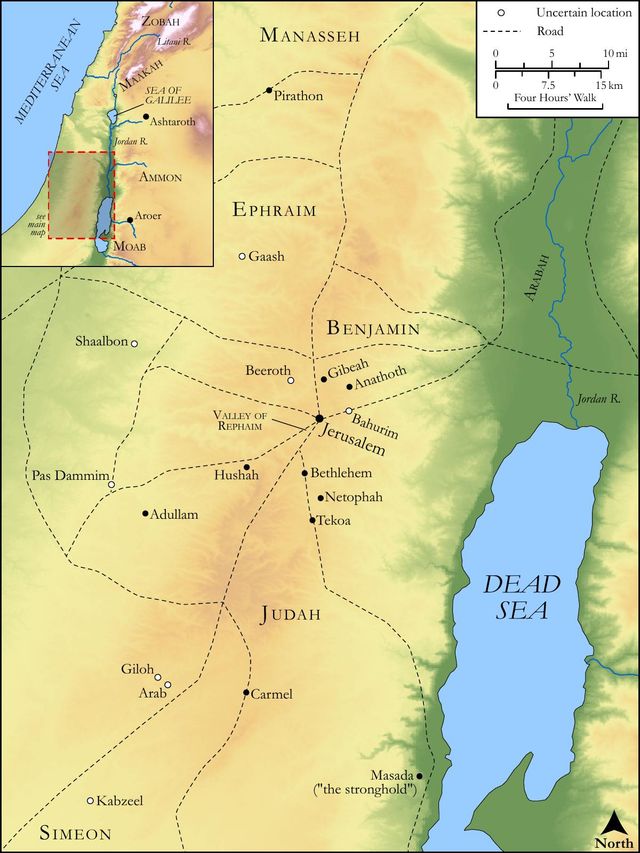
See on the biblical-era map
Study this verse
Public-domain commentary
Matthew Henry
From his Commentary on the Whole Bible. Henry comments on passages, not single verses — this entry covers 1 Chronicles 11:10–47. His two-level outline is real structure in the source text, so it is rendered as structure.
We have here an account of David's worthies, the great men of his time that served him and were preferred by him. The first edition of this catalogue we had, Sa2 23:8, etc. This is much the same, only that those named here from Ch1 11:41 to the end are added. Observe,
I.The connexion of this catalogue with that which is said concerning David, Ch1 11:9.
1.David waxed greater and greater, and these were his mighty men. Much of the strength and honour of great men is borrowed from their servants and depends upon them, which cannot but somewhat diminish pomp and power in the opinion of those that are wise. David is great because he has great men about him; take these away, and he is where he was.
2.The Lord of hosts was with him, and these were the mighty men which he had. God was with him and wrought for him, but by men and means and the use of second causes. By this it appeared that God was with him, that he inclined the hearts of those to come over to him that were able to serve his interest. As, if God be for us none can be against us, so, if God be for us, all shall be for us that we have occasion for. Yet David ascribed his success and increase, not to the hosts he had, but to the Lord of hosts, not to the mighty men that were with him, but to the mighty God whose presence with us is all in all.
II.The title of this catalogue (Ch1 11:10):
These are the men who strengthened themselves with him. In strengthening him they strengthened themselves and their own interest; for his advancement was theirs. What we do in our places for the support of the kingdom of the Son of David we shall be gainers by. In strengthening it we strengthen ourselves. It may be read, They held strongly with him and with all Israel. Note, When God has work to do he will not want fit instruments to do it with. If it be work that requires mighty men, mighty men shall either be found or made to effect it, according to the word of the Lord.
III.That which made all these men honourable was the good service that they did to their king and country; they helped to make David king (Ch1 11:10) - a good work. They slew the Philistines, and other public enemies, and were instrumental to save Israel. Note, The way to be great is to do good. Nor did they gain this honour without labour and the hazard of their lives. The honours of Christ's kingdom are prepared for those that fight the good fight of faith, that labour and suffer, and are willing to venture all, even life itself, for Christ and a good conscience. It is by a patient continuance in well-doing that we must seek for glory, and honour, and immortality; and those that are faithful to the Son of David shall find their names registered and enrolled much more to their honour than these are in the records of fame.
IV.Among all the great exploits of David's mighty men, here is nothing great mentioned concerning David himself but his pouring out water before the Lord which he had longed for, Ch1 11:18, Ch1 11:19. Four very honourable dispositions of David appeared in that action, which, for aught I know, made it as great as any of the achievements of those worthies.
1.Repentance for his own weakness. It is really an honour to a man, when he is made sensible that he has said or done any thing unadvisedly, to unsay it and undo it again by repentance, as it is a shame to a man when he has said or done amiss to stand to it.
2.Denial of his own appetite. He longed for the water of the well of Bethlehem; but, when he had it, he would not drink it, because he would not so far humour himself and gratify a foolish fancy. He that has such a rule as this over his own spirit is better than the mighty. It is an honour to a man to have the command of himself; but he that will command himself must sometimes cross himself.
3.Devotion towards God. That water which he thought too good, too precious, for his own drinking, he poured out to the Lord for a drink offering. If we have any thing better than another, let God be honoured with it, who is the best, and should have the best.
4.Tenderness of his servants. It put him into the greatest confusion imaginable to think that three brave men should hazard their lives to fetch water for him. In his account it turns the water into blood. It is the honour of great men not to be prodigal of the blood of those they employ, but, in all the commands they give them, to put their own souls into their souls' stead.
V.In the wonderful achievements of these heroes the power of God must be acknowledged.
How could one slay 300 and another the same number (Ch1 11:11, Ch1 11:20), another two lion-like men (Ch1 11:22), and another an Egyptian giant (Ch1 11:23), if they had not had the extraordinary presence of God with them, according to that promise, Jos 23:10, One man of you shall chase a thousand, for the Lord your God fighteth for you?
VI.One of these worthies is said to be an Ammonite (Ch1 11:39), another a Moabite (Ch1 11:46), and yet the law was that an Ammonite and a Moabite should not enter into the congregation of the Lord, Deu 23:3. These, it is likely, had approved themselves so hearty for the interest of Israel that in their case it was thought fit to dispense with that law, and the rather because it was an indication that the Son of David would have worthies among the Gentiles: with him there is neither Greek nor Jew.
Continue studying 1 Chronicles 11:38 across the web’s major study libraries — every link below opens this exact verse, chapter, or book on the destination site.
Read & Compare
 BibleGatewayThis verse in more than 200 translations and 70 languages.
 Bible.comThe YouVersion reader — hundreds of translations, reading plans, and highlights.
 ESV.orgCrossway's official English Standard Version reader.
 NET BibleThe NET translation with 60,000+ translators' notes on every rendering decision.
 STEP BibleTyndale House's free study tool — original text, vocabulary, and scholarly resources.
 BibliaLogos Bible Software's free web reader.
 USCCBThe New American Bible (Revised Edition) with the U.S. bishops' study notes.
Commentaries
 BibleHub CommentariesDozens of classic commentaries on this verse, gathered on one page.
 StudyLightMore than 100 commentary sets — the largest collection on the web.
 BibleRefPlain-English commentary on what this verse means, verse by verse.
 Enduring WordDavid Guzik's free commentary on this chapter, widely used by Bible teachers.
 Bible Study ToolsVerse commentary alongside Greek and Hebrew study aids.
Original Language & Research
- BibleHub InterlinearThe verse word by word — original language, transliteration, and English.
- BibleHub LexiconEvery word's original-language definition and Strong's entry.
 Blue Letter BibleDeep-study tools — Strong's numbers, concordance, and word studies.
 SefariaThe Hebrew text with Rashi and centuries of Jewish commentary.
Sermons, Hymns & Audio


TrulyRandomVerse is not affiliated with these sites and doesn’t control their content. They’re linked because they’re genuinely useful.
Summary
1 Chronicles 11:38 meticulously records two additional names, Joel the brother of Nathan and Mibhar the son of Haggeri, as esteemed members of King David's elite corps of "Mighty Men" or "The Thirty." This verse, embedded within a comprehensive roster of David's most valiant warriors, underscores the diverse individuals whose unwavering loyalty, exceptional courage, and dedicated service were indispensable to the establishment, defense, and flourishing of David's divinely ordained kingdom, highlighting the collective effort that underpinned his reign.
Context
ShowHideLiterary Context
This verse is situated within a pivotal section of 1 Chronicles (chapters 11-12) that immediately follows David's anointing as king over all Israel in Hebron and his subsequent capture of Jerusalem, making it the capital. The Chronicler, writing for a post-exilic audience, meticulously emphasizes the legitimacy and divine backing of David's dynasty. After establishing David's kingship and the strategic importance of Jerusalem, the narrative transitions to a detailed enumeration of the individuals who rallied to David's cause, forming his formidable military and administrative core. The extended list of "The Thirty" (commencing in 1 Chronicles 11:26 and concluding in 1 Chronicles 11:47) serves as a powerful testament to the strength, loyalty, and divine favor bestowed upon David's inner circle. Its inclusion reinforces the Chronicler's commitment to detailed historical documentation and the recognition of every individual's contribution to God's unfolding plan, particularly those who "strengthened themselves with him in his kingdom" (1 Chronicles 11:10).
Historical & Cultural Context
Among the kings of that day, the stability and longevity of a king's reign were intrinsically linked to the loyalty and military prowess of his elite fighting force. David's remarkable ascent from a humble shepherd to a unified monarch, especially after years as a fugitive, necessitated the formation of a highly dedicated and exceptionally skilled personal army. These "mighty men" were not merely soldiers; they often functioned as close confidantes, commanders, and even administrators, embodying a feudal-like system where personal allegiance to the sovereign was paramount. Their inclusion in a royal roster, akin to an ancient honor roll, vividly reflects the cultural value placed on valor, military achievement, and unwavering devotion to the monarch. The identification through familial relationships ("brother of Nathan," "son of Haggeri") further underscores the importance of lineage, tribal identity, and clan affiliations within Israelite society, where family ties frequently determined social standing, military roles, and political alliances. The textual variations observed when comparing this list with the parallel account in 2 Samuel 23 also provide insight into the fluid nature of ancient record-keeping and the potential for different scribal traditions or interpretations.
Key Themes
ShowHideThe Chronicler's deliberate inclusion of these mighty men contributes significantly to several overarching theological and narrative themes. Firstly, it powerfully illustrates Valor and Loyalty, showcasing the extraordinary courage, unwavering commitment, and sacrificial service of individuals who risked their lives to support David's God-given leadership. These men were instrumental in securing the kingdom and executing God's sovereign will. Secondly, the meticulous cataloging highlights the theme of Divine Remembrance and Historical Documentation, ensuring that the contributions of these faithful servants, regardless of their prominence, were not forgotten. It reinforces the profound biblical idea that God remembers and honors those who serve His purposes, even those who might appear to be minor figures. Thirdly, and perhaps most centrally for the Chronicler's theological agenda, this section underscores God's Providence and the Establishment of the Davidic Kingdom. While focusing on human agents and their remarkable feats, the broader narrative consistently points to God's active hand in establishing David's rule and fulfilling His covenant promises, particularly the eternal dynasty promised in 2 Samuel 7. The strength and effectiveness of David's army, epitomized by these mighty men, served as a tangible manifestation of God's blessing and His active work in bringing about His kingdom through chosen leaders and their loyal followers.
Exposition and Analysis
ShowHideKey Word Analysis
ShowHideMeaning "Jehovah (is his) God." This common Hebrew name signifies a personal connection to Yahweh. Its frequency necessitated the additional identifier "the brother of Nathan" to distinguish this specific Joel from others, such as the prophet Joel or Samuel's son. This highlights the Chronicler's meticulous attention to detail in identifying individuals within a large collective, ensuring clarity and historical precision.
Meaning "choice," "chosen," or "select." Its appearance as a proper name here is unique in the biblical text and presents a notable textual variant with the parallel account in 2 Samuel 23:36, where the name is "Igal." Many scholars propose that "Mibhar" might not be a proper name but rather a descriptive title, indicating that this individual was a "choice one" or "select warrior" from the son of Haggeri. This interpretation could reconcile the two accounts, with "Igal" being the proper name and "Mibhar" a descriptor of his exceptional quality.
Indicating a Hagrite or member of a certain Arabian clan. This name likely denotes a tribal or ethnic affiliation, suggesting that Mibhar (or Igal) was either of Hagrite descent or originated from a region associated with them. This detail points to the diverse ethnic and geographical origins of David's loyal followers, who came from various backgrounds to form a unified and formidable fighting force under his leadership.
Verse Breakdown
ShowHide"Joel the brother of Nathan"
This clause introduces an individual named Joel, specifically identifying him through his fraternal relationship to Nathan. In ancient Israelite society, identifying individuals by their familial connections (e.g., "son of," "brother of") was a standard and crucial practice, serving as a marker of identity, lineage, and social standing within the community. While Joel and Nathan are not extensively detailed elsewhere in the biblical narrative, their inclusion here signifies their recognized contribution to David's military and the Chronicler's commitment to recording the names of all who served. Their presence underscores the communal and familial fabric of David's support system.
"Mibhar the son of Haggeri"
This clause introduces another warrior, Mibhar, identified by his father Haggeri. As explored in the key word analysis, "Mibhar" presents a textual challenge when compared to the parallel account in 2 Samuel 23:36, which lists "Igal the son of Nathan of Zobah." Regardless of the precise name, the identification "son of Haggeri" points to a specific lineage or tribal affiliation, possibly indicating a non-Israelite origin or a connection to a specific region. This highlights the diverse composition of David's forces, which included individuals from various backgrounds united under his leadership. The textual variation itself serves as a reminder of the complexities of ancient manuscript transmission and the ongoing scholarly work involved in biblical studies.
Literary Devices
ShowHideThe Chronicler's presentation in 1 Chronicles 11:38, as an integral part of the broader list of David's mighty men, employs several significant literary devices. Primarily, it utilizes a Catalog or List format, a literary technique common in Scripture, as in the registers of Numbers, for meticulously documenting significant individuals, events, or possessions. This detailed enumeration serves to underscore the historical authenticity and comprehensive nature of David's support system, lending credibility to his reign. Furthermore, the use of Prosopography is evident, as the Chronicler provides concise, identifying details for each person, such as familial relationships ("brother of Nathan," "son of Haggeri") or tribal affiliations. This technique personalizes the historical record, transforming abstract numbers into concrete individuals whose lives contributed to the narrative. The implicit Comparison and Contrast with the parallel account in 2 Samuel 23 also functions as a literary device, inviting readers to engage with textual variations and consider the process of biblical transmission, even if the Chronicler's primary aim was to present his own authoritative record rather than highlight discrepancies. Ultimately, the entire list, including this specific verse, functions as Symbolism, representing the formidable strength, divine favor, and broad-based support that characterized David's kingdom, showcasing the human instruments through whom God worked to establish His chosen king.
Theological and Thematic Connections
ShowHideThe inclusion of seemingly less prominent figures like Joel and Mibhar within the esteemed list of David's mighty men carries profound theological weight. It powerfully underscores the biblical principle that every individual's contribution, no matter how seemingly small, obscure, or unheralded, is deeply valued and eternally remembered by God. The Chronicler's meticulous record-keeping reflects a divine perspective that acknowledges the faithfulness and devoted service of all who participate in God's grand redemptive plan. These men, through their valor, loyalty, and willingness to serve, were instrumental instruments in establishing God's chosen king and securing the kingdom of Israel. Their lives demonstrate that God sovereignly works through human agency to accomplish His divine purposes. Their presence in the sacred text affirms that faithfulness in supporting roles, behind-the-scenes contributions, and steadfast dedication are just as vital and honored in God's eyes as prominent leadership, contributing holistically to the overall strength and success of God's work in the world.
Reflection and Application
ShowHideThe inclusion of Joel the brother of Nathan and Mibhar the son of Haggeri in this ancient honor roll serves as a profound and timeless reminder that God values every act of faithful service, irrespective of its public recognition, perceived significance, or the stature of the one performing it. In a contemporary culture that often celebrates only the highly visible, the powerfully influential, or the widely acclaimed, these names speak eloquently to the enduring legacy of those who serve diligently and faithfully in supporting roles. They remind us that the true strength and lasting impact of any great endeavor—be it a nation, a church, a community, or a family—resides not solely in its prominent leaders, but equally, if not more so, in the quiet, consistent, and sacrificial faithfulness of its countless members. Our ultimate calling as believers is not necessarily to attain fame or public acclaim, but rather to cultivate unwavering faithfulness; not to seek the spotlight, but to serve with integrity, humility, and wholehearted devotion wherever God has sovereignly placed us. Every unique skill, every dedicated hour, every ounce of strength, and every prayer offered in service to God's kingdom contributes immeasurably to its overall flourishing and is meticulously recorded in His divine ledger, ensuring that no act of love or service is ever forgotten.
Questions for Reflection
ShowHideFAQ
ShowHideWhat is the significance of the textual variation between 1 Chronicles 11:38 ("Mibhar the son of Haggeri") and 2 Samuel 23:36 ("Igal the son of Nathan of Zobah")?
ShowHideThis textual variation is a classic and fascinating example of the complexities inherent in ancient biblical manuscripts and their transmission over centuries. While it might initially appear as a contradiction, biblical scholars offer several compelling explanations. One common and widely accepted theory, supported by the meaning of "Mibhar" (Hebrew for "choice" or "select"), suggests that "Mibhar" in 1 Chronicles 11:38 could be a descriptive title rather than a proper name. In this view, it would indicate that the individual was a "choice one" or "select warrior" from the son of Haggeri, whose actual proper name was "Igal," as listed in 2 Samuel 23:36. Another possibility is that these are two distinct individuals, or that scribal errors occurred during the long process of copying ancient texts. It's also plausible that "Nathan of Zobah" in 2 Samuel 23:36 refers to a different Nathan than the brother of Joel mentioned in 1 Chronicles 11:38. Regardless of the precise historical reconciliation, these minor variations remind us that the Bible is an ancient text transmitted through human hands, and such textual nuances do not undermine its overall divine inspiration, theological truth, or reliability. Instead, they invite deeper textual study and a greater appreciation for the meticulous work of ancient scribes and modern biblical scholars.
Why does the Chronicler include such detailed lists of names, even for seemingly obscure individuals?
ShowHideThe Chronicler's meticulous inclusion of detailed lists, such as the one found in 1 Chronicles 11, serves multiple crucial purposes, both historical and theological. Historically, it provides a comprehensive and authentic record of the specific individuals who contributed significantly to the establishment, defense, and strength of David's kingdom, thereby validating the legitimacy and divine appointment of his reign. Theologically, these lists underscore the Chronicler's profound emphasis on the importance and value of every single member within God's covenant community. It powerfully demonstrates that God remembers and honors the faithfulness, loyalty, and dedicated service of all His people, not solely the prominent leaders or those who achieve widespread fame. For the post-exilic audience, to whom the Chronicler was writing, these extensive lists would have served as a vital reminder of their rich heritage, providing a tangible sense of continuity, identity, and encouragement. They were called to emulate the unwavering loyalty and devotion of their ancestors in the challenging task of rebuilding their own community and spiritual life. Ultimately, these lists reinforce the profound biblical idea that God's grand redemptive plan unfolds through the collective, interdependent efforts of many individuals, each playing a uniquely vital and indispensable role.
Christ-Centered Fulfillment
ShowHideThe faithful service and unwavering loyalty of Joel, Mibhar, and the other mighty men of David, though significant in their own right, ultimately foreshadow the ultimate and perfect service rendered by Jesus Christ, the true and eternal King of Israel. David's earthly kingdom, established and secured through the valor and sacrifice of his loyal followers, was but a temporal shadow and a prophetic type of the eternal kingdom of God, which Christ inaugurates, perfectly rules, and will bring to glorious consummation (Luke 1:33). Just as David's mighty men rallied around him to secure his earthly reign, so too does Christ gather His own "mighty men and women"—His disciples and the Church—who are called to serve Him with unwavering loyalty, self-denial, and sacrificial love (Matthew 16:24). The profound value placed on every individual's contribution within David's army finds its ultimate and most glorious fulfillment in the body of Christ, where every member, no matter how seemingly small, hidden, or unheralded, is indispensable, uniquely gifted, and vital for the building up of the kingdom and the edification of the saints (1 Corinthians 12:12-27). Christ Himself is the "choice one" (reflecting the potential meaning of Mibhar) of God, the perfectly chosen Servant who accomplished salvation through His ultimate act of obedience, self-sacrifice, and atoning death on the cross (Isaiah 42:1; Philippians 2:8). Thus, the loyalty and devoted service of David's warriors serve as a powerful pointer to the supreme loyalty and perfect service of Christ, and in turn, illuminate our own call to be faithful servants in His ever-expanding, eternal, and glorious kingdom.