


Zechariah 11:1
- פְּתַחpe·TachopenH6605V-Qal-Imp-2msVerb Qal Imperative 2nd Singular Masculine
- לְבָנוֹןle·va·NonO LebanonH3844N-properNoun Proper Location
- דְּלָתֶיךָde·la·Tei·khayour doorsH1817N-fdc ¦ 2msNoun Dual Feminine Constructדְּלָתֶיdoorsךָyour
- וְתֹאכַלve·to·Khalso it may consumeH398Conj-w ¦ V-Qal-ConjImperf-3fsVerb Qal Conjunction+Imperfect 3rd Singular Feminineוְsoתֹאכַלit may consume
- אֵשׁ'eshfireH784N-csNoun Singular common gender Absolute
- בַּאֲרָזֶיךָba·'a·ra·Zei·kha<in> your cedarsH730Prep-b ¦ N-mpc ¦ 2msNoun Plural Masculine Constructבַּ<in>אֲרָזֶיcedarsךָyour
English is a literal word-by-word gloss of the Hebrew, not the KJV's wording. Why?
This is the original text the KJV's translators worked from — each Hebrew word with its own literal English meaning in this verse, prepared by scholars at Tyndale House, Cambridge. The KJV translates whole sentences, not word by word, so its wording differs: one Hebrew word can become several English words, and the KJV may choose “the LORD” where the gloss reads “Yahweh”. Both are faithful — they answer different questions. For the KJV's own rendering, switch to the KJV text.
Details
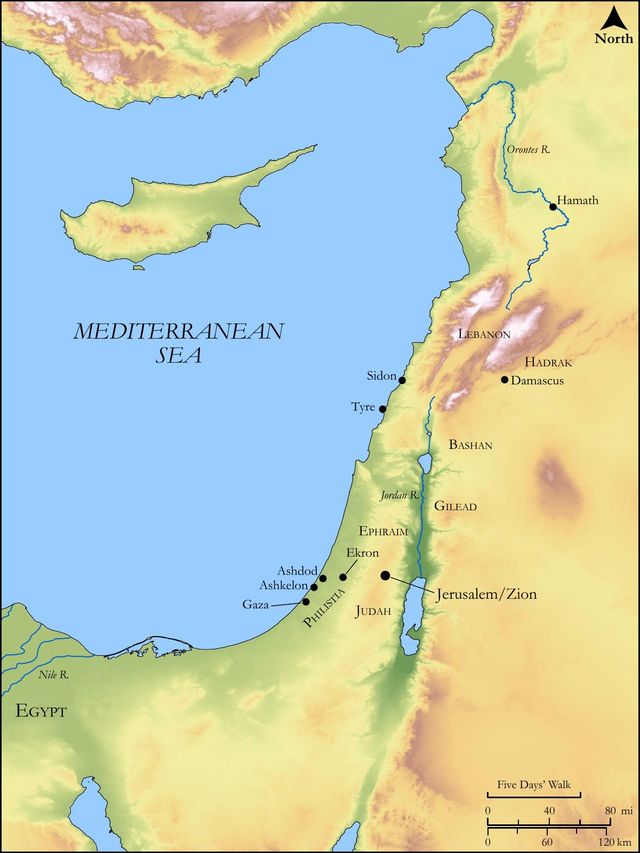
See on the biblical-era map
Study this verse
Public-domain commentary
Matthew Henry
From his Commentary on the Whole Bible. Henry comments on passages, not single verses — this entry covers Zechariah 11:1–3.
In dark and figurative expressions, as is usual in the scripture predictions of things at a great distance, that destruction of Jerusalem and of the Jewish church and nation is here foretold which our Lord Jesus, when the time was at hand, prophesied of very plainly and expressly. We have here, 1. Preparation made for that destruction (Zac 11:1): "Open thy doors, O Lebanon! Thou wouldst not open them to let thy king in - he came to his own and his own received him not; now thou must open them to let thy ruin in. Let the gates of the forest, and all the avenues to it, be thrown open, and let the fire come in and devour its glory." Some by Lebanon here understand the temple, which was built of cedars from Lebanon, and the stones of it white as the snow of Lebanon. It was burnt with fire by the Romans, and its gates were forced open by the fury of the soldiers. To confirm this, they tell a story, that forty years before the destruction of the second temple the gates of it opened of their own accord, upon which prodigy Rabbi Johanan made this remark (as it is found in one of the Jewish authors), "Now I know," said he, "that the destruction of the temple is at hand, according to the prophecy of Zechariah, Open thy doors, O Lebanon! that the fire may devour thy cedars." Others understand it of Jerusalem, or rather of the whole land of Canaan, to which Lebanon was an inlet on the north. All shall lie open to the invader, and the cedars, the mighty and eminent men, shall be devoured, which cannot but alarm those of an inferior rank, Zac 11:2. If the cedars have fallen (if all the mighty are spoiled, and brought to ruin), let the fir-tree howl. How can the slender fir-trees stand if stately cedars fall? If cedars are devoured by fire, it is time for the fir-trees to howl; for no wood is so combustible as that of the fir. And let the oaks of Bashan, that lie exposed to every injury, howl, for the forest of the vintage (or the flourishing vineyard, that used to be guarded with a particular care) has come down, or (as some read it) when the defenced forests, such as Lebanon was, have come down. Note, The falls of the wise and good into sin, and the falls of the rich and great into trouble, are loud alarms to those that are every way their inferiors not to be secure. 2. Lamentation made for the destruction (Zac 11:3): There is a voice of howling. Those who have fallen howl for grief and shame, and those who see their own turn coming howl for fear. But the great men especially receive the alarm with the utmost confusion. Those who were roaring in the day of their revels and triumphs are howling in the day of their terrors; for now they are tormented more than others. Those great men were by office shepherds, and such should have protected God's flock committed to their charge; it is the duty both of princes and priests. But they were as young lions, that made themselves a terror to the flock with their roaring and the flock a prey to themselves with their tearing. Note, It is sad with a people when those who should be as shepherds to them are as young lions to them. But what is the issue? The shepherds howl, for their glory is spoiled. Their pastures, and the flocks which covered them, which were the glory of the swains, are laid waste. The young lions howl, for the pride of Jordan is spoiled. The pride of Jordan was the thickets on the banks, in which the lions reposed themselves; and therefore, when the river overflowed and spoiled them, the lions came up from them (as we read Jer 49:19), and they came up roaring. Note, When those who have power proudly abuse their power, and, instead of being shepherds, are as young lions, they may expect that the righteous God will humble their pride and break their power.
Historical interpretation
Fourteen Centuries of Reception
3 surviving comments on this verse. Each one is dated, so this reads as a timeline rather than a list.
Select a marker to jump to its quote. Markers stagger vertically where authors wrote within a few decades of each other.
(Chapter 11, Verse 1) Open your gates, Lebanon, and let the fire devour your cedars. Howl, fir tree, for the cedar has fallen; the majestic trees are ruined. Wail, you oaks of Bashan, for the thick forest has been cut down. LXX: Open your gates, Lebanon, and let the fire devour your cedars. Let the pine tree wail, for the cedar has fallen; the nobles have been crushed. Wail, you oaks of Bashan, for the dense forest has been laid waste. Clearly, Lebanon, to which the prophetic discourse is directed, saying: Open, Lebanon, your gates, the temple of the Jews is understood, which was restored, rebuilt by Zerubbabel, again sung to be destroyed by Vespasian and Titus. And because he had metaphorically called Lebanon a temple, and he maintains the same translation in the rest, so that through cedars and firs and oaks of Bashan and a wooded grove, he signifies the leaders, priests, and people of the Jews. But Lebanon opens its gates so that the Roman army can enter, and its cedars are consumed by fire, so that everything is either devastated by the conflagration or its leaders and princes are consumed by enemy attack. The firs wail, because the cedar has fallen, and the priests and leaders mourn their people in return. And what he previously said obscurely, he now presents more clearly, because the magnificent ones have been laid waste. I desire to know which are the cedars of Lebanon that have been burned, which firs wail, and which pines have fallen; for, he says, the magnificent ones have been laid waste. Howl, O oak tree of Bazan, that is, of confusion and ignominy, for the well-fortified forest, which is called Besor in Hebrew and is translated by the LXX as wooded and cut down; for the temple, which had grown in impregnable strength and was built by various kings and princes, and later by Herod, was destroyed by the Romans' attack. Some people, not understanding this place, attribute the strength of the Lebanon, the cedars, the pines, and the oak of Bazan, along with the wooded and fortified forest, to opposing powers, about which it is said in Ezekiel under the name of Assyria and Pharaoh: Behold, Assyria is a cypress tree in Lebanon, with fair branches and a dense shade, and tall in stature, and its top was among the clouds: it was nourished by water, and the abyss made it tall, and so on, which are said about both Assyria and Pharaoh, they are thought to be spoken of either opposing powers or proud rulers and princes, about whom we also read in the Psalm: The voice of the Lord breaks the cedars; indeed, the Lord shatters the cedars of Lebanon. And in another place: Day of the Lord of hosts comes upon all the haughty and proud, and upon all that is exalted and lofty (Isaiah 22:12, 13). And a little later: And upon all the high cedars of Lebanon (or, the lofty ones), and upon all the trees of Bashan. And about this Lebanon it is prophesied: Lebanon with its lofty ones will fall. But let us follow the earlier interpretation, especially since what follows also agrees with this meaning.
Thy cedars: Thy princes and chief men.
O Libanus: So Jerusalem, and more particularly the temple, is called by the prophets, from its height, and from its being built of the cedars of Libanus.-- Ibid.
Continue studying Zechariah 11:1 across the web’s major study libraries — every link below opens this exact verse, chapter, or book on the destination site.
Read & Compare
 BibleGatewayThis verse in more than 200 translations and 70 languages.
 Bible.comThe YouVersion reader — hundreds of translations, reading plans, and highlights.
 ESV.orgCrossway's official English Standard Version reader.
 NET BibleThe NET translation with 60,000+ translators' notes on every rendering decision.
 STEP BibleTyndale House's free study tool — original text, vocabulary, and scholarly resources.
 BibliaLogos Bible Software's free web reader.
 USCCBThe New American Bible (Revised Edition) with the U.S. bishops' study notes.
Commentaries
 BibleHub CommentariesDozens of classic commentaries on this verse, gathered on one page.
 StudyLightMore than 100 commentary sets — the largest collection on the web.
 BibleRefPlain-English commentary on what this verse means, verse by verse.
 Enduring WordDavid Guzik's free commentary on this chapter, widely used by Bible teachers.
 Bible Study ToolsVerse commentary alongside Greek and Hebrew study aids.
Original Language & Research
- BibleHub InterlinearThe verse word by word — original language, transliteration, and English.
- BibleHub LexiconEvery word's original-language definition and Strong's entry.
 Blue Letter BibleDeep-study tools — Strong's numbers, concordance, and word studies.
 SefariaThe Hebrew text with Rashi and centuries of Jewish commentary.
Sermons, Hymns & Audio


TrulyRandomVerse is not affiliated with these sites and doesn’t control their content. They’re linked because they’re genuinely useful.
Summary
Zechariah 11:1 delivers a stark prophetic oracle of divine judgment and impending devastation upon the land, symbolized by Lebanon and its mighty cedars. This verse serves as a dramatic opening to a chapter that foretells the rejection of God's chosen shepherd and the subsequent national calamity that would befall Israel, highlighting the severe consequences of spiritual rebellion and unfaithfulness.
Context
ShowHideLiterary Context
Zechariah 11:1 initiates a new prophetic "burden" or oracle, distinct from the preceding chapters. Chapters 9-14 shift focus from the immediate post-exilic concerns of Temple rebuilding to a series of eschatological prophecies concerning Israel's future, the coming of the Messiah, and the ultimate judgment of the nations. Specifically, chapter 11 introduces a dramatic allegory involving shepherds and their flock, setting the stage for the rejection of the "Good Shepherd" (Christ) and the rise of a "worthless shepherd." Verse 1, with its imagery of destruction, serves as a grim prelude, establishing the dire consequences that will follow the nation's spiritual apostasy and rejection of divine leadership, culminating in the scattering of the flock.
Historical & Cultural Context
The prophet Zechariah ministered to the Jewish exiles who had returned to Jerusalem from Babylon, encouraging them in the rebuilding of the Second Temple (c. 520-518 BC). While the immediate historical context is post-exilic, the prophecy in Zechariah 11:1 looks forward to a much later period, likely the first century AD. Lebanon, renowned for its majestic and durable cedars, was a symbol of strength, grandeur, and national pride in the ancient Near East, often associated with kings and powerful nations (e.g., Assyria, Babylon). The cedars themselves were prized for their use in grand construction, such as Solomon's Temple. The "fire" is a common biblical metaphor for divine judgment, war, and desolation, indicating a comprehensive and destructive act. This imagery points to a period of severe national calamity, widely understood to refer to the Roman destruction of Jerusalem and its Temple in 70 AD, a direct consequence of Israel's spiritual unfaithfulness and rejection of their true Shepherd.
Key Themes
ShowHideThis opening verse introduces several profound themes that resonate throughout Zechariah 11 and beyond. The primary theme is Divine Judgment, where God's impending wrath is depicted as a consuming fire that spares nothing, not even the strongest and most prominent elements of the land. This judgment is a direct consequence of the nation's spiritual rebellion. Another crucial theme is Prophetic Foreshadowing, as the destruction described here sets the stage for the narrative of the good shepherd (representing Christ) who is rejected by His flock in favor of a foolish, oppressive shepherd (as elaborated in Zechariah 11:4-17). Finally, the Symbolism of Strength Undone is powerfully conveyed by the cedars of Lebanon, which, though symbols of grandeur, stability, and national pride (as seen in their use for Solomon's Temple), are here depicted as being utterly consumed by God's wrath, signifying that no earthly power or prominence can withstand divine reckoning.
Exposition and Analysis
ShowHideKey Word Analysis
ShowHideMeaning "to open wide (literally or figuratively); specifically, to loosen, begin, plough, carve; appear, break forth, draw (out), let go free, (en-) grave(-n), loose (self), (be, be set) open(-ing), put off, ungird, unstop, have vent." In this context, the imperative "Open!" signifies an unhindered, perhaps even divinely commanded, removal of barriers, allowing destructive forces to enter without resistance. It implies a deliberate act that facilitates the impending judgment.
Meaning "(the) white mountain (from its snow); Lebanon, a mountain range in Palestine; Lebanon." As a geographical region famous for its majestic cedars, Lebanon is used here as a powerful symbol. It represents not just a physical place, but metaphorically, the strength, pride, and perhaps the leadership or prominent institutions of Israel, which are about to face devastation. Its "white" peaks could also subtly highlight its perceived purity or prominence, which will now be stained by fire.
Meaning "a cedar tree (from the tenacity of its roots); cedar (tree)." Cedars were highly valued for their durability, size, and beauty, used in royal palaces and the Temple. Their inclusion here emphasizes that the judgment will not spare the most valuable, strong, or prominent elements. It signifies a complete and devastating destruction, targeting the very pillars of the nation's perceived strength and glory.
Verse Breakdown
ShowHide"Open thy doors, O Lebanon,"
This is a dramatic, imperative command, personifying Lebanon as a city or fortress with gates. The call to "open thy doors" implies an unhindered entry for the destructive force. It suggests either a voluntary surrender to judgment or a divinely mandated removal of all defenses, making the region utterly vulnerable. Lebanon, with its association with strength and grandeur, is thus depicted as defenseless before the coming calamity.
"that the fire may devour thy cedars."
This clause reveals the purpose and nature of the opening: to allow "fire" to enter and "devour." "Fire" is a common biblical metaphor for divine judgment, war, and total destruction. The verb "devour" (Hebrew: akal) signifies complete consumption, leaving nothing behind. The "cedars," representing the strongest, most valuable, and most prominent aspects of Lebanon (and by extension, Israel's leadership, wealth, or power), are the specific targets. This imagery paints a picture of comprehensive and irreversible devastation, where even the most resilient elements are utterly consumed.
Literary Devices
ShowHideZechariah 11:1 is rich in literary devices that amplify its prophetic message. Personification is evident in the command "Open thy doors, O Lebanon," treating the geographical region as if it were a sentient entity capable of opening gates. This device makes the impending judgment more immediate and dramatic, as if Lebanon itself is being commanded to facilitate its own destruction. Symbolism is central to the verse, with "Lebanon" representing the strength, pride, and perhaps the ruling elite of Israel, and its "cedars" symbolizing the nation's most valuable, powerful, and prominent figures or institutions. The "fire" is a powerful metaphor for divine judgment, war, and utter desolation, conveying the intensity and completeness of the destruction. Together, these devices create a vivid and ominous image, underscoring the severity and inevitability of the coming divine reckoning.
Theological and Thematic Connections
ShowHideZechariah 11:1 serves as a stark reminder of the principle that divine judgment inevitably follows national apostasy and rebellion against God's covenant. The imagery of fire consuming the cedars of Lebanon foreshadows a period of severe national calamity, a consequence of Israel's rejection of God's true shepherd. This judgment is not arbitrary but a just response to a people who have strayed from the Lord, opting for false security and worldly strength over divine guidance. Theologically, it underscores God's sovereignty over nations and His unwavering commitment to justice, even when it involves the painful discipline of His own people. This verse sets the stage for the ultimate rejection of the Messiah, the true Shepherd, and the subsequent desolation of Jerusalem.
Reflection and Application
ShowHideZechariah 11:1 stands as a powerful warning for all generations, reminding us that no amount of perceived strength, national pride, or worldly prominence can withstand the righteous judgment of God when a people or an individual turns away from His truth. For believers today, this verse underscores the critical importance of spiritual discernment and submission to God's appointed leadership, rather than trusting in human wisdom, political power, or material wealth. It challenges us to examine where our true security lies and to recognize the severe consequences of spiritual rebellion and the rejection of God's grace. We are called to cultivate faithfulness, humility, and obedience, understanding that true strength comes from aligning ourselves with God's will, not from relying on earthly "cedars" that can be consumed by divine fire. This passage urges constant self-examination and a steadfast commitment to Christ, our true Shepherd, lest we too face the devastating consequences of spiritual unfaithfulness.
Questions for Reflection
ShowHideFAQ
ShowHideWhat does "Lebanon" symbolize in Zechariah 11:1?
ShowHideIn Zechariah 11:1, "Lebanon" symbolizes strength, grandeur, and national pride. It represents not merely the geographical region known for its majestic cedars, but metaphorically, the powerful, prominent, and perhaps even arrogant aspects of Israel's leadership, institutions, or national identity. The reference to its "doors" suggests a fortified, secure entity, which is now commanded to open itself to destruction, indicating that no earthly power or perceived security can withstand divine judgment.
What does the "fire" represent in this verse?
ShowHideThe "fire" in Zechariah 11:1 is a powerful biblical metaphor for divine judgment, war, and utter desolation. It signifies a comprehensive and consuming destruction, implying that God Himself is the ultimate agent of this calamity. This imagery is consistent with other Old Testament passages where fire is used to depict God's wrath against sin and rebellion, such as when the Lord's anger burned against Israel in Numbers 11:1. Here, it portends a period of intense suffering and national ruin for Israel.
When was the prophecy of Zechariah 11:1 fulfilled?
ShowHideWhile Zechariah's prophecies often have multiple layers of fulfillment, the destruction described in Zechariah 11:1 is widely understood by scholars to refer primarily to the Roman destruction of Jerusalem and its magnificent Temple in 70 AD. This event was a direct and devastating consequence of Israel's rejection of Jesus, the true Messiah and Good Shepherd, as prophesied by Jesus Himself in passages like Luke 21:20-24. The "fire" consuming "cedars" vividly portrays the obliteration of the nation's strength and the very heart of its religious life.
Christ-Centered Fulfillment
ShowHideZechariah 11:1, with its ominous pronouncement of judgment upon Lebanon and its cedars, finds its profound Christ-centered fulfillment in the ultimate rejection of Jesus Christ, the Good Shepherd, by His own people. The "fire" devouring the "cedars" foreshadows the devastating consequences that would befall Jerusalem and the Jewish nation, culminating in the Roman destruction of 70 AD, precisely because they rejected their Messiah. Jesus Himself lamented over Jerusalem, knowing its fate (as seen in Matthew 23:37-38), and prophesied the destruction of the Temple, which was indeed brought to ruin (as recorded in Luke 21:5-6). This verse, therefore, is not merely a historical prediction but a powerful testament to the cost of rejecting God's chosen one. Yet, in Christ, there is also hope; for while the old order faced judgment, Jesus, the rejected Shepherd, became the foundation of a new spiritual house, a new Temple not made with hands, where all who believe find refuge and eternal life, fulfilling the promise of a true shepherd who lays down His life for His sheep (as declared in John 10:11).