TRV
TRV
- English
- King James KJV
- Complete Jewish CJB
- World English WEBM
- Berean Standard BSB
- American Standard ASV
- Geneva GNV
- Young's Literal YLT
- Douay-Rheims DRC
- International
- Shqip ALB
- العربية SVD
- বাংলা BN-IRV
- မြန်မာ Judson
- 简体文 CUV-S
- 繁體中文 CUV-T
- Čeština BKR
- Nederlands STVE
- Français LSG
- Deutsch SCH
- Ελληνικά Vamvas
- ગુજરાતી GU-IRV
- Hausa HCB
- עברית Hebrew
- हिन्दी HCV
- Magyar KAROLI
- Bahasa Indonesia INDO-TB
- Italiano Diodati
- 日本語 Kougo
- 한국어 Korean
- മലയാളം MAL
- मराठी MRCV
- Norsk DNB
- فارسی OPV
- Polski BG
- Português Almeida
- Română Cornilescu
- Русский Synodal
- Español RVG
- Kiswahili Neno
- Svenska SV1917
- Tagalog TAG-ADB
- தமிழ் TCV
- తెలుగు TSA
- ภาษาไทย THAI-KJV
- Українська Ohienko
- Tiếng Việt CADMAN
- Yorùbá YCB
Controversy Over the Sabbath
Controversy Over the Sabbath
Study this passage
Commentary written on this passage, not on a single verse.
- Who
- Where
- When
- About
Where else Scripture says this.
John 8:11
She said, “No one, sir.” Yeshua said, “Neither do I condemn you. Now go, and don’t sin any more.”from verse 14Leviticus 26:23
"'If, in spite of all this, you refuse my correction and still go against me;from verse 14Leviticus 26:24
then I too will go against you; and I, yes I, will strike you seven times over for your sins.from verse 14Psalms 118:18
Yah disciplined me severely, but did not hand me over to death.from verse 14Nehemiah 9:28
But as soon as they had gotten some relief, they went back to do evil before you. So you left them in the power of their enemies, who came down hard on them. Yet when they returned and cried out to you, you heard from heaven many times and saved them, according to your compassion.from verse 14Matthew 12:45
Then it goes and takes with it seven other spirits more evil than itself, and they come and live there -- so that in the end, the person is worse off than he was before. This is how it will be for this wicked generation."from verse 14Psalms 107:20
he sent his word and healed them, he delivered them from destruction.from verse 14Psalms 107:22
Let them offer sacrifices of thanksgiving and proclaim his great deeds with songs of joy.from verse 14Revelation 2:21
I gave her time to turn from her sin, but she doesn’t want to repent of her immorality.from verse 14Revelation 2:23
and I will strike her children dead! Then all the Messianic communities will know that I am the one who searches minds and hearts, and that I will give to each of you what your deeds deserve.from verse 14Jeremiah 17:21
Here is what ADONAI says: "If you value your lives, don't carry anything on Shabbat or bring it in through the gates of Yerushalayim;from verse 10John 9:16
At this, some of the P’rushim said, “This man is not from God, because he doesn’t keep Shabbat.” But others said, “How could a man who is a sinner do miracles like these?” And there was a split among them.from verse 10
Public-domain commentary
Matthew Henry
From his Commentary on the Whole Bible. Henry comments on passages, not single verses — this entry covers John 5:1–16. His four-level outline is real structure in the source text, so it is rendered as structure.
This miraculous cure is not recorded by any other of the evangelists, who confine themselves mostly to the miracles wrought in Galilee, but John relates those wrought at Jerusalem. Concerning this observe,
I.The time when this cure was wrought:
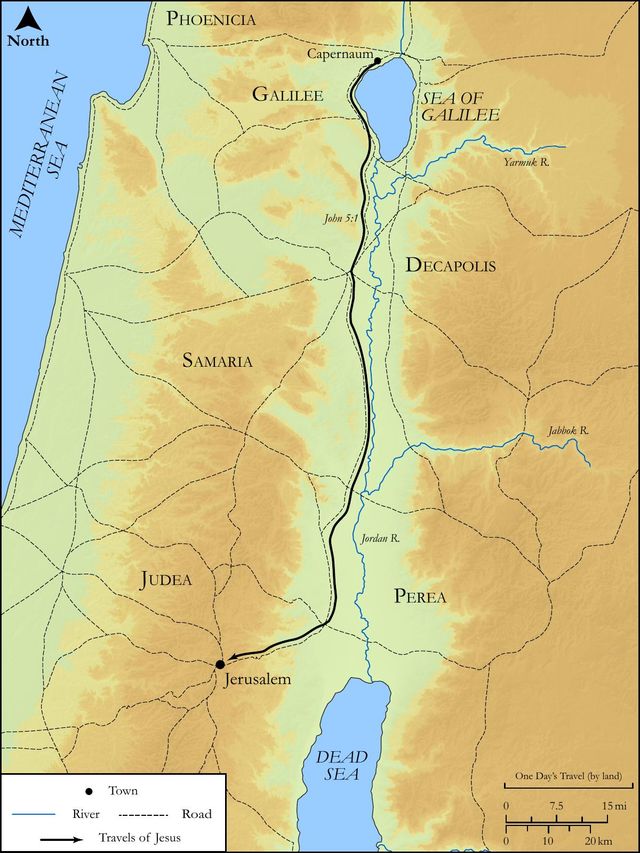
it was at a feast of the Jews, that is, the passover, for that was the most celebrated feast. Christ, though residing in Galilee, yet went up to Jerusalem at the feast, Joh 5:1.
1.Because it was an ordinance of God, which, as a subject, he would observe, being made under the law; though as a Son he might have pleaded an exemption. Thus he would teach us to attend religious assemblies. Heb 10:25.
2.Because it was an opportunity of good; for, (1.) there were great numbers gathered together there at that time; it was a general rendezvous, at least of all serious thinking people, from all parts of the country, besides proselytes from other nations: and Wisdom must cry in the places of concourse, Pro 1:21. (2.) It was to be hoped that they were in a good frame, for they came together to worship God and to spend their time in religious exercises. Now a mind inclined to devotion, and sequestering itself to the exercises of piety, lies very open to the further discoveries of divine light and love, and to it Christ will be acceptable.
II.The place where this cure was wrought:
at the pool of Bethesda, which had a miraculous healing virtue in it, and is here particularly described, Joh 5:2-4.
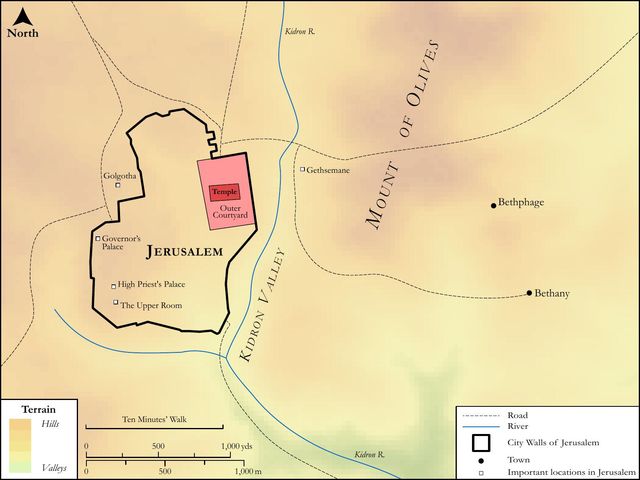
1.Where it was situated: At Jerusalem, by the sheep-market; epi tē probatikē. It might as well be rendered the sheep-cote, where the sheep were kept, or the sheep-gate, which we read of, Neh 3:1, through which the sheep were brought, as the sheep-market, where they were sold. Some think it was near the temple, and, if so, it yielded a melancholy but profitable spectacle to those that went up to the temple to pray.
2.How it was called: It was a pool (a pond or bath), which is called in Hebrew, Bethesda - the house of mercy; for therein appeared much of the mercy of God to the sick and diseased. In a world of so much misery as this is, it is well that there are some Bethesdas - houses of mercy (remedies against those maladies), that the scene is not all melancholy. An alms-house, so Dr. Hammond. Dr. Lightfoot's conjecture is that this was the upper pool (Isa 7:3), and the old pool, Isa 22:11; that it had been used for washing from ceremonial pollutions, for convenience of which the porches were built to dress and undress in, but it was lately become medicinal.
3.How it was fitted up: It had five porches, cloisters, piazzas, or roofed walks, in which the sick lay. Thus the charity of men concurred with the mercy of God for the relief of the distressed. Nature has provided remedies, but men must provide hospitals.
4.How it was frequented with sick and cripples (Joh 5:3): In these lay a great multitude of impotent folks. How many are the afflictions of the afflicted in this world! How full of complaints are all places, and what multitudes of impotent folks! It may do us good to visit the hospitals sometimes, that we may take occasion, from the calamities of others, to thank God for our comforts. The evangelist specifies three sorts of diseased people that lay here, blind, halt, and withered or sinew - shrunk, either in one particular part, as the man with the withered hand, or all over paralytic. These are mentioned because, being least able to help themselves into the water, they lay longest waiting in the porches. Those that were sick of these bodily diseases took the pains to come far and had the patience to wait long for a cure; any of us would have done the same, and we ought to do so: but O that men were as wise for their souls, and as solicitous to get their spiritual diseases healed! We are all by nature impotent folks in spiritual things, blind, halt, and withered; but effectual provision is made for our cure if we will but observe orders.
5.What virtue it had for the cure of these impotent folks (Joh 5:4). An angel went down, and troubled the water; and whoso first stepped in was made whole. That this strange virtue in the pool was natural, or artificial rather, and was the effect of the washing of the sacrifices, which impregnated the water with I know not what healing virtue even for blind people, and that the angel was a messenger, a common person, sent down to stir the water, is altogether groundless; there was a room in the temple on purpose to wash the sacrifices in. Expositors generally agree that the virtue this pool had was supernatural. It is true the Jewish writers, who are not sparing in recounting the praises of Jerusalem, do none of them make the least mention of this healing pool, of which silence in this matter perhaps this is the reason, that it was taken for a presage of the near approach of the Messiah, and therefore those who denied him to be come industriously concealed such an indication of his coming; so that this is all the account we have of it. Observe,
(1.)The preparation of the medicine by an angel, who went down into the pool, and stirred the water. Angels are God's servants, and friends to mankind; and perhaps are more active in the removing of diseases (as evil angels in the inflicting of them) than we are aware of. Raphael, the apocryphal name of an angel, signifies medicina Dei - God's physic, or physician rather. See what mean offices the holy angels condescend to, for the good of men. If we would do the will of God as the angels do it, we must think nothing below us but sin. The troubling of the water was the signal given of the descent of the angel, as the going upon the tops of the mulberry trees was to David, and then they must bestir themselves. The waters of the sanctuary are then healing when they are put in motion. Ministers must stir up the gift that is in them. When they are cold and dull in their ministrations, the waters settle, and are not apt to heal. The angel descended, to stir the water, not daily, perhaps not frequently, but at a certain season; some think, at the three solemn feasts, to grace those solemnities; or, now and then, as Infinite Wisdom saw fit. God is a free agent in dispensing his favours.
(2.)The operation of the medicine: Whoever first stepped in was made whole. here is, [1.] miraculous extent of the virtue as to the diseases cured; what disease soever it was, this water cured it. Natural and artificial baths are as hurtful in some cases as they are useful in others, but this was a remedy for every malady, even for those that came from contrary causes. The power of miracles succeeds where the power of nature succumbs. [2.] A miraculous limitation of the virtue as to the persons cured: He that first stepped in had the benefit; that is, he or they that stepped in immediately were cured, not those that lingered and came in afterwards. This teaches us to observe and improve our opportunities, and to look about us, that we slip not a season which may never return. The angel stirred the waters, but left the diseased to themselves to get in. God has put virtue into the scriptures and ordinances, for he would have healed us; but, if we do not make a due improvement of them, it is our own fault, we would not be healed.
Now this is all the account we have of this standing miracle; it is uncertain when it began and when it ceased. Some conjecture it began when Eliashib the high priest began the building of the wall about Jerusalem, and sanctified it with prayer; and that God testified his acceptance by putting this virtue into the adjoining pool. Some think it began now lately at Christ's birth; nay, others at his baptism. Dr. Lightfoot, finding in Josephus, Antiq. 15.121-122, mention of a great earthquake in the seventh year of Herod, thirty years before Christ's birth, supposed, since there used to be earthquakes at the descent of angels, that then the angel first descended to stir this water. Some think it ceased with this miracle, others at Christ's death; however, it is certain it had a gracious signification. First, it was a token of God's good will to that people, and an indication that, though they had been long without prophets and miracles, yet God had not cast them off; though they were now an oppressed despised people, and many were ready to say, Where are all the wonders that our fathers told us of? God did hereby let them know that he had still a kindness for the city of their solemnities. We may hence take occasion to acknowledge with thankfulness God's power and goodness in the mineral waters, that contribute so much to the health of mankind; for God made the fountains of water, Rev 14:7. Secondly, It was a type of the Messiah, who is the fountain opened; and was intended to raise people's expectations of him who is the Sun of righteousness, that arises with healing under his wings. These waters had formerly been used for purifying, now for healing, to signify both the cleansing and curing virtue of the blood of Christ, that incomparable bath, which heals all our diseases. The waters of Siloam, which filled this pool, signified the kingdom of David, and of Christ the Son of David (Isa 8:6); fitly therefore have they now this sovereign virtue put into them. The laver of regeneration is to us as Bethesda's pool, healing our spiritual diseases; not at certain seasons, but at all times. Whoever will, let him come.
III.The patient on whom this cure was wrought (Joh 5:5): one that had been infirm thirty-eight years.
1.His disease was grievous: He had an infirmity, a weakness; he had lost the use of his limbs, at least on one side, as is usual in palsies. It is sad to have the body so disabled that, instead of being the soul's instrument, it is become, even in the affairs of this life, its burden. What reason have we to thank God for bodily strength, to use it for him, and to pity those who are his prisoners!
2.The duration of it was tedious: Thirty-eight years. He was lame longer than most live. Many are so long disabled for the offices of life that, as the psalmist complains, they seem to be made in vain; for suffering, not for service; born to be always dying. Shall we complain of one wearisome night, or one fit of illness, who perhaps for many years have scarcely known what it has been to be a day sick, when many others, better than we, have scarcely known what it has been to be a day well? Mr. Baxter's note on this passage is very affecting: "How great a mercy was it to live thirty-eight years under God's wholesome discipline! O my God," saith he, "I thank thee for the like discipline of fifty-eight years; how safe a life is this, in comparison of full prosperity and pleasure!"
IV.The cure and the circumstances of it briefly related, Joh 5:6-9.
1.Jesus saw him lie. Observe, When Christ came up to Jerusalem he visited not the palaces, but the hospitals, which is an instance of his humility, and condescension, and tender compassion, and an indication of his great design in coming into the world, which was to seek and save the sick and wounded. There was a great multitude of poor cripples here at Bethesda, but Christ fastened his eye upon this one, and singled him out from the rest, because he was senior of the house, and in a more deplorable condition than any of the rest; and Christ delights to help the helpless, and hath mercy on whom he will have mercy. Perhaps his companions in tribulation insulted over him, because he had often been disappointed of a cure; therefore Christ took him for his patient: it is his honour to side with the weakest, and bear up those whom he sees run down.
2.He knew and considered how long he had lain in this condition. Those that have been long in affliction may comfort themselves with this, that God keeps account how long, and knows our frame.
3.He asked him, Wilt thou be made whole? A strange question to be asked one that had been so long ill. Some indeed would not be made whole, because their sores serve them to beg by and serve them for an excuse for idleness; but this poor man was as unable to go a begging as to work, yet Christ put it to him, (1.) To express his own pity and concern for him. Christ is tenderly inquisitive concerning the desires of those that are in affliction, and is willing to know what is their petition: "What shall I do for you?" (2.) To try him whether he would be beholden for a cure to him against whom the great people were so prejudiced and sought to prejudice others. (3.) To teach him to value the mercy, and to excite in him desires after it. In spiritual cases, people are not willing to be cured of their sins, are loth to part with them. If this point therefore were but gained, if people were willing to be made whole, the work were half done, for Christ is willing to heal, if we be but willing to be healed, Mat 8:3.
4.The poor impotent man takes this opportunity to renew his complaint, and to set forth the misery of his case, which makes his cure the more illustrious: Sir, I have no man to put me into the pool, Joh 5:7. He seems to take Christ's question as an imputation of carelessness and neglect: "If thou hadst had a mind to be healed, thou wouldest have looked better to thy hits, and have got into the healing waters long before now." "No, Master," saith the poor man, "It is not for want of a good will, but of a good friend, that I am unhealed. I have done what I could to help myself, but in vain, for no one else will help me." (1.) He does not think of any other way of being cured than by these waters, and desires no other friendship than to be helped into them; therefore, when Christ cured him, his imagination or expectation could not contribute to it, for he thought of no such thing. (2.) He complains for want of friends to help him in: "I have no man, no friend to do me that kindness." One would think that some of those who had been themselves healed should have lent him a hand; but it is common for the poor to be destitute of friends; no man careth for their soul. To the sick and impotent it is as true a piece of charity to work for them as to relieve them; and thus the poor are capable of being charitable to one another, and ought to be so, though we seldom find that they are so; I speak it to their shame. (3.) He bewails his infelicity, that very often when he was coming another stepped in before him. But a step between him and a cure, and yet he continues impotent. None had the charity to say, "Your case is worse than mine, do you go in now, and I will stay till the next time;" for there is no getting over the old maxim, Every one for himself. Having been so often disappointed, he begins to despair, and now is Christ's time to come to his relief; he delights to help in desperate cases. Observe, How mildly this man speaks of the unkindness of those about him, without any peevish reflections. As we should be thankful for the least kindness, so we should be patient under the greatest contempts; and, let our resentments be ever so just, yet our expressions should ever be calm. And observe further, to his praise, that, though he had waited so long in vain, yet still he continued lying by the pool side, hoping that some time or other help would come, Hab 2:3.
5.Our Lord Jesus hereupon cures him with a word speaking, though he neither asked it nor thought of it. Here is,
(1.)The word he said: Rise, take up thy bed, Joh 5:8.
[1.]He is bidden to rise and walk; a strange command to be given to an impotent man, that had been long disabled; but this divine word was to be the vehicle of a divine power; it was a command to the disease to be gone, to nature to be strong, but it is expressed as a command to him to bestir himself. He must rise and walk, that is, attempt to do it, and in the essay he should receive strength to do it. The conversion of a sinner is the cure of a chronic disease; this is ordinarily done by the word, a word of command: Arise, and walk; turn, and live; make ye a new heart; which no more supposes a power in us to do it, without the grace of God, distinguishing grace, than this supposed such a power in the impotent man. But, if he had not attempted to help himself, he had not been cured, and he must have borne the blame; yet it does not therefore follow that, when he did rise and walk, it was by his own strength; no, it was by the power of Christ, and he must have all the glory. Observe, Christ did not bid him rise and go into the waters, but rise and walk. Christ did that for us which the law could not do, and set that aside.
[2.]He is bidden to take up his bed. First, To make it to appear that it was a perfect cure, and purely miraculous; for he did not recover strength by degrees, but from the extremity of weakness and impotency he suddenly stepped into the highest degree of bodily strength; so that he was able to carry as great a load as any porter that had been as long used to it as he had been disused. He, who this minute was not able to turn himself in his bed, the next minute was able to carry his bed. The man sick of the palsy (Mat 9:6) was bidden to go to his house, but probably this man had no house to go to, the hospital was his home; therefore he is bidden to rise and walk. Secondly, It was to proclaim the cure, and make it public; for, being the sabbath day, whoever carried a burden through the streets made himself very remarkable, and every one would enquire what was the meaning of it; thereby notice of the miracle would spread, to the honour of God. Thirdly, Christ would thus witness against the tradition of the elders, which had stretched the law of the sabbath beyond its intention; and would likewise show that he was Lord of the sabbath, and had power to make what alterations he pleased about it, and to over-rule the law. Joshua, and the host of Israel, marched about Jericho on the sabbath day, when God commanded them, so did this man carry his bed, in obedience to a command. The case may be such that it may become a work of necessity, or mercy, to carry a bed on the sabbath day; but here it was more, it was a work of piety, being designed purely for the glory of God. Fourthly, He would hereby try the faith and obedience of his patient. By carrying his bed publicly, he exposed himself to the censure of the ecclesiastical court, and was liable, at least, to be scourged in the synagogue. Now, will he run the hazard of this, in obedience to Christ? Yes, he will. Those that have been healed by Christ's word should be ruled by his word, whatever it cost them.
(2.)The efficacy of this word (Joh 5:9): a divine power went alone with it, and immediately he was made whole, took up his bed, and walked.
[1.]He felt the power of Christ's word healing him: Immediately he was made whole. What a joyful surprise was this to the poor cripple, to find himself all of a sudden so easy, so strong, so able to help himself! What a new world was he in, in an instant! Nothing is too hard for Christ to do.
[2.]He obeyed the power of Christ's word commanding him. He took up his bed and walked, and did not care who blamed him or threatened him for it. The proof of our spiritual cure is our rising and walking. Hath Christ healed our spiritual diseases? Let us go whithersoever he sends us, and take up whatever he is pleased to lay upon us, and walk before him.
V.What became of the poor man after he was cured. We are here told,
1.What passed between him and the Jews who saw him carry his bed on the sabbath day; for on that day this cure was wrought, and it was the sabbath that fell within the passover week, and therefore a high day, Joh 19:31. Christ's work was such that he needed not make any difference between sabbath days and other days, for he was always about his Father's business; but he wrought many remarkable cures on that day, perhaps to encourage his church to expect those spiritual favours from him, in their observance of the Christian sabbath, which were typified by his miraculous cures. Now here,
(1.)The Jews quarrelled with the man for carrying his bed on the sabbath day, telling him that it was not lawful, Joh 19:10. It does not appear whether they were magistrates, who had power to punish him, or common people, who could only inform against him; but thus far was commendable, that, while they knew not by what authority he did it, they were jealous for the honour of the sabbath, and could not unconcernedly see it profaned; like Nehemiah. Neh 13:17.
(2.)The man justified himself in what he did by a warrant that would bear him out, Joh 5:11. "I do not do it in contempt of the law and the sabbath, but in obedience to one who, by making me whole, has given me an undeniable proof that he is greater than either. He that could work such a miracle as to make me whole no doubt might give me such a command as to carry my bed; he that could overrule the powers of nature no doubt might overrule a positive law, especially in an instance not of the essence of the law. He that was so kind as to make me whole would not be so unkind as to bid me do what is sinful." Christ, by curing another paralytic, proved his power to forgive sin, here to give law; if his pardons are valid, his edicts are so, and his miracles prove both.
(3.)The Jews enquired further who it was that gave him this warrant (Joh 5:12): What man is that? Observe, How industriously they overlooked that which might be a ground of their faith in Christ. They enquire not, no, not for curiosity, "Who is it that made thee whole?" While they industriously caught at that which might be a ground of reflection upon Christ (What man is it who said unto thee, Take up thy bed?) they would fain subpoena the patient to be witness against his physician, and to be his betrayer. In their question, observe,
[1.]They resolve to look upon Christ as a mere man: What man is that? For, though he gave ever such convincing proofs of it, they were resolved that they would never own him to be the Son of God.
[2.]They resolve to look upon him as a bad man, and take it for granted that he who bade this man carry his bed, whatever divine commission he might produce, was certainly a delinquent, and as such they resolve to prosecute him. What man is that who durst give such orders?
(4.)The poor man was unable to give them any account of him: He wist not who he was, Joh 5:13.
[1.]Christ was unknown to him when he healed him. Probably he had heard of the name of Jesus, but had never seen him, and therefore could not tell that this was he. Note, Christ does many a good turn for those that know him not, Isa 45:4, Isa 45:5. He enlightens, strengthens, quickens, comforts us, and we wist not who he is; nor are aware how much we receive daily by his mediation. This man, being unacquainted with Christ, could not actually believe in him for a cure; but Christ knew the dispositions of his soul, and suited his favours to them, as to the blind man in a like case, Joh 9:36. Our covenant and communion with God take rise, not so much from our knowledge of him, as from his knowledge of us. We know God, or, rather, are known of him, Gal 4:9.
[2.]For the present he kept himself unknown; for as soon as he had wrought the cure he conveyed himself away, he made himself unknown (so some read it), a multitude being in that place. This is mentioned to show, either, First, How Christ conveyed himself away - by retiring into the crowd, so as not to be distinguished from a common person. He that was the chief of ten thousand often made himself one of the throng. It is sometimes the lot of those who have by their services signalized themselves to be levelled with the multitude, and overlooked. Or Secondly, Why he conveyed himself away, because there was a multitude there, and he industriously avoided both the applause of those who would admire the miracle and cry that up, and the censure of those who would censure him as a sabbath-breaker, and run him down. Those that are active for God in their generation must expect to pass through evil report and good report; and it is wisdom as much as may be to keep out of the hearing of both; lest by the one we be exalted, and by the other depressed, above measure. Christ left the miracle to commend itself, and the man on whom it was wrought to justify it.
2.What passed between him and our Lord Jesus at their next interview, Joh 5:14. Observe here,
(1.)Where Christ found him: in the temple, the place of public worship. In our attendance on public worship we may expect to meet with Christ, and improve our acquaintance with him. Observe,
[1.]Christ went to the temple. Though he had many enemies, yet he appeared in public, because there he bore his testimony to divine institutions, and had opportunity of doing good.
[2.]The man that was cured went to the temple. There Christ found him the same day, as it should seem, that he was healed; thither he straightway went, First, Because he had, by his infirmity, been so long detained thence. Perhaps he had not been there for thirty-eight years, and therefore, as soon as ever the embargo is taken off, his first visit shall be to the temple, as Hezekiah intimates his shall be (Isa 38:22): What is the sign that I shall go up to the house of the Lord? Secondly, Because he had by his recovery a good errand thither; he went up to the temple to return thanks to God for his recovery. When God has at any time restored us our health we ought to attend him with solemn praises (Psa 116:18, Psa 116:19), and the sooner the better, while the sense of the mercy is fresh. Thirdly, Because he had, by carrying his bed, seemed to put a contempt on the sabbath, he would thus show that he had an honour for it, and made conscience of sabbath-sanctification, in that on which the chief stress of it is laid, which is the public worship of God. Works of necessity and mercy are allowed; but when they are over we must go to the temple.
(2.)What he said to him. When Christ has cured us, he has not done with us; he now applies himself to the healing of his soul, and this by the word too.
[1.]He gives him a memento of his cure: Behold thou art made whole. He found himself made whole, yet Christ calls his attention to it. Behold, consider it seriously, how sudden, how strange, how cheap, how easy, the cure was: admire it; behold, and wonder: Remember it; let the impressions of it abide, and never be lost, Isa 38:9.
[2.]He gives him a caution against sin, in consideration hereof, Being made whole, sin no more. This implies that his disease was the punishment of sin; whether of some remarkably flagrant sin, or only of sin in general, we cannot tell, but we know that sin is the procuring cause of sickness, Psa 107:17, Psa 107:18. Some observe that Christ did not make mention of sin to any of his patients, except to this impotent man, and another who was in like manner diseased, Mar 2:5. While those chronical diseases lasted, they prevented the outward acts of many sins, and therefore watchfulness was the more necessary when the disability was removed. Christ intimates that those who are made whole, who are eased of the present sensible punishment of sin, are in danger of returning to sin when the terror and restraint are over, unless divine grace dry up the fountain. When the trouble which only dammed up the current is over, the waters will return to their old course; and therefore there is great need of watchfulness, lest after healing mercy we return again to folly. The misery we were made whole from warns us to sin no more, having felt the smart of sin; the mercy we were made whole by is an engagement upon us not to offend him who healed us. This is the voice of every providence, Go and sin no more. This man began his new life very hopefully in the temple, yet Christ saw it necessary to give him this caution; for it is common for people, when they are sick, to promise much, when newly recovered to perform something, but after awhile to forget all.
[3.]He gives him warning of his danger, in case he should return to his former sinful course: Lest a worse thing come to thee. Christ, who knows all men's hearts, knew that he was one of those that must be frightened from sin. Thirty-eight years' lameness, one would think, was a thing bad enough; yet there is something worse that will come to him if he relapse into sin after God has given him such a deliverance as this, Ezr 9:13, Ezr 9:14. The hospital where he lay was a melancholy place, but hell is much more so: the doom of apostates is a worse thing than thirty-eight years' lameness.
VI.Now, after this interview between Christ and his patient, observe in the two following verses,
1.The notice which the poor simple man gave to the Jews concerning Christ, Joh 5:15. He told them it was Jesus that had made him whole. We have reason to think that he intended this for the honour of Christ and the benefit of the Jews, little thinking that he who had so much power and goodness could have any enemies; but those who wish well to Christ's kingdom must have the wisdom of the serpent, lest they do more hurt than good with their zeal, and must not cast pearls before swine.
2.The rage and enmity of the Jews against him: Therefore did the rulers of the Jews persecute Jesus. See,
(1.)How absurd and unreasonable their enmity to Christ was. Therefore, because he had made a poor sick man well, and so eased the public charge, upon which, it is likely, he had subsisted; therefore they persecuted him, because he did good in Israel.
(2.)How bloody and cruel it was: They sought to slay him; nothing less than his blood, his life, would satisfy them.
(3.)How it was varnished over with a colour of zeal for the honour of the sabbath; for this was the pretended crime, Because he had done these things on the sabbath day, as if that circumstance were enough to vitiate the best and most divine actions, and to render him obnoxious whose deeds were otherwise most meritorious. Thus hypocrites often cover their real enmity against the power of godliness with a pretended zeal for the form of it.
Historical interpretation
Eighteen Centuries of Reception
50 surviving comments on this passage. Each one is dated, so this reads as a timeline rather than a list.
Select a marker to jump to its quote. Markers stagger vertically where authors wrote within a few decades of each other.
This is in accordance with what the Lord said to the man who had been healed: "Behold, thou art made whole; sin no more, lest a worse thing come unto thee.".
And thus also He healed by a word all the others who were in a weakly condition because of sin; to whom also He said, "Behold, thou art made whole, sin no more, lest a worse thing come upon thee: "
The Jewish elders were unwilling to be subject to the law of God, which was to prepare them for the coming of Christ. But they even blamed the Lord for healing on the Sabbath days, which the law did not prohibit. For they did themselves, in one sense, perform acts of healing upon the Sabbath day, when they circumcised a man [on that day]. But they did not blame themselves for transgressing the command of God through tradition and the previously mentioned pharisaical law. Nor did they condemn themselves for not keeping the commandment of the law, which is the love of God.
But if in Holy Scripture discipline is frequently and everywhere prescribed, and the whole foundation of religion and of faith proceeds from obedience and fear; what is more fitting for us urgently to desire, what more to wish for and to hold fast, than to stand with roots strongly fixed, and with our houses based with solid mass upon the rock unshaken by the storms and whirlwinds of the world, so that we may come by the divine precepts to the rewards of God? considering as well as knowing that our members, when purged from all the filth of the old contagion by the sanctification of the layer of life, are God's temples, and must not be violated nor polluted, since he who does violence to them is himself injured. We are the worshippers and priests of those temples; let us obey Him whose we have already begun to be. Paul tells us in his epistles, in which he has formed us to a course of living by divine teaching, "Ye are not your own, for ye are bought with a great price; glorify and bear God in your body." Let us glorify and bear God in a pure and chaste body, and with a more complete obedience; and since we have been redeemed by the blood of Christ, let us obey and give furtherance to the empire of our Redeemer by all the obedience of service, that nothing impure or profane may be brought into the temple of God, lost He should be offended, and forsake the temple which He inhabits. The words of the Lord giving health and teaching, as well curing as warning, are: "Behold, thou art made whole: sin no more, lest a worse thing come unto thee." He gives the course of life, He gives the law of innocency after He has conferred health, nor suffers the man afterwards to wander with free and unchecked reins, but more severely threatens him who is again enslaved by those same things of which he had been healed, because it is doubtless a smaller fault to have sinned before, while as yet you had not known God's discipline; but there is no further pardon for sinning after you have begun to know God. And, indeed, let as well men as women, as well boys as girls; let each sex and every age observe this, and take care in this respect, according to the religion and faith which they owe to God, that what is received holy and pure from the condescension of the Lord be preserved with a no less anxious fear.
Yet I exhort you by our common faith, by the true and simple love of my heart towards you, that, having overcome the adversary in this first encounter, you should hold fast your glory with a brave and persevering virtue. We are still in the world; we are still placed in the battle-field; we fight daily for our lives. Care must be taken, that after such beginnings as these there should also come an increase, and that what you have begun to be with such a blessed commencement should be consummated in you. It is a slight thing to have been able to attain anything; it is more to be able to keep what you have attained; even as faith itself and saving birth makes alive, not by being received, but by being preserved. Nor is it actually the attainment, but the perfecting, that keeps a man for God. The Lord taught this in His instruction when He said, "Behold, thou art made whole; sin no more, lest a worse thing come unto thee."3 Conceive of Him as saying this also to His confessor, "Lo thou art made a confessor; sin no more, lest a worse thing come unto thee." Solomon also, and Saul, and many others, so long as they walked in the Lord's ways, were able to keep the grace given to them. When the discipline of the Lord was forsaken by them, grace also forsook them.
Or if he appoints himself a searcher and judge of the heart and reins, let him in all cases judge equally. And as he knows that it is written, "Behold, thou art made whole; sin no more, lest a worse thing happen unto thee," let him separate the fraudulent and adulterers from his side and from his company, since the case of an adulterer is by far both graver and worse than that of one who has taken a certificate, because the latter has sinned by necessity, the former by free will: the latter, thinking that it is sufficient for him that he has not sacrificed, has been deceived by an error; the former, a violator of the matrimonial tie of another, or entering a brothel, into the sink and filthy gulf of the common people, has befouled by detestable impurity a sanctified body and God's temple, as says the apostle: "Every sin that a man doeth is without the body, but he that committeth fornication sinneth against his own body." And yet to these persons themselves repentance is granted, and the hope of lamenting and atoning is left, according to the saying of the same apostle: "I fear lest, when I come to you, I shall bewail many of those who have sinned already, and have not repented of the uncleanness, and fornication, and lasciviousness which they have committed."
That even a baptized person loses the grace that he has attained, unless he keep innocency. In the Gospel according to John: "Lo, thou art made whole: sin no more, lest a worse thing happen unto thee." Also in the first Epistle of Paul to the Corinthians: "Know ye not that ye are the temple of God, and the Spirit of God abideth in you? If any one violate the temple of God, him will God destroy." Of this same thing in the Chronicles: "God is with you, while ye are with Him: if ye forsake Him, He will forsake you."