TRV
TRV
- English
- King James KJV
- Complete Jewish CJB
- World English WEBM
- Berean Standard BSB
- American Standard ASV
- Geneva GNV
- Young's Literal YLT
- Douay-Rheims DRC
- International
- Shqip ALB
- العربية SVD
- বাংলা BN-IRV
- မြန်မာ Judson
- 简体文 CUV-S
- 繁體中文 CUV-T
- Čeština BKR
- Nederlands STVE
- Français LSG
- Deutsch SCH
- Ελληνικά Vamvas
- ગુજરાતી GU-IRV
- Hausa HCB
- עברית Hebrew
- हिन्दी HCV
- Magyar KAROLI
- Bahasa Indonesia INDO-TB
- Italiano Diodati
- 日本語 Kougo
- 한국어 Korean
- മലയാളം MAL
- मराठी MRCV
- Norsk DNB
- فارسی OPV
- Polski BG
- Português Almeida
- Română Cornilescu
- Русский Synodal
- Español RVG
- Kiswahili Neno
- Svenska SV1917
- Tagalog TAG-ADB
- தமிழ் TCV
- తెలుగు TSA
- ภาษาไทย THAI-KJV
- Українська Ohienko
- Tiếng Việt CADMAN
- Yorùbá YCB
Solomon's Dealings with Hiram
Solomon's Dealings with Hiram
Study this passage
Commentary written on this passage, not on a single verse.
- Who
- Where
- When
- About
Where else Scripture says this.
1 Kings 6:37
In the fourth year was the foundation of the house of Jehovah laid, in the month Ziv.from verse 101 Kings 7:1
And Solomon was building his own house thirteen years, and he finished all his house.from verse 10Joshua 19:27
and it turned toward the sunrising to Beth-dagon, and reached to Zebulun, and to the valley of Iphtah-el northward to Beth-emek and Neiel; and it went out to Cabul on the left hand,from verse 131 Kings 9:1
And it came to pass, when Solomon had finished the building of the house of Jehovah, and the king’s house, and all Solomon’s desire which he was pleased to do,from verse 102 Chronicles 8:1
And it came to pass at the end of twenty years, wherein Solomon had built the house of Jehovah, and his own house,from verse 102 Chronicles 8:18
And Huram sent him by the hands of his servants ships, and servants that had knowledge of the sea; and they came with the servants of Solomon to Ophir, and fetched from thence four hundred and fifty talents of gold, and brought them to king Solomon.from verse 102 Chronicles 8:2
that the cities which Huram had given to Solomon, Solomon built them, and caused the children of Israel to dwell there.from verse 11Amos 1:9
Thus saith Jehovah: For three transgressions of Tyre, yea, for four, I will not turn away the punishment thereof; because they delivered up the whole people to Edom, and remembered not the brotherly covenant.from verse 131 Kings 9:11
(now Hiram the king of Tyre had furnished Solomon with cedar-trees and fir-trees, and with gold, according to all his desire), that then king Solomon gave Hiram twenty cities in the land of Galilee.from verse 141 Kings 5:6
Now therefore command thou that they cut me cedar-trees out of Lebanon; and my servants shall be with thy servants; and I will give thee hire for thy servants according to all that thou shalt say: for thou knowest that there is not among us any that knoweth how to cut timber like unto the Sidonians.from verse 111 Kings 5:10
So Hiram gave Solomon timber of cedar and timber of fir according to all his desire.from verse 112 Chronicles 2:8
Send me also cedar-trees, fir-trees, and algum-trees, out of Lebanon; for I know that thy servants know how to cut timber in Lebanon. And, behold, my servants shall be with thy servants,from verse 11
Public-domain commentary
Matthew Henry
From his Commentary on the Whole Bible. Henry comments on passages, not single verses — this entry covers 1 Kings 9:10–14.
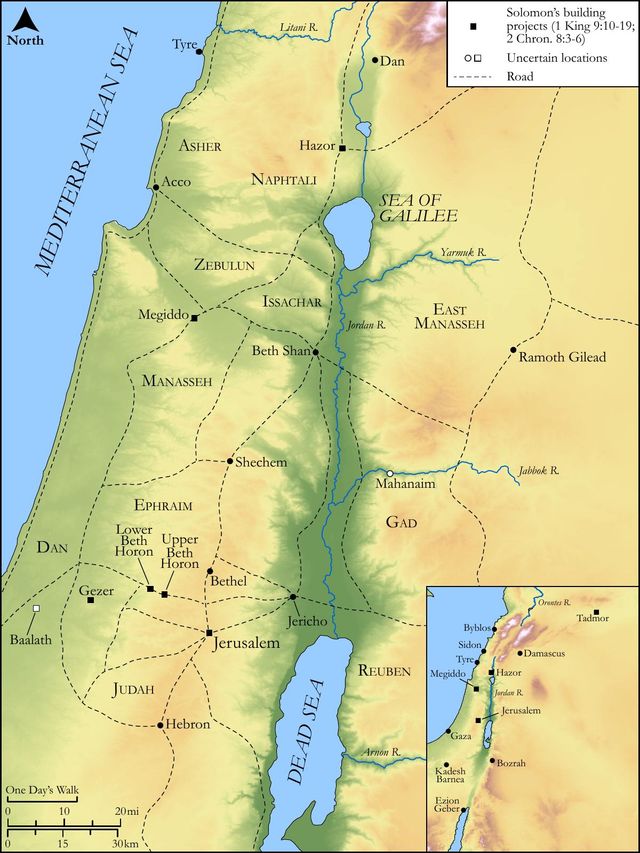
What agreement was made between Solomon and Hiram, when the building-work was to be begun, we read before, ch. 5. Here we have an account of their fair and friendly parting when the work was done. 1. Hiram made good his bargain to the utmost. He had furnished Solomon with materials for his buildings, according to all his desire (Kg1 9:11), and with gold, Kg1 9:15. So far was he from envying Solomon's growing greatness and reputation, and being jealous of him, that he helped to magnify him. Solomon's power, with Solomon's wisdom, needs not be dreaded by any of his neighbours. God honours him; therefore Hiram will. 2. Solomon, no doubt, made good his bargain, and gave Hiram food for his household, as was agreed, Kg1 5:9. But here we are told that, over and above that, he gave him twenty cities (small ones we may suppose, like those mentioned here, Kg1 9:19) in the land of Galilee, Kg1 9:11. It should seem, these were not allotted to any of the tribes of Israel (for the border of Asher came up to them, Jos 19:27, which intimates that it did not include them), but continued in the hands of the natives till Solomon made himself master of them, and then made a present of them to Hiram. It becomes those that are great and good to be generous. Hiram came to see these cities, and did not like them (Kg1 9:12): They pleased him not. He called the country the land of Cabul, a Phoenician word (says Josephus) which signifies displeasing, Kg1 9:13. He therefore returned them to Solomon (as we find, Ch2 8:2), who repaired them, and then caused the children of Israel to inhabit them, which intimates that before they did not; but, when Solomon received back what he had given, no doubt he honourably gave Hiram an equivalent in something else. But what shall we think of this? Did Solomon act meanly in giving Hiram what was not worth his acceptance? Or was Hiram humoursome and hard to please? I am willing to believe it was neither the one nor the other. The country was truly valuable, and so were the cities in it, but not agreeable to Hiram's genius. The Tyrians were merchants, trading men, that lived in fine houses, and became rich by navigation, but knew not how to value a country that was fit for corn and pasture (that was business that lay out of their way); and therefore Hiram desired Solomon to take them again, he knew not what to do with them, and, if he would please to gratify him, let it be in his own element, by becoming his partner in trade, as we find he did, Kg1 9:27. Hiram, who was used to the clean streets of Tyre, could by no means agree with the miry lanes in the land of Cabul, whereas the best lands have commonly the worst roads through them. See how the providence of God suits both the accommodation of this earth to the various dispositions of men and the dispositions of men to the various accommodations of the earth, and all for the good of mankind in general. Some take delight in husbandry, and wonder what pleasure sailors can take on a rough sea; others take as much delight in navigation, and wonder what pleasure husbandmen can take in a dirty country, like the land of Cabul. It is so in many other instances, in which we may observe the wisdom of him whose all souls are and all lands.
Historical interpretation
Historical Reception
One surviving comment on this passage from the historical church.
Chabul: That is, dirty or displeasing.