


Numbers 31:37
Bible text: King James Version (1769 Blayney text) · Public domain
Bible text: Berean Standard Bible · Public domain
Bible text: American Standard Version (1901) · Public domain
Bible text: World English Bible, Messianic edition · Public domain
Bible text: Geneva Bible (1599) · Public domain
Bible text: Young's Literal Translation · Public domain
- וַיְהִיvay·Hiand it wasH1961Conj-w ¦ V-Qal-ConsecImperf-3msVerb Qal Consecutive Imperfect 3rd Singular Masculineוַandיְהִיit was
- הַמֶּכֶסha·Me·khesthe taxH4371Art ¦ N-msNoun Singular Masculine Absoluteהַtheמֶּכֶסtax
- לַיהוָהla·Yah·wehfor YahwehH3068Prep-l ¦ N-properNoun Proper TitleלַforיהוָהYahweh
- מִןminfromH4480PrepPreposition
- הַצֹּאןha·Tzonthe sheepH6629Art ¦ N-csNoun Singular common gender Absoluteהַtheצֹּאןsheep
- שֵׁשׁsheshsixH8337Adj-cscAdjective Numerical Singular common gender Construct
- מֵאוֹתme·'othundred<s>H3967Adj-fpAdjective Numerical Plural Feminine Absolute
- חָמֵשׁcha·MeshfiveH2568Adj-csAdjective Numerical Singular common gender Absolute
- וְשִׁבְעִיםve·shiv·'Imand seventyH7657Conj-w ¦ Adj-mpAdjective Numerical Plural Masculine Absoluteוְandשִׁבְעִיםseventy
English is a literal word-by-word gloss of the Hebrew, not the KJV's wording. Why?
This is the original text the KJV's translators worked from — each Hebrew word with its own literal English meaning in this verse, prepared by scholars at Tyndale House, Cambridge. The KJV translates whole sentences, not word by word, so its wording differs: one Hebrew word can become several English words, and the KJV may choose “the LORD” where the gloss reads “Yahweh”. Both are faithful — they answer different questions. For the KJV's own rendering, switch to the KJV text.
Details
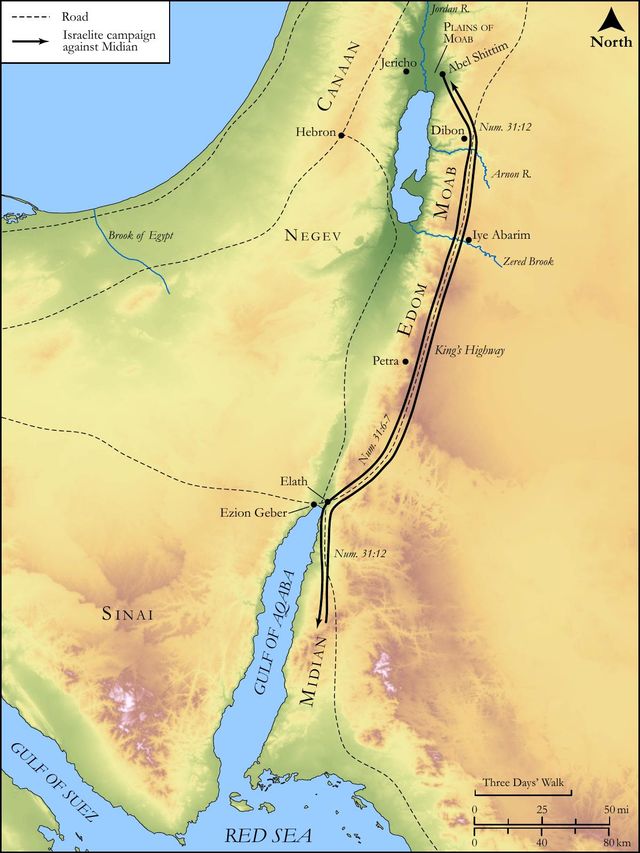
See on the biblical-era map
Study this verse
Continue studying Numbers 31:37 across the web’s major study libraries — every link below opens this exact verse, chapter, or book on the destination site.
Read & Compare
 BibleGatewayThis verse in more than 200 translations and 70 languages.
 Bible.comThe YouVersion reader — hundreds of translations, reading plans, and highlights.
 ESV.orgCrossway's official English Standard Version reader.
 NET BibleThe NET translation with 60,000+ translators' notes on every rendering decision.
 STEP BibleTyndale House's free study tool — original text, vocabulary, and scholarly resources.
 BibliaLogos Bible Software's free web reader.
 USCCBThe New American Bible (Revised Edition) with the U.S. bishops' study notes.
Commentaries
 BibleHub CommentariesDozens of classic commentaries on this verse, gathered on one page.
 StudyLightMore than 100 commentary sets — the largest collection on the web.
 BibleRefPlain-English commentary on what this verse means, verse by verse.
 Enduring WordDavid Guzik's free commentary on this chapter, widely used by Bible teachers.
 Bible Study ToolsVerse commentary alongside Greek and Hebrew study aids.
Original Language & Research
- BibleHub InterlinearThe verse word by word — original language, transliteration, and English.
- BibleHub LexiconEvery word's original-language definition and Strong's entry.
 Blue Letter BibleDeep-study tools — Strong's numbers, concordance, and word studies.
 SefariaThe Hebrew text with Rashi and centuries of Jewish commentary.
Sermons, Hymns & Audio


TrulyRandomVerse is not affiliated with these sites and doesn’t control their content. They’re linked because they’re genuinely useful.
Summary
Numbers 31:37 meticulously records the precise number of sheep designated as the Lord's tribute from the spoils of war against Midian. This specific detail, amounting to six hundred and seventy-five sheep, underscores the divine command for a sacred portion of all plunder to be set apart for the sanctuary, reflecting God's absolute sovereignty over all provision and the meticulous obedience required in Israel's administration of the Mosaic Law.
Context
ShowHideLiterary Context
This verse is embedded within the detailed account of Israel's punitive war against the Midianites, as commanded by Yahweh in Numbers 31:1-2. This war was a direct consequence of Midian's role in seducing Israel into idolatry and sexual immorality at Peor, as recounted in Numbers 25. Following a decisive victory, the narrative shifts to the elaborate process of purifying the spoils of war and their subsequent division. Numbers 31:25-47 outlines the specific instructions given by the Lord to Moses and Eleazar for distributing the vast plunder—animals, gold, and captives—between the warriors who engaged in battle and the rest of the congregation. Crucially, a specific "tribute" was mandated from both portions for the Lord, intended for the priests and Levites who served in the Tabernacle. Verse 37 specifically details the tribute of sheep from the warriors' share, which was a precise 1/500th of their total acquisition, following the general command in Numbers 31:28.
Historical & Cultural Context
The war against Midian was not merely a territorial conflict but a "holy war" (ḥerem), a divine judgment against a people who had actively led Israel astray from their covenant with Yahweh. In the warfare of the nations round about, the spoils of battle were typically claimed by the victorious army and their leaders. However, within Israelite theology, all victories and provisions were attributed to Yahweh, the divine warrior. Therefore, a portion of the spoils was considered "firstfruits" or a "tribute" (mekes) due to Him. This practice acknowledged God's ultimate ownership and sanctified the entire plunder. The specific allocation of this tribute to the priests (Eleazar) and the Levites underscored the economic system designed to support the Tabernacle service, as these religious functionaries had no tribal land inheritance and relied on the offerings and tithes of the people for their sustenance, a principle outlined in Numbers 18. The meticulous accounting reflects the highly organized and divinely ordained structure of Israelite society and worship.
Key Themes
ShowHideThis verse contributes to several overarching themes in Numbers and the Pentateuch. Firstly, it powerfully illustrates the Divine Sovereignty and Ownership over all things, including the outcome of battles and the resulting material wealth. God is not merely a beneficiary but the ultimate source and rightful claimant of a portion of all blessings. Secondly, it highlights the Provision for the Priesthood and Tabernacle Service. The tribute directly supports the Levitical priesthood, ensuring the continuity of worship and the maintenance of the sacred space, a recurring theme emphasizing the importance of dedicated service to God. Thirdly, the Precision and Obedience to Divine Law are paramount; the exact calculation and dedication of the tribute underscore the non-negotiable nature of God's commands and the importance of meticulous adherence to them, even in seemingly minor details. Finally, the act of dedicating a portion of the plunder effectively Sanctifies the Spoils, transforming them from mere material gain into a testament of divine provision and a means of worship, demonstrating that even the mundane or the spoils of war can be brought under God's holy dominion.
Exposition and Analysis
ShowHideKey Word Analysis
ShowHideThis term (H3068) refers to Yahweh, "the self-Existent or Eternal," the covenant God of Israel. The possessive "LORD'S" indicates that this tribute was specifically designated for Him, underscoring the sacred nature of the offering and its direct connection to divine command and ownership. It distinguishes this portion from the shares allocated to the warriors or the congregation, reinforcing that this particular segment was set apart for holy purposes and for the support of those who ministered in His name.
This term (H4371) specifically denotes an assessment, tax, levy, or toll, often collected for sacred purposes or for the king. Unlike a voluntary offering, mekeç signifies a mandated portion, a due obligation. In this context, it emphasizes that the dedication of these sheep was not optional but a commanded requirement, part of the divine legislation regarding the spoils of war, reinforcing God's ultimate authority and ownership.
The Hebrew word (H6629) refers broadly to small livestock, encompassing both sheep and goats. In this context, it specifically denotes sheep, which were a primary form of wealth and sustenance, as the flocks of Abraham and Job show. Their inclusion in the tribute highlights the practical value of the offering and its direct contribution to the sustenance of the priestly community, who would utilize them for food, wool, and possibly sacrificial purposes.
Verse Breakdown
ShowHide"And the LORD'S tribute"
This opening phrase immediately establishes the divine recipient and the nature of the offering. It's not a general share or a human-devised tax, but a specific portion mandated by God Himself (Yahweh) and dedicated to Him. This highlights God's sovereignty over the spoils and His right to claim a portion of what He has provided.
"of the sheep"
This specifies the type of animal being counted for the tribute. The Midianite spoils included various animals, but this verse focuses exclusively on the sheep, indicating a precise accounting for each category of plunder. This detail emphasizes the meticulous nature of the divine command and its execution.
"was six hundred and threescore and fifteen"
This provides the exact numerical quantity of sheep designated as the tribute. "Six hundred and threescore and fifteen" translates to 675. This precise figure, derived from 1/500th of the warriors' share of 337,500 sheep (as detailed in Numbers 31:32), underscores the exactitude required in fulfilling God's commands and the transparency in the administration of the spoils. It reflects a commitment to detailed obedience rather than approximation.
Literary Devices
ShowHideThe most prominent literary device in Numbers 31:37 is Precision/Exactitude. The verse's sole purpose is to state an exact number, "six hundred and threescore and fifteen," for the Lord's tribute of sheep. This meticulous detail is not an oversight but a deliberate literary choice that emphasizes the absolute importance of adhering to God's commands with accuracy and without deviation. It reinforces the theme of divine order and the Israelites' responsibility to follow instructions to the letter, particularly concerning sacred matters like offerings and the support of the priesthood. This numerical specificity serves to validate the divine authority behind the command and the integrity of its execution, leaving no room for ambiguity or approximation in matters pertaining to God's due.
Theological and Thematic Connections
ShowHideNumbers 31:37, though a seemingly minor numerical detail, encapsulates profound theological truths about God's ownership, the nature of worship, and the practicalities of covenant community. It demonstrates that every aspect of life, even the spoils of war, falls under divine jurisdiction and requires a response of dedication and obedience. The setting apart of a specific "tribute" for the Lord signifies that ultimate victory and provision come from Him, and a portion is always due back to Him as an act of acknowledgment and worship. This principle extends beyond material possessions to all areas of life, reminding believers that their talents, time, and resources are ultimately God's and should be stewarded in a way that honors Him and supports His kingdom work.
Reflection and Application
ShowHideWhile the context of holy war and specific tributes from plunder is unique to ancient Israel, the underlying principles of Numbers 31:37 remain profoundly relevant for believers today. This verse calls us to reflect on our understanding of ownership and stewardship. Do we truly recognize that all we possess—our finances, talents, time, and even our very lives—are ultimately gifts from God? The precise accounting of the sheep for the Lord's tribute challenges us to consider the intentionality and faithfulness with which we manage the resources He has entrusted to us. It encourages a mindset where giving back to God, whether through tithes, offerings, or dedicated service, is not merely an option but a joyful acknowledgment of His sovereignty and a tangible expression of our worship and gratitude. Furthermore, it reminds us of the importance of supporting those who are called to full-time ministry, just as the priests and Levites were sustained by the community's offerings, enabling them to devote themselves fully to serving God and His people.
Questions for Reflection
ShowHideFAQ
ShowHideWhy was such a specific number of sheep (675) required as a tribute?
ShowHideThe specific number of 675 sheep was not arbitrary but the result of a precise calculation mandated by God. As detailed in Numbers 31:32, the total number of sheep captured was 675,000. This vast spoil was then divided into two halves: one for the warriors who went to battle and one for the rest of the congregation. From the warriors' share, a tribute of 1/500th was to be given to the Lord (see Numbers 31:28). Since the warriors' share of sheep was 337,500 (half of 675,000), 1/500th of that amount is exactly 675. This meticulous accounting underscores the divine demand for precision and obedience in all matters related to sacred offerings and the administration of God's law. It highlights that God's commands are exact and require faithful, detailed fulfillment.
Christ-Centered Fulfillment
ShowHideNumbers 31:37, with its focus on a precise "tribute" given to the Lord for the sustenance of the priesthood, finds profound Christ-centered fulfillment in the New Covenant. While the Mosaic Law commanded material offerings for a temporary earthly priesthood, Christ Himself is the ultimate and eternal High Priest, as described in Hebrews 7:24. He did not require a tribute of sheep or other material possessions for His sustenance; rather, He offered Himself as the perfect, once-for-all sacrifice, the true Lamb of God who takes away the sin of the world. Furthermore, in Christ, believers are transformed into a "royal priesthood" and a "holy nation" (1 Peter 2:9), called not to offer animal sacrifices but "spiritual sacrifices acceptable to God through Jesus Christ" (1 Peter 2:5). Our "tribute" to the Lord now involves offering our bodies as living sacrifices (Romans 12:1), our praise (Hebrews 13:15), and our material resources given cheerfully and generously to advance His kingdom (2 Corinthians 9:7). Thus, the principle of dedicating a portion to God for the support of His work and His ministers continues, but it is now fulfilled and transformed through Christ's perfect work and the spiritual reality of the New Covenant.