


Numbers 31:38
Bible text: King James Version (1769 Blayney text) · Public domain
Bible text: Berean Standard Bible · Public domain
Bible text: American Standard Version (1901) · Public domain
Bible text: World English Bible, Messianic edition · Public domain
Bible text: Geneva Bible (1599) · Public domain
Bible text: Young's Literal Translation · Public domain
- וְהַבָּקָרve·Ha·ba·Karand the cattleH1241Conj-w ¦ Art ¦ N-csNoun Singular common gender Absoluteוְandהַtheבָּקָרcattle
- שִׁשָּׁהshi·Shah[were] sixH8337Adj-csAdjective Numerical Singular common gender Absolute
- וּשְׁלֹשִׁיםu·she·lo·Shimand thirtyH7970Conj-w ¦ Adj-mpAdjective Numerical Plural Masculine Absoluteוּandשְׁלֹשִׁיםthirty
- אָלֶף'A·lefthousandH505Adj-csAdjective Numerical Singular common gender Absolute
- וּמִכְסָםu·mikh·Samand their taxH4371Conj-w ¦ N-msc ¦ 3mpNoun Singular Masculine Constructוּandמִכְסָtaxםtheir
- לַיהוָהla·Yah·wehfor YahwehH3068Prep-l ¦ N-properNoun Proper TitleלַforיהוָהYahweh
- שְׁנַיִםshe·Na·yim[was] twoH8147Adj-cdAdjective Numerical Dual common gender Absolute
- וְשִׁבְעִיםve·shiv·'Imand seventyH7657Conj-w ¦ Adj-mpAdjective Numerical Plural Masculine Absoluteוְandשִׁבְעִיםseventy
English is a literal word-by-word gloss of the Hebrew, not the KJV's wording. Why?
This is the original text the KJV's translators worked from — each Hebrew word with its own literal English meaning in this verse, prepared by scholars at Tyndale House, Cambridge. The KJV translates whole sentences, not word by word, so its wording differs: one Hebrew word can become several English words, and the KJV may choose “the LORD” where the gloss reads “Yahweh”. Both are faithful — they answer different questions. For the KJV's own rendering, switch to the KJV text.
Details
See on the biblical-era map
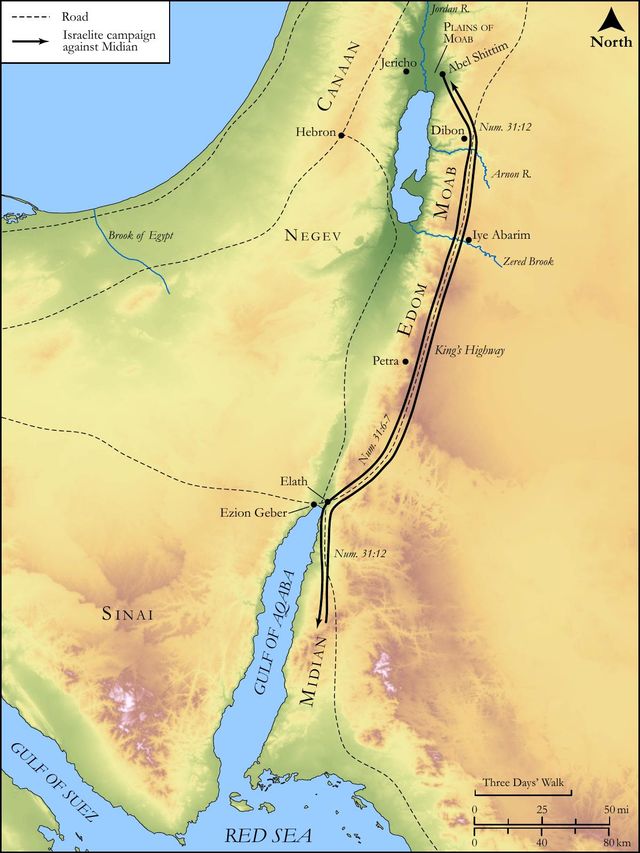
Study this verse
Continue studying Numbers 31:38 across the web’s major study libraries — every link below opens this exact verse, chapter, or book on the destination site.
Read & Compare
 BibleGatewayThis verse in more than 200 translations and 70 languages.
 Bible.comThe YouVersion reader — hundreds of translations, reading plans, and highlights.
 ESV.orgCrossway's official English Standard Version reader.
 NET BibleThe NET translation with 60,000+ translators' notes on every rendering decision.
 STEP BibleTyndale House's free study tool — original text, vocabulary, and scholarly resources.
 BibliaLogos Bible Software's free web reader.
 USCCBThe New American Bible (Revised Edition) with the U.S. bishops' study notes.
Commentaries
 BibleHub CommentariesDozens of classic commentaries on this verse, gathered on one page.
 StudyLightMore than 100 commentary sets — the largest collection on the web.
 BibleRefPlain-English commentary on what this verse means, verse by verse.
 Enduring WordDavid Guzik's free commentary on this chapter, widely used by Bible teachers.
 Bible Study ToolsVerse commentary alongside Greek and Hebrew study aids.
Original Language & Research
- BibleHub InterlinearThe verse word by word — original language, transliteration, and English.
- BibleHub LexiconEvery word's original-language definition and Strong's entry.
 Blue Letter BibleDeep-study tools — Strong's numbers, concordance, and word studies.
 SefariaThe Hebrew text with Rashi and centuries of Jewish commentary.
Sermons, Hymns & Audio


TrulyRandomVerse is not affiliated with these sites and doesn’t control their content. They’re linked because they’re genuinely useful.
Summary
Numbers 31:38 precisely records a specific detail from the immense spoils acquired by the Israelites after their divinely commanded punitive war against the Midianites. This verse meticulously accounts for the vast quantity of cattle seized—thirty-six thousand—and highlights the exact, sacred portion of seventy-two animals designated as "the LORD'S tribute." This detail powerfully underscores the foundational principles of divine ownership, the consecration of all gains to God, and the meticulous obedience required in Israel's covenant relationship, even amidst the spoils of war.
Context
ShowHideLiterary Context
Numbers 31:38 is situated within the concluding section of Numbers chapter 31, which meticulously details the Israelites' victorious campaign against Midian. This war was not an arbitrary act of conquest but a direct divine judgment, commanded by God as retribution for Midian's role in seducing Israel into idolatry and immorality at Baal-peor, as recounted in Numbers 25. Following the decisive victory, Moses, Eleazar the priest, and the tribal leaders meticulously oversaw the division of the immense plunder. The spoils were bifurcated: one half for the 12,000 warriors who engaged in combat, and the other half for the entire congregation. Crucially, from each of these halves, a distinct, specified portion was set aside as a holy offering for the LORD, intended to sustain the priests and Levites in their sacred service at the Tabernacle. This verse, therefore, provides a specific accounting of the cattle within this larger framework of divinely ordained retribution, meticulous distribution, and sacred consecration.
Historical & Cultural Context
The war against Midian was more than a territorial conquest; it was a milhemet Adonai, a "holy war," directly executing God's judgment against a people who had actively sought to corrupt Israel's covenant fidelity. Among the nations, the spoils of war were typically seen as a legitimate outcome of victory, often distributed among the conquering army and leadership as a sign of their prowess and the favor of their deities. However, in Israel, the concept of herem (devotion to destruction) or, in this case, a divinely mandated tribute, elevated the distribution of spoils beyond mere human custom. The meticulous accounting of livestock and other plunder, and the setting aside of a portion for the LORD, reflects the unique covenant relationship between God and Israel. It underscores the understanding that all victory and provision ultimately came from Yahweh, and therefore, a portion was due back to Him as an acknowledgment of His sovereignty and as support for the sacred institutions He established. The "tribute" served to sustain the priestly class, who had no tribal land inheritance, thus ensuring the continuity of worship and the nation's spiritual well-being.
Key Themes
ShowHideThis verse, though a numerical detail, contributes significantly to several overarching themes within Numbers and the broader Pentateuch. Firstly, it powerfully illustrates Divine Sovereignty and Provision. The vast wealth acquired from the Midianites was a direct result of God's command to wage war and His granting of overwhelming victory, as seen in Numbers 31:2-3. The tribute acknowledges Him as the ultimate source of all blessings and abundance, emphasizing that all things ultimately belong to Him, a principle echoed in Psalm 24:1. Secondly, it underscores Consecration and Holiness. Setting aside even a small portion of the spoils for the LORD, regardless of its size relative to the total, was a symbolic act of consecrating the entire gain, maintaining the nation's covenant relationship with a holy God. This act of giving back a "firstfruits" portion is a recurring theme throughout Israel's laws and practices. Thirdly, it highlights Support for Ministry. The "LORD'S tribute" from the warriors' share, as further detailed in Numbers 31:41, was specifically given to Eleazar the priest. This provision was crucial for sustaining the priesthood and enabling their vital service in the Tabernacle, establishing a foundational principle of supporting those dedicated to spiritual ministry. Finally, the Order and Meticulousness of the accounting (36,000 cattle, with 72 specifically for the LORD) reflects the precise nature of divine law and the careful administration required in the Israelite camp to fulfill God's instructions, demonstrating that God cares about even the smallest details of obedience.
Exposition and Analysis
ShowHideKey Word Analysis
ShowHideThis term refers to beef cattle or animals of the ox family, used collectively as a herd. In the context of ancient Israel, cattle represented significant wealth, a primary source of sustenance, and essential sacrificial offerings. The immense number, thirty-six thousand, indicates the overwhelming scale of the Midianite defeat and the abundant provision God granted to Israel, emphasizing the material blessing bestowed upon the nation.
This is the personal, covenantal name of God, "Jehovah" or "Yahweh," signifying "the self-Existent or Eternal One." Attaching "the LORD'S" to "tribute" profoundly elevates the nature of the offering. It is not merely a tax for human authority but a sacred levy for the sovereign God of Israel, acknowledging His ultimate authority over the victory and His right to receive a dedicated portion from the spoils.
This term denotes an assessment, tax, or levy, often based on a census or a portion of gains. Here, it specifically refers to a portion of the spoils set aside as a sacred levy for Yahweh, distinct from a general tithe or offering. It signifies a compulsory, divinely mandated portion, emphasizing God's ultimate ownership and sovereignty over the victory and its proceeds, underscoring that the entire gain is sanctified through this dedicated offering.
Verse Breakdown
ShowHide"And the beeves [were] thirty and six thousand;"
This initial clause establishes the total quantity of cattle taken as spoil from the Midianites. The staggering figure of 36,000 underscores the overwhelming victory granted by God and the immense material wealth acquired by the Israelites. It speaks to the vastness of the Midianite herds and the thoroughness of the conquest, highlighting the scale of divine provision and the completeness of the judgment.
"of which the LORD'S tribute [was] threescore and twelve."
This second clause specifies the exact portion of these cattle that was designated as a sacred levy for Yahweh. The phrase "the LORD'S tribute" (מֶכֶס לַיהוָה, mekes l'YHWH) indicates a specific, divinely ordained portion set apart for sacred use, distinct from the general division of spoils. The number 72, which is precisely 1/500th of the total from the warriors' share, highlights the meticulous nature of God's instructions and the careful obedience required in fulfilling them. This small, yet profoundly significant, portion was a tangible acknowledgment of God's ownership over all the spoils and His right to receive a dedicated share, symbolizing the consecration of the entire acquisition.
Literary Devices
ShowHideThe verse employs Precision and Numerology to convey its profound message. The exact figures of "thirty and six thousand" and "threescore and twelve" are not arbitrary but reflect the meticulousness of divine command and the careful administration of the Israelite camp. This precision emphasizes the divine order underlying the distribution of spoils, contrasting with the chaos of war and highlighting God's attention to detail in His covenant dealings. Furthermore, the tribute itself functions as Symbolism of divine ownership and consecration. The small, specific portion set aside for the LORD from the vast spoils symbolizes that all wealth and victory ultimately belong to God, and a part of everything acquired must be consecrated back to Him as an act of worship and acknowledgment of His sovereignty. This act of setting apart a portion also serves as a Metonymy for the entire process of purification and dedication of the spoils, ensuring that the wealth gained from a pagan nation could be integrated into the holy community of Israel without defilement, reinforcing the nation's unique identity as God's consecrated people.
Theological and Thematic Connections
ShowHideNumbers 31:38, though seemingly a mere accounting detail, profoundly reinforces the theological principle of God's ultimate ownership of all things and humanity's role as faithful stewards. The precise setting aside of a "tribute" for the LORD from the spoils of war demonstrates that even in the context of human conflict and material gain, God's sovereignty remains paramount. It teaches that all blessings, victories, and possessions flow from His hand, and therefore, a portion is rightly due back to Him in acknowledgment and worship. This act of consecration ensures that the material abundance does not lead to self-sufficiency or forgetfulness of God, but rather reinforces the covenant relationship through acts of obedience and gratitude. The tribute also served a practical purpose, supporting the priesthood and the Tabernacle service, thereby sustaining the spiritual life of the nation and ensuring the continuity of worship.
Reflection and Application
ShowHideNumbers 31:38, despite its ancient context of war spoils and Old Testament law, holds enduring principles for contemporary believers. It challenges us to reflect on our understanding of ownership and stewardship in a profound way. In a world that often encourages accumulation, self-reliance, and the pursuit of personal gain, this verse powerfully reminds us that all our resources—our finances, talents, time, possessions, and even our very lives—are ultimately gifts from God, entrusted to us for His purposes. The act of setting aside a portion for the LORD, whether through tithes, offerings, dedicated service, or the consecration of our abilities, is not merely a religious obligation but a profound act of worship that acknowledges His ultimate sovereignty and our complete dependence on Him. It is a tangible expression of gratitude, trust, and obedience, demonstrating that we prioritize His kingdom and His work above our own desires. This principle encourages a generous heart, recognizing that when we give back to God, we are not diminishing our own resources but participating in His divine economy, where faithfulness leads to blessing, purpose, and the advancement of His redemptive plan in the world.
Questions for Reflection
ShowHideFAQ
ShowHideWhy was the "LORD'S tribute" such a small portion (1/500th of the warriors' share, or 1/50th of the congregation's share)?
ShowHideThe seemingly small proportion of the "LORD'S tribute" (72 cattle out of 36,000 from the warriors' share, which is 1/500th of their total, and 1/50th of the congregation's share as detailed in Numbers 31:30) underscores a crucial theological point: the significance of the offering was not in its quantity relative to the total, but in the principle it represented. It was a symbolic act of consecration, acknowledging God's ultimate ownership over all the spoils and His decisive role in granting the victory. This small, precise portion, divinely commanded, served as a tangible reminder that even immense material gain was ultimately from God and that a part of everything belonged to Him. It functioned as a "firstfruits" principle, sanctifying the whole. Furthermore, this specific tribute was designated for the priests and Levites, directly supporting their service in the Tabernacle, as seen in Numbers 31:41. It was a practical provision for those who had no tribal land inheritance, ensuring the continuity of worship and the spiritual well-being of the nation.
Christ-Centered Fulfillment
ShowHideNumbers 31:38, with its emphasis on a divinely commanded tribute and the meticulous setting apart of a portion for the LORD, finds its ultimate fulfillment and transformation in Christ. While the Old Testament tribute involved material possessions and animal sacrifices, the New Covenant reveals a deeper, more profound offering: the complete dedication of oneself to God through faith in Jesus Christ. Jesus, as the ultimate Lamb of God, became the perfect and final sacrifice, fulfilling all the requirements of the Old Testament sacrificial system, as highlighted in Hebrews 10:10. He is the true "tribute" given by God for humanity, purchasing us with His own blood, as 1 Peter 1:18-19 proclaims, thereby making us His own. Consequently, believers are called to offer themselves as living sacrifices, holy and pleasing to God, which is their "spiritual worship" (Romans 12:1). The meticulous accounting of the cattle in Numbers 31 foreshadows the divine precision in God's plan of salvation, where every detail, from the Lamb's sacrifice to our redemption, is perfectly orchestrated. Our "tribute" now is not merely a portion of our material wealth, but our entire being—our lives, our talents, our resources—consecrated to Him who bought us at a great price, empowering us to live lives that reflect His glory and advance His kingdom, just as the Old Testament tribute supported the Tabernacle ministry.